SUBSCRIBE TO OUR FREE NEWSLETTER
Daily news & progressive opinion—funded by the people, not the corporations—delivered straight to your inbox.
5
#000000
#FFFFFF
To donate by check, phone, or other method, see our More Ways to Give page.
Daily news & progressive opinion—funded by the people, not the corporations—delivered straight to your inbox.
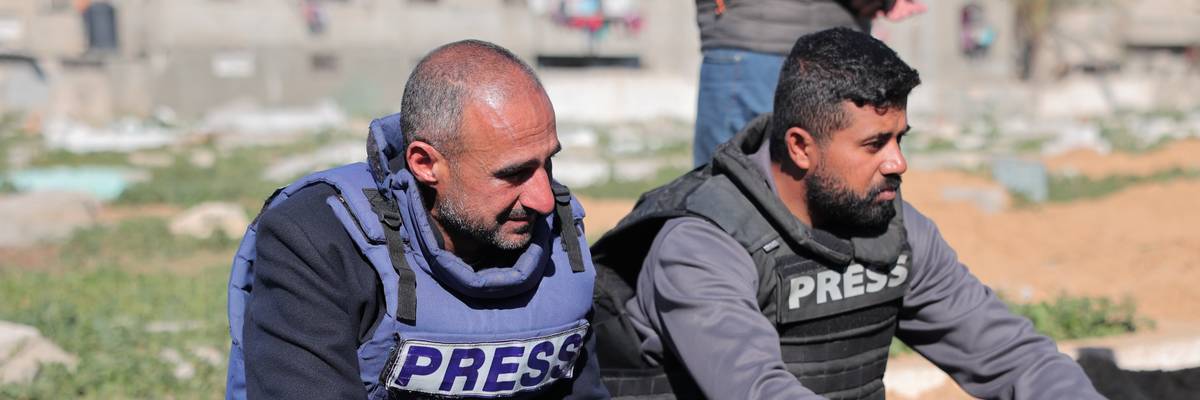
Families, loved ones, and colleagues mourn two journalists killed by Israeli airstrikes in Rafah, Gaza on January 7, 2024.
"This intimidation, this terror, these endless attempts to silence Palestinian journalism, whether by chains, bullets, or bombs, must stop," said the head of Reporters Without Borders' Middle East desk.
Reporters Without Borders said Tuesday that Israeli authorities have arrested at least 38 Palestinian journalists since the start of its latest assault on Gaza, which has taken a devastating toll on media workers and their families in the besieged enclave.
The watchdog group, known internationally as Reporters Sans Frontières (RSF), slammed the Israeli government's "use of detention to silence the Palestinian media." Most of the Palestinian journalists arrested by Israel since October 7 have been held without charge under a notorious procedure known as administrative detention.
People in administrative detention "can be jailed for periods of up to six months that can be renewed on nothing more than an Israeli judge's order," RSF explained. The group said at least 19 Palestinian journalists are currently being held in administrative detention while others have been jailed "pending trial on trumped-up charges of inciting violence."
Many Palestinian detainees have reported torture and other degrading treatment while in Israeli custody. Said Kilani, a photojournalist who has done freelance work for The Associated Press and other outlets, told RSF that he was arrested along with a medical team as Israeli forces closed in on Kamal Adwan Hospital in northern Gaza.
"We were forced to take our clothes off, we were insulted and humiliated," said Kilani, who was detained for 14 hours despite immediately identifying himself as a journalist.
Kilani told RSF that after his release, he reunited with his wife and son, who had also been briefly arrested.
"While they had been held, their house had been set on fire," RSF reported, "and the journalistic equipment that Kilani had hidden in the hospital had also been burned."
Diaa al-Kahlout, a reporter for the Al-Araby Al-Jadeed news site who was released from Israeli detention on Tuesday, said he was tortured while in custody for more than a month. His home was also burned down.
Jonathan Dagher, the head of RSF's Middle East desk, said in a statement that "at least 31 Palestinian reporters are currently held in Israeli prisons in connection with their journalism."
"This intimidation, this terror, these endless attempts to silence Palestinian journalism, whether by chains, bullets, or bombs, must stop," said RSF. "We call for the immediate release of all detained journalists and for their urgent protection."
Dozens of journalists, most of them Palestinian, have been killed in Israel, Gaza, and Lebanon since October 7, according to the Committee to Protect Journalists (CPJ)—a death toll the group has described as "unparalleled."
Throughout the war, journalists have been violently beaten by Israeli soldiers, targeted by airstrikes, and fired on by tanks. Over the weekend, an Israeli airstrike killed two journalists in southern Gaza, including the eldest son of Al Jazeera's Gaza bureau chief Wael Dahdouh. Five members of Dahdouh's family have now been killed by Israeli bombing.
RSF has filed two war crimes complaints against the Israeli government at the International Criminal Court, accusing the country's forces of intentionally massacring members of the press.
Asked about Israel's targeting of journalists during a press conference in Tel Aviv on Tuesday, U.S. Secretary of State Antony Blinken said, "To the journalists who've lost their lives or have been injured in Gaza, we feel very strongly for them as well, and the essential work that they do is more vital than ever."
Blinken did not pledge to investigate or hold Israel accountable for deliberately killing members of the media, which is a war crime.
Chris McGreal, a former Guardian correspondent in Jerusalem, condemned the lack of outrage from the West in the face of such atrocities.
"It would surely be different if American or European reporters were the ones dying," McGreal wrote in a column on Wednesday.
Dear Common Dreams reader, It’s been nearly 30 years since I co-founded Common Dreams with my late wife, Lina Newhouser. We had the radical notion that journalism should serve the public good, not corporate profits. It was clear to us from the outset what it would take to build such a project. No paid advertisements. No corporate sponsors. No millionaire publisher telling us what to think or do. Many people said we wouldn't last a year, but we proved those doubters wrong. Together with a tremendous team of journalists and dedicated staff, we built an independent media outlet free from the constraints of profits and corporate control. Our mission has always been simple: To inform. To inspire. To ignite change for the common good. Building Common Dreams was not easy. Our survival was never guaranteed. When you take on the most powerful forces—Wall Street greed, fossil fuel industry destruction, Big Tech lobbyists, and uber-rich oligarchs who have spent billions upon billions rigging the economy and democracy in their favor—the only bulwark you have is supporters who believe in your work. But here’s the urgent message from me today. It's never been this bad out there. And it's never been this hard to keep us going. At the very moment Common Dreams is most needed, the threats we face are intensifying. We need your support now more than ever. We don't accept corporate advertising and never will. We don't have a paywall because we don't think people should be blocked from critical news based on their ability to pay. Everything we do is funded by the donations of readers like you. When everyone does the little they can afford, we are strong. But if that support retreats or dries up, so do we. Will you donate now to make sure Common Dreams not only survives but thrives? —Craig Brown, Co-founder |
Reporters Without Borders said Tuesday that Israeli authorities have arrested at least 38 Palestinian journalists since the start of its latest assault on Gaza, which has taken a devastating toll on media workers and their families in the besieged enclave.
The watchdog group, known internationally as Reporters Sans Frontières (RSF), slammed the Israeli government's "use of detention to silence the Palestinian media." Most of the Palestinian journalists arrested by Israel since October 7 have been held without charge under a notorious procedure known as administrative detention.
People in administrative detention "can be jailed for periods of up to six months that can be renewed on nothing more than an Israeli judge's order," RSF explained. The group said at least 19 Palestinian journalists are currently being held in administrative detention while others have been jailed "pending trial on trumped-up charges of inciting violence."
Many Palestinian detainees have reported torture and other degrading treatment while in Israeli custody. Said Kilani, a photojournalist who has done freelance work for The Associated Press and other outlets, told RSF that he was arrested along with a medical team as Israeli forces closed in on Kamal Adwan Hospital in northern Gaza.
"We were forced to take our clothes off, we were insulted and humiliated," said Kilani, who was detained for 14 hours despite immediately identifying himself as a journalist.
Kilani told RSF that after his release, he reunited with his wife and son, who had also been briefly arrested.
"While they had been held, their house had been set on fire," RSF reported, "and the journalistic equipment that Kilani had hidden in the hospital had also been burned."
Diaa al-Kahlout, a reporter for the Al-Araby Al-Jadeed news site who was released from Israeli detention on Tuesday, said he was tortured while in custody for more than a month. His home was also burned down.
Jonathan Dagher, the head of RSF's Middle East desk, said in a statement that "at least 31 Palestinian reporters are currently held in Israeli prisons in connection with their journalism."
"This intimidation, this terror, these endless attempts to silence Palestinian journalism, whether by chains, bullets, or bombs, must stop," said RSF. "We call for the immediate release of all detained journalists and for their urgent protection."
Dozens of journalists, most of them Palestinian, have been killed in Israel, Gaza, and Lebanon since October 7, according to the Committee to Protect Journalists (CPJ)—a death toll the group has described as "unparalleled."
Throughout the war, journalists have been violently beaten by Israeli soldiers, targeted by airstrikes, and fired on by tanks. Over the weekend, an Israeli airstrike killed two journalists in southern Gaza, including the eldest son of Al Jazeera's Gaza bureau chief Wael Dahdouh. Five members of Dahdouh's family have now been killed by Israeli bombing.
RSF has filed two war crimes complaints against the Israeli government at the International Criminal Court, accusing the country's forces of intentionally massacring members of the press.
Asked about Israel's targeting of journalists during a press conference in Tel Aviv on Tuesday, U.S. Secretary of State Antony Blinken said, "To the journalists who've lost their lives or have been injured in Gaza, we feel very strongly for them as well, and the essential work that they do is more vital than ever."
Blinken did not pledge to investigate or hold Israel accountable for deliberately killing members of the media, which is a war crime.
Chris McGreal, a former Guardian correspondent in Jerusalem, condemned the lack of outrage from the West in the face of such atrocities.
"It would surely be different if American or European reporters were the ones dying," McGreal wrote in a column on Wednesday.
Reporters Without Borders said Tuesday that Israeli authorities have arrested at least 38 Palestinian journalists since the start of its latest assault on Gaza, which has taken a devastating toll on media workers and their families in the besieged enclave.
The watchdog group, known internationally as Reporters Sans Frontières (RSF), slammed the Israeli government's "use of detention to silence the Palestinian media." Most of the Palestinian journalists arrested by Israel since October 7 have been held without charge under a notorious procedure known as administrative detention.
People in administrative detention "can be jailed for periods of up to six months that can be renewed on nothing more than an Israeli judge's order," RSF explained. The group said at least 19 Palestinian journalists are currently being held in administrative detention while others have been jailed "pending trial on trumped-up charges of inciting violence."
Many Palestinian detainees have reported torture and other degrading treatment while in Israeli custody. Said Kilani, a photojournalist who has done freelance work for The Associated Press and other outlets, told RSF that he was arrested along with a medical team as Israeli forces closed in on Kamal Adwan Hospital in northern Gaza.
"We were forced to take our clothes off, we were insulted and humiliated," said Kilani, who was detained for 14 hours despite immediately identifying himself as a journalist.
Kilani told RSF that after his release, he reunited with his wife and son, who had also been briefly arrested.
"While they had been held, their house had been set on fire," RSF reported, "and the journalistic equipment that Kilani had hidden in the hospital had also been burned."
Diaa al-Kahlout, a reporter for the Al-Araby Al-Jadeed news site who was released from Israeli detention on Tuesday, said he was tortured while in custody for more than a month. His home was also burned down.
Jonathan Dagher, the head of RSF's Middle East desk, said in a statement that "at least 31 Palestinian reporters are currently held in Israeli prisons in connection with their journalism."
"This intimidation, this terror, these endless attempts to silence Palestinian journalism, whether by chains, bullets, or bombs, must stop," said RSF. "We call for the immediate release of all detained journalists and for their urgent protection."
Dozens of journalists, most of them Palestinian, have been killed in Israel, Gaza, and Lebanon since October 7, according to the Committee to Protect Journalists (CPJ)—a death toll the group has described as "unparalleled."
Throughout the war, journalists have been violently beaten by Israeli soldiers, targeted by airstrikes, and fired on by tanks. Over the weekend, an Israeli airstrike killed two journalists in southern Gaza, including the eldest son of Al Jazeera's Gaza bureau chief Wael Dahdouh. Five members of Dahdouh's family have now been killed by Israeli bombing.
RSF has filed two war crimes complaints against the Israeli government at the International Criminal Court, accusing the country's forces of intentionally massacring members of the press.
Asked about Israel's targeting of journalists during a press conference in Tel Aviv on Tuesday, U.S. Secretary of State Antony Blinken said, "To the journalists who've lost their lives or have been injured in Gaza, we feel very strongly for them as well, and the essential work that they do is more vital than ever."
Blinken did not pledge to investigate or hold Israel accountable for deliberately killing members of the media, which is a war crime.
Chris McGreal, a former Guardian correspondent in Jerusalem, condemned the lack of outrage from the West in the face of such atrocities.
"It would surely be different if American or European reporters were the ones dying," McGreal wrote in a column on Wednesday.