

SUBSCRIBE TO OUR FREE NEWSLETTER
Daily news & progressive opinion—funded by the people, not the corporations—delivered straight to your inbox.
5
#000000
#FFFFFF
To donate by check, phone, or other method, see our More Ways to Give page.
Daily news & progressive opinion—funded by the people, not the corporations—delivered straight to your inbox.
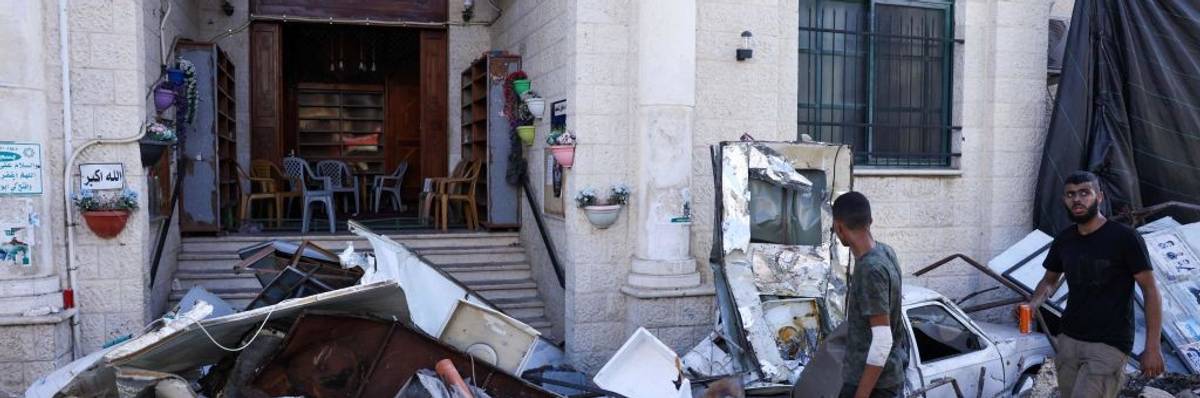
Men walk among rubble in front of a building in the occupied West Bank city of Jenin on July 4, 2023, a day after an Israeli military operation. Israeli forces killed nine Palestinians in a large-scale operation Monday in the occupied West Bank that the army labelled an "extensive counterterrorism effort," involving air strikes and hundreds of troops.
Israeli bulldozers, said one eyewitness in the occupied West Bank refugee camp, "turned our streets into crumbs" as thousands flee amid destruction of critical infrastructure.
Thousands of people who live in Jenin in the occupied West Bank are reportedly fleeing the poverty-stricken refugee camp as Israeli military forces Tuesday continued to batter the city's water, power, and healthcare infrastructure.
Muhammad Abu Talal, a resident of the camp, told Middle East Eye on Tuesday—a day after a large-scale assault by the IDF left at least 10 Palestinians dead and scores more wounded—that the refugee camp's "streets are all dug up and uprooted" by bulldozers used by the Israeli forces.
The bulldozers, said Abu Talal, "have left nothing as it is here, they turned our streets into crumbs."
Citing a witness on the ground, MEE reports that "residential buildings were so severely damaged that Israeli soldiers made large holes in the walls of the houses for snipers to position themselves and shoot through" and local hospitals "were exposed to direct fire from Israeli soldiers with heavy weapons, which damaged many of their facilities."
In a Tuesday update on the situation in Jenin, the Palestinian Centre for Human Rights said ongoing military activities, including bombings, have "caused a complete power outage across the camp's neighborhoods as well as cutting off water supplies and internet services, exacerbating the humanitarian situation and isolating the camp from the outside world."
"Moreover," the group said, "ambulances were denied access to evacuate the wounded due to the tight siege imposed on the camp and the intensive deployment of Israeli military vehicles."
In a statement on Tuesday, Jovana Arsenijevic, operations coordinator in Jenin for Médecins Sans Frontières, reported that "Israeli forces fired tear gas several times inside the Khalil Suleiman hospital," making the delivery of urgently needed treatment impossible in some portions of the facility.
"This is unacceptable," said Arsenijevic. "The emergency room is not usable right now—it's completely filled with smoke, as is the rest of the hospital. People who need treatment can't be treated in the ER, and we have to treat the wounded in the main hall on the floor. Our teams have treated 125 patients since the start of this raid."
"The humanitarian situation in Jenin is catastrophic. What's happening is like an earthquake." —Mayor Nidal Obeidi, Jenin
City officials said the Israeli military had destroyed the main water lines, leaving the entire camp without access to running water.
Mayor Nidal Obeidi of Jenin city said Tuesday that the Israeli military assault on the refugee camp has resulted in total devastation for the people there.
"The humanitarian situation in Jenin is catastrophic," al-Obeidi told reporters. "What's happening is like an earthquake. It reminds us of the days of Nakba."
In an eyewitness account from Jenin on Monday, journalist and theater manager Mustafa Sheta said the destruction could not be overstated and that the message being sent by the Israeli government was obvious.
"The occupation relentlessly tightens its grip on the refugee camp, decimating its infrastructure and obliterating the main roads in the camp," Sheta wrote for Mondoweiss. "The message is crystal clear—punish the stronghold of popular resistance in Jenin, and project an image of invincibility to Israeli society regarding their military prowess."
On Tuesday, Jenin's deputy governor, Kamal Abu al-Roub, told Agence France Presse there were "about 3,000 people who have left the camp so far," approximately one-quarter of the 12,000 Palestinians who live there.
In a post on Monday, Lynn Hastings, the U.N.'s Resident and Humanitarian Coordinator in Palestine, said she was "alarmed by scale of Israeli forces operation" in Jenin—noting that Israeli "airstrikes were used in the densely populated refugee camp"—and called for all efforts to be made to assist Palestinians suffering as a result of the incursion.
The World Health Organization office in the occupied Palestinian territory said Tuesday it remained "deeply concerned by the escalating situation, high number of casualties, and displacement affecting Jenin refugee camp in the West Bank. Health workers and health facilities must be respected and protected. Safe passage for humanitarian access needs to be ensured."
In his frontline dispatch on Tuesday, Sheta said there is no future in Jenin for him other than a continuation of the resistance that residents of the camp have long upheld.
"The occupation's attempts to eradicate the resistance in Jenin will not succeed, just as their predecessors failed in 2002," Sheta wrote.
"Buildings may crumble, cars may be reduced to wreckage, and countless individuals may be detained, wounded and even martyred," he continued. "However, these actions will only serve to breed a new generation that will carry the torch of resistance passed down by those who came before them, as we do today, and as our children will do in the future. It is a relentless pursuit, driven by the aspiration to reclaim our land and restore the dignity of every human being."
Dear Common Dreams reader, It’s been nearly 30 years since I co-founded Common Dreams with my late wife, Lina Newhouser. We had the radical notion that journalism should serve the public good, not corporate profits. It was clear to us from the outset what it would take to build such a project. No paid advertisements. No corporate sponsors. No millionaire publisher telling us what to think or do. Many people said we wouldn't last a year, but we proved those doubters wrong. Together with a tremendous team of journalists and dedicated staff, we built an independent media outlet free from the constraints of profits and corporate control. Our mission has always been simple: To inform. To inspire. To ignite change for the common good. Building Common Dreams was not easy. Our survival was never guaranteed. When you take on the most powerful forces—Wall Street greed, fossil fuel industry destruction, Big Tech lobbyists, and uber-rich oligarchs who have spent billions upon billions rigging the economy and democracy in their favor—the only bulwark you have is supporters who believe in your work. But here’s the urgent message from me today. It's never been this bad out there. And it's never been this hard to keep us going. At the very moment Common Dreams is most needed, the threats we face are intensifying. We need your support now more than ever. We don't accept corporate advertising and never will. We don't have a paywall because we don't think people should be blocked from critical news based on their ability to pay. Everything we do is funded by the donations of readers like you. When everyone does the little they can afford, we are strong. But if that support retreats or dries up, so do we. Will you donate now to make sure Common Dreams not only survives but thrives? —Craig Brown, Co-founder |
Thousands of people who live in Jenin in the occupied West Bank are reportedly fleeing the poverty-stricken refugee camp as Israeli military forces Tuesday continued to batter the city's water, power, and healthcare infrastructure.
Muhammad Abu Talal, a resident of the camp, told Middle East Eye on Tuesday—a day after a large-scale assault by the IDF left at least 10 Palestinians dead and scores more wounded—that the refugee camp's "streets are all dug up and uprooted" by bulldozers used by the Israeli forces.
The bulldozers, said Abu Talal, "have left nothing as it is here, they turned our streets into crumbs."
Citing a witness on the ground, MEE reports that "residential buildings were so severely damaged that Israeli soldiers made large holes in the walls of the houses for snipers to position themselves and shoot through" and local hospitals "were exposed to direct fire from Israeli soldiers with heavy weapons, which damaged many of their facilities."
In a Tuesday update on the situation in Jenin, the Palestinian Centre for Human Rights said ongoing military activities, including bombings, have "caused a complete power outage across the camp's neighborhoods as well as cutting off water supplies and internet services, exacerbating the humanitarian situation and isolating the camp from the outside world."
"Moreover," the group said, "ambulances were denied access to evacuate the wounded due to the tight siege imposed on the camp and the intensive deployment of Israeli military vehicles."
In a statement on Tuesday, Jovana Arsenijevic, operations coordinator in Jenin for Médecins Sans Frontières, reported that "Israeli forces fired tear gas several times inside the Khalil Suleiman hospital," making the delivery of urgently needed treatment impossible in some portions of the facility.
"This is unacceptable," said Arsenijevic. "The emergency room is not usable right now—it's completely filled with smoke, as is the rest of the hospital. People who need treatment can't be treated in the ER, and we have to treat the wounded in the main hall on the floor. Our teams have treated 125 patients since the start of this raid."
"The humanitarian situation in Jenin is catastrophic. What's happening is like an earthquake." —Mayor Nidal Obeidi, Jenin
City officials said the Israeli military had destroyed the main water lines, leaving the entire camp without access to running water.
Mayor Nidal Obeidi of Jenin city said Tuesday that the Israeli military assault on the refugee camp has resulted in total devastation for the people there.
"The humanitarian situation in Jenin is catastrophic," al-Obeidi told reporters. "What's happening is like an earthquake. It reminds us of the days of Nakba."
In an eyewitness account from Jenin on Monday, journalist and theater manager Mustafa Sheta said the destruction could not be overstated and that the message being sent by the Israeli government was obvious.
"The occupation relentlessly tightens its grip on the refugee camp, decimating its infrastructure and obliterating the main roads in the camp," Sheta wrote for Mondoweiss. "The message is crystal clear—punish the stronghold of popular resistance in Jenin, and project an image of invincibility to Israeli society regarding their military prowess."
On Tuesday, Jenin's deputy governor, Kamal Abu al-Roub, told Agence France Presse there were "about 3,000 people who have left the camp so far," approximately one-quarter of the 12,000 Palestinians who live there.
In a post on Monday, Lynn Hastings, the U.N.'s Resident and Humanitarian Coordinator in Palestine, said she was "alarmed by scale of Israeli forces operation" in Jenin—noting that Israeli "airstrikes were used in the densely populated refugee camp"—and called for all efforts to be made to assist Palestinians suffering as a result of the incursion.
The World Health Organization office in the occupied Palestinian territory said Tuesday it remained "deeply concerned by the escalating situation, high number of casualties, and displacement affecting Jenin refugee camp in the West Bank. Health workers and health facilities must be respected and protected. Safe passage for humanitarian access needs to be ensured."
In his frontline dispatch on Tuesday, Sheta said there is no future in Jenin for him other than a continuation of the resistance that residents of the camp have long upheld.
"The occupation's attempts to eradicate the resistance in Jenin will not succeed, just as their predecessors failed in 2002," Sheta wrote.
"Buildings may crumble, cars may be reduced to wreckage, and countless individuals may be detained, wounded and even martyred," he continued. "However, these actions will only serve to breed a new generation that will carry the torch of resistance passed down by those who came before them, as we do today, and as our children will do in the future. It is a relentless pursuit, driven by the aspiration to reclaim our land and restore the dignity of every human being."
Thousands of people who live in Jenin in the occupied West Bank are reportedly fleeing the poverty-stricken refugee camp as Israeli military forces Tuesday continued to batter the city's water, power, and healthcare infrastructure.
Muhammad Abu Talal, a resident of the camp, told Middle East Eye on Tuesday—a day after a large-scale assault by the IDF left at least 10 Palestinians dead and scores more wounded—that the refugee camp's "streets are all dug up and uprooted" by bulldozers used by the Israeli forces.
The bulldozers, said Abu Talal, "have left nothing as it is here, they turned our streets into crumbs."
Citing a witness on the ground, MEE reports that "residential buildings were so severely damaged that Israeli soldiers made large holes in the walls of the houses for snipers to position themselves and shoot through" and local hospitals "were exposed to direct fire from Israeli soldiers with heavy weapons, which damaged many of their facilities."
In a Tuesday update on the situation in Jenin, the Palestinian Centre for Human Rights said ongoing military activities, including bombings, have "caused a complete power outage across the camp's neighborhoods as well as cutting off water supplies and internet services, exacerbating the humanitarian situation and isolating the camp from the outside world."
"Moreover," the group said, "ambulances were denied access to evacuate the wounded due to the tight siege imposed on the camp and the intensive deployment of Israeli military vehicles."
In a statement on Tuesday, Jovana Arsenijevic, operations coordinator in Jenin for Médecins Sans Frontières, reported that "Israeli forces fired tear gas several times inside the Khalil Suleiman hospital," making the delivery of urgently needed treatment impossible in some portions of the facility.
"This is unacceptable," said Arsenijevic. "The emergency room is not usable right now—it's completely filled with smoke, as is the rest of the hospital. People who need treatment can't be treated in the ER, and we have to treat the wounded in the main hall on the floor. Our teams have treated 125 patients since the start of this raid."
"The humanitarian situation in Jenin is catastrophic. What's happening is like an earthquake." —Mayor Nidal Obeidi, Jenin
City officials said the Israeli military had destroyed the main water lines, leaving the entire camp without access to running water.
Mayor Nidal Obeidi of Jenin city said Tuesday that the Israeli military assault on the refugee camp has resulted in total devastation for the people there.
"The humanitarian situation in Jenin is catastrophic," al-Obeidi told reporters. "What's happening is like an earthquake. It reminds us of the days of Nakba."
In an eyewitness account from Jenin on Monday, journalist and theater manager Mustafa Sheta said the destruction could not be overstated and that the message being sent by the Israeli government was obvious.
"The occupation relentlessly tightens its grip on the refugee camp, decimating its infrastructure and obliterating the main roads in the camp," Sheta wrote for Mondoweiss. "The message is crystal clear—punish the stronghold of popular resistance in Jenin, and project an image of invincibility to Israeli society regarding their military prowess."
On Tuesday, Jenin's deputy governor, Kamal Abu al-Roub, told Agence France Presse there were "about 3,000 people who have left the camp so far," approximately one-quarter of the 12,000 Palestinians who live there.
In a post on Monday, Lynn Hastings, the U.N.'s Resident and Humanitarian Coordinator in Palestine, said she was "alarmed by scale of Israeli forces operation" in Jenin—noting that Israeli "airstrikes were used in the densely populated refugee camp"—and called for all efforts to be made to assist Palestinians suffering as a result of the incursion.
The World Health Organization office in the occupied Palestinian territory said Tuesday it remained "deeply concerned by the escalating situation, high number of casualties, and displacement affecting Jenin refugee camp in the West Bank. Health workers and health facilities must be respected and protected. Safe passage for humanitarian access needs to be ensured."
In his frontline dispatch on Tuesday, Sheta said there is no future in Jenin for him other than a continuation of the resistance that residents of the camp have long upheld.
"The occupation's attempts to eradicate the resistance in Jenin will not succeed, just as their predecessors failed in 2002," Sheta wrote.
"Buildings may crumble, cars may be reduced to wreckage, and countless individuals may be detained, wounded and even martyred," he continued. "However, these actions will only serve to breed a new generation that will carry the torch of resistance passed down by those who came before them, as we do today, and as our children will do in the future. It is a relentless pursuit, driven by the aspiration to reclaim our land and restore the dignity of every human being."

