SUBSCRIBE TO OUR FREE NEWSLETTER
Daily news & progressive opinion—funded by the people, not the corporations—delivered straight to your inbox.
5
#000000
#FFFFFF
To donate by check, phone, or other method, see our More Ways to Give page.
Daily news & progressive opinion—funded by the people, not the corporations—delivered straight to your inbox.
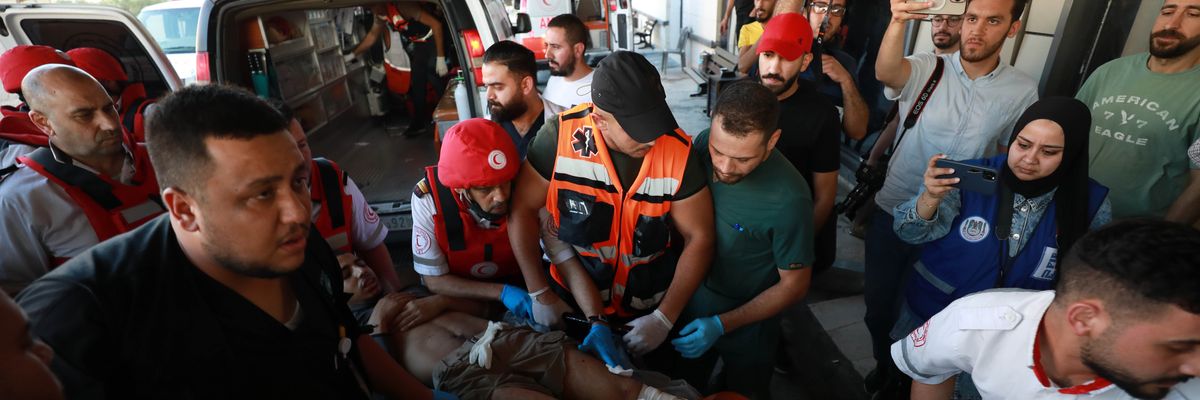
A man wounded by Israeli forces is taken to a nearby hospital for treatment in Jenin, West Bank on July 3, 2023.
"This is how the Israeli government treats Gaza—and now Netanyahu brought it to the occupied West Bank," said one advocacy group. "We demand accountability: End U.S. military funding to Israel now."
Israeli forces killed at least eight Palestinians and injured dozens on Monday in their latest large-scale raid on the Jenin refugee camp in the occupied West Bank, deploying hundreds of troops and launching at least 10 drone strikes—the largest aerial attack on the besieged territory in nearly two decades.
Al Jazeera reported that "a convoy of dozens of Israeli armored vehicles also surrounded the refugee camp and launched a ground military operation, causing heavy damage to homes and roads."
Walid al-Omari, Al Jazeera's Jerusalem bureau chief, said that Israeli soldiers are "enforcing a total siege on the camp, while special forces are operating inside the camp, raiding homes, searching them, and arresting many people."
The massive raid drew alarm from human rights groups and the United Nations. Lynn Hastings, the U.N.'s humanitarian coordinator in Palestine, wrote on Twitter early Monday that she was "alarmed by the scale of Israeli forces' operation in Jenin."
"Airstrikes were used in the densely populated refugee camp. Several dead and critically wounded. Access to all injured must be ensured," Hastings added.
The advocacy organization Jewish Voice for Peace said in response to the Jenin raid that "this is how the Israeli government treats Gaza—and now Netanyahu brought it to the occupied West Bank."
"We demand accountability: End U.S. military funding to Israel now," the group tweeted.
The Palestinian Red Crescent Society said the number of Palestinians wounded in the Israeli raid is "on the rise" and demanded a "safe passage to evacuate the wounded and injured."
Monday's raid came just two weeks after Israeli forces killed several Palestinians, including two 15-year-old children, in an attack on the Jenin refugee camp, which Israel's far-right government claims is being used as a "hub" for "terrorist activities." The latest assault also came amid growing settler violence in the West Bank.
Israeli Foreign Minister Eli Cohen said Monday that "we don't have a fight with Palestinians," but with "the proxies of Iran in our region, which is mainly Hamas and Islamic Jihad."
Palestinian Authority President Mahmoud Abbas, for his part, called the raid "a new war crime against our defenseless people."
"Security and stability will not be achieved in the region unless our Palestinian people feel it," said Abbas.
A 60-year-old resident of the Jenin camp told Al Jazeera that Israeli forces fired live ammunition into his home and wounded his 25-year-old niece, who was visiting from Jordan.
"The bullet pierced her leg and went out from the other side," the woman said. "We found at least three bullets on our front door, and others across the walls."
Cohen on Monday denied that the Israeli government, headed by Prime Minister Benjamin Netanyahu and packed with extremists, is planning on expanding its Jenin operations to the entire West Bank.
But Amjad Iraqi, a senior editor at +972 Magazine and a Palestinian citizen of Israel, warned last week that "far from being one-off incidents, the aerial assaults [on Jenin] reveal a dangerous phase in the evolution of Israel's occupation."
"Like Gaza, Jenin has long been a center of Palestinian social life and political resistance—and as such, a target of vicious repression," Iraqi wrote. "Gaza is hardly an exception to the rule of Israeli apartheid. Rather, it is the ultimate bantustan—the model for controlling and weakening a native population in a besieged space, using modern weapons and technology, with local rulers to handle their basic needs, at minimal cost to the settler society surrounding them."
"West Bank centers like Jenin and Nablus, already subjected to various forms of closure and invasion, are now catching a glimpse of what is yet to come," he added.
Dear Common Dreams reader, It’s been nearly 30 years since I co-founded Common Dreams with my late wife, Lina Newhouser. We had the radical notion that journalism should serve the public good, not corporate profits. It was clear to us from the outset what it would take to build such a project. No paid advertisements. No corporate sponsors. No millionaire publisher telling us what to think or do. Many people said we wouldn't last a year, but we proved those doubters wrong. Together with a tremendous team of journalists and dedicated staff, we built an independent media outlet free from the constraints of profits and corporate control. Our mission has always been simple: To inform. To inspire. To ignite change for the common good. Building Common Dreams was not easy. Our survival was never guaranteed. When you take on the most powerful forces—Wall Street greed, fossil fuel industry destruction, Big Tech lobbyists, and uber-rich oligarchs who have spent billions upon billions rigging the economy and democracy in their favor—the only bulwark you have is supporters who believe in your work. But here’s the urgent message from me today. It's never been this bad out there. And it's never been this hard to keep us going. At the very moment Common Dreams is most needed, the threats we face are intensifying. We need your support now more than ever. We don't accept corporate advertising and never will. We don't have a paywall because we don't think people should be blocked from critical news based on their ability to pay. Everything we do is funded by the donations of readers like you. When everyone does the little they can afford, we are strong. But if that support retreats or dries up, so do we. Will you donate now to make sure Common Dreams not only survives but thrives? —Craig Brown, Co-founder |
Israeli forces killed at least eight Palestinians and injured dozens on Monday in their latest large-scale raid on the Jenin refugee camp in the occupied West Bank, deploying hundreds of troops and launching at least 10 drone strikes—the largest aerial attack on the besieged territory in nearly two decades.
Al Jazeera reported that "a convoy of dozens of Israeli armored vehicles also surrounded the refugee camp and launched a ground military operation, causing heavy damage to homes and roads."
Walid al-Omari, Al Jazeera's Jerusalem bureau chief, said that Israeli soldiers are "enforcing a total siege on the camp, while special forces are operating inside the camp, raiding homes, searching them, and arresting many people."
The massive raid drew alarm from human rights groups and the United Nations. Lynn Hastings, the U.N.'s humanitarian coordinator in Palestine, wrote on Twitter early Monday that she was "alarmed by the scale of Israeli forces' operation in Jenin."
"Airstrikes were used in the densely populated refugee camp. Several dead and critically wounded. Access to all injured must be ensured," Hastings added.
The advocacy organization Jewish Voice for Peace said in response to the Jenin raid that "this is how the Israeli government treats Gaza—and now Netanyahu brought it to the occupied West Bank."
"We demand accountability: End U.S. military funding to Israel now," the group tweeted.
The Palestinian Red Crescent Society said the number of Palestinians wounded in the Israeli raid is "on the rise" and demanded a "safe passage to evacuate the wounded and injured."
Monday's raid came just two weeks after Israeli forces killed several Palestinians, including two 15-year-old children, in an attack on the Jenin refugee camp, which Israel's far-right government claims is being used as a "hub" for "terrorist activities." The latest assault also came amid growing settler violence in the West Bank.
Israeli Foreign Minister Eli Cohen said Monday that "we don't have a fight with Palestinians," but with "the proxies of Iran in our region, which is mainly Hamas and Islamic Jihad."
Palestinian Authority President Mahmoud Abbas, for his part, called the raid "a new war crime against our defenseless people."
"Security and stability will not be achieved in the region unless our Palestinian people feel it," said Abbas.
A 60-year-old resident of the Jenin camp told Al Jazeera that Israeli forces fired live ammunition into his home and wounded his 25-year-old niece, who was visiting from Jordan.
"The bullet pierced her leg and went out from the other side," the woman said. "We found at least three bullets on our front door, and others across the walls."
Cohen on Monday denied that the Israeli government, headed by Prime Minister Benjamin Netanyahu and packed with extremists, is planning on expanding its Jenin operations to the entire West Bank.
But Amjad Iraqi, a senior editor at +972 Magazine and a Palestinian citizen of Israel, warned last week that "far from being one-off incidents, the aerial assaults [on Jenin] reveal a dangerous phase in the evolution of Israel's occupation."
"Like Gaza, Jenin has long been a center of Palestinian social life and political resistance—and as such, a target of vicious repression," Iraqi wrote. "Gaza is hardly an exception to the rule of Israeli apartheid. Rather, it is the ultimate bantustan—the model for controlling and weakening a native population in a besieged space, using modern weapons and technology, with local rulers to handle their basic needs, at minimal cost to the settler society surrounding them."
"West Bank centers like Jenin and Nablus, already subjected to various forms of closure and invasion, are now catching a glimpse of what is yet to come," he added.
Israeli forces killed at least eight Palestinians and injured dozens on Monday in their latest large-scale raid on the Jenin refugee camp in the occupied West Bank, deploying hundreds of troops and launching at least 10 drone strikes—the largest aerial attack on the besieged territory in nearly two decades.
Al Jazeera reported that "a convoy of dozens of Israeli armored vehicles also surrounded the refugee camp and launched a ground military operation, causing heavy damage to homes and roads."
Walid al-Omari, Al Jazeera's Jerusalem bureau chief, said that Israeli soldiers are "enforcing a total siege on the camp, while special forces are operating inside the camp, raiding homes, searching them, and arresting many people."
The massive raid drew alarm from human rights groups and the United Nations. Lynn Hastings, the U.N.'s humanitarian coordinator in Palestine, wrote on Twitter early Monday that she was "alarmed by the scale of Israeli forces' operation in Jenin."
"Airstrikes were used in the densely populated refugee camp. Several dead and critically wounded. Access to all injured must be ensured," Hastings added.
The advocacy organization Jewish Voice for Peace said in response to the Jenin raid that "this is how the Israeli government treats Gaza—and now Netanyahu brought it to the occupied West Bank."
"We demand accountability: End U.S. military funding to Israel now," the group tweeted.
The Palestinian Red Crescent Society said the number of Palestinians wounded in the Israeli raid is "on the rise" and demanded a "safe passage to evacuate the wounded and injured."
Monday's raid came just two weeks after Israeli forces killed several Palestinians, including two 15-year-old children, in an attack on the Jenin refugee camp, which Israel's far-right government claims is being used as a "hub" for "terrorist activities." The latest assault also came amid growing settler violence in the West Bank.
Israeli Foreign Minister Eli Cohen said Monday that "we don't have a fight with Palestinians," but with "the proxies of Iran in our region, which is mainly Hamas and Islamic Jihad."
Palestinian Authority President Mahmoud Abbas, for his part, called the raid "a new war crime against our defenseless people."
"Security and stability will not be achieved in the region unless our Palestinian people feel it," said Abbas.
A 60-year-old resident of the Jenin camp told Al Jazeera that Israeli forces fired live ammunition into his home and wounded his 25-year-old niece, who was visiting from Jordan.
"The bullet pierced her leg and went out from the other side," the woman said. "We found at least three bullets on our front door, and others across the walls."
Cohen on Monday denied that the Israeli government, headed by Prime Minister Benjamin Netanyahu and packed with extremists, is planning on expanding its Jenin operations to the entire West Bank.
But Amjad Iraqi, a senior editor at +972 Magazine and a Palestinian citizen of Israel, warned last week that "far from being one-off incidents, the aerial assaults [on Jenin] reveal a dangerous phase in the evolution of Israel's occupation."
"Like Gaza, Jenin has long been a center of Palestinian social life and political resistance—and as such, a target of vicious repression," Iraqi wrote. "Gaza is hardly an exception to the rule of Israeli apartheid. Rather, it is the ultimate bantustan—the model for controlling and weakening a native population in a besieged space, using modern weapons and technology, with local rulers to handle their basic needs, at minimal cost to the settler society surrounding them."
"West Bank centers like Jenin and Nablus, already subjected to various forms of closure and invasion, are now catching a glimpse of what is yet to come," he added.