SUBSCRIBE TO OUR FREE NEWSLETTER
Daily news & progressive opinion—funded by the people, not the corporations—delivered straight to your inbox.
5
#000000
#FFFFFF
To donate by check, phone, or other method, see our More Ways to Give page.
Daily news & progressive opinion—funded by the people, not the corporations—delivered straight to your inbox.
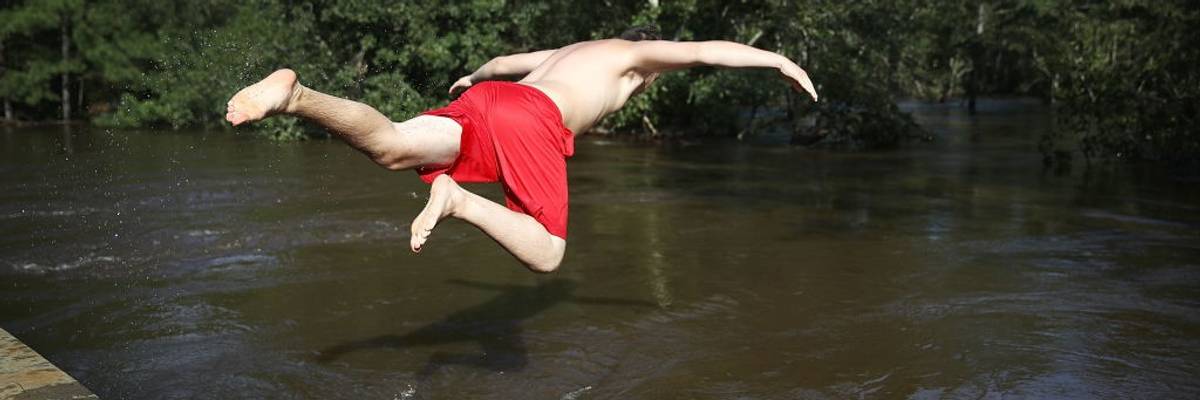
A man jumps into an overflowing North Carolina creek in 2018, following Hurricane Florence.
"All of these rivers should be treated as hazmat sites," a local official in western North Carolina said.
Local officials, academic researchers, and volunteer responders have raised concerns about chemical and biological contamination brought by the floodwaters of Hurricane Helene in the southeastern U.S. last week, which potentially threaten the safety not only of drinking water but also the quality of soil—leading experts to call for tighter regulations on stored pollutants.
Helene struck Florida as a Category 4 hurricane on September 26 and swept through a number of states in the days that followed. Most of the damage came from extreme rainfall that triggered flooding. The storm killed at least 232 people.
The biological and chemical threats posed by floodwaters are typically manifold, often containing, for example, e. coli from overflowing sewage systems.
While it's not yet clear what bacteria or chemicals Helene's floodwaters may have contained, the storm passed through hundreds of industrial sites with toxic pollutants, including paper mills, fertilizer factories, oil and gas storage facilities, and even a retired nuclear plant, according to three researchers at Rice University, writing in The Conversation this week.
The researchers called for tighter regulations on the storage and release of chemical pollutants.
"Hazardous releases remain largely invisible due to limited disclosure requirements and scant public information," they wrote. "Even emergency responders often don’t know exactly which hazardous chemicals they are facing in emergency situations."
"We believe this limited public information on rising chemical threats from our changing climate should be front-page news every hurricane season," they added. "Communities should be aware of the risks of hosting vulnerable industrial infrastructure, particularly as rising global temperatures increase the risk of extreme downpours and powerful hurricanes."
Another devastating scene due to Hurricane Helene’s impact in several states. We are in the historic downtown area of Marshall, N.C. where the clean up process has started. We’ve seen people with PPE and hazmat suits as we’ve been hearing the mud in this area is hazardous. pic.twitter.com/K52uZceDE4
— Cristina Corujo (@cristina_corujo) October 4, 2024
The devastation of infrastructure and the lack of drinking water in cities such Asheville, North Carolina, has rightly received national media attention following the storm. In North Carolina alone, more than 700,000 households lost power, and 170,000 still didn't have it as of Thursday.
Yet the National Weather Service warns that while floodwaters can create clear-cut devastation, "what you can't see can be just as dangerous." Helene also brought with it public health concerns that are less obvious, including to other, non-public sources of drinking water.
Helene's floodwaters overran many wells, rendering them unsafe to drink, at least until treatment and testing can be done. North Carolina's Department of Health and Human Services advised residents not to use contaminated well water earlier this week.
One problem following Helene is that most studies of flooding's impact on drinking water have been done in coastal areas, and it's not clear how they apply to the mountainous areas of North Carolina that took the worst hit from the storm.
"We don't have a lot of knowledge about mountain flooding, from a hydrology standpoint," Kelsey Pieper, a professor in environmental engineering at Northeastern University, told Inside Climate News.
"Water velocities tend to be higher in mountain floodings because it's getting funneled into the valley, where the water is accumulating. In a coastal area, you’re going to see more water spreading out," she said. "The flooding mechanisms are different, and we know very little."
Wells tested in eastern North Carolina after Hurricane Florence in 2018 showed some detections of e. coli or total fecal coliform, which were partly attributed to industrialized hog farms in the area, Inside Climate News reported.
Crops are often rendered unsafe after flooding due to biological or chemical contamination, according to Food Safety Alliance.
Natural bodies of water are also often unsafe to swim in following floods. Virginia Department of Health and other agencies warned people to avoid them after Helene.
The period after a tropical storm brings increased risk of both biological contaminants, such as bacteria and viruses, and chemical contaminants, such as heavy metals and pesticides, according to the Duke University Superfund Research Center.
Following Helene, a grassroots volunteer cleanup effort has sprung up in western North Carolina, but it brings risks for the volunteers because of the potential contamination.
"We were supposed to get a big shipment of gloves, coveralls, masks, respirators, but we aren't," Rachel Bennett, a coordinating volunteer in the town of Marshall, which sits along the banks of the French Broad River, told the Citizen Times, an Asheville newspaper. "So, we're hoping to get more. Those are the big things because we're in cleanup right now. We need thick things."
"Right now, it's boots, and it's hard to get people to put on gloves, because when you're in this, you're like, 'I'm already exposed,'" she added.
A Marshall resident conducted a soil test this week but the results haven't come back yet, the newspaper reported.
"All of these rivers should be treated as hazmat sites," Buncombe County spokesperson Stacey Wood said at a briefing Friday, according to a local journalist. Buncombe County encompasses Asheville and Marshall is just outside it.
The Rice University researchers called for better preparation for future storms in the form of stronger regulation. They've developed a map showing the U.S. areas that are most vulnerable to chemical pollution brought on by floodwaters. One hotspot is the area of Texas and Louisiana full of petrochemical industry sites.
The climate crisis, driven by the burning of fossil fuels, is increasing the frequency and intensity of extreme weather events, and likely contributed to Helene's development, experts have said.
In addition to their immediate damage, storms like Helene can have surprising long-term impacts. A study published in Nature this week found that tropical storms—even those far less deadly than Helene—typically lead to many thousands of excess deaths in the 15 years that follow their arrival.
Dear Common Dreams reader, It’s been nearly 30 years since I co-founded Common Dreams with my late wife, Lina Newhouser. We had the radical notion that journalism should serve the public good, not corporate profits. It was clear to us from the outset what it would take to build such a project. No paid advertisements. No corporate sponsors. No millionaire publisher telling us what to think or do. Many people said we wouldn't last a year, but we proved those doubters wrong. Together with a tremendous team of journalists and dedicated staff, we built an independent media outlet free from the constraints of profits and corporate control. Our mission has always been simple: To inform. To inspire. To ignite change for the common good. Building Common Dreams was not easy. Our survival was never guaranteed. When you take on the most powerful forces—Wall Street greed, fossil fuel industry destruction, Big Tech lobbyists, and uber-rich oligarchs who have spent billions upon billions rigging the economy and democracy in their favor—the only bulwark you have is supporters who believe in your work. But here’s the urgent message from me today. It's never been this bad out there. And it's never been this hard to keep us going. At the very moment Common Dreams is most needed, the threats we face are intensifying. We need your support now more than ever. We don't accept corporate advertising and never will. We don't have a paywall because we don't think people should be blocked from critical news based on their ability to pay. Everything we do is funded by the donations of readers like you. When everyone does the little they can afford, we are strong. But if that support retreats or dries up, so do we. Will you donate now to make sure Common Dreams not only survives but thrives? —Craig Brown, Co-founder |
Local officials, academic researchers, and volunteer responders have raised concerns about chemical and biological contamination brought by the floodwaters of Hurricane Helene in the southeastern U.S. last week, which potentially threaten the safety not only of drinking water but also the quality of soil—leading experts to call for tighter regulations on stored pollutants.
Helene struck Florida as a Category 4 hurricane on September 26 and swept through a number of states in the days that followed. Most of the damage came from extreme rainfall that triggered flooding. The storm killed at least 232 people.
The biological and chemical threats posed by floodwaters are typically manifold, often containing, for example, e. coli from overflowing sewage systems.
While it's not yet clear what bacteria or chemicals Helene's floodwaters may have contained, the storm passed through hundreds of industrial sites with toxic pollutants, including paper mills, fertilizer factories, oil and gas storage facilities, and even a retired nuclear plant, according to three researchers at Rice University, writing in The Conversation this week.
The researchers called for tighter regulations on the storage and release of chemical pollutants.
"Hazardous releases remain largely invisible due to limited disclosure requirements and scant public information," they wrote. "Even emergency responders often don’t know exactly which hazardous chemicals they are facing in emergency situations."
"We believe this limited public information on rising chemical threats from our changing climate should be front-page news every hurricane season," they added. "Communities should be aware of the risks of hosting vulnerable industrial infrastructure, particularly as rising global temperatures increase the risk of extreme downpours and powerful hurricanes."
Another devastating scene due to Hurricane Helene’s impact in several states. We are in the historic downtown area of Marshall, N.C. where the clean up process has started. We’ve seen people with PPE and hazmat suits as we’ve been hearing the mud in this area is hazardous. pic.twitter.com/K52uZceDE4
— Cristina Corujo (@cristina_corujo) October 4, 2024
The devastation of infrastructure and the lack of drinking water in cities such Asheville, North Carolina, has rightly received national media attention following the storm. In North Carolina alone, more than 700,000 households lost power, and 170,000 still didn't have it as of Thursday.
Yet the National Weather Service warns that while floodwaters can create clear-cut devastation, "what you can't see can be just as dangerous." Helene also brought with it public health concerns that are less obvious, including to other, non-public sources of drinking water.
Helene's floodwaters overran many wells, rendering them unsafe to drink, at least until treatment and testing can be done. North Carolina's Department of Health and Human Services advised residents not to use contaminated well water earlier this week.
One problem following Helene is that most studies of flooding's impact on drinking water have been done in coastal areas, and it's not clear how they apply to the mountainous areas of North Carolina that took the worst hit from the storm.
"We don't have a lot of knowledge about mountain flooding, from a hydrology standpoint," Kelsey Pieper, a professor in environmental engineering at Northeastern University, told Inside Climate News.
"Water velocities tend to be higher in mountain floodings because it's getting funneled into the valley, where the water is accumulating. In a coastal area, you’re going to see more water spreading out," she said. "The flooding mechanisms are different, and we know very little."
Wells tested in eastern North Carolina after Hurricane Florence in 2018 showed some detections of e. coli or total fecal coliform, which were partly attributed to industrialized hog farms in the area, Inside Climate News reported.
Crops are often rendered unsafe after flooding due to biological or chemical contamination, according to Food Safety Alliance.
Natural bodies of water are also often unsafe to swim in following floods. Virginia Department of Health and other agencies warned people to avoid them after Helene.
The period after a tropical storm brings increased risk of both biological contaminants, such as bacteria and viruses, and chemical contaminants, such as heavy metals and pesticides, according to the Duke University Superfund Research Center.
Following Helene, a grassroots volunteer cleanup effort has sprung up in western North Carolina, but it brings risks for the volunteers because of the potential contamination.
"We were supposed to get a big shipment of gloves, coveralls, masks, respirators, but we aren't," Rachel Bennett, a coordinating volunteer in the town of Marshall, which sits along the banks of the French Broad River, told the Citizen Times, an Asheville newspaper. "So, we're hoping to get more. Those are the big things because we're in cleanup right now. We need thick things."
"Right now, it's boots, and it's hard to get people to put on gloves, because when you're in this, you're like, 'I'm already exposed,'" she added.
A Marshall resident conducted a soil test this week but the results haven't come back yet, the newspaper reported.
"All of these rivers should be treated as hazmat sites," Buncombe County spokesperson Stacey Wood said at a briefing Friday, according to a local journalist. Buncombe County encompasses Asheville and Marshall is just outside it.
The Rice University researchers called for better preparation for future storms in the form of stronger regulation. They've developed a map showing the U.S. areas that are most vulnerable to chemical pollution brought on by floodwaters. One hotspot is the area of Texas and Louisiana full of petrochemical industry sites.
The climate crisis, driven by the burning of fossil fuels, is increasing the frequency and intensity of extreme weather events, and likely contributed to Helene's development, experts have said.
In addition to their immediate damage, storms like Helene can have surprising long-term impacts. A study published in Nature this week found that tropical storms—even those far less deadly than Helene—typically lead to many thousands of excess deaths in the 15 years that follow their arrival.
Local officials, academic researchers, and volunteer responders have raised concerns about chemical and biological contamination brought by the floodwaters of Hurricane Helene in the southeastern U.S. last week, which potentially threaten the safety not only of drinking water but also the quality of soil—leading experts to call for tighter regulations on stored pollutants.
Helene struck Florida as a Category 4 hurricane on September 26 and swept through a number of states in the days that followed. Most of the damage came from extreme rainfall that triggered flooding. The storm killed at least 232 people.
The biological and chemical threats posed by floodwaters are typically manifold, often containing, for example, e. coli from overflowing sewage systems.
While it's not yet clear what bacteria or chemicals Helene's floodwaters may have contained, the storm passed through hundreds of industrial sites with toxic pollutants, including paper mills, fertilizer factories, oil and gas storage facilities, and even a retired nuclear plant, according to three researchers at Rice University, writing in The Conversation this week.
The researchers called for tighter regulations on the storage and release of chemical pollutants.
"Hazardous releases remain largely invisible due to limited disclosure requirements and scant public information," they wrote. "Even emergency responders often don’t know exactly which hazardous chemicals they are facing in emergency situations."
"We believe this limited public information on rising chemical threats from our changing climate should be front-page news every hurricane season," they added. "Communities should be aware of the risks of hosting vulnerable industrial infrastructure, particularly as rising global temperatures increase the risk of extreme downpours and powerful hurricanes."
Another devastating scene due to Hurricane Helene’s impact in several states. We are in the historic downtown area of Marshall, N.C. where the clean up process has started. We’ve seen people with PPE and hazmat suits as we’ve been hearing the mud in this area is hazardous. pic.twitter.com/K52uZceDE4
— Cristina Corujo (@cristina_corujo) October 4, 2024
The devastation of infrastructure and the lack of drinking water in cities such Asheville, North Carolina, has rightly received national media attention following the storm. In North Carolina alone, more than 700,000 households lost power, and 170,000 still didn't have it as of Thursday.
Yet the National Weather Service warns that while floodwaters can create clear-cut devastation, "what you can't see can be just as dangerous." Helene also brought with it public health concerns that are less obvious, including to other, non-public sources of drinking water.
Helene's floodwaters overran many wells, rendering them unsafe to drink, at least until treatment and testing can be done. North Carolina's Department of Health and Human Services advised residents not to use contaminated well water earlier this week.
One problem following Helene is that most studies of flooding's impact on drinking water have been done in coastal areas, and it's not clear how they apply to the mountainous areas of North Carolina that took the worst hit from the storm.
"We don't have a lot of knowledge about mountain flooding, from a hydrology standpoint," Kelsey Pieper, a professor in environmental engineering at Northeastern University, told Inside Climate News.
"Water velocities tend to be higher in mountain floodings because it's getting funneled into the valley, where the water is accumulating. In a coastal area, you’re going to see more water spreading out," she said. "The flooding mechanisms are different, and we know very little."
Wells tested in eastern North Carolina after Hurricane Florence in 2018 showed some detections of e. coli or total fecal coliform, which were partly attributed to industrialized hog farms in the area, Inside Climate News reported.
Crops are often rendered unsafe after flooding due to biological or chemical contamination, according to Food Safety Alliance.
Natural bodies of water are also often unsafe to swim in following floods. Virginia Department of Health and other agencies warned people to avoid them after Helene.
The period after a tropical storm brings increased risk of both biological contaminants, such as bacteria and viruses, and chemical contaminants, such as heavy metals and pesticides, according to the Duke University Superfund Research Center.
Following Helene, a grassroots volunteer cleanup effort has sprung up in western North Carolina, but it brings risks for the volunteers because of the potential contamination.
"We were supposed to get a big shipment of gloves, coveralls, masks, respirators, but we aren't," Rachel Bennett, a coordinating volunteer in the town of Marshall, which sits along the banks of the French Broad River, told the Citizen Times, an Asheville newspaper. "So, we're hoping to get more. Those are the big things because we're in cleanup right now. We need thick things."
"Right now, it's boots, and it's hard to get people to put on gloves, because when you're in this, you're like, 'I'm already exposed,'" she added.
A Marshall resident conducted a soil test this week but the results haven't come back yet, the newspaper reported.
"All of these rivers should be treated as hazmat sites," Buncombe County spokesperson Stacey Wood said at a briefing Friday, according to a local journalist. Buncombe County encompasses Asheville and Marshall is just outside it.
The Rice University researchers called for better preparation for future storms in the form of stronger regulation. They've developed a map showing the U.S. areas that are most vulnerable to chemical pollution brought on by floodwaters. One hotspot is the area of Texas and Louisiana full of petrochemical industry sites.
The climate crisis, driven by the burning of fossil fuels, is increasing the frequency and intensity of extreme weather events, and likely contributed to Helene's development, experts have said.
In addition to their immediate damage, storms like Helene can have surprising long-term impacts. A study published in Nature this week found that tropical storms—even those far less deadly than Helene—typically lead to many thousands of excess deaths in the 15 years that follow their arrival.