

SUBSCRIBE TO OUR FREE NEWSLETTER
Daily news & progressive opinion—funded by the people, not the corporations—delivered straight to your inbox.
5
#000000
#FFFFFF
To donate by check, phone, or other method, see our More Ways to Give page.
Daily news & progressive opinion—funded by the people, not the corporations—delivered straight to your inbox.
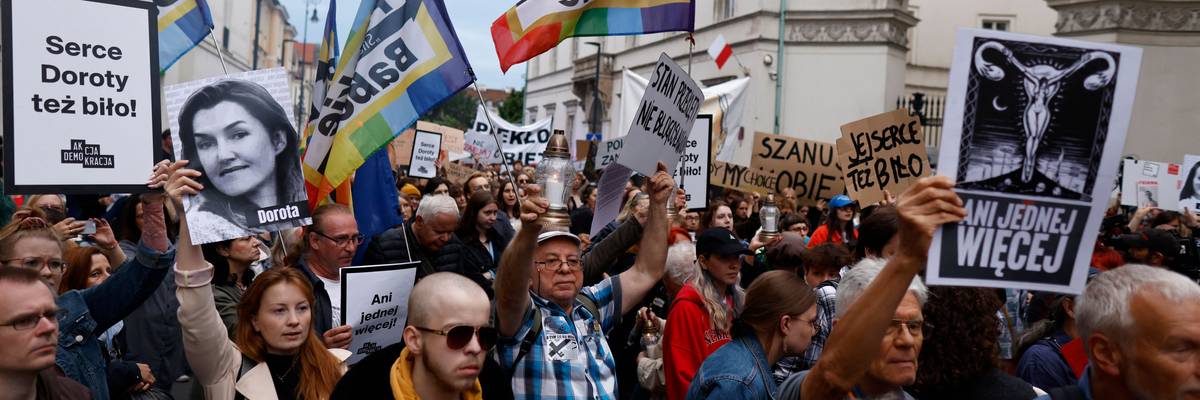
A demonstrator holds up an image showing the late Dorota Lalik on June 14, 2023, as people take to the streets in downtown Warsaw and other Polish cities to protest the nation's abortion restrictions.
"We want to raise the alarm: If you are pregnant this could happen to you, if you're not prepared to fight for your life," said organizers.
Abortion rights activists chanted "stop killing us" as they marched through several communities in Poland on Wednesday over the death of a pregnant woman who should have been offered a legal abortion, according to a government ombudsman.
In Poland, abortions are only permitted in cases of rape or incest, or to protect the health or life of a pregnant person. Since the October 2020 ruling that outlawed nearly all abortions in the European nation took effect the following January, protests have erupted in response to the deaths of pregnant women including Izabela in September 2021 and Agnieszka T. in January 2022.
The new demonstrations follow the death of Dorota Lalik last month. The 33-year-old, who was five months pregnant, sought medical care because her water broke. She was told to lie with her legs up and died of septic shock three days after being admitted to Pope John Paul II hospital in Nowy Targ.
The Associated Press noted that "it is a hospital in a deeply conservative region of the mostly Catholic nation. The hospital contains relics of the late Polish pope and Polish media have reported that it never performs abortions on principle."
"No one told us that we had practically no chance for a healthy baby… The entire time they were giving us false hope that everything will be OK… that [in the worst case] the child will be premature," Lalik's husband told Polish media, according to The Guardian. "No one gave us the choice or the chance to save Dorota, because no one told us her life was at risk."
During a Monday press conference, Reuters reported, Bartlomiej Chmielowiec, the Polish patients' rights ombudsman, said that Lalik's "rights have been violated, the right to provide health services in accordance with current medical knowledge has been violated, the patient's right to having services provided with due diligence has been violated."
Politico pointed out that while Poland's health ministry announced Monday it had "appointed a team to develop guidelines for medical facilities on how to proceed in situations where there may be indications for termination of pregnancy," Lalik's death has provoked fresh calls for reviewing the law, including from the Polish Chamber of Physicians.
Lalik "is at least the seventh woman known to have died as a result of pregnancy complications since the tightening of the abortion law under a Constitutional Tribunal ruling in October 2020," reported Notes From Poland.
As the Kraków-based outlet detailed:
Protests took place in around 40 towns and cities under the slogan "Not one more." Protesters waved placards saying "A state cursed, not blessed," "Pregnancy by choice, not by terror," and "Women's Hell." Some held up photographs and names of Dorota and other pregnant women who have died in hospital.
"Dorota from Nowy Targ is dead because Poland's anti-abortion law kills and makes doctors into political minions instead of healthcare experts," wrote the organizers of the protests. "Haven't enough of us died yet?"
Lempart tied Lalik's death to others in the past few years, and stressed that "it is difficult to say that this situation is just the fault of the government when doctors are refusing to perform abortions permitted by the law in cases when not only the health is endangered but even life."
"Since the protests in 2020 everybody in Poland knows the number to Abortion Without Borders," she said of a group that provides abortion pills. "But not everyone realized that if you're pregnant and you go to a Polish hospital you might not leave alive. That you have to go prepared; you need to have a number to a lawyer and contacts with the media ready, and you have to keep fighting and arguing and not believe a single word anyone says because you might not stay alive."
Poland's strict abortion policy has been sharply condemned across Europe and beyond—including in the United States, where reproductive rights are also under attack, particularly in the wake of the U.S. Supreme Court reversing Roe v. Wade last year.
As U.S. states dominated by anti-choice Republican policymakers continue to enact new abortion restrictions, American patients are also enduring hospital experiences in which their lives are further endangered by doctors declining to provide legal care.
Dear Common Dreams reader, It’s been nearly 30 years since I co-founded Common Dreams with my late wife, Lina Newhouser. We had the radical notion that journalism should serve the public good, not corporate profits. It was clear to us from the outset what it would take to build such a project. No paid advertisements. No corporate sponsors. No millionaire publisher telling us what to think or do. Many people said we wouldn't last a year, but we proved those doubters wrong. Together with a tremendous team of journalists and dedicated staff, we built an independent media outlet free from the constraints of profits and corporate control. Our mission has always been simple: To inform. To inspire. To ignite change for the common good. Building Common Dreams was not easy. Our survival was never guaranteed. When you take on the most powerful forces—Wall Street greed, fossil fuel industry destruction, Big Tech lobbyists, and uber-rich oligarchs who have spent billions upon billions rigging the economy and democracy in their favor—the only bulwark you have is supporters who believe in your work. But here’s the urgent message from me today. It's never been this bad out there. And it's never been this hard to keep us going. At the very moment Common Dreams is most needed, the threats we face are intensifying. We need your support now more than ever. We don't accept corporate advertising and never will. We don't have a paywall because we don't think people should be blocked from critical news based on their ability to pay. Everything we do is funded by the donations of readers like you. When everyone does the little they can afford, we are strong. But if that support retreats or dries up, so do we. Will you donate now to make sure Common Dreams not only survives but thrives? —Craig Brown, Co-founder |
Abortion rights activists chanted "stop killing us" as they marched through several communities in Poland on Wednesday over the death of a pregnant woman who should have been offered a legal abortion, according to a government ombudsman.
In Poland, abortions are only permitted in cases of rape or incest, or to protect the health or life of a pregnant person. Since the October 2020 ruling that outlawed nearly all abortions in the European nation took effect the following January, protests have erupted in response to the deaths of pregnant women including Izabela in September 2021 and Agnieszka T. in January 2022.
The new demonstrations follow the death of Dorota Lalik last month. The 33-year-old, who was five months pregnant, sought medical care because her water broke. She was told to lie with her legs up and died of septic shock three days after being admitted to Pope John Paul II hospital in Nowy Targ.
The Associated Press noted that "it is a hospital in a deeply conservative region of the mostly Catholic nation. The hospital contains relics of the late Polish pope and Polish media have reported that it never performs abortions on principle."
"No one told us that we had practically no chance for a healthy baby… The entire time they were giving us false hope that everything will be OK… that [in the worst case] the child will be premature," Lalik's husband told Polish media, according to The Guardian. "No one gave us the choice or the chance to save Dorota, because no one told us her life was at risk."
During a Monday press conference, Reuters reported, Bartlomiej Chmielowiec, the Polish patients' rights ombudsman, said that Lalik's "rights have been violated, the right to provide health services in accordance with current medical knowledge has been violated, the patient's right to having services provided with due diligence has been violated."
Politico pointed out that while Poland's health ministry announced Monday it had "appointed a team to develop guidelines for medical facilities on how to proceed in situations where there may be indications for termination of pregnancy," Lalik's death has provoked fresh calls for reviewing the law, including from the Polish Chamber of Physicians.
Lalik "is at least the seventh woman known to have died as a result of pregnancy complications since the tightening of the abortion law under a Constitutional Tribunal ruling in October 2020," reported Notes From Poland.
As the Kraków-based outlet detailed:
Protests took place in around 40 towns and cities under the slogan "Not one more." Protesters waved placards saying "A state cursed, not blessed," "Pregnancy by choice, not by terror," and "Women's Hell." Some held up photographs and names of Dorota and other pregnant women who have died in hospital.
"Dorota from Nowy Targ is dead because Poland's anti-abortion law kills and makes doctors into political minions instead of healthcare experts," wrote the organizers of the protests. "Haven't enough of us died yet?"
Lempart tied Lalik's death to others in the past few years, and stressed that "it is difficult to say that this situation is just the fault of the government when doctors are refusing to perform abortions permitted by the law in cases when not only the health is endangered but even life."
"Since the protests in 2020 everybody in Poland knows the number to Abortion Without Borders," she said of a group that provides abortion pills. "But not everyone realized that if you're pregnant and you go to a Polish hospital you might not leave alive. That you have to go prepared; you need to have a number to a lawyer and contacts with the media ready, and you have to keep fighting and arguing and not believe a single word anyone says because you might not stay alive."
Poland's strict abortion policy has been sharply condemned across Europe and beyond—including in the United States, where reproductive rights are also under attack, particularly in the wake of the U.S. Supreme Court reversing Roe v. Wade last year.
As U.S. states dominated by anti-choice Republican policymakers continue to enact new abortion restrictions, American patients are also enduring hospital experiences in which their lives are further endangered by doctors declining to provide legal care.
Abortion rights activists chanted "stop killing us" as they marched through several communities in Poland on Wednesday over the death of a pregnant woman who should have been offered a legal abortion, according to a government ombudsman.
In Poland, abortions are only permitted in cases of rape or incest, or to protect the health or life of a pregnant person. Since the October 2020 ruling that outlawed nearly all abortions in the European nation took effect the following January, protests have erupted in response to the deaths of pregnant women including Izabela in September 2021 and Agnieszka T. in January 2022.
The new demonstrations follow the death of Dorota Lalik last month. The 33-year-old, who was five months pregnant, sought medical care because her water broke. She was told to lie with her legs up and died of septic shock three days after being admitted to Pope John Paul II hospital in Nowy Targ.
The Associated Press noted that "it is a hospital in a deeply conservative region of the mostly Catholic nation. The hospital contains relics of the late Polish pope and Polish media have reported that it never performs abortions on principle."
"No one told us that we had practically no chance for a healthy baby… The entire time they were giving us false hope that everything will be OK… that [in the worst case] the child will be premature," Lalik's husband told Polish media, according to The Guardian. "No one gave us the choice or the chance to save Dorota, because no one told us her life was at risk."
During a Monday press conference, Reuters reported, Bartlomiej Chmielowiec, the Polish patients' rights ombudsman, said that Lalik's "rights have been violated, the right to provide health services in accordance with current medical knowledge has been violated, the patient's right to having services provided with due diligence has been violated."
Politico pointed out that while Poland's health ministry announced Monday it had "appointed a team to develop guidelines for medical facilities on how to proceed in situations where there may be indications for termination of pregnancy," Lalik's death has provoked fresh calls for reviewing the law, including from the Polish Chamber of Physicians.
Lalik "is at least the seventh woman known to have died as a result of pregnancy complications since the tightening of the abortion law under a Constitutional Tribunal ruling in October 2020," reported Notes From Poland.
As the Kraków-based outlet detailed:
Protests took place in around 40 towns and cities under the slogan "Not one more." Protesters waved placards saying "A state cursed, not blessed," "Pregnancy by choice, not by terror," and "Women's Hell." Some held up photographs and names of Dorota and other pregnant women who have died in hospital.
"Dorota from Nowy Targ is dead because Poland's anti-abortion law kills and makes doctors into political minions instead of healthcare experts," wrote the organizers of the protests. "Haven't enough of us died yet?"
Lempart tied Lalik's death to others in the past few years, and stressed that "it is difficult to say that this situation is just the fault of the government when doctors are refusing to perform abortions permitted by the law in cases when not only the health is endangered but even life."
"Since the protests in 2020 everybody in Poland knows the number to Abortion Without Borders," she said of a group that provides abortion pills. "But not everyone realized that if you're pregnant and you go to a Polish hospital you might not leave alive. That you have to go prepared; you need to have a number to a lawyer and contacts with the media ready, and you have to keep fighting and arguing and not believe a single word anyone says because you might not stay alive."
Poland's strict abortion policy has been sharply condemned across Europe and beyond—including in the United States, where reproductive rights are also under attack, particularly in the wake of the U.S. Supreme Court reversing Roe v. Wade last year.
As U.S. states dominated by anti-choice Republican policymakers continue to enact new abortion restrictions, American patients are also enduring hospital experiences in which their lives are further endangered by doctors declining to provide legal care.

