SUBSCRIBE TO OUR FREE NEWSLETTER
Daily news & progressive opinion—funded by the people, not the corporations—delivered straight to your inbox.
5
#000000
#FFFFFF
To donate by check, phone, or other method, see our More Ways to Give page.
Daily news & progressive opinion—funded by the people, not the corporations—delivered straight to your inbox.
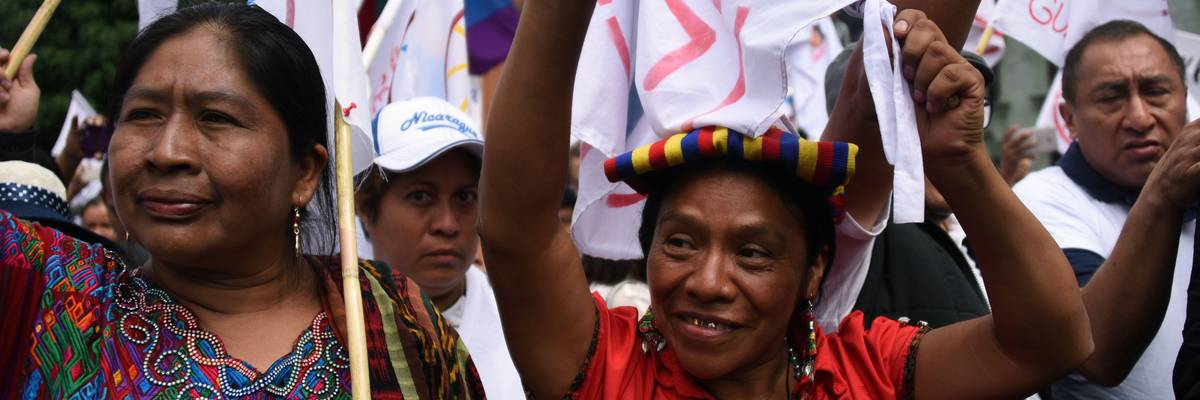
Thelma Cabrera rallies with supporters in Guatemala City on June 8, 2019.
One election expert called the decision an "electoral coup."
Guatemala's Supreme Electoral Tribunal ruled earlier this week that a leftist presidential ticket headed by Indigenous human rights defender Thelma Cabrera should be barred from the June ballot, prompting fury and vows of mass protests from Cabrera's supporters.
Thursday's ruling—which Cabrera's young political party, the Movement for the Liberation of the Peoples (MLP), is vowing to appeal to the Supreme Court of Justice—stems from Guatemala electoral authorities' refusal to certify the candidacy of Cabrera's running mate, former human rights ombudsman Jordán Rodas.
Reporting indicates that election officials have justified stonewalling Rodas—a longtime target of Guatemala's right-wing political establishment—by citing supposed "anomalies during the collection of compensation" upon his departure from the ombudsman post last year.
But Cabrera and Rodas contend that the electoral tribunal's decision is a politically motivated attempt to keep a left-wing party—whose base is largely rural—off the ballot, which is set to include the daughter of Gen. Efraín Ríos Montt, the former U.S.-backed Guatemalan dictator who was convicted of genocide and crimes against humanity in 2013.
Montt's victims were largely Indigenous peasants.
Last month, the same electoral body that deemed Cabrera and Rodas disqualified from the June ballot ruled that Zury Ríos can participate, despite a constitutional provision barring the relatives of coup leaders from serving as Guatemala's president. Ríos was blocked from the 2019 presidential ballot on those grounds.
That year, as Nick Burns of Americas Quarterly recently reported, Cabrera "gave the Guatemalan political establishment a shock" by winning 10% of the vote in the presidential election.
"It was the most successful presidential run by an indigenous person in Guatemala’s modern history—the only other was by Nobel Prize winner Rigoberta Menchú in 2007, who won 3% of the vote," Burns noted. "Cabrera’s biography is striking. She grew up in a Maya Mam family of poor laborers on a coffee plantation on Guatemala's Pacific coast and was married at 15. She described in a book how she and her sister Vilma went to school through the sixth grade because their mother—who could not read or write—saw education as crucial."
Cabrera's supporters have vowed to "paralyze the country" with large-scale demonstrations if the electoral body's decision isn't reversed.
"If they do not do it, we are going to take over the international airport, the three ports of the country, the Supreme Electoral Tribunal, and all state institutions," said one MLP supporter. "We are Indigenous, we are Maya, and we can be out here for a month!"
Daniel Zovatto, a political scientist and expert in Latin American elections, said the tribunal's ruling against the MLP presidential ticket amounts to an "electoral coup" that "vitiates the integrity and credibility" of the upcoming contest.
Rodas, a human rights champion, lamented in response to the decision that "democracy in Guatemala has taken another step back."
"They are afraid of the people and their sovereign decisions," he said.
Dear Common Dreams reader, It’s been nearly 30 years since I co-founded Common Dreams with my late wife, Lina Newhouser. We had the radical notion that journalism should serve the public good, not corporate profits. It was clear to us from the outset what it would take to build such a project. No paid advertisements. No corporate sponsors. No millionaire publisher telling us what to think or do. Many people said we wouldn't last a year, but we proved those doubters wrong. Together with a tremendous team of journalists and dedicated staff, we built an independent media outlet free from the constraints of profits and corporate control. Our mission has always been simple: To inform. To inspire. To ignite change for the common good. Building Common Dreams was not easy. Our survival was never guaranteed. When you take on the most powerful forces—Wall Street greed, fossil fuel industry destruction, Big Tech lobbyists, and uber-rich oligarchs who have spent billions upon billions rigging the economy and democracy in their favor—the only bulwark you have is supporters who believe in your work. But here’s the urgent message from me today. It's never been this bad out there. And it's never been this hard to keep us going. At the very moment Common Dreams is most needed, the threats we face are intensifying. We need your support now more than ever. We don't accept corporate advertising and never will. We don't have a paywall because we don't think people should be blocked from critical news based on their ability to pay. Everything we do is funded by the donations of readers like you. When everyone does the little they can afford, we are strong. But if that support retreats or dries up, so do we. Will you donate now to make sure Common Dreams not only survives but thrives? —Craig Brown, Co-founder |
Guatemala's Supreme Electoral Tribunal ruled earlier this week that a leftist presidential ticket headed by Indigenous human rights defender Thelma Cabrera should be barred from the June ballot, prompting fury and vows of mass protests from Cabrera's supporters.
Thursday's ruling—which Cabrera's young political party, the Movement for the Liberation of the Peoples (MLP), is vowing to appeal to the Supreme Court of Justice—stems from Guatemala electoral authorities' refusal to certify the candidacy of Cabrera's running mate, former human rights ombudsman Jordán Rodas.
Reporting indicates that election officials have justified stonewalling Rodas—a longtime target of Guatemala's right-wing political establishment—by citing supposed "anomalies during the collection of compensation" upon his departure from the ombudsman post last year.
But Cabrera and Rodas contend that the electoral tribunal's decision is a politically motivated attempt to keep a left-wing party—whose base is largely rural—off the ballot, which is set to include the daughter of Gen. Efraín Ríos Montt, the former U.S.-backed Guatemalan dictator who was convicted of genocide and crimes against humanity in 2013.
Montt's victims were largely Indigenous peasants.
Last month, the same electoral body that deemed Cabrera and Rodas disqualified from the June ballot ruled that Zury Ríos can participate, despite a constitutional provision barring the relatives of coup leaders from serving as Guatemala's president. Ríos was blocked from the 2019 presidential ballot on those grounds.
That year, as Nick Burns of Americas Quarterly recently reported, Cabrera "gave the Guatemalan political establishment a shock" by winning 10% of the vote in the presidential election.
"It was the most successful presidential run by an indigenous person in Guatemala’s modern history—the only other was by Nobel Prize winner Rigoberta Menchú in 2007, who won 3% of the vote," Burns noted. "Cabrera’s biography is striking. She grew up in a Maya Mam family of poor laborers on a coffee plantation on Guatemala's Pacific coast and was married at 15. She described in a book how she and her sister Vilma went to school through the sixth grade because their mother—who could not read or write—saw education as crucial."
Cabrera's supporters have vowed to "paralyze the country" with large-scale demonstrations if the electoral body's decision isn't reversed.
"If they do not do it, we are going to take over the international airport, the three ports of the country, the Supreme Electoral Tribunal, and all state institutions," said one MLP supporter. "We are Indigenous, we are Maya, and we can be out here for a month!"
Daniel Zovatto, a political scientist and expert in Latin American elections, said the tribunal's ruling against the MLP presidential ticket amounts to an "electoral coup" that "vitiates the integrity and credibility" of the upcoming contest.
Rodas, a human rights champion, lamented in response to the decision that "democracy in Guatemala has taken another step back."
"They are afraid of the people and their sovereign decisions," he said.
Guatemala's Supreme Electoral Tribunal ruled earlier this week that a leftist presidential ticket headed by Indigenous human rights defender Thelma Cabrera should be barred from the June ballot, prompting fury and vows of mass protests from Cabrera's supporters.
Thursday's ruling—which Cabrera's young political party, the Movement for the Liberation of the Peoples (MLP), is vowing to appeal to the Supreme Court of Justice—stems from Guatemala electoral authorities' refusal to certify the candidacy of Cabrera's running mate, former human rights ombudsman Jordán Rodas.
Reporting indicates that election officials have justified stonewalling Rodas—a longtime target of Guatemala's right-wing political establishment—by citing supposed "anomalies during the collection of compensation" upon his departure from the ombudsman post last year.
But Cabrera and Rodas contend that the electoral tribunal's decision is a politically motivated attempt to keep a left-wing party—whose base is largely rural—off the ballot, which is set to include the daughter of Gen. Efraín Ríos Montt, the former U.S.-backed Guatemalan dictator who was convicted of genocide and crimes against humanity in 2013.
Montt's victims were largely Indigenous peasants.
Last month, the same electoral body that deemed Cabrera and Rodas disqualified from the June ballot ruled that Zury Ríos can participate, despite a constitutional provision barring the relatives of coup leaders from serving as Guatemala's president. Ríos was blocked from the 2019 presidential ballot on those grounds.
That year, as Nick Burns of Americas Quarterly recently reported, Cabrera "gave the Guatemalan political establishment a shock" by winning 10% of the vote in the presidential election.
"It was the most successful presidential run by an indigenous person in Guatemala’s modern history—the only other was by Nobel Prize winner Rigoberta Menchú in 2007, who won 3% of the vote," Burns noted. "Cabrera’s biography is striking. She grew up in a Maya Mam family of poor laborers on a coffee plantation on Guatemala's Pacific coast and was married at 15. She described in a book how she and her sister Vilma went to school through the sixth grade because their mother—who could not read or write—saw education as crucial."
Cabrera's supporters have vowed to "paralyze the country" with large-scale demonstrations if the electoral body's decision isn't reversed.
"If they do not do it, we are going to take over the international airport, the three ports of the country, the Supreme Electoral Tribunal, and all state institutions," said one MLP supporter. "We are Indigenous, we are Maya, and we can be out here for a month!"
Daniel Zovatto, a political scientist and expert in Latin American elections, said the tribunal's ruling against the MLP presidential ticket amounts to an "electoral coup" that "vitiates the integrity and credibility" of the upcoming contest.
Rodas, a human rights champion, lamented in response to the decision that "democracy in Guatemala has taken another step back."
"They are afraid of the people and their sovereign decisions," he said.