SUBSCRIBE TO OUR FREE NEWSLETTER
Daily news & progressive opinion—funded by the people, not the corporations—delivered straight to your inbox.
5
#000000
#FFFFFF
To donate by check, phone, or other method, see our More Ways to Give page.
Daily news & progressive opinion—funded by the people, not the corporations—delivered straight to your inbox.
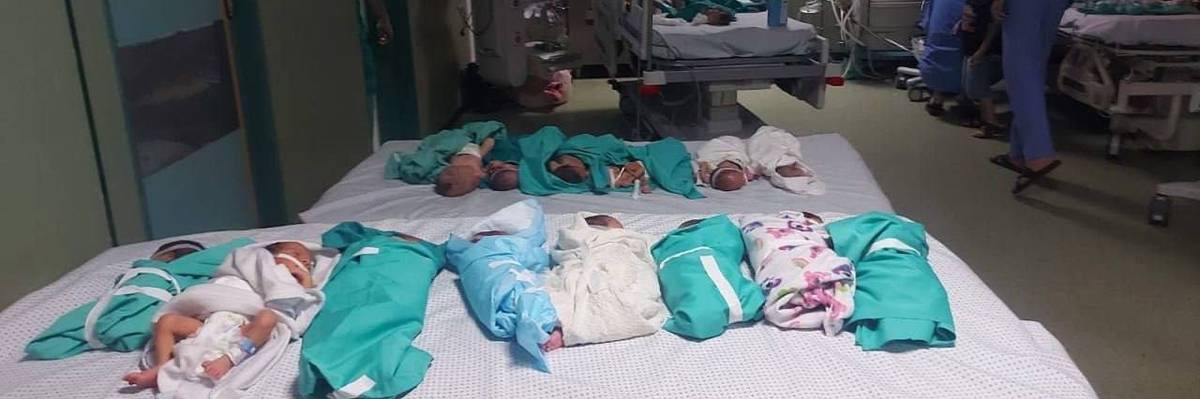
A view of 33 premature babies whose lives are in danger at an intensive care unit as the Israeli attack continues on its 36th day in Gaza City, Gaza on November 11, 2023.
"The humanitarian situation... continues to deteriorate rapidly and dramatically," the Palestine Red Crescent Society said.
As the humanitarian situation at hospitals in northern Gaza continues to deteriorate, the Palestine Red Crescent Society put out a call Monday to the international community, pleading with its Red Cross and Red Crescent partners and United Nations agencies to ensure safe passage for medical missions in Gaza, especially in the north.
The call comes after shelling prevented an attempt by PRCS and the International Committee of the Red Cross to send an evacuation team to al-Quds hospital, which has ceased to function entirely due to lack of fuel.
"The medical team, patients, and their families remain besieged in the hospital with no food, water, or electricity," the group wrote on social media.
PRCS said the convoy had left Khan Younis to reach al-Quds in Tel Al-Hawa, but was forced to turn back due to "relentless bombardment."
In its appeal statement, PRCS said that it was receiving hundreds of calls on the 101 emergency number from people in northern Gaza asking for ambulances to assist the wounded, retrieve the dead, or help them evacuate.
"A lot of phone calls received informed PRCS teams about a huge number of people stuck under the rubble, and tens of injured who need emergency medical care," the group wrote.
PRCS said that the Israeli army prevented ambulances from traveling in the north, and would target anyone who tried to move, meaning people were forced to abandon bodies in the streets.
"The humanitarian situation [in] Gaza and the northern governorates of the strip continues to deteriorate rapidly and dramatically," PRCS said. "Civilians in these areas are left behind, without emergency medical services due to the inability of ambulances to reach the injured."
The PRCS also said that any ambulances would have no hospitals to transport the injured to, since they were all either "besieged or out of service."
In response to the news that the convoy to al-Quds had to turn back, the U.N. Human Rights Office in Palestine also said there was an "urgent need for humanitarian access to northern Gaza and Gaza City." The office called for hospitals and their staff and patients to be protected.
Another struggling hospital in Gaza's north is al-Shifa Hospital, where staff continue to report harrowing conditions amid an ongoing siege by Israeli military.
"We don't have electricity," a surgeon with Doctors Without Borders/Médecins Sans Frontières (MSF) told the humanitarian group via phone on Monday. "There's no water in the hospital. There's no food. People will die in a few hours without functioning ventilators."
Over the weekend, hospital staff had to remove 39 premature babies from incubators due to lack of electricity and place them together in a bed. Since then, three have died, pediatrics head Dr. Mohamed Tabasha told Reuters Monday.
"The situation is very bad, it is inhuman."
"Yesterday I had 39 babies and today they have become 36," Tabasha said. "I cannot say how long they can last. I can lose another two babies today, or in an hour."
Tabasha said that fuel shortages also meant it wasn't possible to maintain the proper temperature for the infants, and that the hospital had no way to sterilize their milk or bottle teats. Because of this, some of the infants had become infected with gastritis, putting them at risk of dehydration.
"Unfortunately, this situation means that we are waiting for them to die one by one," Ahmad Mukhallati, who leads al-Shifa's plastic surgery department, told Middle East Eye on Monday.
The hospital is under siege by the Israeli military because it claims that Hamas operates a command center from the hospital and underground, The Associated Press reported. Both Hamas and the hospital staff deny this, and Israel has not supplied any evidence. It is considered a war crime to target a hospital.
The MSF surgeon said that the staff there would only evacuate if they received a guarantee that their patients, including the premature babies, would be evacuated safely first.
Mohammed Zaqout, the director of hospitals in Gaza, told AP that there were around 650 patients, 500 staff, and 2,500 displaced people still inside the hospital.
The MSF surgeon said that Israeli forces had bombed or shot at people who had attempted to leave the hospital, and also prevented hospital staff from bringing the injured in.
"When we sent the ambulance to bring the patients, a few meters away, they attacked the ambulance. There are injured people around the hospital, they are looking for medical care, we can't bring them inside," the surgeon said. "There's also a sniper who attacked patients, they have gunshot wounds, we operated on three of them. The situation is very bad, it is inhuman."
The Israeli military presence also means that staff have not been able to retrieve or bury the bodies of the dead outside the hospital.
Health ministry official Munir al-Bursh choked up while speaking to Al Jazeera Monday as he described seeing stray dogs eat the bodies left in the hospital's courtyard and being unable to stop them.
The European Union's humanitarian aid chief called for "meaningful" pauses in the fighting Monday so that fuel could be delivered to hospitals, as Agence France-Presse reported.
"First of all, they have to be announced well in advance of the implementation so organizations can prepare to exploit them. Second, they have to be clearly defined time-wise," Janez Lenarcic, European commissioner for crisis management, said during a meeting in Brussels.
So far, at least 1,200 Israelis and more than 11,000 Palestinians in Gaza have been killed since Hamas' October 7 attack on Israel and Israel's retaliatory bombardment and invasion of Gaza. Gaza's Health Ministry said that 32 patients had died at al-Shifa since it lost fuel on Saturday, according to AP.
On Sunday, World Health Organization Director-General Tedros Adhanom Ghebreyesus put out a call for an immediate cease-fire in response to conditions at al-Shifa.
"The world cannot stand silent while hospitals, which should be safe havens, are transformed into scenes of death, devastation, and despair," Tedros said on social media.
In response to growing calls for a cease-fire from humanitarian organizations and civil society, both Israeli Prime Minister Benjamin Netanhayu and U.S. President Joe Biden have refused.
Dear Common Dreams reader, It’s been nearly 30 years since I co-founded Common Dreams with my late wife, Lina Newhouser. We had the radical notion that journalism should serve the public good, not corporate profits. It was clear to us from the outset what it would take to build such a project. No paid advertisements. No corporate sponsors. No millionaire publisher telling us what to think or do. Many people said we wouldn't last a year, but we proved those doubters wrong. Together with a tremendous team of journalists and dedicated staff, we built an independent media outlet free from the constraints of profits and corporate control. Our mission has always been simple: To inform. To inspire. To ignite change for the common good. Building Common Dreams was not easy. Our survival was never guaranteed. When you take on the most powerful forces—Wall Street greed, fossil fuel industry destruction, Big Tech lobbyists, and uber-rich oligarchs who have spent billions upon billions rigging the economy and democracy in their favor—the only bulwark you have is supporters who believe in your work. But here’s the urgent message from me today. It's never been this bad out there. And it's never been this hard to keep us going. At the very moment Common Dreams is most needed, the threats we face are intensifying. We need your support now more than ever. We don't accept corporate advertising and never will. We don't have a paywall because we don't think people should be blocked from critical news based on their ability to pay. Everything we do is funded by the donations of readers like you. When everyone does the little they can afford, we are strong. But if that support retreats or dries up, so do we. Will you donate now to make sure Common Dreams not only survives but thrives? —Craig Brown, Co-founder |
As the humanitarian situation at hospitals in northern Gaza continues to deteriorate, the Palestine Red Crescent Society put out a call Monday to the international community, pleading with its Red Cross and Red Crescent partners and United Nations agencies to ensure safe passage for medical missions in Gaza, especially in the north.
The call comes after shelling prevented an attempt by PRCS and the International Committee of the Red Cross to send an evacuation team to al-Quds hospital, which has ceased to function entirely due to lack of fuel.
"The medical team, patients, and their families remain besieged in the hospital with no food, water, or electricity," the group wrote on social media.
PRCS said the convoy had left Khan Younis to reach al-Quds in Tel Al-Hawa, but was forced to turn back due to "relentless bombardment."
In its appeal statement, PRCS said that it was receiving hundreds of calls on the 101 emergency number from people in northern Gaza asking for ambulances to assist the wounded, retrieve the dead, or help them evacuate.
"A lot of phone calls received informed PRCS teams about a huge number of people stuck under the rubble, and tens of injured who need emergency medical care," the group wrote.
PRCS said that the Israeli army prevented ambulances from traveling in the north, and would target anyone who tried to move, meaning people were forced to abandon bodies in the streets.
"The humanitarian situation [in] Gaza and the northern governorates of the strip continues to deteriorate rapidly and dramatically," PRCS said. "Civilians in these areas are left behind, without emergency medical services due to the inability of ambulances to reach the injured."
The PRCS also said that any ambulances would have no hospitals to transport the injured to, since they were all either "besieged or out of service."
In response to the news that the convoy to al-Quds had to turn back, the U.N. Human Rights Office in Palestine also said there was an "urgent need for humanitarian access to northern Gaza and Gaza City." The office called for hospitals and their staff and patients to be protected.
Another struggling hospital in Gaza's north is al-Shifa Hospital, where staff continue to report harrowing conditions amid an ongoing siege by Israeli military.
"We don't have electricity," a surgeon with Doctors Without Borders/Médecins Sans Frontières (MSF) told the humanitarian group via phone on Monday. "There's no water in the hospital. There's no food. People will die in a few hours without functioning ventilators."
Over the weekend, hospital staff had to remove 39 premature babies from incubators due to lack of electricity and place them together in a bed. Since then, three have died, pediatrics head Dr. Mohamed Tabasha told Reuters Monday.
"The situation is very bad, it is inhuman."
"Yesterday I had 39 babies and today they have become 36," Tabasha said. "I cannot say how long they can last. I can lose another two babies today, or in an hour."
Tabasha said that fuel shortages also meant it wasn't possible to maintain the proper temperature for the infants, and that the hospital had no way to sterilize their milk or bottle teats. Because of this, some of the infants had become infected with gastritis, putting them at risk of dehydration.
"Unfortunately, this situation means that we are waiting for them to die one by one," Ahmad Mukhallati, who leads al-Shifa's plastic surgery department, told Middle East Eye on Monday.
The hospital is under siege by the Israeli military because it claims that Hamas operates a command center from the hospital and underground, The Associated Press reported. Both Hamas and the hospital staff deny this, and Israel has not supplied any evidence. It is considered a war crime to target a hospital.
The MSF surgeon said that the staff there would only evacuate if they received a guarantee that their patients, including the premature babies, would be evacuated safely first.
Mohammed Zaqout, the director of hospitals in Gaza, told AP that there were around 650 patients, 500 staff, and 2,500 displaced people still inside the hospital.
The MSF surgeon said that Israeli forces had bombed or shot at people who had attempted to leave the hospital, and also prevented hospital staff from bringing the injured in.
"When we sent the ambulance to bring the patients, a few meters away, they attacked the ambulance. There are injured people around the hospital, they are looking for medical care, we can't bring them inside," the surgeon said. "There's also a sniper who attacked patients, they have gunshot wounds, we operated on three of them. The situation is very bad, it is inhuman."
The Israeli military presence also means that staff have not been able to retrieve or bury the bodies of the dead outside the hospital.
Health ministry official Munir al-Bursh choked up while speaking to Al Jazeera Monday as he described seeing stray dogs eat the bodies left in the hospital's courtyard and being unable to stop them.
The European Union's humanitarian aid chief called for "meaningful" pauses in the fighting Monday so that fuel could be delivered to hospitals, as Agence France-Presse reported.
"First of all, they have to be announced well in advance of the implementation so organizations can prepare to exploit them. Second, they have to be clearly defined time-wise," Janez Lenarcic, European commissioner for crisis management, said during a meeting in Brussels.
So far, at least 1,200 Israelis and more than 11,000 Palestinians in Gaza have been killed since Hamas' October 7 attack on Israel and Israel's retaliatory bombardment and invasion of Gaza. Gaza's Health Ministry said that 32 patients had died at al-Shifa since it lost fuel on Saturday, according to AP.
On Sunday, World Health Organization Director-General Tedros Adhanom Ghebreyesus put out a call for an immediate cease-fire in response to conditions at al-Shifa.
"The world cannot stand silent while hospitals, which should be safe havens, are transformed into scenes of death, devastation, and despair," Tedros said on social media.
In response to growing calls for a cease-fire from humanitarian organizations and civil society, both Israeli Prime Minister Benjamin Netanhayu and U.S. President Joe Biden have refused.
As the humanitarian situation at hospitals in northern Gaza continues to deteriorate, the Palestine Red Crescent Society put out a call Monday to the international community, pleading with its Red Cross and Red Crescent partners and United Nations agencies to ensure safe passage for medical missions in Gaza, especially in the north.
The call comes after shelling prevented an attempt by PRCS and the International Committee of the Red Cross to send an evacuation team to al-Quds hospital, which has ceased to function entirely due to lack of fuel.
"The medical team, patients, and their families remain besieged in the hospital with no food, water, or electricity," the group wrote on social media.
PRCS said the convoy had left Khan Younis to reach al-Quds in Tel Al-Hawa, but was forced to turn back due to "relentless bombardment."
In its appeal statement, PRCS said that it was receiving hundreds of calls on the 101 emergency number from people in northern Gaza asking for ambulances to assist the wounded, retrieve the dead, or help them evacuate.
"A lot of phone calls received informed PRCS teams about a huge number of people stuck under the rubble, and tens of injured who need emergency medical care," the group wrote.
PRCS said that the Israeli army prevented ambulances from traveling in the north, and would target anyone who tried to move, meaning people were forced to abandon bodies in the streets.
"The humanitarian situation [in] Gaza and the northern governorates of the strip continues to deteriorate rapidly and dramatically," PRCS said. "Civilians in these areas are left behind, without emergency medical services due to the inability of ambulances to reach the injured."
The PRCS also said that any ambulances would have no hospitals to transport the injured to, since they were all either "besieged or out of service."
In response to the news that the convoy to al-Quds had to turn back, the U.N. Human Rights Office in Palestine also said there was an "urgent need for humanitarian access to northern Gaza and Gaza City." The office called for hospitals and their staff and patients to be protected.
Another struggling hospital in Gaza's north is al-Shifa Hospital, where staff continue to report harrowing conditions amid an ongoing siege by Israeli military.
"We don't have electricity," a surgeon with Doctors Without Borders/Médecins Sans Frontières (MSF) told the humanitarian group via phone on Monday. "There's no water in the hospital. There's no food. People will die in a few hours without functioning ventilators."
Over the weekend, hospital staff had to remove 39 premature babies from incubators due to lack of electricity and place them together in a bed. Since then, three have died, pediatrics head Dr. Mohamed Tabasha told Reuters Monday.
"The situation is very bad, it is inhuman."
"Yesterday I had 39 babies and today they have become 36," Tabasha said. "I cannot say how long they can last. I can lose another two babies today, or in an hour."
Tabasha said that fuel shortages also meant it wasn't possible to maintain the proper temperature for the infants, and that the hospital had no way to sterilize their milk or bottle teats. Because of this, some of the infants had become infected with gastritis, putting them at risk of dehydration.
"Unfortunately, this situation means that we are waiting for them to die one by one," Ahmad Mukhallati, who leads al-Shifa's plastic surgery department, told Middle East Eye on Monday.
The hospital is under siege by the Israeli military because it claims that Hamas operates a command center from the hospital and underground, The Associated Press reported. Both Hamas and the hospital staff deny this, and Israel has not supplied any evidence. It is considered a war crime to target a hospital.
The MSF surgeon said that the staff there would only evacuate if they received a guarantee that their patients, including the premature babies, would be evacuated safely first.
Mohammed Zaqout, the director of hospitals in Gaza, told AP that there were around 650 patients, 500 staff, and 2,500 displaced people still inside the hospital.
The MSF surgeon said that Israeli forces had bombed or shot at people who had attempted to leave the hospital, and also prevented hospital staff from bringing the injured in.
"When we sent the ambulance to bring the patients, a few meters away, they attacked the ambulance. There are injured people around the hospital, they are looking for medical care, we can't bring them inside," the surgeon said. "There's also a sniper who attacked patients, they have gunshot wounds, we operated on three of them. The situation is very bad, it is inhuman."
The Israeli military presence also means that staff have not been able to retrieve or bury the bodies of the dead outside the hospital.
Health ministry official Munir al-Bursh choked up while speaking to Al Jazeera Monday as he described seeing stray dogs eat the bodies left in the hospital's courtyard and being unable to stop them.
The European Union's humanitarian aid chief called for "meaningful" pauses in the fighting Monday so that fuel could be delivered to hospitals, as Agence France-Presse reported.
"First of all, they have to be announced well in advance of the implementation so organizations can prepare to exploit them. Second, they have to be clearly defined time-wise," Janez Lenarcic, European commissioner for crisis management, said during a meeting in Brussels.
So far, at least 1,200 Israelis and more than 11,000 Palestinians in Gaza have been killed since Hamas' October 7 attack on Israel and Israel's retaliatory bombardment and invasion of Gaza. Gaza's Health Ministry said that 32 patients had died at al-Shifa since it lost fuel on Saturday, according to AP.
On Sunday, World Health Organization Director-General Tedros Adhanom Ghebreyesus put out a call for an immediate cease-fire in response to conditions at al-Shifa.
"The world cannot stand silent while hospitals, which should be safe havens, are transformed into scenes of death, devastation, and despair," Tedros said on social media.
In response to growing calls for a cease-fire from humanitarian organizations and civil society, both Israeli Prime Minister Benjamin Netanhayu and U.S. President Joe Biden have refused.