SUBSCRIBE TO OUR FREE NEWSLETTER
Daily news & progressive opinion—funded by the people, not the corporations—delivered straight to your inbox.
5
#000000
#FFFFFF
To donate by check, phone, or other method, see our More Ways to Give page.
Daily news & progressive opinion—funded by the people, not the corporations—delivered straight to your inbox.
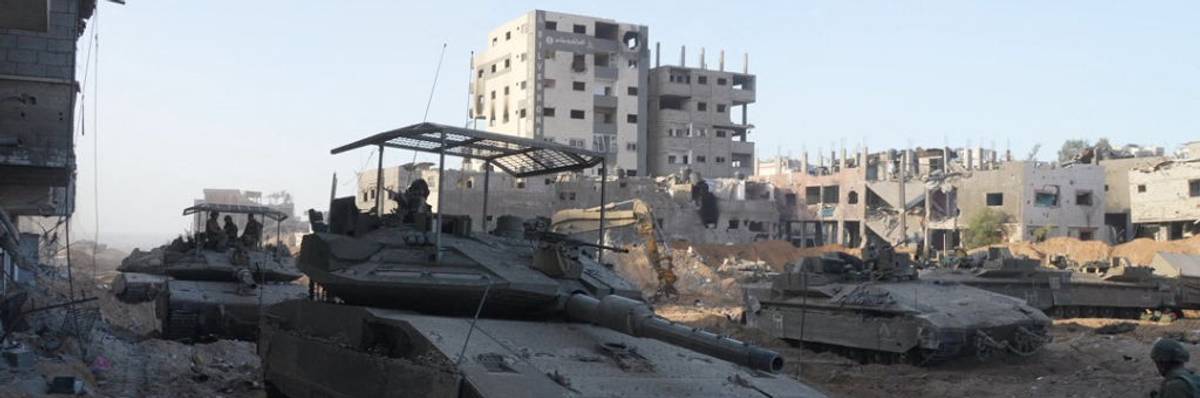
Israeli troops engage in operations in northern Gaza on November 8, 2023.
"We call on states to live up to their joint and individual responsibility to cooperate in providing humanitarian assistance," said one group leader. "They cannot sit by and witness this suffering any longer."
Over a dozen international relief organizations and human rights groups on Wednesday urged any world leaders joining French President Emmanuel Macron's "humanitarian conference" in Paris to support a cease-fire in Israel's war on the Gaza Strip, which has killed more than 10,000 Palestinians.
The coalition's call came on the eve of the conference, which is set to occur "on the margins" of the annual Paris Peace Forum.
The 13 organizations urged the conference attendees "to do everything in their power to achieve an immediate cease-fire; take concrete steps to free civilian hostages and protect all civilian populations; and ensure the entry of humanitarian aid into Gaza and respect for international humanitarian law."
The groups include Amnesty International, the International Federation for Human Rights, the Norwegian Refugee Council (NRC), Oxfam France, and Doctors Without Borders, known internationally as Médecins Sans Frontières (MSF).
"We are receiving increasingly desperate calls for protection and aid from our humanitarian workers inside the locked-down Gaza Strip," NRC secretary general Jan Egeland said in the statement. "It is unacceptable that there is still no humanitarian cease-fire, no humanitarian corridors, and no end to the suffocating siege."
Israel intensified its 16-year blockade of Gaza and began bombarding the besieged enclave in response to a Hamas-led attack on October 7. Officials say over 1,500 Israelis have been killed in the past month and around 240 others are still being held hostage by Palestinian militants.
Israeli forces are now conducting a ground assault in what global experts are calling a "genocidal" war on Gaza, where 2.3 million Palestinians must contend with relentless bombing, devastated civilian infrastructure, limited essential supplies, and a healthcare system on the brink of collapse.
MSF France president Dr. Isabelle Defourny emphasized Wednesday that "hospitals caring for the wounded must be spared at all times" and achieving a cease-fire "is a vital emergency" given the scale of need and "catastrophic health situation" in Gaza.
Amnesty secretary general Agnès Callamard similarly stressed the need for a cease-fire, welcomed Macron's "decision to host an international humanitarian conference for the people of Gaza," and "strongly" encouraged other nations to also do their part.
"For this cease-fire to be effective, states must ensure it covers the entire Gaza Strip and that it's long enough to allow a substantive alleviation of suffering," she said. "The wounded have to be properly taken care of and hospitals and clinics must be repaired, relief has to be distributed safely and unconditionally, and the dead must be recovered and buried."
Callamard—whose group also released a separate statement on the French-hosted conference—also said that "we call on states to live up to their joint and individual responsibility to cooperate in providing humanitarian assistance in times of emergency," declaring that "they cannot sit by and witness this suffering any longer."
"Going forward," she concluded, "Amnesty International is calling on those attending the conference to commit to the long-term recovery of Gaza, ensure people are able to eventually return to their homes, and put an enduring, human rights-centered political solution to the crisis on the agenda."
According to the French government, "The conference will mobilize the main players involved in the humanitarian response in Gaza and determined to take concrete action to support Palestinian civilians in the city: states, main donors, international organizations and NGOs active in Gaza."
The government of Israeli Prime Minister Benjamin Netanyahu is refusing to participate in the event. Citing an official in Macron's office, The Times of Israel reported that the pair spoke on Tuesday and "will talk again once the aid conference is over."
"The French leader had also spoken to Egypt's President Abdel Fattah El-Sisi and Qatar's Emir Sheikh Tamim bin Hamad Al-Thani on Tuesday," the newspaper noted. "Both countries are playing a key role in attempts to bring more aid into the Gaza Strip."
While some humanitarian aid has begun entering Gaza through the Rafah border crossing with Egypt, the United Nations World Food Program said Sunday that "it is nowhere near enough to meet the exponentially growing needs."
Increasingly large protests around the world have demanded a cease-fire—a position opposed by Netanyahu's government as well as the Biden administration, which has responded to the war by asking U.S. lawmakers for over $14 billion in military aid for Israel, on top of the nearly $4 billion that the nation already receives annually.
Dear Common Dreams reader, It’s been nearly 30 years since I co-founded Common Dreams with my late wife, Lina Newhouser. We had the radical notion that journalism should serve the public good, not corporate profits. It was clear to us from the outset what it would take to build such a project. No paid advertisements. No corporate sponsors. No millionaire publisher telling us what to think or do. Many people said we wouldn't last a year, but we proved those doubters wrong. Together with a tremendous team of journalists and dedicated staff, we built an independent media outlet free from the constraints of profits and corporate control. Our mission has always been simple: To inform. To inspire. To ignite change for the common good. Building Common Dreams was not easy. Our survival was never guaranteed. When you take on the most powerful forces—Wall Street greed, fossil fuel industry destruction, Big Tech lobbyists, and uber-rich oligarchs who have spent billions upon billions rigging the economy and democracy in their favor—the only bulwark you have is supporters who believe in your work. But here’s the urgent message from me today. It's never been this bad out there. And it's never been this hard to keep us going. At the very moment Common Dreams is most needed, the threats we face are intensifying. We need your support now more than ever. We don't accept corporate advertising and never will. We don't have a paywall because we don't think people should be blocked from critical news based on their ability to pay. Everything we do is funded by the donations of readers like you. When everyone does the little they can afford, we are strong. But if that support retreats or dries up, so do we. Will you donate now to make sure Common Dreams not only survives but thrives? —Craig Brown, Co-founder |
Over a dozen international relief organizations and human rights groups on Wednesday urged any world leaders joining French President Emmanuel Macron's "humanitarian conference" in Paris to support a cease-fire in Israel's war on the Gaza Strip, which has killed more than 10,000 Palestinians.
The coalition's call came on the eve of the conference, which is set to occur "on the margins" of the annual Paris Peace Forum.
The 13 organizations urged the conference attendees "to do everything in their power to achieve an immediate cease-fire; take concrete steps to free civilian hostages and protect all civilian populations; and ensure the entry of humanitarian aid into Gaza and respect for international humanitarian law."
The groups include Amnesty International, the International Federation for Human Rights, the Norwegian Refugee Council (NRC), Oxfam France, and Doctors Without Borders, known internationally as Médecins Sans Frontières (MSF).
"We are receiving increasingly desperate calls for protection and aid from our humanitarian workers inside the locked-down Gaza Strip," NRC secretary general Jan Egeland said in the statement. "It is unacceptable that there is still no humanitarian cease-fire, no humanitarian corridors, and no end to the suffocating siege."
Israel intensified its 16-year blockade of Gaza and began bombarding the besieged enclave in response to a Hamas-led attack on October 7. Officials say over 1,500 Israelis have been killed in the past month and around 240 others are still being held hostage by Palestinian militants.
Israeli forces are now conducting a ground assault in what global experts are calling a "genocidal" war on Gaza, where 2.3 million Palestinians must contend with relentless bombing, devastated civilian infrastructure, limited essential supplies, and a healthcare system on the brink of collapse.
MSF France president Dr. Isabelle Defourny emphasized Wednesday that "hospitals caring for the wounded must be spared at all times" and achieving a cease-fire "is a vital emergency" given the scale of need and "catastrophic health situation" in Gaza.
Amnesty secretary general Agnès Callamard similarly stressed the need for a cease-fire, welcomed Macron's "decision to host an international humanitarian conference for the people of Gaza," and "strongly" encouraged other nations to also do their part.
"For this cease-fire to be effective, states must ensure it covers the entire Gaza Strip and that it's long enough to allow a substantive alleviation of suffering," she said. "The wounded have to be properly taken care of and hospitals and clinics must be repaired, relief has to be distributed safely and unconditionally, and the dead must be recovered and buried."
Callamard—whose group also released a separate statement on the French-hosted conference—also said that "we call on states to live up to their joint and individual responsibility to cooperate in providing humanitarian assistance in times of emergency," declaring that "they cannot sit by and witness this suffering any longer."
"Going forward," she concluded, "Amnesty International is calling on those attending the conference to commit to the long-term recovery of Gaza, ensure people are able to eventually return to their homes, and put an enduring, human rights-centered political solution to the crisis on the agenda."
According to the French government, "The conference will mobilize the main players involved in the humanitarian response in Gaza and determined to take concrete action to support Palestinian civilians in the city: states, main donors, international organizations and NGOs active in Gaza."
The government of Israeli Prime Minister Benjamin Netanyahu is refusing to participate in the event. Citing an official in Macron's office, The Times of Israel reported that the pair spoke on Tuesday and "will talk again once the aid conference is over."
"The French leader had also spoken to Egypt's President Abdel Fattah El-Sisi and Qatar's Emir Sheikh Tamim bin Hamad Al-Thani on Tuesday," the newspaper noted. "Both countries are playing a key role in attempts to bring more aid into the Gaza Strip."
While some humanitarian aid has begun entering Gaza through the Rafah border crossing with Egypt, the United Nations World Food Program said Sunday that "it is nowhere near enough to meet the exponentially growing needs."
Increasingly large protests around the world have demanded a cease-fire—a position opposed by Netanyahu's government as well as the Biden administration, which has responded to the war by asking U.S. lawmakers for over $14 billion in military aid for Israel, on top of the nearly $4 billion that the nation already receives annually.
Over a dozen international relief organizations and human rights groups on Wednesday urged any world leaders joining French President Emmanuel Macron's "humanitarian conference" in Paris to support a cease-fire in Israel's war on the Gaza Strip, which has killed more than 10,000 Palestinians.
The coalition's call came on the eve of the conference, which is set to occur "on the margins" of the annual Paris Peace Forum.
The 13 organizations urged the conference attendees "to do everything in their power to achieve an immediate cease-fire; take concrete steps to free civilian hostages and protect all civilian populations; and ensure the entry of humanitarian aid into Gaza and respect for international humanitarian law."
The groups include Amnesty International, the International Federation for Human Rights, the Norwegian Refugee Council (NRC), Oxfam France, and Doctors Without Borders, known internationally as Médecins Sans Frontières (MSF).
"We are receiving increasingly desperate calls for protection and aid from our humanitarian workers inside the locked-down Gaza Strip," NRC secretary general Jan Egeland said in the statement. "It is unacceptable that there is still no humanitarian cease-fire, no humanitarian corridors, and no end to the suffocating siege."
Israel intensified its 16-year blockade of Gaza and began bombarding the besieged enclave in response to a Hamas-led attack on October 7. Officials say over 1,500 Israelis have been killed in the past month and around 240 others are still being held hostage by Palestinian militants.
Israeli forces are now conducting a ground assault in what global experts are calling a "genocidal" war on Gaza, where 2.3 million Palestinians must contend with relentless bombing, devastated civilian infrastructure, limited essential supplies, and a healthcare system on the brink of collapse.
MSF France president Dr. Isabelle Defourny emphasized Wednesday that "hospitals caring for the wounded must be spared at all times" and achieving a cease-fire "is a vital emergency" given the scale of need and "catastrophic health situation" in Gaza.
Amnesty secretary general Agnès Callamard similarly stressed the need for a cease-fire, welcomed Macron's "decision to host an international humanitarian conference for the people of Gaza," and "strongly" encouraged other nations to also do their part.
"For this cease-fire to be effective, states must ensure it covers the entire Gaza Strip and that it's long enough to allow a substantive alleviation of suffering," she said. "The wounded have to be properly taken care of and hospitals and clinics must be repaired, relief has to be distributed safely and unconditionally, and the dead must be recovered and buried."
Callamard—whose group also released a separate statement on the French-hosted conference—also said that "we call on states to live up to their joint and individual responsibility to cooperate in providing humanitarian assistance in times of emergency," declaring that "they cannot sit by and witness this suffering any longer."
"Going forward," she concluded, "Amnesty International is calling on those attending the conference to commit to the long-term recovery of Gaza, ensure people are able to eventually return to their homes, and put an enduring, human rights-centered political solution to the crisis on the agenda."
According to the French government, "The conference will mobilize the main players involved in the humanitarian response in Gaza and determined to take concrete action to support Palestinian civilians in the city: states, main donors, international organizations and NGOs active in Gaza."
The government of Israeli Prime Minister Benjamin Netanyahu is refusing to participate in the event. Citing an official in Macron's office, The Times of Israel reported that the pair spoke on Tuesday and "will talk again once the aid conference is over."
"The French leader had also spoken to Egypt's President Abdel Fattah El-Sisi and Qatar's Emir Sheikh Tamim bin Hamad Al-Thani on Tuesday," the newspaper noted. "Both countries are playing a key role in attempts to bring more aid into the Gaza Strip."
While some humanitarian aid has begun entering Gaza through the Rafah border crossing with Egypt, the United Nations World Food Program said Sunday that "it is nowhere near enough to meet the exponentially growing needs."
Increasingly large protests around the world have demanded a cease-fire—a position opposed by Netanyahu's government as well as the Biden administration, which has responded to the war by asking U.S. lawmakers for over $14 billion in military aid for Israel, on top of the nearly $4 billion that the nation already receives annually.