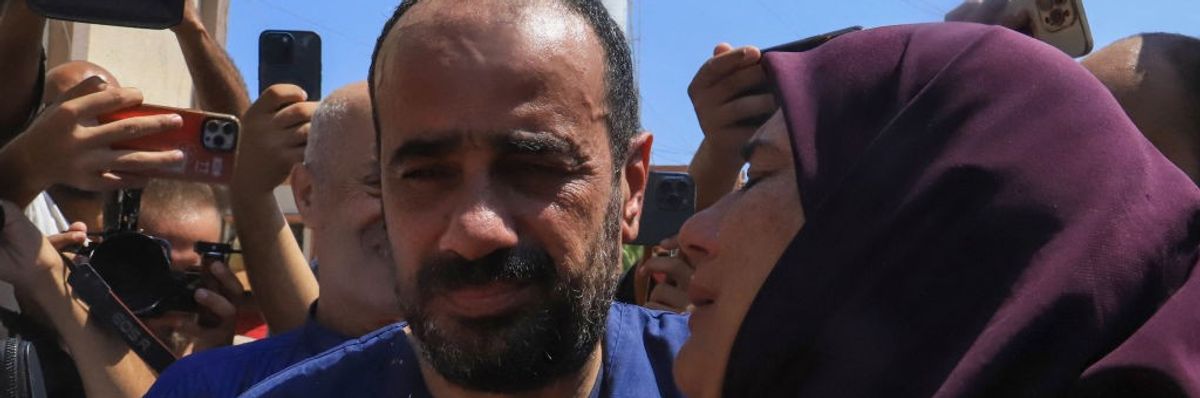
Al-Shifa hospital director Muhammad Abu Salmiya is welcomed by relatives as he arrives in the Gaza Strip on July 1, 2024, after being detained by Israel for more than seven months. Abu Salmiya said that he and his fellow detainees were subjected to torture and terrible conditions.
Newly Released Gaza Hospital Director Alleges 'Almost Daily Torture' in Israeli Detention
The hospital director, who'd been held without trial since Israeli forces detained him in November, said that he and others were subjected to torture, psychological humiliation, and severe undernourishment.
The director of Gaza's main hospital said at a press conference on Monday that he was tortured while being held without charges for the last seven months at an Israeli detention center.
Muhammad Abu Salmiya, director of the Al-Shifa hospital, once Gaza's main medical center, made the claims after he and 54 other Palestinian detainees were released and arrived back to the Gaza Strip.
Israeli forces had raided the hospital in November and alleged that Abu Salmiya was involved in making it a Hamas command center. They later destroyed the hospital.
Abu Salmiya said detention guards broke his finger and beat him to the point that his head bled—and that he wasn't the only one.
"Our detainees have been subjected to all kinds of torture behind bars," Abu Salmiya said. "There was almost daily torture."
There was "daily physical and psychological humiliation," he added.
He also said that they were severely underfed, surviving on nothing more than a loaf of bread per day. He said that all of the detainees had lost at least 30 kilograms (66 pounds).
"Our detainees have been subjected to all kinds of torture behind bars. There was almost daily torture."
Israeli forces seized Abu Salmiya from a United Nations convoy on November 22. They took him to court three times while in detainment but brought no charges and allowed him no lawyer, Abu Salmiya said.
His detention in November followed an Israeli siege of Al-Shifa hospital, which Israeli officials said had become a Hamas control center. Though weapons were found at the hospital, an investigation by The Washington Post in December showed that the evidence fell short of revealing a command center, and that key claims the Israelis had made to justify the siege turned out to be incorrect.
Israeli forces attacked the hospital again in late March, killing hundreds and leaving the facility mostly destroyed. Several mass graves were discovered near the hospital site in the weeks that followed.
Israel has detained thousands of Palestinians since the war started, leading to "intolerable overcrowding" of its facilities, as Haaretz reported in February. Many detainees are held without charges in what is called "administrative detention."
At least 40 Palestinians have died in Israeli detention during the war, according to Addameer, a Palestinian watchdog group. Salmiya said Monday that some had been killed in interrogation cells, Al Jazeera reported.
At least one other doctor was among those released on Monday: Bassam Miqdad, head of the orthopedic unit at Gaza European hospital in Khan Younis.
In April, Adnan Ahmad Albursh, a 50-year-old Palestinian surgeon, died in Israeli detention, according to Palestinian officials and rights groups. He had been the head of orthopedics at Al-Shifa hospital. Overall, hundreds of healthcare workers have been killed during the war.
Israeli officials and political figures from various parties denounced the release of the 55 detainees, which was reportedly done to make space in the overcrowded detention centers.
Itamar Ben-Gvir, a far-right minister in charge of Israel's police and prison service, called the release of the detainees a case of "security negligence" and blamed another ministry. Benny Gantz, an opposition figure who recently resigned from the war cabinet, said whoever released the detainees should be fired and that government offices should be made available to "free up space and budget for prisoners," according to Al Jazeera.
We are at a crossroads
This country and this world are at a monumental crossroads. In a few short weeks, US voters will have an opportunity to beat back the forces of fascism and confront the billionaires who are rigging the economy, our media system, and our democracy, making it increasingly impossible for ordinary people to get by. We’re not just talking about the election. We’re talking about what must be done once these fascist elements are vanquished from power. We need a bolder set of solutions than what either major party has so far been willing to offer and a working-class movement ready to fight like hell for it. Trump didn't emerge from nowhere. The conditions that fueled MAGA authoritarianism were created by decades of radical neoliberal economic policies and a corrupt political system dominated by corporate interests. They slashed taxes on the super-rich, promising that the benefits would trickle down. They said giveaways to the corporate titans would make life more affordable for the rest of us. It was all bullshit. And when a bitter, betrayed populace searches for someone to blame, right-wing demagogues have little trouble finding scapegoats. People know when they're being lied to, but you won't hear any of this from the corporate media. Only independent journalism—powered and funded by people who believe in building a better world—can deliver truly trustworthy daily news. Our Fall Campaign is underway, and we need your help. To power our newsroom through the rest of the year, we need to raise $125,000 by midnight on October 31. So if you share our vision, please contribute whatever you can to sustain our work. |
The director of Gaza's main hospital said at a press conference on Monday that he was tortured while being held without charges for the last seven months at an Israeli detention center.
Muhammad Abu Salmiya, director of the Al-Shifa hospital, once Gaza's main medical center, made the claims after he and 54 other Palestinian detainees were released and arrived back to the Gaza Strip.
Israeli forces had raided the hospital in November and alleged that Abu Salmiya was involved in making it a Hamas command center. They later destroyed the hospital.
Abu Salmiya said detention guards broke his finger and beat him to the point that his head bled—and that he wasn't the only one.
"Our detainees have been subjected to all kinds of torture behind bars," Abu Salmiya said. "There was almost daily torture."
There was "daily physical and psychological humiliation," he added.
He also said that they were severely underfed, surviving on nothing more than a loaf of bread per day. He said that all of the detainees had lost at least 30 kilograms (66 pounds).
"Our detainees have been subjected to all kinds of torture behind bars. There was almost daily torture."
Israeli forces seized Abu Salmiya from a United Nations convoy on November 22. They took him to court three times while in detainment but brought no charges and allowed him no lawyer, Abu Salmiya said.
His detention in November followed an Israeli siege of Al-Shifa hospital, which Israeli officials said had become a Hamas control center. Though weapons were found at the hospital, an investigation by The Washington Post in December showed that the evidence fell short of revealing a command center, and that key claims the Israelis had made to justify the siege turned out to be incorrect.
Israeli forces attacked the hospital again in late March, killing hundreds and leaving the facility mostly destroyed. Several mass graves were discovered near the hospital site in the weeks that followed.
Israel has detained thousands of Palestinians since the war started, leading to "intolerable overcrowding" of its facilities, as Haaretz reported in February. Many detainees are held without charges in what is called "administrative detention."
At least 40 Palestinians have died in Israeli detention during the war, according to Addameer, a Palestinian watchdog group. Salmiya said Monday that some had been killed in interrogation cells, Al Jazeera reported.
At least one other doctor was among those released on Monday: Bassam Miqdad, head of the orthopedic unit at Gaza European hospital in Khan Younis.
In April, Adnan Ahmad Albursh, a 50-year-old Palestinian surgeon, died in Israeli detention, according to Palestinian officials and rights groups. He had been the head of orthopedics at Al-Shifa hospital. Overall, hundreds of healthcare workers have been killed during the war.
Israeli officials and political figures from various parties denounced the release of the 55 detainees, which was reportedly done to make space in the overcrowded detention centers.
Itamar Ben-Gvir, a far-right minister in charge of Israel's police and prison service, called the release of the detainees a case of "security negligence" and blamed another ministry. Benny Gantz, an opposition figure who recently resigned from the war cabinet, said whoever released the detainees should be fired and that government offices should be made available to "free up space and budget for prisoners," according to Al Jazeera.
- Biden Refuses to Provide Proof of Hamas Base at Gaza Hospital ›
- UN Rights Chief Demands International Probe of Mass Graves Near Gaza Hospitals ›
- ICC Urged to Probe Israel's Alleged Torture of Gaza Medical Workers | Common Dreams ›
- Israeli Raid Puts Last Hospital in Besieged Northern Gaza Out of Service | Common Dreams ›
- Israel's Takeovers of Gaza Hospitals Amount to 'War Crimes,' Says Human Rights Watch | Common Dreams ›
The director of Gaza's main hospital said at a press conference on Monday that he was tortured while being held without charges for the last seven months at an Israeli detention center.
Muhammad Abu Salmiya, director of the Al-Shifa hospital, once Gaza's main medical center, made the claims after he and 54 other Palestinian detainees were released and arrived back to the Gaza Strip.
Israeli forces had raided the hospital in November and alleged that Abu Salmiya was involved in making it a Hamas command center. They later destroyed the hospital.
Abu Salmiya said detention guards broke his finger and beat him to the point that his head bled—and that he wasn't the only one.
"Our detainees have been subjected to all kinds of torture behind bars," Abu Salmiya said. "There was almost daily torture."
There was "daily physical and psychological humiliation," he added.
He also said that they were severely underfed, surviving on nothing more than a loaf of bread per day. He said that all of the detainees had lost at least 30 kilograms (66 pounds).
"Our detainees have been subjected to all kinds of torture behind bars. There was almost daily torture."
Israeli forces seized Abu Salmiya from a United Nations convoy on November 22. They took him to court three times while in detainment but brought no charges and allowed him no lawyer, Abu Salmiya said.
His detention in November followed an Israeli siege of Al-Shifa hospital, which Israeli officials said had become a Hamas control center. Though weapons were found at the hospital, an investigation by The Washington Post in December showed that the evidence fell short of revealing a command center, and that key claims the Israelis had made to justify the siege turned out to be incorrect.
Israeli forces attacked the hospital again in late March, killing hundreds and leaving the facility mostly destroyed. Several mass graves were discovered near the hospital site in the weeks that followed.
Israel has detained thousands of Palestinians since the war started, leading to "intolerable overcrowding" of its facilities, as Haaretz reported in February. Many detainees are held without charges in what is called "administrative detention."
At least 40 Palestinians have died in Israeli detention during the war, according to Addameer, a Palestinian watchdog group. Salmiya said Monday that some had been killed in interrogation cells, Al Jazeera reported.
At least one other doctor was among those released on Monday: Bassam Miqdad, head of the orthopedic unit at Gaza European hospital in Khan Younis.
In April, Adnan Ahmad Albursh, a 50-year-old Palestinian surgeon, died in Israeli detention, according to Palestinian officials and rights groups. He had been the head of orthopedics at Al-Shifa hospital. Overall, hundreds of healthcare workers have been killed during the war.
Israeli officials and political figures from various parties denounced the release of the 55 detainees, which was reportedly done to make space in the overcrowded detention centers.
Itamar Ben-Gvir, a far-right minister in charge of Israel's police and prison service, called the release of the detainees a case of "security negligence" and blamed another ministry. Benny Gantz, an opposition figure who recently resigned from the war cabinet, said whoever released the detainees should be fired and that government offices should be made available to "free up space and budget for prisoners," according to Al Jazeera.
- Biden Refuses to Provide Proof of Hamas Base at Gaza Hospital ›
- UN Rights Chief Demands International Probe of Mass Graves Near Gaza Hospitals ›
- ICC Urged to Probe Israel's Alleged Torture of Gaza Medical Workers | Common Dreams ›
- Israeli Raid Puts Last Hospital in Besieged Northern Gaza Out of Service | Common Dreams ›
- Israel's Takeovers of Gaza Hospitals Amount to 'War Crimes,' Says Human Rights Watch | Common Dreams ›