SUBSCRIBE TO OUR FREE NEWSLETTER
Daily news & progressive opinion—funded by the people, not the corporations—delivered straight to your inbox.
5
#000000
#FFFFFF
To donate by check, phone, or other method, see our More Ways to Give page.
Daily news & progressive opinion—funded by the people, not the corporations—delivered straight to your inbox.
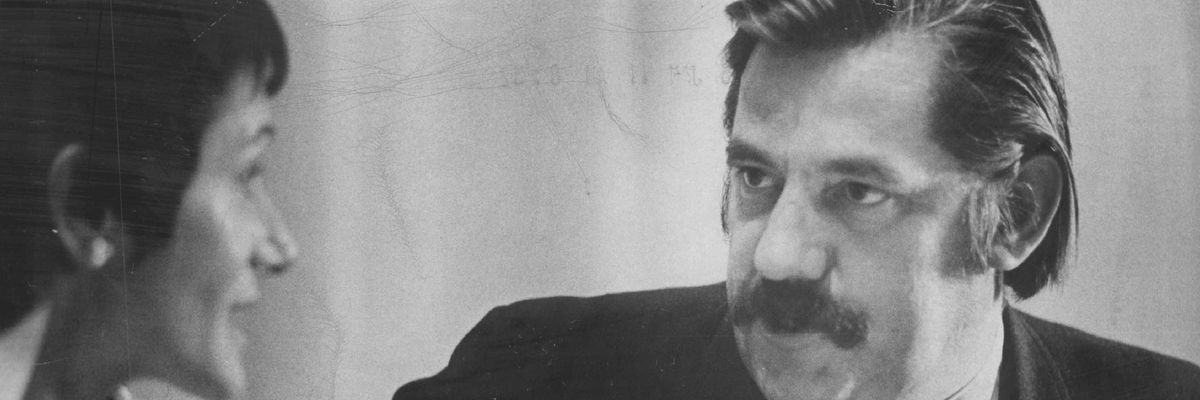
Sen. Fred Harris (right) is seen at an event on March 26, 1972.
"The fundamental problem is that too few people have all the money and power, and everybody else has too little of either," said Harris in 1975.
Former Oklahoma Senator Fred Harris, a moderate Democratic lawmaker who fully embraced economic populism in his later political career and ran what one journalist called a "proto-Bernie" presidential campaign in 1976, died on Saturday at the age of 94.
Harris' death inspired tributes from an array of Democratic politicians and progressives, who remembered the former senator's outspoken support for working people and his championing of Indigenous rights.
Harris was voted into the Senate to replace Sen. Robert Kerr (D-Okla.) in 1964 after Kerr died of a heart attack. He began as a close ally of President Lyndon Johnson, supporting U.S. involvement in the Vietnam War and Johnson's Great Society programs aimed at reducing poverty.
But he "underwent a dramatic passage from moderate-conservative to liberal ideas," as The New York Times reported, embracing a "new populism" that was centered on promoting racial equality and a redistribution of economic and political power and fighting against the exploitation of workers. He also gradually changed his stance on Vietnam, calling for troop reductions and eventually a full withdrawal of the U.S. military in the region.
In 1967 he was a member of the Kerner Commission on Civil Disorders, convened to determine the root cause of riots in Black communities across the country. He concluded that "entrenched racism" was to blame.
He was also credited with sponsoring a bill that pushed President Richard Nixon to return Blue Lake, a site that was sacred to the people of the Taos Pueblo tribe, to them.
"In Senator Harris, Oklahoma sent a public servant to Washington, D.C. who gave voice to those in need, lifted up those the economy left behind, was a champion of civil rights, and was a friend to Indian Country," said Chief Chuck Hoskin, Jr. of the Cherokee Nation.
"His story is one that too few people know—the story of an Oklahoman who championed working families and fought for justice and equity at every turn."
Running for the Democratic presidential nomination in 1976, Harris called for higher taxes on the richest Americans and lower taxes for the rest of the country, stricter regulations on large corporations, a "moral" foreign policy, abortion rights, and "community control" of police forces.
Columnist John Nichols of The Nation said Harris adopted the slogan "No More Bullshit" during his presidential campaign.
Harris' presidential bid, said journalist Ryan Grim of Drop Site News, "was a road-not-taken that would have led to a much better world than we have now."
Harris told the Times in 1975 that the issue he was most concerned with was "privilege."
"The fundamental problem is that too few people have all the money and power, and everybody else has too little of either," he said. "The widespread diffusion of economic and political power ought to be the express goal—the stated goal—of government."
Harris' campaign garnered enthusiastic support from many voters, with the former senator taking aim at "the superrich, giant corporations" and leading efforts to gain the confidence of blue-collar workers, farmers, poor Black and white voters, and unemployed people.
"Those in the coalition don't have to love one another," Harris said. "All they have to do is recognize that they are commonly exploited, and that if they get themselves together they are a popular majority and can take back the government."
After his presidential run, Harris became a political science professor at the University of New Mexico at Albuquerque and left politics to raise chickens on a farm in Corrales, New Mexico.
In conversations with Axios reporter Russell Contreras in his later years, Harris expressed frustration with the Democratic Party, saying leaders didn't discuss poverty as much as they should.
"It's harder to get out of poverty today than it was back then," he told Contreras.
He added that showing a commitment to fight for working-class and low-income people would motivate people in Appalachia, the Mississippi Delta, and on Native American reservations across the country.
"We are grateful to see national media highlighting the life and legacy of former Senator Fred Harris," said the Oklahoma Democratic Party. "His story is one that too few people know—the story of an Oklahoman who championed working families and fought for justice and equity at every turn."
Dear Common Dreams reader, It’s been nearly 30 years since I co-founded Common Dreams with my late wife, Lina Newhouser. We had the radical notion that journalism should serve the public good, not corporate profits. It was clear to us from the outset what it would take to build such a project. No paid advertisements. No corporate sponsors. No millionaire publisher telling us what to think or do. Many people said we wouldn't last a year, but we proved those doubters wrong. Together with a tremendous team of journalists and dedicated staff, we built an independent media outlet free from the constraints of profits and corporate control. Our mission has always been simple: To inform. To inspire. To ignite change for the common good. Building Common Dreams was not easy. Our survival was never guaranteed. When you take on the most powerful forces—Wall Street greed, fossil fuel industry destruction, Big Tech lobbyists, and uber-rich oligarchs who have spent billions upon billions rigging the economy and democracy in their favor—the only bulwark you have is supporters who believe in your work. But here’s the urgent message from me today. It's never been this bad out there. And it's never been this hard to keep us going. At the very moment Common Dreams is most needed, the threats we face are intensifying. We need your support now more than ever. We don't accept corporate advertising and never will. We don't have a paywall because we don't think people should be blocked from critical news based on their ability to pay. Everything we do is funded by the donations of readers like you. When everyone does the little they can afford, we are strong. But if that support retreats or dries up, so do we. Will you donate now to make sure Common Dreams not only survives but thrives? —Craig Brown, Co-founder |
Former Oklahoma Senator Fred Harris, a moderate Democratic lawmaker who fully embraced economic populism in his later political career and ran what one journalist called a "proto-Bernie" presidential campaign in 1976, died on Saturday at the age of 94.
Harris' death inspired tributes from an array of Democratic politicians and progressives, who remembered the former senator's outspoken support for working people and his championing of Indigenous rights.
Harris was voted into the Senate to replace Sen. Robert Kerr (D-Okla.) in 1964 after Kerr died of a heart attack. He began as a close ally of President Lyndon Johnson, supporting U.S. involvement in the Vietnam War and Johnson's Great Society programs aimed at reducing poverty.
But he "underwent a dramatic passage from moderate-conservative to liberal ideas," as The New York Times reported, embracing a "new populism" that was centered on promoting racial equality and a redistribution of economic and political power and fighting against the exploitation of workers. He also gradually changed his stance on Vietnam, calling for troop reductions and eventually a full withdrawal of the U.S. military in the region.
In 1967 he was a member of the Kerner Commission on Civil Disorders, convened to determine the root cause of riots in Black communities across the country. He concluded that "entrenched racism" was to blame.
He was also credited with sponsoring a bill that pushed President Richard Nixon to return Blue Lake, a site that was sacred to the people of the Taos Pueblo tribe, to them.
"In Senator Harris, Oklahoma sent a public servant to Washington, D.C. who gave voice to those in need, lifted up those the economy left behind, was a champion of civil rights, and was a friend to Indian Country," said Chief Chuck Hoskin, Jr. of the Cherokee Nation.
"His story is one that too few people know—the story of an Oklahoman who championed working families and fought for justice and equity at every turn."
Running for the Democratic presidential nomination in 1976, Harris called for higher taxes on the richest Americans and lower taxes for the rest of the country, stricter regulations on large corporations, a "moral" foreign policy, abortion rights, and "community control" of police forces.
Columnist John Nichols of The Nation said Harris adopted the slogan "No More Bullshit" during his presidential campaign.
Harris' presidential bid, said journalist Ryan Grim of Drop Site News, "was a road-not-taken that would have led to a much better world than we have now."
Harris told the Times in 1975 that the issue he was most concerned with was "privilege."
"The fundamental problem is that too few people have all the money and power, and everybody else has too little of either," he said. "The widespread diffusion of economic and political power ought to be the express goal—the stated goal—of government."
Harris' campaign garnered enthusiastic support from many voters, with the former senator taking aim at "the superrich, giant corporations" and leading efforts to gain the confidence of blue-collar workers, farmers, poor Black and white voters, and unemployed people.
"Those in the coalition don't have to love one another," Harris said. "All they have to do is recognize that they are commonly exploited, and that if they get themselves together they are a popular majority and can take back the government."
After his presidential run, Harris became a political science professor at the University of New Mexico at Albuquerque and left politics to raise chickens on a farm in Corrales, New Mexico.
In conversations with Axios reporter Russell Contreras in his later years, Harris expressed frustration with the Democratic Party, saying leaders didn't discuss poverty as much as they should.
"It's harder to get out of poverty today than it was back then," he told Contreras.
He added that showing a commitment to fight for working-class and low-income people would motivate people in Appalachia, the Mississippi Delta, and on Native American reservations across the country.
"We are grateful to see national media highlighting the life and legacy of former Senator Fred Harris," said the Oklahoma Democratic Party. "His story is one that too few people know—the story of an Oklahoman who championed working families and fought for justice and equity at every turn."
Former Oklahoma Senator Fred Harris, a moderate Democratic lawmaker who fully embraced economic populism in his later political career and ran what one journalist called a "proto-Bernie" presidential campaign in 1976, died on Saturday at the age of 94.
Harris' death inspired tributes from an array of Democratic politicians and progressives, who remembered the former senator's outspoken support for working people and his championing of Indigenous rights.
Harris was voted into the Senate to replace Sen. Robert Kerr (D-Okla.) in 1964 after Kerr died of a heart attack. He began as a close ally of President Lyndon Johnson, supporting U.S. involvement in the Vietnam War and Johnson's Great Society programs aimed at reducing poverty.
But he "underwent a dramatic passage from moderate-conservative to liberal ideas," as The New York Times reported, embracing a "new populism" that was centered on promoting racial equality and a redistribution of economic and political power and fighting against the exploitation of workers. He also gradually changed his stance on Vietnam, calling for troop reductions and eventually a full withdrawal of the U.S. military in the region.
In 1967 he was a member of the Kerner Commission on Civil Disorders, convened to determine the root cause of riots in Black communities across the country. He concluded that "entrenched racism" was to blame.
He was also credited with sponsoring a bill that pushed President Richard Nixon to return Blue Lake, a site that was sacred to the people of the Taos Pueblo tribe, to them.
"In Senator Harris, Oklahoma sent a public servant to Washington, D.C. who gave voice to those in need, lifted up those the economy left behind, was a champion of civil rights, and was a friend to Indian Country," said Chief Chuck Hoskin, Jr. of the Cherokee Nation.
"His story is one that too few people know—the story of an Oklahoman who championed working families and fought for justice and equity at every turn."
Running for the Democratic presidential nomination in 1976, Harris called for higher taxes on the richest Americans and lower taxes for the rest of the country, stricter regulations on large corporations, a "moral" foreign policy, abortion rights, and "community control" of police forces.
Columnist John Nichols of The Nation said Harris adopted the slogan "No More Bullshit" during his presidential campaign.
Harris' presidential bid, said journalist Ryan Grim of Drop Site News, "was a road-not-taken that would have led to a much better world than we have now."
Harris told the Times in 1975 that the issue he was most concerned with was "privilege."
"The fundamental problem is that too few people have all the money and power, and everybody else has too little of either," he said. "The widespread diffusion of economic and political power ought to be the express goal—the stated goal—of government."
Harris' campaign garnered enthusiastic support from many voters, with the former senator taking aim at "the superrich, giant corporations" and leading efforts to gain the confidence of blue-collar workers, farmers, poor Black and white voters, and unemployed people.
"Those in the coalition don't have to love one another," Harris said. "All they have to do is recognize that they are commonly exploited, and that if they get themselves together they are a popular majority and can take back the government."
After his presidential run, Harris became a political science professor at the University of New Mexico at Albuquerque and left politics to raise chickens on a farm in Corrales, New Mexico.
In conversations with Axios reporter Russell Contreras in his later years, Harris expressed frustration with the Democratic Party, saying leaders didn't discuss poverty as much as they should.
"It's harder to get out of poverty today than it was back then," he told Contreras.
He added that showing a commitment to fight for working-class and low-income people would motivate people in Appalachia, the Mississippi Delta, and on Native American reservations across the country.
"We are grateful to see national media highlighting the life and legacy of former Senator Fred Harris," said the Oklahoma Democratic Party. "His story is one that too few people know—the story of an Oklahoman who championed working families and fought for justice and equity at every turn."