

SUBSCRIBE TO OUR FREE NEWSLETTER
Daily news & progressive opinion—funded by the people, not the corporations—delivered straight to your inbox.
5
#000000
#FFFFFF
To donate by check, phone, or other method, see our More Ways to Give page.
Daily news & progressive opinion—funded by the people, not the corporations—delivered straight to your inbox.
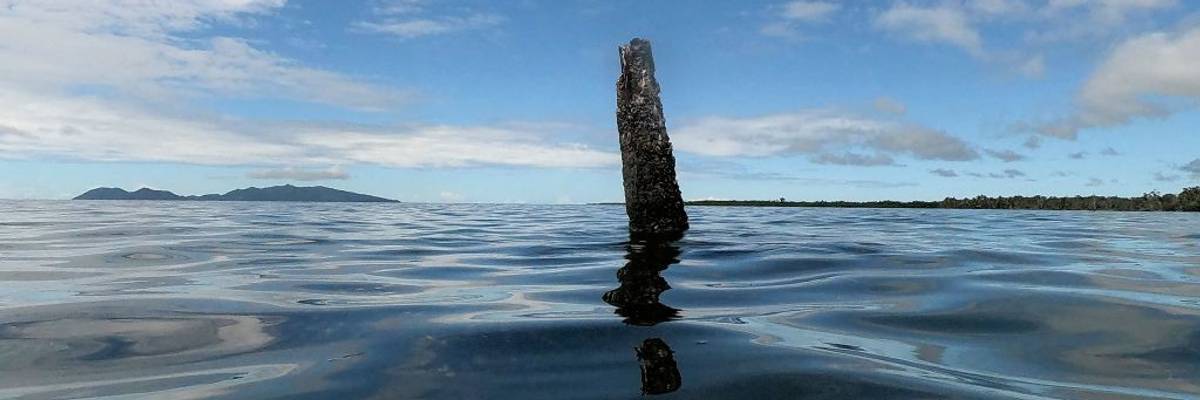
This picture taken on December 13, 2022 shows a tombstone in a village graveyard, now underwater due to the effects of climate change, in the coastal town of Togoru, some 35 kilometers from Fijis capital city Suva.
"The time for bold, ambitious, and transformative measures is now," said a representative of the Fijian government.
Fiji on Monday became the latest country to speak out on the world's stage for a Fossil Fuel Non-Proliferation Treaty.
The country had already joined with five other Pacific island nations in backing the treaty at a summit in Port Vila, Vanuatu, in March. Now, it raised its voice to call for a global treaty to phase out fossil fuels at a side event at the ongoing U.N. Climate Change Conference in Bonn, Germany.
"We cannot afford to delay action any longer. Our climate is radically changing, and with it, our ecosystems, our livelihoods, and our cultures all come under increasing threat," Genevieve Jiva, the principal international relations officer for the government of Fiji, said at the conference. "The time for bold, ambitious, and transformative measures is now."
The 14 Pacific Island Developing States are responsible for only 0.23% of global greenhouse gas emissions that cause the climate crisis, compared to the 14 most fossil-fuel burning nations, which contribute more than 70%. Despite this, Pacific nations are disproportionately vulnerable to climate impacts.
Fiji, for example, is already suffering economic damage and population displacement because of more extreme tropical cyclones. Warmer ocean waters are bleaching its coral reefs, which help protect its coasts, provide habitat for fish, and attract tourists, while changing rainfall patterns and rising temperatures threaten its agriculture and freshwater supplies.
"Even as one of the nations least responsible for the climate crisis, we shoulder some of the most devastating loss and damage," Alisi Rabukawaqa, a 350.org Pacific Council Elder from Fiji, said in a statement. "The fight against the climate crisis is fought on multiple fronts—through community and storytelling, through activism and diplomacy."
"Tuvalu calls on all countries to follow the example set by Fiji today and commit to addressing the root cause of the climate crisis: Fossil Fuels."
Pacific island nations have emerged as diplomatic leaders in the struggle for a just response to the climate emergency. Fiji was the first nation to formally ratify the Paris agreement. Then Vanuatu became the first nation to call for a Fossil Fuel Non-Proliferation Treaty at the U.N. General Assembly in New York in September 2022, followed by Tuvalu at COP27 in Sharm El-Sheikh, Egypt, two months later.
"Vanuatu warmly welcomes Fiji's resolute call for a Fossil Fuel Treaty," Vanuatu's Climate Minister Hon. Ralph Regenvanu said in a statement. "As fellow Pacific island nations, we share the same vulnerability to the impacts of climate change and recognize the urgent need for decisive action. Our commitment to a sustainable and renewable future sets a powerful example to the world."
Tuvalu's Minister of Finance & Economic Development, Hon. Seve Paeniu, also welcomed Fiji's statement.
"A Fossil Fuel Treaty will ensure that we do not cross the 1.5 warming threshold, which is a red line for Tuvalu, Fiji, and all Pacific Small Island Developing States who are constantly having to deal with extreme weather events and the degradation of our lands and livelihoods," Paneiu said. "Tuvalu calls on all countries to follow the example set by Fiji today and commit to addressing the root cause of the climate crisis: Fossil Fuels."
The proposed Fossil Fuel Non-Proliferation Treaty has three pillars: an end to fossil fuel expansion; a fair phase out of fossil fuels, with nations that have historically contributed more to the current emergency moving faster; and a just transition from fossil fuels to renewable energy that ensures no workers, communities, or nations are abandoned.
Treaty supporters note that fossil fuels were responsible for 86% of carbon dioxide emissions this decade, yet the Paris agreement doesn't mention fossil fuels by name and the agreements coming out of COP27 did not mention oil and gas.
Six Pacific island nations–with Tonga, the Solomon Islands, and Niue joining Fiji, Vanuatu, and Tuvalu–signed the Port Vila Call for a Just Transition to a Fossil Fuel-Free Pacific in March, which included support for the treaty.
"With oil CEO, Al Jabar, at the helm of COP28 this year, we are going to need all of the Pacific strength we can get to fight the propaganda of fossil fuel expansion."
"The Pacific continues to show the world what real leadership during a crisis looks like and that without greater ambition and vision, we cannot overcome the greatest threat to our planet," Auimatagi Joe Moeono-Kolio, Pacific director of the Fossil Fuel Non-Proliferation Treaty Initiative, said in a statement.
Outside the Pacific, the treaty has also been backed by the World Health Organization, the European Parliament, 84 municipal and regional governments including the California Senate, 101 Nobel laureates, 2,150 civil society organizations, 3,000 scientists and academics, and more than 600,000 individuals.
"Without a managed phaseout of fossil fuels, there is no hope of meeting the aims of the Paris agreement," Moeono-Kolio said. "A Fossil Fuel Treaty would play a key role in reducing the risks of extreme weather events and other physical impacts we experience almost daily now in the Pacific. We stand ready to support the Pacific's vision of a world free from fossil fuels."
Joseph Sikulu, 350.org's Pacific managing director, also hoped that Pacific leadership would yield results during the upcoming COP28 negotiations in the UAE.
"With oil CEO, Al Jabar, at the helm of COP28 this year, we are going to need all of the Pacific strength we can get to fight the propaganda of fossil fuel expansion," Sikulu said. "Another world is possible, one built on justice, equity and safe renewable energy, and I firmly believe the Pacific is going to lead us in getting there."
Dear Common Dreams reader, It’s been nearly 30 years since I co-founded Common Dreams with my late wife, Lina Newhouser. We had the radical notion that journalism should serve the public good, not corporate profits. It was clear to us from the outset what it would take to build such a project. No paid advertisements. No corporate sponsors. No millionaire publisher telling us what to think or do. Many people said we wouldn't last a year, but we proved those doubters wrong. Together with a tremendous team of journalists and dedicated staff, we built an independent media outlet free from the constraints of profits and corporate control. Our mission has always been simple: To inform. To inspire. To ignite change for the common good. Building Common Dreams was not easy. Our survival was never guaranteed. When you take on the most powerful forces—Wall Street greed, fossil fuel industry destruction, Big Tech lobbyists, and uber-rich oligarchs who have spent billions upon billions rigging the economy and democracy in their favor—the only bulwark you have is supporters who believe in your work. But here’s the urgent message from me today. It's never been this bad out there. And it's never been this hard to keep us going. At the very moment Common Dreams is most needed, the threats we face are intensifying. We need your support now more than ever. We don't accept corporate advertising and never will. We don't have a paywall because we don't think people should be blocked from critical news based on their ability to pay. Everything we do is funded by the donations of readers like you. When everyone does the little they can afford, we are strong. But if that support retreats or dries up, so do we. Will you donate now to make sure Common Dreams not only survives but thrives? —Craig Brown, Co-founder |
Fiji on Monday became the latest country to speak out on the world's stage for a Fossil Fuel Non-Proliferation Treaty.
The country had already joined with five other Pacific island nations in backing the treaty at a summit in Port Vila, Vanuatu, in March. Now, it raised its voice to call for a global treaty to phase out fossil fuels at a side event at the ongoing U.N. Climate Change Conference in Bonn, Germany.
"We cannot afford to delay action any longer. Our climate is radically changing, and with it, our ecosystems, our livelihoods, and our cultures all come under increasing threat," Genevieve Jiva, the principal international relations officer for the government of Fiji, said at the conference. "The time for bold, ambitious, and transformative measures is now."
The 14 Pacific Island Developing States are responsible for only 0.23% of global greenhouse gas emissions that cause the climate crisis, compared to the 14 most fossil-fuel burning nations, which contribute more than 70%. Despite this, Pacific nations are disproportionately vulnerable to climate impacts.
Fiji, for example, is already suffering economic damage and population displacement because of more extreme tropical cyclones. Warmer ocean waters are bleaching its coral reefs, which help protect its coasts, provide habitat for fish, and attract tourists, while changing rainfall patterns and rising temperatures threaten its agriculture and freshwater supplies.
"Even as one of the nations least responsible for the climate crisis, we shoulder some of the most devastating loss and damage," Alisi Rabukawaqa, a 350.org Pacific Council Elder from Fiji, said in a statement. "The fight against the climate crisis is fought on multiple fronts—through community and storytelling, through activism and diplomacy."
"Tuvalu calls on all countries to follow the example set by Fiji today and commit to addressing the root cause of the climate crisis: Fossil Fuels."
Pacific island nations have emerged as diplomatic leaders in the struggle for a just response to the climate emergency. Fiji was the first nation to formally ratify the Paris agreement. Then Vanuatu became the first nation to call for a Fossil Fuel Non-Proliferation Treaty at the U.N. General Assembly in New York in September 2022, followed by Tuvalu at COP27 in Sharm El-Sheikh, Egypt, two months later.
"Vanuatu warmly welcomes Fiji's resolute call for a Fossil Fuel Treaty," Vanuatu's Climate Minister Hon. Ralph Regenvanu said in a statement. "As fellow Pacific island nations, we share the same vulnerability to the impacts of climate change and recognize the urgent need for decisive action. Our commitment to a sustainable and renewable future sets a powerful example to the world."
Tuvalu's Minister of Finance & Economic Development, Hon. Seve Paeniu, also welcomed Fiji's statement.
"A Fossil Fuel Treaty will ensure that we do not cross the 1.5 warming threshold, which is a red line for Tuvalu, Fiji, and all Pacific Small Island Developing States who are constantly having to deal with extreme weather events and the degradation of our lands and livelihoods," Paneiu said. "Tuvalu calls on all countries to follow the example set by Fiji today and commit to addressing the root cause of the climate crisis: Fossil Fuels."
The proposed Fossil Fuel Non-Proliferation Treaty has three pillars: an end to fossil fuel expansion; a fair phase out of fossil fuels, with nations that have historically contributed more to the current emergency moving faster; and a just transition from fossil fuels to renewable energy that ensures no workers, communities, or nations are abandoned.
Treaty supporters note that fossil fuels were responsible for 86% of carbon dioxide emissions this decade, yet the Paris agreement doesn't mention fossil fuels by name and the agreements coming out of COP27 did not mention oil and gas.
Six Pacific island nations–with Tonga, the Solomon Islands, and Niue joining Fiji, Vanuatu, and Tuvalu–signed the Port Vila Call for a Just Transition to a Fossil Fuel-Free Pacific in March, which included support for the treaty.
"With oil CEO, Al Jabar, at the helm of COP28 this year, we are going to need all of the Pacific strength we can get to fight the propaganda of fossil fuel expansion."
"The Pacific continues to show the world what real leadership during a crisis looks like and that without greater ambition and vision, we cannot overcome the greatest threat to our planet," Auimatagi Joe Moeono-Kolio, Pacific director of the Fossil Fuel Non-Proliferation Treaty Initiative, said in a statement.
Outside the Pacific, the treaty has also been backed by the World Health Organization, the European Parliament, 84 municipal and regional governments including the California Senate, 101 Nobel laureates, 2,150 civil society organizations, 3,000 scientists and academics, and more than 600,000 individuals.
"Without a managed phaseout of fossil fuels, there is no hope of meeting the aims of the Paris agreement," Moeono-Kolio said. "A Fossil Fuel Treaty would play a key role in reducing the risks of extreme weather events and other physical impacts we experience almost daily now in the Pacific. We stand ready to support the Pacific's vision of a world free from fossil fuels."
Joseph Sikulu, 350.org's Pacific managing director, also hoped that Pacific leadership would yield results during the upcoming COP28 negotiations in the UAE.
"With oil CEO, Al Jabar, at the helm of COP28 this year, we are going to need all of the Pacific strength we can get to fight the propaganda of fossil fuel expansion," Sikulu said. "Another world is possible, one built on justice, equity and safe renewable energy, and I firmly believe the Pacific is going to lead us in getting there."
Fiji on Monday became the latest country to speak out on the world's stage for a Fossil Fuel Non-Proliferation Treaty.
The country had already joined with five other Pacific island nations in backing the treaty at a summit in Port Vila, Vanuatu, in March. Now, it raised its voice to call for a global treaty to phase out fossil fuels at a side event at the ongoing U.N. Climate Change Conference in Bonn, Germany.
"We cannot afford to delay action any longer. Our climate is radically changing, and with it, our ecosystems, our livelihoods, and our cultures all come under increasing threat," Genevieve Jiva, the principal international relations officer for the government of Fiji, said at the conference. "The time for bold, ambitious, and transformative measures is now."
The 14 Pacific Island Developing States are responsible for only 0.23% of global greenhouse gas emissions that cause the climate crisis, compared to the 14 most fossil-fuel burning nations, which contribute more than 70%. Despite this, Pacific nations are disproportionately vulnerable to climate impacts.
Fiji, for example, is already suffering economic damage and population displacement because of more extreme tropical cyclones. Warmer ocean waters are bleaching its coral reefs, which help protect its coasts, provide habitat for fish, and attract tourists, while changing rainfall patterns and rising temperatures threaten its agriculture and freshwater supplies.
"Even as one of the nations least responsible for the climate crisis, we shoulder some of the most devastating loss and damage," Alisi Rabukawaqa, a 350.org Pacific Council Elder from Fiji, said in a statement. "The fight against the climate crisis is fought on multiple fronts—through community and storytelling, through activism and diplomacy."
"Tuvalu calls on all countries to follow the example set by Fiji today and commit to addressing the root cause of the climate crisis: Fossil Fuels."
Pacific island nations have emerged as diplomatic leaders in the struggle for a just response to the climate emergency. Fiji was the first nation to formally ratify the Paris agreement. Then Vanuatu became the first nation to call for a Fossil Fuel Non-Proliferation Treaty at the U.N. General Assembly in New York in September 2022, followed by Tuvalu at COP27 in Sharm El-Sheikh, Egypt, two months later.
"Vanuatu warmly welcomes Fiji's resolute call for a Fossil Fuel Treaty," Vanuatu's Climate Minister Hon. Ralph Regenvanu said in a statement. "As fellow Pacific island nations, we share the same vulnerability to the impacts of climate change and recognize the urgent need for decisive action. Our commitment to a sustainable and renewable future sets a powerful example to the world."
Tuvalu's Minister of Finance & Economic Development, Hon. Seve Paeniu, also welcomed Fiji's statement.
"A Fossil Fuel Treaty will ensure that we do not cross the 1.5 warming threshold, which is a red line for Tuvalu, Fiji, and all Pacific Small Island Developing States who are constantly having to deal with extreme weather events and the degradation of our lands and livelihoods," Paneiu said. "Tuvalu calls on all countries to follow the example set by Fiji today and commit to addressing the root cause of the climate crisis: Fossil Fuels."
The proposed Fossil Fuel Non-Proliferation Treaty has three pillars: an end to fossil fuel expansion; a fair phase out of fossil fuels, with nations that have historically contributed more to the current emergency moving faster; and a just transition from fossil fuels to renewable energy that ensures no workers, communities, or nations are abandoned.
Treaty supporters note that fossil fuels were responsible for 86% of carbon dioxide emissions this decade, yet the Paris agreement doesn't mention fossil fuels by name and the agreements coming out of COP27 did not mention oil and gas.
Six Pacific island nations–with Tonga, the Solomon Islands, and Niue joining Fiji, Vanuatu, and Tuvalu–signed the Port Vila Call for a Just Transition to a Fossil Fuel-Free Pacific in March, which included support for the treaty.
"With oil CEO, Al Jabar, at the helm of COP28 this year, we are going to need all of the Pacific strength we can get to fight the propaganda of fossil fuel expansion."
"The Pacific continues to show the world what real leadership during a crisis looks like and that without greater ambition and vision, we cannot overcome the greatest threat to our planet," Auimatagi Joe Moeono-Kolio, Pacific director of the Fossil Fuel Non-Proliferation Treaty Initiative, said in a statement.
Outside the Pacific, the treaty has also been backed by the World Health Organization, the European Parliament, 84 municipal and regional governments including the California Senate, 101 Nobel laureates, 2,150 civil society organizations, 3,000 scientists and academics, and more than 600,000 individuals.
"Without a managed phaseout of fossil fuels, there is no hope of meeting the aims of the Paris agreement," Moeono-Kolio said. "A Fossil Fuel Treaty would play a key role in reducing the risks of extreme weather events and other physical impacts we experience almost daily now in the Pacific. We stand ready to support the Pacific's vision of a world free from fossil fuels."
Joseph Sikulu, 350.org's Pacific managing director, also hoped that Pacific leadership would yield results during the upcoming COP28 negotiations in the UAE.
"With oil CEO, Al Jabar, at the helm of COP28 this year, we are going to need all of the Pacific strength we can get to fight the propaganda of fossil fuel expansion," Sikulu said. "Another world is possible, one built on justice, equity and safe renewable energy, and I firmly believe the Pacific is going to lead us in getting there."

