SUBSCRIBE TO OUR FREE NEWSLETTER
Daily news & progressive opinion—funded by the people, not the corporations—delivered straight to your inbox.
5
#000000
#FFFFFF
To donate by check, phone, or other method, see our More Ways to Give page.
Daily news & progressive opinion—funded by the people, not the corporations—delivered straight to your inbox.
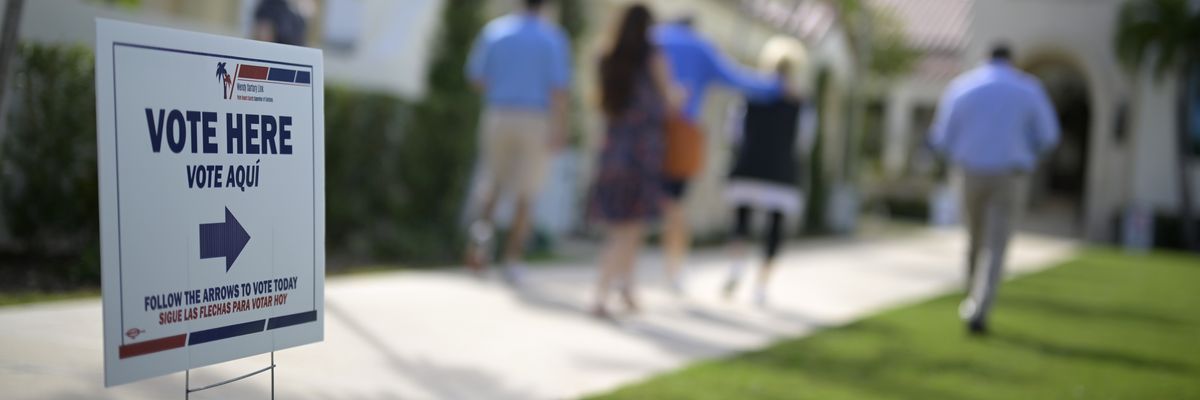
People arrive to vote at the Morton and Barbara Mandel Recreation Center on November 8, 2022 in Palm Beach, Florida.
"We applaud the court's decision, but we must ensure this harmful law is struck down altogether," said the ACLU of Florida's legal director.
A federal judge on Monday blocked a provision of a recently enacted Florida law that the ACLU characterized as a "clear and brazen attack on civic participation in our democracy."
S.B. 7050, which Republican Gov. Ron DeSantis signed into law in May, would have imposed $50,000 fines on community organizations for every noncitizen individual who collected or handled voter registration forms for the groups—even if the people were legally authorized to work in the United States.
In a scathing 58-page order granting rights groups' request for a preliminary injunction, Chief U.S. District Judge Mark Walker of the Northern District of Florida called the law "Florida's latest assault on the right to vote" and agreed that the voter registration provision would have "substantially interrupted" community groups' outreach efforts.
"Tomorrow, Floridians across the state will commemorate our nation's birthday," Walker wrote. "They will endure the heat of the Florida summer to celebrate the Fourth of July with family and friends at barbecues and picnics. They will gather with their communities at public parks for music and fireworks. They will cheer and sweat at parades and block parties. And amid these patriotic festivities, some may feel moved, for the first time, to embrace their solemn privilege as citizens by registering to vote."
"That's where plaintiffs come in," the judge continued, pointing to the testimony of Veronica Herrera-Lucha, a lawful permanent resident who works as the Florida state field director for Mi Vecino, a nonprofit voter registration group.
"Absent the challenged provisions at issue in these cases, individuals like Ms. Herrera-Lucha and [third-party voter registration organizations] like the Florida NAACP and Hispanic Federation would be engaging with their communities and registering new voters," Walker wrote. "Ms. Herrera-Lucha, a noncitizen who, herself, lacks the right to vote, has spent years registering and encouraging citizens to exercise that solemn right. She may, at least for now, continue to do so and add more voices to the millions of others singing a more perfect union into existence."
"We applaud this ruling, and will not rest until everyone's right to participate in our democracy is protected."
Frankie Miranda, president and CEO of the Hispanic Federation, celebrated Walker's ruling as confirmation of "what we knew from the very beginning: Florida's latest voter registration law was unconstitutional and served no other purpose than to silence our communities."
"This ruling is a win for all Floridians—especially for underrepresented communities who rely on nonpartisan organizations like us to help make their voices heard," said Miranda. "We applaud this ruling, and will not rest until everyone's right to participate in our democracy is protected."
The Hispanic Federation was one of several groups that sued the state of Florida over the provision targeting noncitizen voter registration advocates, part of a broader voter suppression effort by the state's governor and dominant Republican Party.
In addition to its sweeping attack on voter registration groups and restrictions on mail-in voting, S.B. 7050 includes a
provision that allowed DeSantis to run for president without resigning as Florida's governor.
Walker wrote in his order Monday that Florida's political leaders in recent years have struggled to govern "within the bounds set by the United States Constitution."
"When state government power threatens to spread beyond constitutional bounds and reduce individual rights to ashes, the federal judiciary stands as a firewall," Walker added. "The Free State of Florida is simply not free to exceed the bounds of the United States Constitution."
Daniel Tilley, legal director at the ACLU of Florida, said in a statement that Walker's ruling "fortifies the idea that all Floridians have a right to participate in building a stronger democracy through civic engagement."
"While this is a step in the right direction, our work is not finished," said Tilley. "People in our communities, including noncitizens, work tirelessly to assist in voter registration efforts to empower Floridians to vote on issues that impact their daily lives. We applaud the court's decision, but we must ensure this harmful law is struck down altogether."
Dear Common Dreams reader, It’s been nearly 30 years since I co-founded Common Dreams with my late wife, Lina Newhouser. We had the radical notion that journalism should serve the public good, not corporate profits. It was clear to us from the outset what it would take to build such a project. No paid advertisements. No corporate sponsors. No millionaire publisher telling us what to think or do. Many people said we wouldn't last a year, but we proved those doubters wrong. Together with a tremendous team of journalists and dedicated staff, we built an independent media outlet free from the constraints of profits and corporate control. Our mission has always been simple: To inform. To inspire. To ignite change for the common good. Building Common Dreams was not easy. Our survival was never guaranteed. When you take on the most powerful forces—Wall Street greed, fossil fuel industry destruction, Big Tech lobbyists, and uber-rich oligarchs who have spent billions upon billions rigging the economy and democracy in their favor—the only bulwark you have is supporters who believe in your work. But here’s the urgent message from me today. It's never been this bad out there. And it's never been this hard to keep us going. At the very moment Common Dreams is most needed, the threats we face are intensifying. We need your support now more than ever. We don't accept corporate advertising and never will. We don't have a paywall because we don't think people should be blocked from critical news based on their ability to pay. Everything we do is funded by the donations of readers like you. When everyone does the little they can afford, we are strong. But if that support retreats or dries up, so do we. Will you donate now to make sure Common Dreams not only survives but thrives? —Craig Brown, Co-founder |
A federal judge on Monday blocked a provision of a recently enacted Florida law that the ACLU characterized as a "clear and brazen attack on civic participation in our democracy."
S.B. 7050, which Republican Gov. Ron DeSantis signed into law in May, would have imposed $50,000 fines on community organizations for every noncitizen individual who collected or handled voter registration forms for the groups—even if the people were legally authorized to work in the United States.
In a scathing 58-page order granting rights groups' request for a preliminary injunction, Chief U.S. District Judge Mark Walker of the Northern District of Florida called the law "Florida's latest assault on the right to vote" and agreed that the voter registration provision would have "substantially interrupted" community groups' outreach efforts.
"Tomorrow, Floridians across the state will commemorate our nation's birthday," Walker wrote. "They will endure the heat of the Florida summer to celebrate the Fourth of July with family and friends at barbecues and picnics. They will gather with their communities at public parks for music and fireworks. They will cheer and sweat at parades and block parties. And amid these patriotic festivities, some may feel moved, for the first time, to embrace their solemn privilege as citizens by registering to vote."
"That's where plaintiffs come in," the judge continued, pointing to the testimony of Veronica Herrera-Lucha, a lawful permanent resident who works as the Florida state field director for Mi Vecino, a nonprofit voter registration group.
"Absent the challenged provisions at issue in these cases, individuals like Ms. Herrera-Lucha and [third-party voter registration organizations] like the Florida NAACP and Hispanic Federation would be engaging with their communities and registering new voters," Walker wrote. "Ms. Herrera-Lucha, a noncitizen who, herself, lacks the right to vote, has spent years registering and encouraging citizens to exercise that solemn right. She may, at least for now, continue to do so and add more voices to the millions of others singing a more perfect union into existence."
"We applaud this ruling, and will not rest until everyone's right to participate in our democracy is protected."
Frankie Miranda, president and CEO of the Hispanic Federation, celebrated Walker's ruling as confirmation of "what we knew from the very beginning: Florida's latest voter registration law was unconstitutional and served no other purpose than to silence our communities."
"This ruling is a win for all Floridians—especially for underrepresented communities who rely on nonpartisan organizations like us to help make their voices heard," said Miranda. "We applaud this ruling, and will not rest until everyone's right to participate in our democracy is protected."
The Hispanic Federation was one of several groups that sued the state of Florida over the provision targeting noncitizen voter registration advocates, part of a broader voter suppression effort by the state's governor and dominant Republican Party.
In addition to its sweeping attack on voter registration groups and restrictions on mail-in voting, S.B. 7050 includes a
provision that allowed DeSantis to run for president without resigning as Florida's governor.
Walker wrote in his order Monday that Florida's political leaders in recent years have struggled to govern "within the bounds set by the United States Constitution."
"When state government power threatens to spread beyond constitutional bounds and reduce individual rights to ashes, the federal judiciary stands as a firewall," Walker added. "The Free State of Florida is simply not free to exceed the bounds of the United States Constitution."
Daniel Tilley, legal director at the ACLU of Florida, said in a statement that Walker's ruling "fortifies the idea that all Floridians have a right to participate in building a stronger democracy through civic engagement."
"While this is a step in the right direction, our work is not finished," said Tilley. "People in our communities, including noncitizens, work tirelessly to assist in voter registration efforts to empower Floridians to vote on issues that impact their daily lives. We applaud the court's decision, but we must ensure this harmful law is struck down altogether."
A federal judge on Monday blocked a provision of a recently enacted Florida law that the ACLU characterized as a "clear and brazen attack on civic participation in our democracy."
S.B. 7050, which Republican Gov. Ron DeSantis signed into law in May, would have imposed $50,000 fines on community organizations for every noncitizen individual who collected or handled voter registration forms for the groups—even if the people were legally authorized to work in the United States.
In a scathing 58-page order granting rights groups' request for a preliminary injunction, Chief U.S. District Judge Mark Walker of the Northern District of Florida called the law "Florida's latest assault on the right to vote" and agreed that the voter registration provision would have "substantially interrupted" community groups' outreach efforts.
"Tomorrow, Floridians across the state will commemorate our nation's birthday," Walker wrote. "They will endure the heat of the Florida summer to celebrate the Fourth of July with family and friends at barbecues and picnics. They will gather with their communities at public parks for music and fireworks. They will cheer and sweat at parades and block parties. And amid these patriotic festivities, some may feel moved, for the first time, to embrace their solemn privilege as citizens by registering to vote."
"That's where plaintiffs come in," the judge continued, pointing to the testimony of Veronica Herrera-Lucha, a lawful permanent resident who works as the Florida state field director for Mi Vecino, a nonprofit voter registration group.
"Absent the challenged provisions at issue in these cases, individuals like Ms. Herrera-Lucha and [third-party voter registration organizations] like the Florida NAACP and Hispanic Federation would be engaging with their communities and registering new voters," Walker wrote. "Ms. Herrera-Lucha, a noncitizen who, herself, lacks the right to vote, has spent years registering and encouraging citizens to exercise that solemn right. She may, at least for now, continue to do so and add more voices to the millions of others singing a more perfect union into existence."
"We applaud this ruling, and will not rest until everyone's right to participate in our democracy is protected."
Frankie Miranda, president and CEO of the Hispanic Federation, celebrated Walker's ruling as confirmation of "what we knew from the very beginning: Florida's latest voter registration law was unconstitutional and served no other purpose than to silence our communities."
"This ruling is a win for all Floridians—especially for underrepresented communities who rely on nonpartisan organizations like us to help make their voices heard," said Miranda. "We applaud this ruling, and will not rest until everyone's right to participate in our democracy is protected."
The Hispanic Federation was one of several groups that sued the state of Florida over the provision targeting noncitizen voter registration advocates, part of a broader voter suppression effort by the state's governor and dominant Republican Party.
In addition to its sweeping attack on voter registration groups and restrictions on mail-in voting, S.B. 7050 includes a
provision that allowed DeSantis to run for president without resigning as Florida's governor.
Walker wrote in his order Monday that Florida's political leaders in recent years have struggled to govern "within the bounds set by the United States Constitution."
"When state government power threatens to spread beyond constitutional bounds and reduce individual rights to ashes, the federal judiciary stands as a firewall," Walker added. "The Free State of Florida is simply not free to exceed the bounds of the United States Constitution."
Daniel Tilley, legal director at the ACLU of Florida, said in a statement that Walker's ruling "fortifies the idea that all Floridians have a right to participate in building a stronger democracy through civic engagement."
"While this is a step in the right direction, our work is not finished," said Tilley. "People in our communities, including noncitizens, work tirelessly to assist in voter registration efforts to empower Floridians to vote on issues that impact their daily lives. We applaud the court's decision, but we must ensure this harmful law is struck down altogether."