SUBSCRIBE TO OUR FREE NEWSLETTER
Daily news & progressive opinion—funded by the people, not the corporations—delivered straight to your inbox.
5
#000000
#FFFFFF
To donate by check, phone, or other method, see our More Ways to Give page.
Daily news & progressive opinion—funded by the people, not the corporations—delivered straight to your inbox.
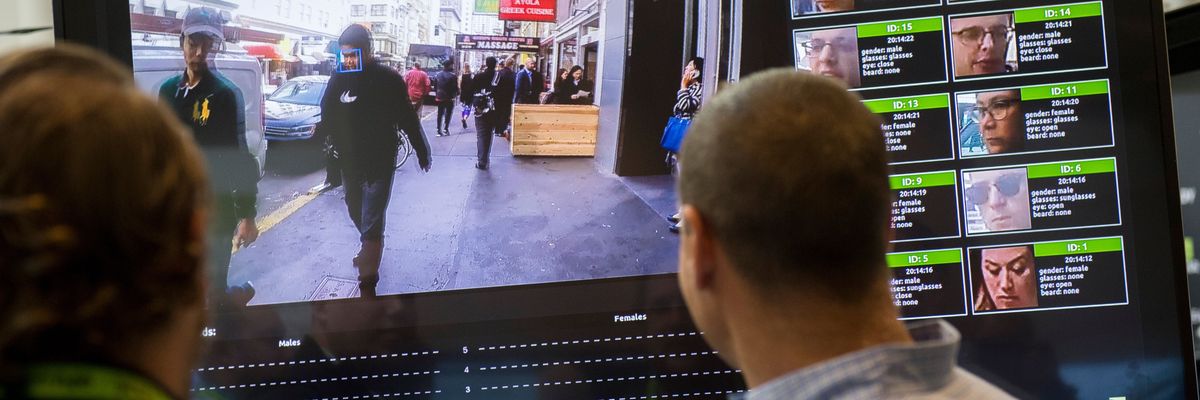
A display shows a facial recognition system for law enforcement during the NVIDIA GPU Technology Conference in Washington, D.C. on November 1, 2017.
"The continued proliferation of surveillance tools like facial recognition technologies in our society is deeply disturbing," said Sen. Ed Markey, reintroducing a federal ban.
Thousands of records about U.S. government involvement in the research and development of facial recognition technology—unveiled due to an ACLU lawsuit and first reported on Tuesday by The Washington Post—fueled fresh calls for a federal ban on such tools.
"Americans' ability to navigate our communities without constant tracking and surveillance is being chipped away at an alarming pace," Sen. Ed Markey (D-Mass.) told the Post. "We cannot stand by as the tentacles of the surveillance state dig deeper into our private lives, treating every one of us like suspects in an unbridled investigation that undermines our rights and freedom."
While some cities and states have taken action, there is currently no federal law restricting the use of facial recognition tools. However, Markey pledged to reintroduce his proposed ban on government use of the technology—which he did, alongside Rep. Pramila Jayapal (D-Wash.) and other Democrats, within hours of the reporting.
"As we work to make our country more equitable, we cannot ignore the technologies that stand in the way of progress and perpetuate injustice."
"The year is 2023, but we are living through 1984. The continued proliferation of surveillance tools like facial recognition technologies in our society is deeply disturbing," declared Markey, reintroducing the Facial Recognition and Biometric Technology Moratorium Act, which is backed by various groups including the ACLU.
"Biometric data collection poses serious risks of privacy invasion and discrimination, and Americans know they should not have to forgo personal privacy for safety," the senator said. "As we work to make our country more equitable, we cannot ignore the technologies that stand in the way of progress and perpetuate injustice."
Despite concerns about accuracy and bias—bolstered by examples of misidentified Black men being arrested for crimes they did not commit—the U.S. Defense Department and Federal Bureau of Investigation (FBI) were more closely involved in work on facial recognition software to identify people from drone and street camera footage than was previously known, according to the documents revealed as a result of the ACLU's public records lawsuit filed in late 2019.
The Post reported that documents including internal emails and presentations expose how intimately officials at the FBI—which is part of the Justice Department—and Pentagon "worked with academic researchers to refine artificial intelligence techniques that could help in the identification or tracking of Americans without their awareness or consent."
Many of the records pertain to the Janus program, which was funded by the Intelligence Advanced Research Projects Agency (IARPA) and ultimately folded into a search tool used by multiple federal agencies called Horus. As the newspaper detailed:
Program leaders worked with FBI scientists and some of the nation's leading computer vision experts to design and test software that would quickly and accurately process the "truly unconstrained face imagery" recorded by surveillance cameras in public places, including subway stations and street corners, according to the documents, which the ACLU shared with The Washington Post.
In a 2019 presentation, an IARPA program manager said the goal had been to "dramatically improve" the power and performance of facial recognition systems, with "scaling to support millions of subjects" and the ability to quickly identify faces from partially obstructed angles. One version of the system was trained for "Face ID... at target distances" of more than a half-mile.
To refine the system's capabilities, researchers staged a data-gathering test in 2017, paying dozens of volunteers to simulate real-world scenarios at a Defense Department training facility made to resemble a hospital, a subway station, an outdoor marketplace, and a school, the documents show. The test yielded thousands of surveillance videos and images, some of which were captured by a drone.
"IARPA said in public filings that the Janus program had helped advance 'virtually every aspect of fundamental face recognition research' and led to algorithms that were 'twice as accurate as the most widely used government-off-the-shelf systems,'" the Post noted.
Nathan Freed Wessler, deputy director of the ACLU's Speech, Privacy, and Technology Project, told the newspaper that the tool's use in U.S. mass surveillance would be a "nightmare scenario."
"It could give the government the ability to pervasively track as many people as they want for as long as they want," he said. "There's no good outcome for that in a democratic society."
Dear Common Dreams reader, It’s been nearly 30 years since I co-founded Common Dreams with my late wife, Lina Newhouser. We had the radical notion that journalism should serve the public good, not corporate profits. It was clear to us from the outset what it would take to build such a project. No paid advertisements. No corporate sponsors. No millionaire publisher telling us what to think or do. Many people said we wouldn't last a year, but we proved those doubters wrong. Together with a tremendous team of journalists and dedicated staff, we built an independent media outlet free from the constraints of profits and corporate control. Our mission has always been simple: To inform. To inspire. To ignite change for the common good. Building Common Dreams was not easy. Our survival was never guaranteed. When you take on the most powerful forces—Wall Street greed, fossil fuel industry destruction, Big Tech lobbyists, and uber-rich oligarchs who have spent billions upon billions rigging the economy and democracy in their favor—the only bulwark you have is supporters who believe in your work. But here’s the urgent message from me today. It's never been this bad out there. And it's never been this hard to keep us going. At the very moment Common Dreams is most needed, the threats we face are intensifying. We need your support now more than ever. We don't accept corporate advertising and never will. We don't have a paywall because we don't think people should be blocked from critical news based on their ability to pay. Everything we do is funded by the donations of readers like you. When everyone does the little they can afford, we are strong. But if that support retreats or dries up, so do we. Will you donate now to make sure Common Dreams not only survives but thrives? —Craig Brown, Co-founder |
Thousands of records about U.S. government involvement in the research and development of facial recognition technology—unveiled due to an ACLU lawsuit and first reported on Tuesday by The Washington Post—fueled fresh calls for a federal ban on such tools.
"Americans' ability to navigate our communities without constant tracking and surveillance is being chipped away at an alarming pace," Sen. Ed Markey (D-Mass.) told the Post. "We cannot stand by as the tentacles of the surveillance state dig deeper into our private lives, treating every one of us like suspects in an unbridled investigation that undermines our rights and freedom."
While some cities and states have taken action, there is currently no federal law restricting the use of facial recognition tools. However, Markey pledged to reintroduce his proposed ban on government use of the technology—which he did, alongside Rep. Pramila Jayapal (D-Wash.) and other Democrats, within hours of the reporting.
"As we work to make our country more equitable, we cannot ignore the technologies that stand in the way of progress and perpetuate injustice."
"The year is 2023, but we are living through 1984. The continued proliferation of surveillance tools like facial recognition technologies in our society is deeply disturbing," declared Markey, reintroducing the Facial Recognition and Biometric Technology Moratorium Act, which is backed by various groups including the ACLU.
"Biometric data collection poses serious risks of privacy invasion and discrimination, and Americans know they should not have to forgo personal privacy for safety," the senator said. "As we work to make our country more equitable, we cannot ignore the technologies that stand in the way of progress and perpetuate injustice."
Despite concerns about accuracy and bias—bolstered by examples of misidentified Black men being arrested for crimes they did not commit—the U.S. Defense Department and Federal Bureau of Investigation (FBI) were more closely involved in work on facial recognition software to identify people from drone and street camera footage than was previously known, according to the documents revealed as a result of the ACLU's public records lawsuit filed in late 2019.
The Post reported that documents including internal emails and presentations expose how intimately officials at the FBI—which is part of the Justice Department—and Pentagon "worked with academic researchers to refine artificial intelligence techniques that could help in the identification or tracking of Americans without their awareness or consent."
Many of the records pertain to the Janus program, which was funded by the Intelligence Advanced Research Projects Agency (IARPA) and ultimately folded into a search tool used by multiple federal agencies called Horus. As the newspaper detailed:
Program leaders worked with FBI scientists and some of the nation's leading computer vision experts to design and test software that would quickly and accurately process the "truly unconstrained face imagery" recorded by surveillance cameras in public places, including subway stations and street corners, according to the documents, which the ACLU shared with The Washington Post.
In a 2019 presentation, an IARPA program manager said the goal had been to "dramatically improve" the power and performance of facial recognition systems, with "scaling to support millions of subjects" and the ability to quickly identify faces from partially obstructed angles. One version of the system was trained for "Face ID... at target distances" of more than a half-mile.
To refine the system's capabilities, researchers staged a data-gathering test in 2017, paying dozens of volunteers to simulate real-world scenarios at a Defense Department training facility made to resemble a hospital, a subway station, an outdoor marketplace, and a school, the documents show. The test yielded thousands of surveillance videos and images, some of which were captured by a drone.
"IARPA said in public filings that the Janus program had helped advance 'virtually every aspect of fundamental face recognition research' and led to algorithms that were 'twice as accurate as the most widely used government-off-the-shelf systems,'" the Post noted.
Nathan Freed Wessler, deputy director of the ACLU's Speech, Privacy, and Technology Project, told the newspaper that the tool's use in U.S. mass surveillance would be a "nightmare scenario."
"It could give the government the ability to pervasively track as many people as they want for as long as they want," he said. "There's no good outcome for that in a democratic society."
Thousands of records about U.S. government involvement in the research and development of facial recognition technology—unveiled due to an ACLU lawsuit and first reported on Tuesday by The Washington Post—fueled fresh calls for a federal ban on such tools.
"Americans' ability to navigate our communities without constant tracking and surveillance is being chipped away at an alarming pace," Sen. Ed Markey (D-Mass.) told the Post. "We cannot stand by as the tentacles of the surveillance state dig deeper into our private lives, treating every one of us like suspects in an unbridled investigation that undermines our rights and freedom."
While some cities and states have taken action, there is currently no federal law restricting the use of facial recognition tools. However, Markey pledged to reintroduce his proposed ban on government use of the technology—which he did, alongside Rep. Pramila Jayapal (D-Wash.) and other Democrats, within hours of the reporting.
"As we work to make our country more equitable, we cannot ignore the technologies that stand in the way of progress and perpetuate injustice."
"The year is 2023, but we are living through 1984. The continued proliferation of surveillance tools like facial recognition technologies in our society is deeply disturbing," declared Markey, reintroducing the Facial Recognition and Biometric Technology Moratorium Act, which is backed by various groups including the ACLU.
"Biometric data collection poses serious risks of privacy invasion and discrimination, and Americans know they should not have to forgo personal privacy for safety," the senator said. "As we work to make our country more equitable, we cannot ignore the technologies that stand in the way of progress and perpetuate injustice."
Despite concerns about accuracy and bias—bolstered by examples of misidentified Black men being arrested for crimes they did not commit—the U.S. Defense Department and Federal Bureau of Investigation (FBI) were more closely involved in work on facial recognition software to identify people from drone and street camera footage than was previously known, according to the documents revealed as a result of the ACLU's public records lawsuit filed in late 2019.
The Post reported that documents including internal emails and presentations expose how intimately officials at the FBI—which is part of the Justice Department—and Pentagon "worked with academic researchers to refine artificial intelligence techniques that could help in the identification or tracking of Americans without their awareness or consent."
Many of the records pertain to the Janus program, which was funded by the Intelligence Advanced Research Projects Agency (IARPA) and ultimately folded into a search tool used by multiple federal agencies called Horus. As the newspaper detailed:
Program leaders worked with FBI scientists and some of the nation's leading computer vision experts to design and test software that would quickly and accurately process the "truly unconstrained face imagery" recorded by surveillance cameras in public places, including subway stations and street corners, according to the documents, which the ACLU shared with The Washington Post.
In a 2019 presentation, an IARPA program manager said the goal had been to "dramatically improve" the power and performance of facial recognition systems, with "scaling to support millions of subjects" and the ability to quickly identify faces from partially obstructed angles. One version of the system was trained for "Face ID... at target distances" of more than a half-mile.
To refine the system's capabilities, researchers staged a data-gathering test in 2017, paying dozens of volunteers to simulate real-world scenarios at a Defense Department training facility made to resemble a hospital, a subway station, an outdoor marketplace, and a school, the documents show. The test yielded thousands of surveillance videos and images, some of which were captured by a drone.
"IARPA said in public filings that the Janus program had helped advance 'virtually every aspect of fundamental face recognition research' and led to algorithms that were 'twice as accurate as the most widely used government-off-the-shelf systems,'" the Post noted.
Nathan Freed Wessler, deputy director of the ACLU's Speech, Privacy, and Technology Project, told the newspaper that the tool's use in U.S. mass surveillance would be a "nightmare scenario."
"It could give the government the ability to pervasively track as many people as they want for as long as they want," he said. "There's no good outcome for that in a democratic society."