SUBSCRIBE TO OUR FREE NEWSLETTER
Daily news & progressive opinion—funded by the people, not the corporations—delivered straight to your inbox.
5
#000000
#FFFFFF
To donate by check, phone, or other method, see our More Ways to Give page.
Daily news & progressive opinion—funded by the people, not the corporations—delivered straight to your inbox.
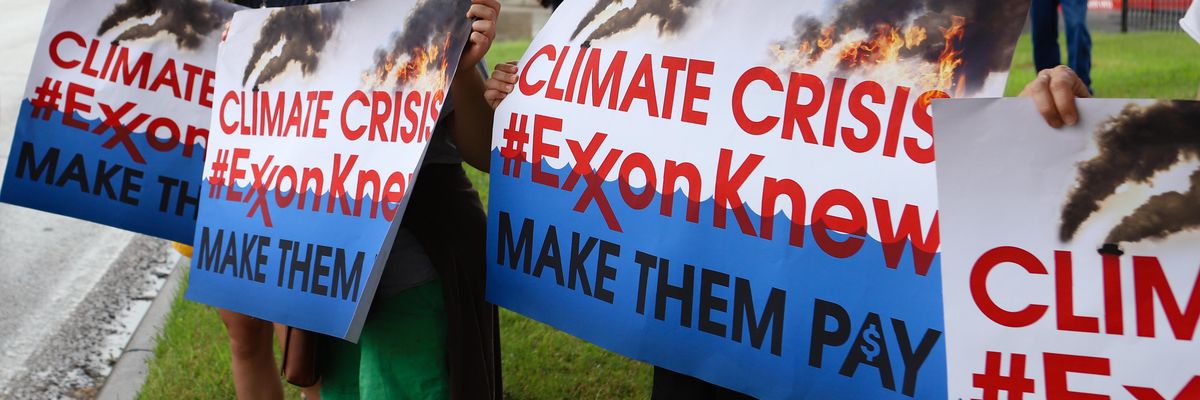
Climate activists protest outside ExxonMobil's annual shareholder meeting on May 29, 2019 in Irving, Texas.
"This deal shows that Exxon is doubling down on fossil fuels and has no intention of moving towards clean energy," argued one climate campaigner.
ExxonMobil announced Wednesday that it has agreed to acquire shale competitor Pioneer Natural Resources in an all-stock deal worth nearly $60 billion, a move seen as further evidence that the largest oil giant in the U.S. has no plans to heed scientists' increasingly dire warnings and scale back fossil fuel production.
"This deal shows that Exxon is doubling down on fossil fuels and has no intention of moving towards clean energy," argued Jamie Henn, director of Fossil Free Media. "Even after the hottest summer on record, Exxon is hellbent on driving the thermostat even higher."
The merger, which is expected to face intense scrutiny from the Lina Khan-led Federal Trade Commission (FTC), would make Exxon the biggest producer in the Permian Basin, a massive oilfield in the U.S. Southwest that climate campaigners have described as a "carbon bomb."
"This is a potentially massive consolidation which should be closely investigated by the [U.S. government] for antitrust concerns, with Exxon doubling down on fossil fuels when it should be phasing them out," Antonia Juhasz, a senior researcher on fossil fuels at Human Rights Watch, argued last week amid reports of a looming agreement.
Environmental groups have estimated that if drilling in the Permian Basin is allowed to continue, it could unleash around 40 billion tons of planet-warming CO2 by 2050—roughly 10% of the world's rapidly dwindling carbon budget.
Exxon said in a statement that once the Pioneer merger is complete, the company "will have an estimated 16 billion barrels of oil equivalent resource in the Permian."
"At close, ExxonMobil's Permian production volume would more than double to 1.3 million barrels of oil equivalent per day (MOEBD), based on 2023 volumes, and is expected to increase to approximately 2 MOEBD in 2027," the company said.
As Reuters reported Wednesday, Exxon CEO Darren Woods "has rebuffed investor and political pressure to shift strategies and embrace renewable energy as European oil majors have done."
"He faced heavy criticism for sticking to a heavy oil-dependent strategy as climate concerns became more pressing," the outlet added. "Exxon's decision paid off when the company last year earned a record $56 billion profit, two years after losses ballooned to $22 billion during the Covid-19 pandemic."
News of the merger deal comes less than a month after The Wall Street Journal published documents detailing Exxon's decadeslong effort to cast doubt on climate science even after it publicly acknowledged the connection between fossil fuel emissions and climate change in 2006.
Exxon and other fossil fuel giants are currently facing lawsuits from dozens of U.S. cities and states for misleading the public about their role in the worsening climate emergency.
"ExxonMobil is planning to ramp up its climate pollution while continuing to lie to the public and policymakers about its so-called commitment to solutions," said Richard Wiles, president of the Center for Climate Integrity. "Big Oil companies are driving the world toward climate catastrophe, and as the crisis accelerates, it's more important than ever that officials call out their climate deception and hold these polluters accountable."
This story has been updated to include a statement from the Center for Climate Integrity.
Dear Common Dreams reader, It’s been nearly 30 years since I co-founded Common Dreams with my late wife, Lina Newhouser. We had the radical notion that journalism should serve the public good, not corporate profits. It was clear to us from the outset what it would take to build such a project. No paid advertisements. No corporate sponsors. No millionaire publisher telling us what to think or do. Many people said we wouldn't last a year, but we proved those doubters wrong. Together with a tremendous team of journalists and dedicated staff, we built an independent media outlet free from the constraints of profits and corporate control. Our mission has always been simple: To inform. To inspire. To ignite change for the common good. Building Common Dreams was not easy. Our survival was never guaranteed. When you take on the most powerful forces—Wall Street greed, fossil fuel industry destruction, Big Tech lobbyists, and uber-rich oligarchs who have spent billions upon billions rigging the economy and democracy in their favor—the only bulwark you have is supporters who believe in your work. But here’s the urgent message from me today. It's never been this bad out there. And it's never been this hard to keep us going. At the very moment Common Dreams is most needed, the threats we face are intensifying. We need your support now more than ever. We don't accept corporate advertising and never will. We don't have a paywall because we don't think people should be blocked from critical news based on their ability to pay. Everything we do is funded by the donations of readers like you. When everyone does the little they can afford, we are strong. But if that support retreats or dries up, so do we. Will you donate now to make sure Common Dreams not only survives but thrives? —Craig Brown, Co-founder |
ExxonMobil announced Wednesday that it has agreed to acquire shale competitor Pioneer Natural Resources in an all-stock deal worth nearly $60 billion, a move seen as further evidence that the largest oil giant in the U.S. has no plans to heed scientists' increasingly dire warnings and scale back fossil fuel production.
"This deal shows that Exxon is doubling down on fossil fuels and has no intention of moving towards clean energy," argued Jamie Henn, director of Fossil Free Media. "Even after the hottest summer on record, Exxon is hellbent on driving the thermostat even higher."
The merger, which is expected to face intense scrutiny from the Lina Khan-led Federal Trade Commission (FTC), would make Exxon the biggest producer in the Permian Basin, a massive oilfield in the U.S. Southwest that climate campaigners have described as a "carbon bomb."
"This is a potentially massive consolidation which should be closely investigated by the [U.S. government] for antitrust concerns, with Exxon doubling down on fossil fuels when it should be phasing them out," Antonia Juhasz, a senior researcher on fossil fuels at Human Rights Watch, argued last week amid reports of a looming agreement.
Environmental groups have estimated that if drilling in the Permian Basin is allowed to continue, it could unleash around 40 billion tons of planet-warming CO2 by 2050—roughly 10% of the world's rapidly dwindling carbon budget.
Exxon said in a statement that once the Pioneer merger is complete, the company "will have an estimated 16 billion barrels of oil equivalent resource in the Permian."
"At close, ExxonMobil's Permian production volume would more than double to 1.3 million barrels of oil equivalent per day (MOEBD), based on 2023 volumes, and is expected to increase to approximately 2 MOEBD in 2027," the company said.
As Reuters reported Wednesday, Exxon CEO Darren Woods "has rebuffed investor and political pressure to shift strategies and embrace renewable energy as European oil majors have done."
"He faced heavy criticism for sticking to a heavy oil-dependent strategy as climate concerns became more pressing," the outlet added. "Exxon's decision paid off when the company last year earned a record $56 billion profit, two years after losses ballooned to $22 billion during the Covid-19 pandemic."
News of the merger deal comes less than a month after The Wall Street Journal published documents detailing Exxon's decadeslong effort to cast doubt on climate science even after it publicly acknowledged the connection between fossil fuel emissions and climate change in 2006.
Exxon and other fossil fuel giants are currently facing lawsuits from dozens of U.S. cities and states for misleading the public about their role in the worsening climate emergency.
"ExxonMobil is planning to ramp up its climate pollution while continuing to lie to the public and policymakers about its so-called commitment to solutions," said Richard Wiles, president of the Center for Climate Integrity. "Big Oil companies are driving the world toward climate catastrophe, and as the crisis accelerates, it's more important than ever that officials call out their climate deception and hold these polluters accountable."
This story has been updated to include a statement from the Center for Climate Integrity.
ExxonMobil announced Wednesday that it has agreed to acquire shale competitor Pioneer Natural Resources in an all-stock deal worth nearly $60 billion, a move seen as further evidence that the largest oil giant in the U.S. has no plans to heed scientists' increasingly dire warnings and scale back fossil fuel production.
"This deal shows that Exxon is doubling down on fossil fuels and has no intention of moving towards clean energy," argued Jamie Henn, director of Fossil Free Media. "Even after the hottest summer on record, Exxon is hellbent on driving the thermostat even higher."
The merger, which is expected to face intense scrutiny from the Lina Khan-led Federal Trade Commission (FTC), would make Exxon the biggest producer in the Permian Basin, a massive oilfield in the U.S. Southwest that climate campaigners have described as a "carbon bomb."
"This is a potentially massive consolidation which should be closely investigated by the [U.S. government] for antitrust concerns, with Exxon doubling down on fossil fuels when it should be phasing them out," Antonia Juhasz, a senior researcher on fossil fuels at Human Rights Watch, argued last week amid reports of a looming agreement.
Environmental groups have estimated that if drilling in the Permian Basin is allowed to continue, it could unleash around 40 billion tons of planet-warming CO2 by 2050—roughly 10% of the world's rapidly dwindling carbon budget.
Exxon said in a statement that once the Pioneer merger is complete, the company "will have an estimated 16 billion barrels of oil equivalent resource in the Permian."
"At close, ExxonMobil's Permian production volume would more than double to 1.3 million barrels of oil equivalent per day (MOEBD), based on 2023 volumes, and is expected to increase to approximately 2 MOEBD in 2027," the company said.
As Reuters reported Wednesday, Exxon CEO Darren Woods "has rebuffed investor and political pressure to shift strategies and embrace renewable energy as European oil majors have done."
"He faced heavy criticism for sticking to a heavy oil-dependent strategy as climate concerns became more pressing," the outlet added. "Exxon's decision paid off when the company last year earned a record $56 billion profit, two years after losses ballooned to $22 billion during the Covid-19 pandemic."
News of the merger deal comes less than a month after The Wall Street Journal published documents detailing Exxon's decadeslong effort to cast doubt on climate science even after it publicly acknowledged the connection between fossil fuel emissions and climate change in 2006.
Exxon and other fossil fuel giants are currently facing lawsuits from dozens of U.S. cities and states for misleading the public about their role in the worsening climate emergency.
"ExxonMobil is planning to ramp up its climate pollution while continuing to lie to the public and policymakers about its so-called commitment to solutions," said Richard Wiles, president of the Center for Climate Integrity. "Big Oil companies are driving the world toward climate catastrophe, and as the crisis accelerates, it's more important than ever that officials call out their climate deception and hold these polluters accountable."
This story has been updated to include a statement from the Center for Climate Integrity.