SUBSCRIBE TO OUR FREE NEWSLETTER
Daily news & progressive opinion—funded by the people, not the corporations—delivered straight to your inbox.
5
#000000
#FFFFFF
To donate by check, phone, or other method, see our More Ways to Give page.
Daily news & progressive opinion—funded by the people, not the corporations—delivered straight to your inbox.
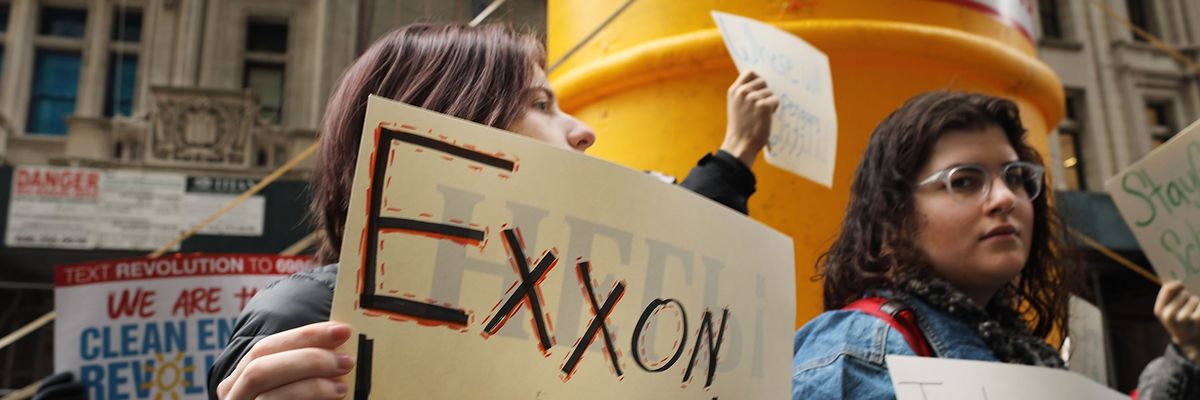
Activists rally to support an investigation into whether the oil giant Exxon covered up its knowledge about climate change on February 22, 2017 in New York City.
"Apparently," said the founder of an activist shareholder group, "the board fears shareholders will vote in favor of emissions reductions targets."
As the only major U.S. oil company that still hasn't set emissions-reduction targets for all of their operations and products, an activist shareholder group said Monday that ExxonMobil has likely seen "the writing on the wall" and is making a last-ditch effort to avoid new pollution requirements, leading it to file a lawsuit to stop investors from voting on a climate resolution at its next annual meeting.
Exxon filed a complaint on Sunday in the U.S. District Court for the Northern District of Texas—outside the district where the firm usually files cases—asking a judge to exclude a climate proposal from its proxy statement, which investors will vote on at the company's annual general meeting (AGM) in May.
The proposal was put forward by Dutch activist shareholder group Follow This, which has introduced motions at other fossil fuel companies' investor meetings, and investment firm Arjuna Capital. The groups are calling on Exxon to set "Scope 3" emissions targets, which would require the company to reduce emissions produced by those who use its products.
Exxon said last year it plans to reach net zero emissions by 2050, but included only direct emissions from its own infrastructure (Scope 1) and indirect emissions from its operations (Scope 2) in its pledge.
Going to court to stop a similar vote from going forward, said Follow This founder Mark van Baal, is a "remarkable step" by the firm.
" ExxonMobil clearly wants to prevent shareholders using their rights," said van Baal.
An Exxon spokesperson told The Guardian the company is trying to stop "the breakdown of the shareholder proposal process, one that allows proponents to advance their agendas through a flood of proposals," and said the proposal requiring Scope 3 emissions targets "does not serve the interests of investors."
"We are simply asking the court to apply the [Securities and Exchange Commission's] proxy rules as written to stop this abuse and eliminate the significant resources required to address them," the spokesperson said.
But as Reuters reported, Follow This—which says it filed its proposal in accordance with SEC rules—has said that investing in a transition to renewable energy sources is in fossil fuel company investors' best interests, as it would "prevent risks of losing access to capital markets, of facing policy interventions, and incurring in losses associated with stranded assets."
"ExxonMobil appears to interpret reducing emissions as decreasing business even though fossil fuels can be replaced by renewable energy," said van Baal. "The resolution leaves the strategy of how to achieve emissions reductions entirely up to the board. ExxonMobil's interpretation shows a lack of imagination beyond oil and gas."
Follow This urged Exxon to listen to the growing number of shareholders who "want to tackle the climate crisis."
"They realize Big Oil has a key role to play, like the 27 institutional investors who recently co-filed a similar climate resolution at Shell alongside Follow This," said van Baal.
A coalition of investors controlling about 5% of Shell's shares plan to back a resolution requiring the company to align its Scope 3 targets with the 2015 Paris climate agreement.
Some observers noted that Exxon filed its complaint in the Northern District of Texas, despite the fact that the company is based in the Houston area and the Southern District usually hears its cases.
Exxon's case will be heard by U.S. District Judge Reed O'Connor, an appointee of Republican former President George W. Bush who has a record of ruling in favor of right-wing causes. He declared the Affordable Care Act unconstitutional in 2018, ruled last year that "ghost guns" are exempt from background checks, and blocked married same-sex couples from exercising their rights under the Family Medical Leave Act.
Van Baal said Exxon likely took the step because it "is afraid of its shareholders."
"Apparently," he said, "the board fears shareholders will vote in favor of emissions-reductions targets."
Dear Common Dreams reader, It’s been nearly 30 years since I co-founded Common Dreams with my late wife, Lina Newhouser. We had the radical notion that journalism should serve the public good, not corporate profits. It was clear to us from the outset what it would take to build such a project. No paid advertisements. No corporate sponsors. No millionaire publisher telling us what to think or do. Many people said we wouldn't last a year, but we proved those doubters wrong. Together with a tremendous team of journalists and dedicated staff, we built an independent media outlet free from the constraints of profits and corporate control. Our mission has always been simple: To inform. To inspire. To ignite change for the common good. Building Common Dreams was not easy. Our survival was never guaranteed. When you take on the most powerful forces—Wall Street greed, fossil fuel industry destruction, Big Tech lobbyists, and uber-rich oligarchs who have spent billions upon billions rigging the economy and democracy in their favor—the only bulwark you have is supporters who believe in your work. But here’s the urgent message from me today. It's never been this bad out there. And it's never been this hard to keep us going. At the very moment Common Dreams is most needed, the threats we face are intensifying. We need your support now more than ever. We don't accept corporate advertising and never will. We don't have a paywall because we don't think people should be blocked from critical news based on their ability to pay. Everything we do is funded by the donations of readers like you. When everyone does the little they can afford, we are strong. But if that support retreats or dries up, so do we. Will you donate now to make sure Common Dreams not only survives but thrives? —Craig Brown, Co-founder |
As the only major U.S. oil company that still hasn't set emissions-reduction targets for all of their operations and products, an activist shareholder group said Monday that ExxonMobil has likely seen "the writing on the wall" and is making a last-ditch effort to avoid new pollution requirements, leading it to file a lawsuit to stop investors from voting on a climate resolution at its next annual meeting.
Exxon filed a complaint on Sunday in the U.S. District Court for the Northern District of Texas—outside the district where the firm usually files cases—asking a judge to exclude a climate proposal from its proxy statement, which investors will vote on at the company's annual general meeting (AGM) in May.
The proposal was put forward by Dutch activist shareholder group Follow This, which has introduced motions at other fossil fuel companies' investor meetings, and investment firm Arjuna Capital. The groups are calling on Exxon to set "Scope 3" emissions targets, which would require the company to reduce emissions produced by those who use its products.
Exxon said last year it plans to reach net zero emissions by 2050, but included only direct emissions from its own infrastructure (Scope 1) and indirect emissions from its operations (Scope 2) in its pledge.
Going to court to stop a similar vote from going forward, said Follow This founder Mark van Baal, is a "remarkable step" by the firm.
" ExxonMobil clearly wants to prevent shareholders using their rights," said van Baal.
An Exxon spokesperson told The Guardian the company is trying to stop "the breakdown of the shareholder proposal process, one that allows proponents to advance their agendas through a flood of proposals," and said the proposal requiring Scope 3 emissions targets "does not serve the interests of investors."
"We are simply asking the court to apply the [Securities and Exchange Commission's] proxy rules as written to stop this abuse and eliminate the significant resources required to address them," the spokesperson said.
But as Reuters reported, Follow This—which says it filed its proposal in accordance with SEC rules—has said that investing in a transition to renewable energy sources is in fossil fuel company investors' best interests, as it would "prevent risks of losing access to capital markets, of facing policy interventions, and incurring in losses associated with stranded assets."
"ExxonMobil appears to interpret reducing emissions as decreasing business even though fossil fuels can be replaced by renewable energy," said van Baal. "The resolution leaves the strategy of how to achieve emissions reductions entirely up to the board. ExxonMobil's interpretation shows a lack of imagination beyond oil and gas."
Follow This urged Exxon to listen to the growing number of shareholders who "want to tackle the climate crisis."
"They realize Big Oil has a key role to play, like the 27 institutional investors who recently co-filed a similar climate resolution at Shell alongside Follow This," said van Baal.
A coalition of investors controlling about 5% of Shell's shares plan to back a resolution requiring the company to align its Scope 3 targets with the 2015 Paris climate agreement.
Some observers noted that Exxon filed its complaint in the Northern District of Texas, despite the fact that the company is based in the Houston area and the Southern District usually hears its cases.
Exxon's case will be heard by U.S. District Judge Reed O'Connor, an appointee of Republican former President George W. Bush who has a record of ruling in favor of right-wing causes. He declared the Affordable Care Act unconstitutional in 2018, ruled last year that "ghost guns" are exempt from background checks, and blocked married same-sex couples from exercising their rights under the Family Medical Leave Act.
Van Baal said Exxon likely took the step because it "is afraid of its shareholders."
"Apparently," he said, "the board fears shareholders will vote in favor of emissions-reductions targets."
As the only major U.S. oil company that still hasn't set emissions-reduction targets for all of their operations and products, an activist shareholder group said Monday that ExxonMobil has likely seen "the writing on the wall" and is making a last-ditch effort to avoid new pollution requirements, leading it to file a lawsuit to stop investors from voting on a climate resolution at its next annual meeting.
Exxon filed a complaint on Sunday in the U.S. District Court for the Northern District of Texas—outside the district where the firm usually files cases—asking a judge to exclude a climate proposal from its proxy statement, which investors will vote on at the company's annual general meeting (AGM) in May.
The proposal was put forward by Dutch activist shareholder group Follow This, which has introduced motions at other fossil fuel companies' investor meetings, and investment firm Arjuna Capital. The groups are calling on Exxon to set "Scope 3" emissions targets, which would require the company to reduce emissions produced by those who use its products.
Exxon said last year it plans to reach net zero emissions by 2050, but included only direct emissions from its own infrastructure (Scope 1) and indirect emissions from its operations (Scope 2) in its pledge.
Going to court to stop a similar vote from going forward, said Follow This founder Mark van Baal, is a "remarkable step" by the firm.
" ExxonMobil clearly wants to prevent shareholders using their rights," said van Baal.
An Exxon spokesperson told The Guardian the company is trying to stop "the breakdown of the shareholder proposal process, one that allows proponents to advance their agendas through a flood of proposals," and said the proposal requiring Scope 3 emissions targets "does not serve the interests of investors."
"We are simply asking the court to apply the [Securities and Exchange Commission's] proxy rules as written to stop this abuse and eliminate the significant resources required to address them," the spokesperson said.
But as Reuters reported, Follow This—which says it filed its proposal in accordance with SEC rules—has said that investing in a transition to renewable energy sources is in fossil fuel company investors' best interests, as it would "prevent risks of losing access to capital markets, of facing policy interventions, and incurring in losses associated with stranded assets."
"ExxonMobil appears to interpret reducing emissions as decreasing business even though fossil fuels can be replaced by renewable energy," said van Baal. "The resolution leaves the strategy of how to achieve emissions reductions entirely up to the board. ExxonMobil's interpretation shows a lack of imagination beyond oil and gas."
Follow This urged Exxon to listen to the growing number of shareholders who "want to tackle the climate crisis."
"They realize Big Oil has a key role to play, like the 27 institutional investors who recently co-filed a similar climate resolution at Shell alongside Follow This," said van Baal.
A coalition of investors controlling about 5% of Shell's shares plan to back a resolution requiring the company to align its Scope 3 targets with the 2015 Paris climate agreement.
Some observers noted that Exxon filed its complaint in the Northern District of Texas, despite the fact that the company is based in the Houston area and the Southern District usually hears its cases.
Exxon's case will be heard by U.S. District Judge Reed O'Connor, an appointee of Republican former President George W. Bush who has a record of ruling in favor of right-wing causes. He declared the Affordable Care Act unconstitutional in 2018, ruled last year that "ghost guns" are exempt from background checks, and blocked married same-sex couples from exercising their rights under the Family Medical Leave Act.
Van Baal said Exxon likely took the step because it "is afraid of its shareholders."
"Apparently," he said, "the board fears shareholders will vote in favor of emissions-reductions targets."