SUBSCRIBE TO OUR FREE NEWSLETTER
Daily news & progressive opinion—funded by the people, not the corporations—delivered straight to your inbox.
5
#000000
#FFFFFF
To donate by check, phone, or other method, see our More Ways to Give page.
Daily news & progressive opinion—funded by the people, not the corporations—delivered straight to your inbox.
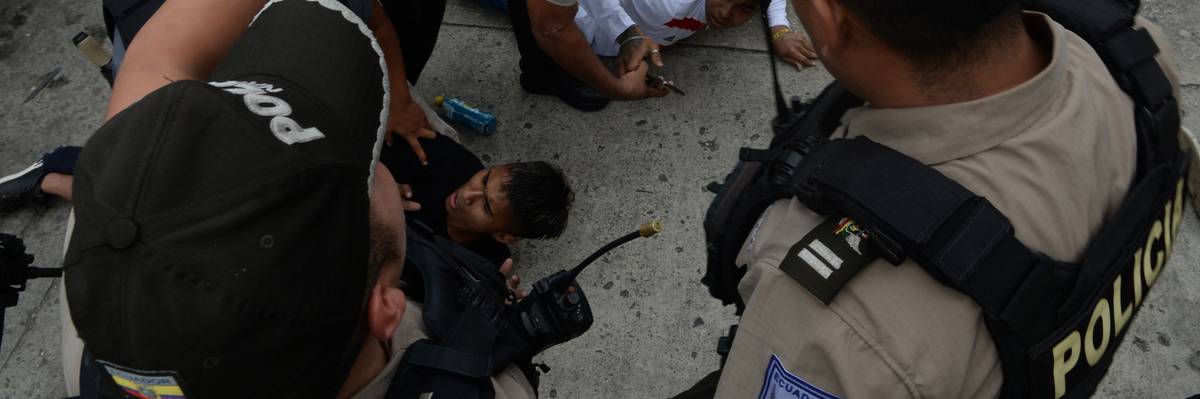
Ecuadorean police arrest several armed men who broke into the set of a public television channel after the government declared an 'internal armed conflict,' in Guayaquil, Ecuador on January 9, 2024.
The surge in violence in Ecuador "underscores the urgency of revisiting global drug prohibition," said one human rights expert.
The prison escapes of two criminal gang leaders in Ecuador has been linked to President Daniel Noboa's decision this week to declare a 60-day "state of emergency," but one human rights expert said Wednesday that the violence that's erupted in recent days—and Ecuador's explosion in violent crime in recent years—was made inevitable by the United States-led "war on drugs."
On Sunday, Los Choneros gang leader José Adolfo Macías Villamar, also known as Fito, escaped from a prison in the port city of Guayaquil—shortly before Fabricio Colón Pico of the rival gang Los Lobos also fled a detention center. Los Choneros works with Mexico's Sinaloa drug cartel while Colón's gang is linked to Jalisco New Generation (CJNG).
The prison breaks led authorities to call for a massive police deployment, sparking clashes which ultimately led to the killings of eight people in Guayaquil as well as two police officers in nearby Nobol, officials said Tuesday.
"Authorities say there have been at least 23 different violent incidents in eight provinces, including a number of car bombs going off," Alessandro Rampietti of Al Jazeera reported from Quito on Tuesday. "A number of police cars were incinerated and at least seven police officers were kidnapped by gang members."
Noboa took action shortly after 13 armed people, disguised in hoods, stunned the nation Tuesday by storming the publicly-owned TC Television studio in Guayaquil, a central point for drug smuggling in Ecuador. The attack took place while cameras were rolling, with audiences able to hear a woman saying, "Don't shoot, please don't shoot."
The 13 attackers were arrested when police arrived about 30 minutes into the incident, followed by an announcement by the president that Ecuador had entered a state of "internal armed conflict."
"I have just signed a state of emergency decree so that the armed forces have all the political and legal support for their actions," Noboa said. "The time is over when drug trafficking convicts, hitmen, and organized crime dictate to the government what to do."
Noboa ordered the armed forces to "neutralize" criminal gangs including Los Lobos and Los Choneros, whose cartels have increased their presence in Ecuador since the coronavirus pandemic began as they fight to take over the Guayaquil area—a key stop on international drug trafficking routes from Colombia to the U.S. and Europe.
Violent deaths surged to at least 8,008 in 2023, according to government figures—nearly doubling from the previous year. A record 200 tonnes of drugs were seized by authorities last year, Al Jazeera reported.
As journalist Nick Corbishley wrote at Naked Capitalism in early October, the U.S. has recently escalated the "war on drugs" in Ecuador:
Last Friday (September 29), the country's outgoing president (and former senior banker) Guillermo Lasso held a closed-door meeting with senior officials of the U.S. Coast Guard and Department of Defense in Washington. The outcome of that meeting was two status agreements, one that will allow the deployment of U.S. naval forces along Ecuador’s coastline while the other will permit the disembarking of U.S. land forces on Ecuador's soil, albeit only at the request of Ecuador’s government.
All with the ostensible aim of combating drug trafficking organizations.
Obviously, that is not what this is really about. If Washington were serious about tackling the violence generated by the drug cartels, the first thing it could do is pass legislation to stem the southward flow of U.S.-produced guns and other weapons. But that would hurt the profits of arms manufacturers. And if it were remotely serious about tackling the major cause of the drug problem—the rampant consumption of narcotics within its own borders—it would never have let Big Pharma unleash the opium epidemic. And once it had, it would never have let the perps walk free with the daintiest of financial slaps on the wrists.
The primary goal of this latest escalation in the U.S.' decades-old war on drugs, as with all previous escalations, is to achieve or maintain geostrategic dominance in key, normally resource-rich regions of the world while keeping the restive populace at home in line—or in prison, generating big bucks for the prison industrial complex.
Ecuador's rise in violence, including the escalation over the last several days "underscores the urgency of revisiting global drug prohibition, in addition to addressing other root causes," said Maria McFarland, acting deputy program director of Human Right Watch (HRW).
"In 2012 the presidents of Colombia, Guatemala, and Brazil made a plea to the United Nations to revisit global drug prohibition for precisely these reasons," said McFarland, former executive director of the Drug Policy Alliance. "Former heads of state from multiple countries continue to call for alternative approaches."
The violence combined with economic hardship has propelled tens of thousands of Ecuadoreans to flee, crossing the dangerous Darién Gap between Colombia and Panama to head north, with many arriving at the U.S.-Mexico border.
Juanita Goebertus, director of the Americas division for HRW, told El País that to make Ecuador safer for all residents the government must "strengthen its judicial capacity, control prisons, and investigate money laundering, and corruption."
"The decision to characterize a context as an internal armed conflict must always be technical and based on international humanitarian law," said Goebertus of Noboa's decree. "Otherwise, the rights of citizens are put at risk."
Dear Common Dreams reader, It’s been nearly 30 years since I co-founded Common Dreams with my late wife, Lina Newhouser. We had the radical notion that journalism should serve the public good, not corporate profits. It was clear to us from the outset what it would take to build such a project. No paid advertisements. No corporate sponsors. No millionaire publisher telling us what to think or do. Many people said we wouldn't last a year, but we proved those doubters wrong. Together with a tremendous team of journalists and dedicated staff, we built an independent media outlet free from the constraints of profits and corporate control. Our mission has always been simple: To inform. To inspire. To ignite change for the common good. Building Common Dreams was not easy. Our survival was never guaranteed. When you take on the most powerful forces—Wall Street greed, fossil fuel industry destruction, Big Tech lobbyists, and uber-rich oligarchs who have spent billions upon billions rigging the economy and democracy in their favor—the only bulwark you have is supporters who believe in your work. But here’s the urgent message from me today. It's never been this bad out there. And it's never been this hard to keep us going. At the very moment Common Dreams is most needed, the threats we face are intensifying. We need your support now more than ever. We don't accept corporate advertising and never will. We don't have a paywall because we don't think people should be blocked from critical news based on their ability to pay. Everything we do is funded by the donations of readers like you. When everyone does the little they can afford, we are strong. But if that support retreats or dries up, so do we. Will you donate now to make sure Common Dreams not only survives but thrives? —Craig Brown, Co-founder |
The prison escapes of two criminal gang leaders in Ecuador has been linked to President Daniel Noboa's decision this week to declare a 60-day "state of emergency," but one human rights expert said Wednesday that the violence that's erupted in recent days—and Ecuador's explosion in violent crime in recent years—was made inevitable by the United States-led "war on drugs."
On Sunday, Los Choneros gang leader José Adolfo Macías Villamar, also known as Fito, escaped from a prison in the port city of Guayaquil—shortly before Fabricio Colón Pico of the rival gang Los Lobos also fled a detention center. Los Choneros works with Mexico's Sinaloa drug cartel while Colón's gang is linked to Jalisco New Generation (CJNG).
The prison breaks led authorities to call for a massive police deployment, sparking clashes which ultimately led to the killings of eight people in Guayaquil as well as two police officers in nearby Nobol, officials said Tuesday.
"Authorities say there have been at least 23 different violent incidents in eight provinces, including a number of car bombs going off," Alessandro Rampietti of Al Jazeera reported from Quito on Tuesday. "A number of police cars were incinerated and at least seven police officers were kidnapped by gang members."
Noboa took action shortly after 13 armed people, disguised in hoods, stunned the nation Tuesday by storming the publicly-owned TC Television studio in Guayaquil, a central point for drug smuggling in Ecuador. The attack took place while cameras were rolling, with audiences able to hear a woman saying, "Don't shoot, please don't shoot."
The 13 attackers were arrested when police arrived about 30 minutes into the incident, followed by an announcement by the president that Ecuador had entered a state of "internal armed conflict."
"I have just signed a state of emergency decree so that the armed forces have all the political and legal support for their actions," Noboa said. "The time is over when drug trafficking convicts, hitmen, and organized crime dictate to the government what to do."
Noboa ordered the armed forces to "neutralize" criminal gangs including Los Lobos and Los Choneros, whose cartels have increased their presence in Ecuador since the coronavirus pandemic began as they fight to take over the Guayaquil area—a key stop on international drug trafficking routes from Colombia to the U.S. and Europe.
Violent deaths surged to at least 8,008 in 2023, according to government figures—nearly doubling from the previous year. A record 200 tonnes of drugs were seized by authorities last year, Al Jazeera reported.
As journalist Nick Corbishley wrote at Naked Capitalism in early October, the U.S. has recently escalated the "war on drugs" in Ecuador:
Last Friday (September 29), the country's outgoing president (and former senior banker) Guillermo Lasso held a closed-door meeting with senior officials of the U.S. Coast Guard and Department of Defense in Washington. The outcome of that meeting was two status agreements, one that will allow the deployment of U.S. naval forces along Ecuador’s coastline while the other will permit the disembarking of U.S. land forces on Ecuador's soil, albeit only at the request of Ecuador’s government.
All with the ostensible aim of combating drug trafficking organizations.
Obviously, that is not what this is really about. If Washington were serious about tackling the violence generated by the drug cartels, the first thing it could do is pass legislation to stem the southward flow of U.S.-produced guns and other weapons. But that would hurt the profits of arms manufacturers. And if it were remotely serious about tackling the major cause of the drug problem—the rampant consumption of narcotics within its own borders—it would never have let Big Pharma unleash the opium epidemic. And once it had, it would never have let the perps walk free with the daintiest of financial slaps on the wrists.
The primary goal of this latest escalation in the U.S.' decades-old war on drugs, as with all previous escalations, is to achieve or maintain geostrategic dominance in key, normally resource-rich regions of the world while keeping the restive populace at home in line—or in prison, generating big bucks for the prison industrial complex.
Ecuador's rise in violence, including the escalation over the last several days "underscores the urgency of revisiting global drug prohibition, in addition to addressing other root causes," said Maria McFarland, acting deputy program director of Human Right Watch (HRW).
"In 2012 the presidents of Colombia, Guatemala, and Brazil made a plea to the United Nations to revisit global drug prohibition for precisely these reasons," said McFarland, former executive director of the Drug Policy Alliance. "Former heads of state from multiple countries continue to call for alternative approaches."
The violence combined with economic hardship has propelled tens of thousands of Ecuadoreans to flee, crossing the dangerous Darién Gap between Colombia and Panama to head north, with many arriving at the U.S.-Mexico border.
Juanita Goebertus, director of the Americas division for HRW, told El País that to make Ecuador safer for all residents the government must "strengthen its judicial capacity, control prisons, and investigate money laundering, and corruption."
"The decision to characterize a context as an internal armed conflict must always be technical and based on international humanitarian law," said Goebertus of Noboa's decree. "Otherwise, the rights of citizens are put at risk."
The prison escapes of two criminal gang leaders in Ecuador has been linked to President Daniel Noboa's decision this week to declare a 60-day "state of emergency," but one human rights expert said Wednesday that the violence that's erupted in recent days—and Ecuador's explosion in violent crime in recent years—was made inevitable by the United States-led "war on drugs."
On Sunday, Los Choneros gang leader José Adolfo Macías Villamar, also known as Fito, escaped from a prison in the port city of Guayaquil—shortly before Fabricio Colón Pico of the rival gang Los Lobos also fled a detention center. Los Choneros works with Mexico's Sinaloa drug cartel while Colón's gang is linked to Jalisco New Generation (CJNG).
The prison breaks led authorities to call for a massive police deployment, sparking clashes which ultimately led to the killings of eight people in Guayaquil as well as two police officers in nearby Nobol, officials said Tuesday.
"Authorities say there have been at least 23 different violent incidents in eight provinces, including a number of car bombs going off," Alessandro Rampietti of Al Jazeera reported from Quito on Tuesday. "A number of police cars were incinerated and at least seven police officers were kidnapped by gang members."
Noboa took action shortly after 13 armed people, disguised in hoods, stunned the nation Tuesday by storming the publicly-owned TC Television studio in Guayaquil, a central point for drug smuggling in Ecuador. The attack took place while cameras were rolling, with audiences able to hear a woman saying, "Don't shoot, please don't shoot."
The 13 attackers were arrested when police arrived about 30 minutes into the incident, followed by an announcement by the president that Ecuador had entered a state of "internal armed conflict."
"I have just signed a state of emergency decree so that the armed forces have all the political and legal support for their actions," Noboa said. "The time is over when drug trafficking convicts, hitmen, and organized crime dictate to the government what to do."
Noboa ordered the armed forces to "neutralize" criminal gangs including Los Lobos and Los Choneros, whose cartels have increased their presence in Ecuador since the coronavirus pandemic began as they fight to take over the Guayaquil area—a key stop on international drug trafficking routes from Colombia to the U.S. and Europe.
Violent deaths surged to at least 8,008 in 2023, according to government figures—nearly doubling from the previous year. A record 200 tonnes of drugs were seized by authorities last year, Al Jazeera reported.
As journalist Nick Corbishley wrote at Naked Capitalism in early October, the U.S. has recently escalated the "war on drugs" in Ecuador:
Last Friday (September 29), the country's outgoing president (and former senior banker) Guillermo Lasso held a closed-door meeting with senior officials of the U.S. Coast Guard and Department of Defense in Washington. The outcome of that meeting was two status agreements, one that will allow the deployment of U.S. naval forces along Ecuador’s coastline while the other will permit the disembarking of U.S. land forces on Ecuador's soil, albeit only at the request of Ecuador’s government.
All with the ostensible aim of combating drug trafficking organizations.
Obviously, that is not what this is really about. If Washington were serious about tackling the violence generated by the drug cartels, the first thing it could do is pass legislation to stem the southward flow of U.S.-produced guns and other weapons. But that would hurt the profits of arms manufacturers. And if it were remotely serious about tackling the major cause of the drug problem—the rampant consumption of narcotics within its own borders—it would never have let Big Pharma unleash the opium epidemic. And once it had, it would never have let the perps walk free with the daintiest of financial slaps on the wrists.
The primary goal of this latest escalation in the U.S.' decades-old war on drugs, as with all previous escalations, is to achieve or maintain geostrategic dominance in key, normally resource-rich regions of the world while keeping the restive populace at home in line—or in prison, generating big bucks for the prison industrial complex.
Ecuador's rise in violence, including the escalation over the last several days "underscores the urgency of revisiting global drug prohibition, in addition to addressing other root causes," said Maria McFarland, acting deputy program director of Human Right Watch (HRW).
"In 2012 the presidents of Colombia, Guatemala, and Brazil made a plea to the United Nations to revisit global drug prohibition for precisely these reasons," said McFarland, former executive director of the Drug Policy Alliance. "Former heads of state from multiple countries continue to call for alternative approaches."
The violence combined with economic hardship has propelled tens of thousands of Ecuadoreans to flee, crossing the dangerous Darién Gap between Colombia and Panama to head north, with many arriving at the U.S.-Mexico border.
Juanita Goebertus, director of the Americas division for HRW, told El País that to make Ecuador safer for all residents the government must "strengthen its judicial capacity, control prisons, and investigate money laundering, and corruption."
"The decision to characterize a context as an internal armed conflict must always be technical and based on international humanitarian law," said Goebertus of Noboa's decree. "Otherwise, the rights of citizens are put at risk."