SUBSCRIBE TO OUR FREE NEWSLETTER
Daily news & progressive opinion—funded by the people, not the corporations—delivered straight to your inbox.
5
#000000
#FFFFFF
To donate by check, phone, or other method, see our More Ways to Give page.
Daily news & progressive opinion—funded by the people, not the corporations—delivered straight to your inbox.
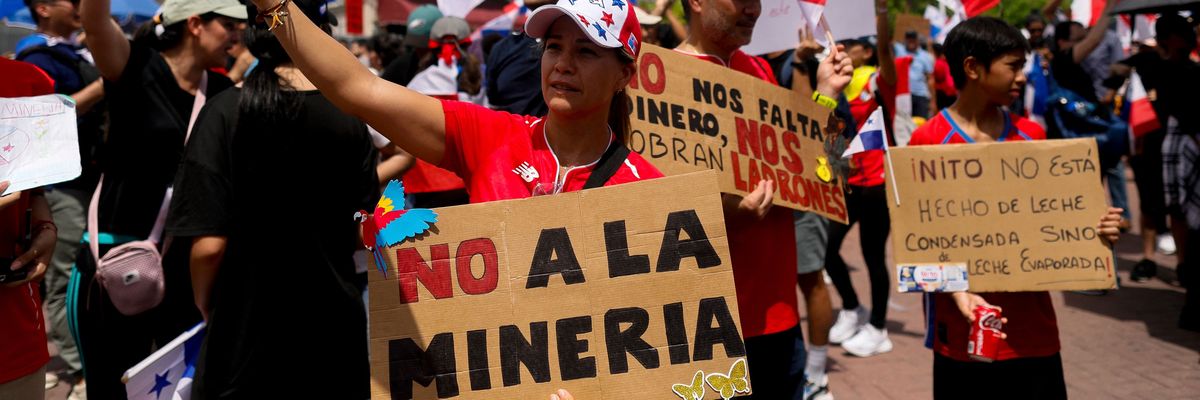
People protest during a march against the government contract with Canadian mining company First Quantum and its subsidiary Minera Panama in Panama City on November 3, 2023.
"The people have spoken and expressed that they don't want more mines, that they want sustainable economic development, and have no intention of destroying the country for profit," said one campaigner.
Indigenous and environmental campaigners this week hailed a landmark win for the Rights of Nature movement, the Panamanian Supreme Court's unanimous ruling that the contract for the Cobré mineral mine—one of the world's largest—is unconstitutional and must be shut down.
The November 24 ruling against Minera Panamá, a subsidiary of the Canadian company First Quantum Minerals, followed weeks of nationwide protests against the open-pit mine, which began operations in 2019 and where mainly copper, but also gold, silver, and molybdenum, are extracted. Opponents say the mine threatens area water supplies. A gunman shot and killed two people at a protest against the mine earlier this month.
Last year, the Cobré mine produced over 86,000 tons of copper, approximately 1% of the world's total production, 5% of Panama's gross domestic product, and 75% of the Central American country's export revenue. More than 2% of Panama's workforce is employed at the mine.
Cobré—which is located in a biodiverse area on Panama's Caribbean coast—will now shut down as a result of the ruling.
"The Panamanian people have spoken," Kherson Ruiz, executive director of the London-based Sustainable Development Foundation, told Mongabay. "The people have spoken and expressed that they don't want more mines, that they want sustainable economic development and have no intention of destroying the country for profit."
Referring to his introduction of Panama's Rights of Nature law, Juan Diego Vásquez Gutiérrez, an independent—and, at age 27, the youngest—member of Panama's National Assembly, said Wednesday that "I am very happy to have been part of a fundamental legal instrument to end the metal mining industry in the country."
"This is one of many tangible effects that we must repeat in defense of the environment thanks to legislation like this," Vásquez added.
Rengifo Navas Revilla, secretary of the National Coordinator of Indigenous Peoples of Panama, said in a statement that "when all this nature is contaminated, we all die."
"Even the planet itself, even Mother Earth herself, dies," he added. "This is the principle that has been instilled in us and that is why we continue to fight."
Since Ecuador became the first country to constitutionally enshrine the Rights of Nature in 2008, more than 30 nations have taken similar actions to protect their environment.
The advocacy groups Leatherback Project and Earth Law Center noted Wednesday that the Panamanian ruling "comes after a similar blocking of a copper mine earlier this year in Ecuador, where a provincial court ruled a mining project violated the constitutional Rights of Nature in the Intag Valley of the tropical Andes."
Constanza Prieto Figelist, Latin America legal director at Earth Law Center—which provided input and expertise on the Rights of Nature as the law was being drafted—said of the Panama ruling that "this case demonstrates that under a Rights of Nature framework, governments must give stronger consideration to the health and intrinsic value of nature when overseeing mining and other activities, elevating the interests of species and ecosystems to a higher status alongside human interests."
"The case also shows that the Rights of Nature can be an effective tool to protect the environment where traditional laws might fall short," she added. "We hope this will inspire other governments to give nature a formal voice and rights in the legal system, as Panama did."
Dear Common Dreams reader, It’s been nearly 30 years since I co-founded Common Dreams with my late wife, Lina Newhouser. We had the radical notion that journalism should serve the public good, not corporate profits. It was clear to us from the outset what it would take to build such a project. No paid advertisements. No corporate sponsors. No millionaire publisher telling us what to think or do. Many people said we wouldn't last a year, but we proved those doubters wrong. Together with a tremendous team of journalists and dedicated staff, we built an independent media outlet free from the constraints of profits and corporate control. Our mission has always been simple: To inform. To inspire. To ignite change for the common good. Building Common Dreams was not easy. Our survival was never guaranteed. When you take on the most powerful forces—Wall Street greed, fossil fuel industry destruction, Big Tech lobbyists, and uber-rich oligarchs who have spent billions upon billions rigging the economy and democracy in their favor—the only bulwark you have is supporters who believe in your work. But here’s the urgent message from me today. It's never been this bad out there. And it's never been this hard to keep us going. At the very moment Common Dreams is most needed, the threats we face are intensifying. We need your support now more than ever. We don't accept corporate advertising and never will. We don't have a paywall because we don't think people should be blocked from critical news based on their ability to pay. Everything we do is funded by the donations of readers like you. When everyone does the little they can afford, we are strong. But if that support retreats or dries up, so do we. Will you donate now to make sure Common Dreams not only survives but thrives? —Craig Brown, Co-founder |
Indigenous and environmental campaigners this week hailed a landmark win for the Rights of Nature movement, the Panamanian Supreme Court's unanimous ruling that the contract for the Cobré mineral mine—one of the world's largest—is unconstitutional and must be shut down.
The November 24 ruling against Minera Panamá, a subsidiary of the Canadian company First Quantum Minerals, followed weeks of nationwide protests against the open-pit mine, which began operations in 2019 and where mainly copper, but also gold, silver, and molybdenum, are extracted. Opponents say the mine threatens area water supplies. A gunman shot and killed two people at a protest against the mine earlier this month.
Last year, the Cobré mine produced over 86,000 tons of copper, approximately 1% of the world's total production, 5% of Panama's gross domestic product, and 75% of the Central American country's export revenue. More than 2% of Panama's workforce is employed at the mine.
Cobré—which is located in a biodiverse area on Panama's Caribbean coast—will now shut down as a result of the ruling.
"The Panamanian people have spoken," Kherson Ruiz, executive director of the London-based Sustainable Development Foundation, told Mongabay. "The people have spoken and expressed that they don't want more mines, that they want sustainable economic development and have no intention of destroying the country for profit."
Referring to his introduction of Panama's Rights of Nature law, Juan Diego Vásquez Gutiérrez, an independent—and, at age 27, the youngest—member of Panama's National Assembly, said Wednesday that "I am very happy to have been part of a fundamental legal instrument to end the metal mining industry in the country."
"This is one of many tangible effects that we must repeat in defense of the environment thanks to legislation like this," Vásquez added.
Rengifo Navas Revilla, secretary of the National Coordinator of Indigenous Peoples of Panama, said in a statement that "when all this nature is contaminated, we all die."
"Even the planet itself, even Mother Earth herself, dies," he added. "This is the principle that has been instilled in us and that is why we continue to fight."
Since Ecuador became the first country to constitutionally enshrine the Rights of Nature in 2008, more than 30 nations have taken similar actions to protect their environment.
The advocacy groups Leatherback Project and Earth Law Center noted Wednesday that the Panamanian ruling "comes after a similar blocking of a copper mine earlier this year in Ecuador, where a provincial court ruled a mining project violated the constitutional Rights of Nature in the Intag Valley of the tropical Andes."
Constanza Prieto Figelist, Latin America legal director at Earth Law Center—which provided input and expertise on the Rights of Nature as the law was being drafted—said of the Panama ruling that "this case demonstrates that under a Rights of Nature framework, governments must give stronger consideration to the health and intrinsic value of nature when overseeing mining and other activities, elevating the interests of species and ecosystems to a higher status alongside human interests."
"The case also shows that the Rights of Nature can be an effective tool to protect the environment where traditional laws might fall short," she added. "We hope this will inspire other governments to give nature a formal voice and rights in the legal system, as Panama did."
Indigenous and environmental campaigners this week hailed a landmark win for the Rights of Nature movement, the Panamanian Supreme Court's unanimous ruling that the contract for the Cobré mineral mine—one of the world's largest—is unconstitutional and must be shut down.
The November 24 ruling against Minera Panamá, a subsidiary of the Canadian company First Quantum Minerals, followed weeks of nationwide protests against the open-pit mine, which began operations in 2019 and where mainly copper, but also gold, silver, and molybdenum, are extracted. Opponents say the mine threatens area water supplies. A gunman shot and killed two people at a protest against the mine earlier this month.
Last year, the Cobré mine produced over 86,000 tons of copper, approximately 1% of the world's total production, 5% of Panama's gross domestic product, and 75% of the Central American country's export revenue. More than 2% of Panama's workforce is employed at the mine.
Cobré—which is located in a biodiverse area on Panama's Caribbean coast—will now shut down as a result of the ruling.
"The Panamanian people have spoken," Kherson Ruiz, executive director of the London-based Sustainable Development Foundation, told Mongabay. "The people have spoken and expressed that they don't want more mines, that they want sustainable economic development and have no intention of destroying the country for profit."
Referring to his introduction of Panama's Rights of Nature law, Juan Diego Vásquez Gutiérrez, an independent—and, at age 27, the youngest—member of Panama's National Assembly, said Wednesday that "I am very happy to have been part of a fundamental legal instrument to end the metal mining industry in the country."
"This is one of many tangible effects that we must repeat in defense of the environment thanks to legislation like this," Vásquez added.
Rengifo Navas Revilla, secretary of the National Coordinator of Indigenous Peoples of Panama, said in a statement that "when all this nature is contaminated, we all die."
"Even the planet itself, even Mother Earth herself, dies," he added. "This is the principle that has been instilled in us and that is why we continue to fight."
Since Ecuador became the first country to constitutionally enshrine the Rights of Nature in 2008, more than 30 nations have taken similar actions to protect their environment.
The advocacy groups Leatherback Project and Earth Law Center noted Wednesday that the Panamanian ruling "comes after a similar blocking of a copper mine earlier this year in Ecuador, where a provincial court ruled a mining project violated the constitutional Rights of Nature in the Intag Valley of the tropical Andes."
Constanza Prieto Figelist, Latin America legal director at Earth Law Center—which provided input and expertise on the Rights of Nature as the law was being drafted—said of the Panama ruling that "this case demonstrates that under a Rights of Nature framework, governments must give stronger consideration to the health and intrinsic value of nature when overseeing mining and other activities, elevating the interests of species and ecosystems to a higher status alongside human interests."
"The case also shows that the Rights of Nature can be an effective tool to protect the environment where traditional laws might fall short," she added. "We hope this will inspire other governments to give nature a formal voice and rights in the legal system, as Panama did."