SUBSCRIBE TO OUR FREE NEWSLETTER
Daily news & progressive opinion—funded by the people, not the corporations—delivered straight to your inbox.
5
#000000
#FFFFFF
To donate by check, phone, or other method, see our More Ways to Give page.
Daily news & progressive opinion—funded by the people, not the corporations—delivered straight to your inbox.
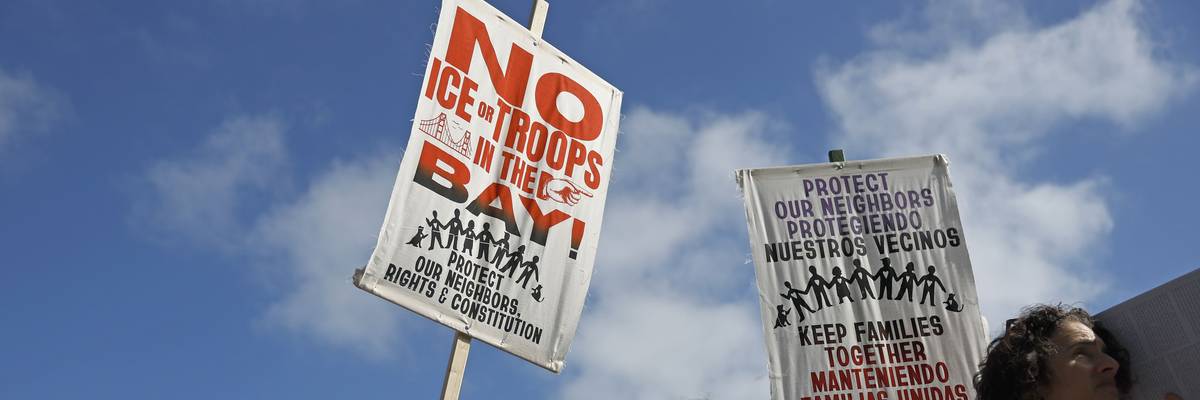
Protesters hold signs during an anti-ICE protest outside of San Francisco City Hall on October 23, 2025 in San Francisco, California.
"Maybe other cities should try to convince a wealthy tech CEO or two to keep the president from siccing his agents on them," quipped one writer.
After threatening for days to deploy troops to San Francisco, President Donald Trump announced Thursday that he would pull back for the moment, apparently after some of his billionaire "friends" in the city called him and asked him not to.
"The Federal Government was preparing to 'surge' San Francisco, California, on Saturday," Trump wrote on Truth Social. "But friends of mine who live in the area called last night to ask me not to go forward with the surge in that the Mayor, Daniel Lurie, was making substantial progress."
Trump said he "spoke to Mayor Lurie last night and he asked, very nicely, that I give him a chance to see if he can turn it around. I told [Lurie], I think he is making a mistake, because we can do it much faster, and remove the criminals that the Law does not permit him to remove. I told him, 'It's an easier process if we do it, faster, stronger, and safer but, let's see how you do?'"
In a separate post, Lurie affirmed that he had spoken with Trump. He said he told the president that "San Francisco is on the rise," and that a military occupation would "hinder our recovery."
Although Trump is walking back his troop threat, for now, US Customs and Border Protection agents still arrived in the Bay Area on Thursday as part of the Trump administration's crackdown on immigrants.
The Associated Press reported that "police used at least one flash-bang grenade to clear a handful of demonstrators from the entrance" of Coast Guard Island in Alameda, where the CBP agents will be based.
In addition to threatening San Francisco in recent days, Trump has sent National Guard troops to Los Angeles, California; Washington, DC; Portland, Oregon; and Chicago, Illinois—where a judge has halted the deployment.
Like virtually all of the cities where Trump has either surged or threatened to surge federalized troops, San Francisco has no crime wave to "turn around." In fact, crime has been falling precipitously in the city. Homicides dropped by 35% during 2024 and hit a 60-year low this year, contradicting Trump's assertions that the city is a "mess" and that people there lived in constant fear of being "mugged, murdered, robbed, raped, assaulted, or shot."
Lurie said he agreed to help Trump go to war on this imaginary crime wave, and said he would welcome "would welcome continued partnerships with the FBI, DEA, ATF, and US attorney."
Trump said he was persuaded to hold off on the surge of troops after he was called by two Silicon Valley billionaires, Marc Benioff and Jensen Huang, whom he called "great people."
Benioff, the CEO of Salesforce, was a longtime Democrat who quickly morphed into an outspoken Trump supporter after his victory in 2024. He was also an initial champion of Trump's proposal to send troops to San Francisco, but later backed off and even apologized after facing criticism from local officials and former political allies.
Huang, the CEO of the computer tech company Nvidia, meanwhile, cut an unprecedented deal with Trump in August that allowed the company to sell computer chips in China if it handed 15% of the revenue from those sales to the federal government, which was described as a "shakedown" by one financial columnist.
Trump said that these two and some unspecified "others" called him, "saying that the future of San Francisco is great" and that "they want to give [Lurie's efforts] a 'shot.'"
"Therefore," Trump said, "we will not surge San Francisco on Saturday."
Hafiz Rashid, a writer for the New Republic, quipped that "maybe other cities should try to convince a wealthy tech CEO or two to keep the president from siccing his agents on them."
Dear Common Dreams reader, It’s been nearly 30 years since I co-founded Common Dreams with my late wife, Lina Newhouser. We had the radical notion that journalism should serve the public good, not corporate profits. It was clear to us from the outset what it would take to build such a project. No paid advertisements. No corporate sponsors. No millionaire publisher telling us what to think or do. Many people said we wouldn't last a year, but we proved those doubters wrong. Together with a tremendous team of journalists and dedicated staff, we built an independent media outlet free from the constraints of profits and corporate control. Our mission has always been simple: To inform. To inspire. To ignite change for the common good. Building Common Dreams was not easy. Our survival was never guaranteed. When you take on the most powerful forces—Wall Street greed, fossil fuel industry destruction, Big Tech lobbyists, and uber-rich oligarchs who have spent billions upon billions rigging the economy and democracy in their favor—the only bulwark you have is supporters who believe in your work. But here’s the urgent message from me today. It's never been this bad out there. And it's never been this hard to keep us going. At the very moment Common Dreams is most needed, the threats we face are intensifying. We need your support now more than ever. We don't accept corporate advertising and never will. We don't have a paywall because we don't think people should be blocked from critical news based on their ability to pay. Everything we do is funded by the donations of readers like you. When everyone does the little they can afford, we are strong. But if that support retreats or dries up, so do we. Will you donate now to make sure Common Dreams not only survives but thrives? —Craig Brown, Co-founder |
After threatening for days to deploy troops to San Francisco, President Donald Trump announced Thursday that he would pull back for the moment, apparently after some of his billionaire "friends" in the city called him and asked him not to.
"The Federal Government was preparing to 'surge' San Francisco, California, on Saturday," Trump wrote on Truth Social. "But friends of mine who live in the area called last night to ask me not to go forward with the surge in that the Mayor, Daniel Lurie, was making substantial progress."
Trump said he "spoke to Mayor Lurie last night and he asked, very nicely, that I give him a chance to see if he can turn it around. I told [Lurie], I think he is making a mistake, because we can do it much faster, and remove the criminals that the Law does not permit him to remove. I told him, 'It's an easier process if we do it, faster, stronger, and safer but, let's see how you do?'"
In a separate post, Lurie affirmed that he had spoken with Trump. He said he told the president that "San Francisco is on the rise," and that a military occupation would "hinder our recovery."
Although Trump is walking back his troop threat, for now, US Customs and Border Protection agents still arrived in the Bay Area on Thursday as part of the Trump administration's crackdown on immigrants.
The Associated Press reported that "police used at least one flash-bang grenade to clear a handful of demonstrators from the entrance" of Coast Guard Island in Alameda, where the CBP agents will be based.
In addition to threatening San Francisco in recent days, Trump has sent National Guard troops to Los Angeles, California; Washington, DC; Portland, Oregon; and Chicago, Illinois—where a judge has halted the deployment.
Like virtually all of the cities where Trump has either surged or threatened to surge federalized troops, San Francisco has no crime wave to "turn around." In fact, crime has been falling precipitously in the city. Homicides dropped by 35% during 2024 and hit a 60-year low this year, contradicting Trump's assertions that the city is a "mess" and that people there lived in constant fear of being "mugged, murdered, robbed, raped, assaulted, or shot."
Lurie said he agreed to help Trump go to war on this imaginary crime wave, and said he would welcome "would welcome continued partnerships with the FBI, DEA, ATF, and US attorney."
Trump said he was persuaded to hold off on the surge of troops after he was called by two Silicon Valley billionaires, Marc Benioff and Jensen Huang, whom he called "great people."
Benioff, the CEO of Salesforce, was a longtime Democrat who quickly morphed into an outspoken Trump supporter after his victory in 2024. He was also an initial champion of Trump's proposal to send troops to San Francisco, but later backed off and even apologized after facing criticism from local officials and former political allies.
Huang, the CEO of the computer tech company Nvidia, meanwhile, cut an unprecedented deal with Trump in August that allowed the company to sell computer chips in China if it handed 15% of the revenue from those sales to the federal government, which was described as a "shakedown" by one financial columnist.
Trump said that these two and some unspecified "others" called him, "saying that the future of San Francisco is great" and that "they want to give [Lurie's efforts] a 'shot.'"
"Therefore," Trump said, "we will not surge San Francisco on Saturday."
Hafiz Rashid, a writer for the New Republic, quipped that "maybe other cities should try to convince a wealthy tech CEO or two to keep the president from siccing his agents on them."
After threatening for days to deploy troops to San Francisco, President Donald Trump announced Thursday that he would pull back for the moment, apparently after some of his billionaire "friends" in the city called him and asked him not to.
"The Federal Government was preparing to 'surge' San Francisco, California, on Saturday," Trump wrote on Truth Social. "But friends of mine who live in the area called last night to ask me not to go forward with the surge in that the Mayor, Daniel Lurie, was making substantial progress."
Trump said he "spoke to Mayor Lurie last night and he asked, very nicely, that I give him a chance to see if he can turn it around. I told [Lurie], I think he is making a mistake, because we can do it much faster, and remove the criminals that the Law does not permit him to remove. I told him, 'It's an easier process if we do it, faster, stronger, and safer but, let's see how you do?'"
In a separate post, Lurie affirmed that he had spoken with Trump. He said he told the president that "San Francisco is on the rise," and that a military occupation would "hinder our recovery."
Although Trump is walking back his troop threat, for now, US Customs and Border Protection agents still arrived in the Bay Area on Thursday as part of the Trump administration's crackdown on immigrants.
The Associated Press reported that "police used at least one flash-bang grenade to clear a handful of demonstrators from the entrance" of Coast Guard Island in Alameda, where the CBP agents will be based.
In addition to threatening San Francisco in recent days, Trump has sent National Guard troops to Los Angeles, California; Washington, DC; Portland, Oregon; and Chicago, Illinois—where a judge has halted the deployment.
Like virtually all of the cities where Trump has either surged or threatened to surge federalized troops, San Francisco has no crime wave to "turn around." In fact, crime has been falling precipitously in the city. Homicides dropped by 35% during 2024 and hit a 60-year low this year, contradicting Trump's assertions that the city is a "mess" and that people there lived in constant fear of being "mugged, murdered, robbed, raped, assaulted, or shot."
Lurie said he agreed to help Trump go to war on this imaginary crime wave, and said he would welcome "would welcome continued partnerships with the FBI, DEA, ATF, and US attorney."
Trump said he was persuaded to hold off on the surge of troops after he was called by two Silicon Valley billionaires, Marc Benioff and Jensen Huang, whom he called "great people."
Benioff, the CEO of Salesforce, was a longtime Democrat who quickly morphed into an outspoken Trump supporter after his victory in 2024. He was also an initial champion of Trump's proposal to send troops to San Francisco, but later backed off and even apologized after facing criticism from local officials and former political allies.
Huang, the CEO of the computer tech company Nvidia, meanwhile, cut an unprecedented deal with Trump in August that allowed the company to sell computer chips in China if it handed 15% of the revenue from those sales to the federal government, which was described as a "shakedown" by one financial columnist.
Trump said that these two and some unspecified "others" called him, "saying that the future of San Francisco is great" and that "they want to give [Lurie's efforts] a 'shot.'"
"Therefore," Trump said, "we will not surge San Francisco on Saturday."
Hafiz Rashid, a writer for the New Republic, quipped that "maybe other cities should try to convince a wealthy tech CEO or two to keep the president from siccing his agents on them."