SUBSCRIBE TO OUR FREE NEWSLETTER
Daily news & progressive opinion—funded by the people, not the corporations—delivered straight to your inbox.
5
#000000
#FFFFFF
To donate by check, phone, or other method, see our More Ways to Give page.
Daily news & progressive opinion—funded by the people, not the corporations—delivered straight to your inbox.
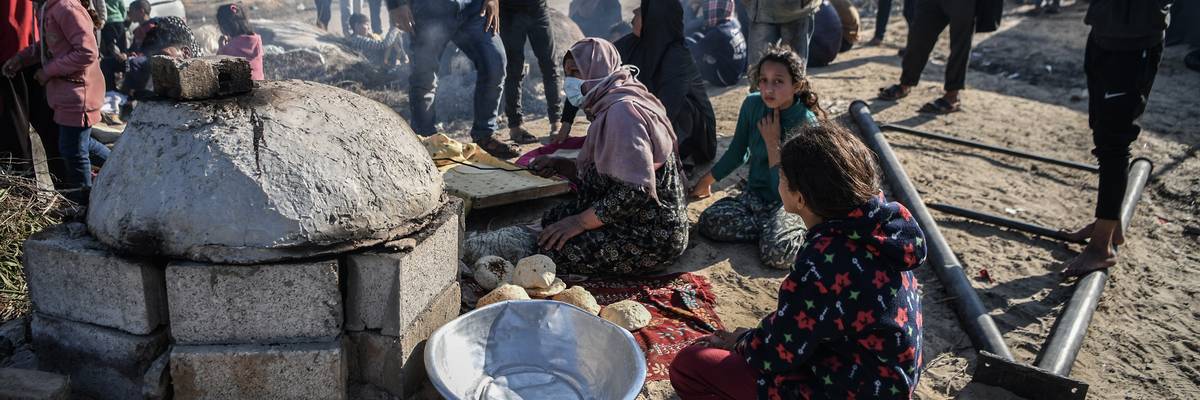
Displaced people prepare food in a clay oven in Rafah, Gaza on December 18, 2023.
Rising hunger in the Palestinian territory, said the head of the humanitarian group, is a "direct, damning, and predictable consequence of Israel's policy choices—and President Biden's unconditional support."
Oxfam America said Thursday that U.S. President Joe Biden's unwavering military and diplomatic support for the Israeli government has helped fuel a staggering rise in hunger in the Gaza Strip, where more than 90% of the population is facing acute food insecurity and the risk of famine is growing by the day.
That finding is from an alarming new analysis by the Integrated Food Security Phase Classification (IPC), which said Thursday that the entire population of Gaza is in crisis due to increasingly scarce food supplies—shortages caused by Israel's relentless bombing campaign and blockade.
"This is the highest share of people facing high levels of acute food insecurity that the IPC initiative has ever classified for any given area or country," the organization said.
More than half a million Gazans, according to the IPC, are "facing catastrophic conditions... characterized by households experiencing an extreme lack of food, starvation, and exhaustion of coping capacities."
Abby Maxman, president and CEO of Oxfam America, said in a
statement that the figures "are a direct, damning, and predictable consequence of Israel's policy choices—and President Biden's unconditional support and diplomatic approach."
“The U.S. government has repeatedly given Israel diplomatic cover, but now must urgently change course and put politics aside to prioritize the lives of civilians," said Maxman, demanding that the U.S. support a U.N. Security Council resolution calling for a suspension of the fighting and an acceleration of humanitarian aid.
"I have never seen something at the scale that is happening in Gaza. And at this speed." —Arif Hussain, World Food Program
The resolution that the U.N. Security Council is currently negotiating aims to put the U.N. in charge of monitoring the flow of humanitarian aid to Gaza—something that Israel and the United States are standing firmly against. The Biden administration has delayed a vote on the resolution several times this week, and many diplomats reportedly expect the U.S. to once again use its veto power to tank the measure.
Maxman said Thursday that the Biden administration "must use all of its influence to achieve an immediate cease-fire to stop the bloodshed, allow for the safe return of hostages to Israel, and allow aid and commercial goods in, so we can save lives now."
"The U.S. cannot continue to stand by and allow Palestinians to be starved to death," she added.
The IPC's new analysis is in line with harrowing testimony from ordinary Gazans who are struggling to survive Israel's siege, indiscriminate airstrikes, and ground assault.
One mother whose family, like so many others, has been left homeless by Israel's attack on the strip told Reuters that "her children had lost weight and were getting dizzy spells because they were not eating enough." A doctor in the southern Gaza city of Rafah told the news agency that "weight loss and anemia were common and people were so weak and dehydrated they were more susceptible to chest infections and skin conditions," with children most at risk.
Earlier this week, Human Rights Watch accused Israel of using starvation as a "method of warfare" in Gaza, destroying the territory's agricultural sector and bakeries while restricting the amount of aid allowed to enter the strip—collective punishment that the group said constitutes a war crime.
Arif Husain, chief economist for the World Food Program (WFP), told The Associated Press on Thursday that "it doesn't get any worse" than present conditions in the Gaza Strip.
"I have never seen something at the scale that is happening in Gaza. And at this speed," Husain added.
The WFP said Wednesday that 90% of Gazans are eating less than one meal per day. Compounding the disaster is the lack of uncontaminated water, fuel, and medical supplies, causing infectious diseases to spread.
In a statement on Thursday, the World Health Organization (WHO) warned that the "lethal combination of hunger and disease" is resulting in more death and suffering in Gaza, one of the most densely populated areas in the world.
"While a healthy body can more easily fight off these diseases, a wasted and weakened body will struggle," the WHO said. "Hunger weakens the body's defenses and opens the door to disease. Malnutrition increases the risk of children dying from illnesses like diarrhea, pneumonia, and measles, especially in a setting where they lack access to life-saving health services."
Noelia Monge, head of emergencies at Action Against Hunger, said in response to the IPC data that "everything we are doing is insufficient to meet the needs of 2 million people."
"We are experiencing a level of complexity in this emergency like I have never seen before," said Monge. "There are no supplies in the local market, and we can no longer reach areas in the north due to fighting and lack of transportation. It is a desperate situation."
Dear Common Dreams reader, It’s been nearly 30 years since I co-founded Common Dreams with my late wife, Lina Newhouser. We had the radical notion that journalism should serve the public good, not corporate profits. It was clear to us from the outset what it would take to build such a project. No paid advertisements. No corporate sponsors. No millionaire publisher telling us what to think or do. Many people said we wouldn't last a year, but we proved those doubters wrong. Together with a tremendous team of journalists and dedicated staff, we built an independent media outlet free from the constraints of profits and corporate control. Our mission has always been simple: To inform. To inspire. To ignite change for the common good. Building Common Dreams was not easy. Our survival was never guaranteed. When you take on the most powerful forces—Wall Street greed, fossil fuel industry destruction, Big Tech lobbyists, and uber-rich oligarchs who have spent billions upon billions rigging the economy and democracy in their favor—the only bulwark you have is supporters who believe in your work. But here’s the urgent message from me today. It's never been this bad out there. And it's never been this hard to keep us going. At the very moment Common Dreams is most needed, the threats we face are intensifying. We need your support now more than ever. We don't accept corporate advertising and never will. We don't have a paywall because we don't think people should be blocked from critical news based on their ability to pay. Everything we do is funded by the donations of readers like you. When everyone does the little they can afford, we are strong. But if that support retreats or dries up, so do we. Will you donate now to make sure Common Dreams not only survives but thrives? —Craig Brown, Co-founder |
Oxfam America said Thursday that U.S. President Joe Biden's unwavering military and diplomatic support for the Israeli government has helped fuel a staggering rise in hunger in the Gaza Strip, where more than 90% of the population is facing acute food insecurity and the risk of famine is growing by the day.
That finding is from an alarming new analysis by the Integrated Food Security Phase Classification (IPC), which said Thursday that the entire population of Gaza is in crisis due to increasingly scarce food supplies—shortages caused by Israel's relentless bombing campaign and blockade.
"This is the highest share of people facing high levels of acute food insecurity that the IPC initiative has ever classified for any given area or country," the organization said.
More than half a million Gazans, according to the IPC, are "facing catastrophic conditions... characterized by households experiencing an extreme lack of food, starvation, and exhaustion of coping capacities."
Abby Maxman, president and CEO of Oxfam America, said in a
statement that the figures "are a direct, damning, and predictable consequence of Israel's policy choices—and President Biden's unconditional support and diplomatic approach."
“The U.S. government has repeatedly given Israel diplomatic cover, but now must urgently change course and put politics aside to prioritize the lives of civilians," said Maxman, demanding that the U.S. support a U.N. Security Council resolution calling for a suspension of the fighting and an acceleration of humanitarian aid.
"I have never seen something at the scale that is happening in Gaza. And at this speed." —Arif Hussain, World Food Program
The resolution that the U.N. Security Council is currently negotiating aims to put the U.N. in charge of monitoring the flow of humanitarian aid to Gaza—something that Israel and the United States are standing firmly against. The Biden administration has delayed a vote on the resolution several times this week, and many diplomats reportedly expect the U.S. to once again use its veto power to tank the measure.
Maxman said Thursday that the Biden administration "must use all of its influence to achieve an immediate cease-fire to stop the bloodshed, allow for the safe return of hostages to Israel, and allow aid and commercial goods in, so we can save lives now."
"The U.S. cannot continue to stand by and allow Palestinians to be starved to death," she added.
The IPC's new analysis is in line with harrowing testimony from ordinary Gazans who are struggling to survive Israel's siege, indiscriminate airstrikes, and ground assault.
One mother whose family, like so many others, has been left homeless by Israel's attack on the strip told Reuters that "her children had lost weight and were getting dizzy spells because they were not eating enough." A doctor in the southern Gaza city of Rafah told the news agency that "weight loss and anemia were common and people were so weak and dehydrated they were more susceptible to chest infections and skin conditions," with children most at risk.
Earlier this week, Human Rights Watch accused Israel of using starvation as a "method of warfare" in Gaza, destroying the territory's agricultural sector and bakeries while restricting the amount of aid allowed to enter the strip—collective punishment that the group said constitutes a war crime.
Arif Husain, chief economist for the World Food Program (WFP), told The Associated Press on Thursday that "it doesn't get any worse" than present conditions in the Gaza Strip.
"I have never seen something at the scale that is happening in Gaza. And at this speed," Husain added.
The WFP said Wednesday that 90% of Gazans are eating less than one meal per day. Compounding the disaster is the lack of uncontaminated water, fuel, and medical supplies, causing infectious diseases to spread.
In a statement on Thursday, the World Health Organization (WHO) warned that the "lethal combination of hunger and disease" is resulting in more death and suffering in Gaza, one of the most densely populated areas in the world.
"While a healthy body can more easily fight off these diseases, a wasted and weakened body will struggle," the WHO said. "Hunger weakens the body's defenses and opens the door to disease. Malnutrition increases the risk of children dying from illnesses like diarrhea, pneumonia, and measles, especially in a setting where they lack access to life-saving health services."
Noelia Monge, head of emergencies at Action Against Hunger, said in response to the IPC data that "everything we are doing is insufficient to meet the needs of 2 million people."
"We are experiencing a level of complexity in this emergency like I have never seen before," said Monge. "There are no supplies in the local market, and we can no longer reach areas in the north due to fighting and lack of transportation. It is a desperate situation."
Oxfam America said Thursday that U.S. President Joe Biden's unwavering military and diplomatic support for the Israeli government has helped fuel a staggering rise in hunger in the Gaza Strip, where more than 90% of the population is facing acute food insecurity and the risk of famine is growing by the day.
That finding is from an alarming new analysis by the Integrated Food Security Phase Classification (IPC), which said Thursday that the entire population of Gaza is in crisis due to increasingly scarce food supplies—shortages caused by Israel's relentless bombing campaign and blockade.
"This is the highest share of people facing high levels of acute food insecurity that the IPC initiative has ever classified for any given area or country," the organization said.
More than half a million Gazans, according to the IPC, are "facing catastrophic conditions... characterized by households experiencing an extreme lack of food, starvation, and exhaustion of coping capacities."
Abby Maxman, president and CEO of Oxfam America, said in a
statement that the figures "are a direct, damning, and predictable consequence of Israel's policy choices—and President Biden's unconditional support and diplomatic approach."
“The U.S. government has repeatedly given Israel diplomatic cover, but now must urgently change course and put politics aside to prioritize the lives of civilians," said Maxman, demanding that the U.S. support a U.N. Security Council resolution calling for a suspension of the fighting and an acceleration of humanitarian aid.
"I have never seen something at the scale that is happening in Gaza. And at this speed." —Arif Hussain, World Food Program
The resolution that the U.N. Security Council is currently negotiating aims to put the U.N. in charge of monitoring the flow of humanitarian aid to Gaza—something that Israel and the United States are standing firmly against. The Biden administration has delayed a vote on the resolution several times this week, and many diplomats reportedly expect the U.S. to once again use its veto power to tank the measure.
Maxman said Thursday that the Biden administration "must use all of its influence to achieve an immediate cease-fire to stop the bloodshed, allow for the safe return of hostages to Israel, and allow aid and commercial goods in, so we can save lives now."
"The U.S. cannot continue to stand by and allow Palestinians to be starved to death," she added.
The IPC's new analysis is in line with harrowing testimony from ordinary Gazans who are struggling to survive Israel's siege, indiscriminate airstrikes, and ground assault.
One mother whose family, like so many others, has been left homeless by Israel's attack on the strip told Reuters that "her children had lost weight and were getting dizzy spells because they were not eating enough." A doctor in the southern Gaza city of Rafah told the news agency that "weight loss and anemia were common and people were so weak and dehydrated they were more susceptible to chest infections and skin conditions," with children most at risk.
Earlier this week, Human Rights Watch accused Israel of using starvation as a "method of warfare" in Gaza, destroying the territory's agricultural sector and bakeries while restricting the amount of aid allowed to enter the strip—collective punishment that the group said constitutes a war crime.
Arif Husain, chief economist for the World Food Program (WFP), told The Associated Press on Thursday that "it doesn't get any worse" than present conditions in the Gaza Strip.
"I have never seen something at the scale that is happening in Gaza. And at this speed," Husain added.
The WFP said Wednesday that 90% of Gazans are eating less than one meal per day. Compounding the disaster is the lack of uncontaminated water, fuel, and medical supplies, causing infectious diseases to spread.
In a statement on Thursday, the World Health Organization (WHO) warned that the "lethal combination of hunger and disease" is resulting in more death and suffering in Gaza, one of the most densely populated areas in the world.
"While a healthy body can more easily fight off these diseases, a wasted and weakened body will struggle," the WHO said. "Hunger weakens the body's defenses and opens the door to disease. Malnutrition increases the risk of children dying from illnesses like diarrhea, pneumonia, and measles, especially in a setting where they lack access to life-saving health services."
Noelia Monge, head of emergencies at Action Against Hunger, said in response to the IPC data that "everything we are doing is insufficient to meet the needs of 2 million people."
"We are experiencing a level of complexity in this emergency like I have never seen before," said Monge. "There are no supplies in the local market, and we can no longer reach areas in the north due to fighting and lack of transportation. It is a desperate situation."