SUBSCRIBE TO OUR FREE NEWSLETTER
Daily news & progressive opinion—funded by the people, not the corporations—delivered straight to your inbox.
5
#000000
#FFFFFF
To donate by check, phone, or other method, see our More Ways to Give page.
Daily news & progressive opinion—funded by the people, not the corporations—delivered straight to your inbox.
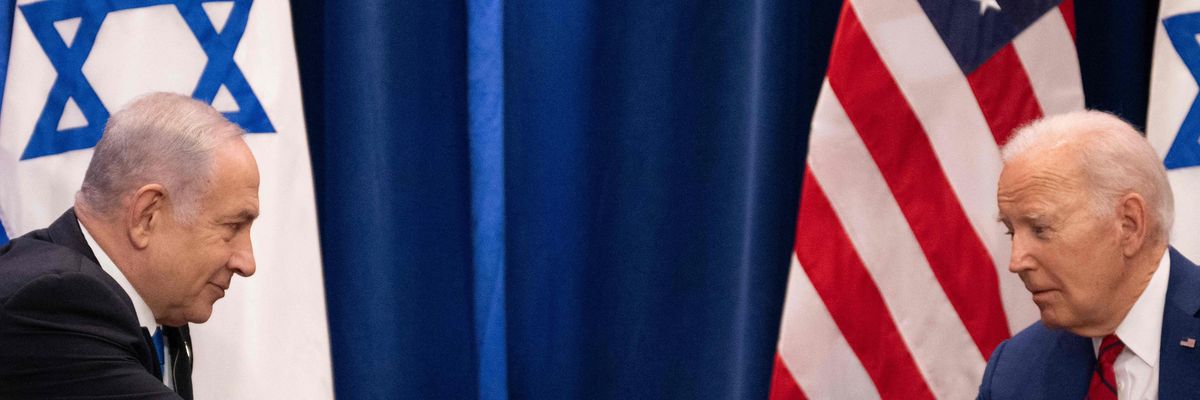
U.S. President Joe Biden shakes hands with Israeli Prime Minister Benjamin Netanyahu as they meet on the sidelines of the 78th United Nations General Assembly in New York City on September 20, 2023.
"It took me till Wednesday or Thursday to have the courage to say, 'I don't think it would be good for America if we are seen as responsible for killing Palestinian children,'" said one official. "There was awkward silence like a pin could drop."
Days after reporting revealed that State Department officials were cracking down on the use of any language in press materials that called for halting civilian casualties in Gaza, Biden administration staffers reported that a similar "culture of silence" has become pervasive across federal agencies since Hamas attacked Israel 11 days ago.
Despite claims by the White House that it welcomes "a range of views" in internal meetings on the crisis in Israel and Palestine, HuffPost reported that numerous staff members have had interactions in the last week and a half that left them feeling as though any criticism of Israel's U.S.-backed onslaught in Gaza, which has killed roughly 3,450 Palestinians, will not be tolerated.
One official told HuffPost that with U.S. President Joe Biden releasing a statement last week pledging support for Israel and asserting the country had the "right to defend itself" without any mention of limiting civilian casualties or operating within the bounds of international law, it took them several days to feel able to bring up the likely long-term consequences of a U.S.-backed massacre in Gaza.
"It took me till Wednesday or Thursday to have the courage to say, 'I don't think it would be good for America if we are seen as responsible for killing Palestinian children,'" the official told the outlet. "There was awkward silence like a pin could drop, and I'm like, 'Are they going to report me to the House Un-American Activities Committee?'"
"One reason to want a diverse staff is to have a variety of inputs into your decision-making... The inner, inner circle on these issues is not at all diverse."
The internal pressure to avoid questioning the administration's decision to provide Israel with additional military support has mirrored the White House's public-facing response, with Press Secretary Karine Jean-Pierre telling a reporter on October 10 that statements from progressive lawmakers who have called for a cease-fire were "repugnant" and "disgraceful."
Inside the White House, another official told HuffPost, "It feels like post-9/11 where you feel like your thoughts are being policed, and you're really afraid of being seen as anti-American or an antisemite."
Younger staffers have begun "self-censorship," a career federal employee told the outlet, with workers in national security-related posts in particular reporting fears of retaliation if they speak out against the United States' continued support for a campaign that has already killed and injured thousands and is expected to be even more destructive if Israel launches an expected ground assault.
Some of the concerns, which are especially prevalent among civil servants and staffers with Arab or Muslim backgrounds, have apparently reached high-level officials, as HuffPost reported White House Chief of Staff Jeff Zients is now planning to hold a "listening session with Muslim, Arab, and Palestinian staff to hear from them directly" about the crisis in the Middle East.
The staffers expressed doubt that the session will lead to the Biden administration rethinking its backing of Israel, where the U.S. has sent $260 billion in military and economic aid since World War II.
"One reason to want a diverse staff is to have a variety of inputs into your decision-making, not just to check a box on a little quota sheet—you want to benefit from the more informed decision-making that happens from a broader set of experiences having a seat at the table," a staff member told HuffPost. "The inner, inner circle on these issues is not at all diverse."
Mitchell Plitnick, president of nonprofit organization ReThinking Foreign Policy, said the anxiety among White House staffers who are concerned for Palestinian lives is reflective of "the 'thought police' nature of this administration, indeed this whole country, in 2023."
"The Biden administration should be calling for a cease-fire and working towards minimizing the loss of Palestinian and Israeli life," said IfNotNow, a Jewish-led Palestinian rights group, "not silencing staffers who care about the people in Gaza."
Dear Common Dreams reader, It’s been nearly 30 years since I co-founded Common Dreams with my late wife, Lina Newhouser. We had the radical notion that journalism should serve the public good, not corporate profits. It was clear to us from the outset what it would take to build such a project. No paid advertisements. No corporate sponsors. No millionaire publisher telling us what to think or do. Many people said we wouldn't last a year, but we proved those doubters wrong. Together with a tremendous team of journalists and dedicated staff, we built an independent media outlet free from the constraints of profits and corporate control. Our mission has always been simple: To inform. To inspire. To ignite change for the common good. Building Common Dreams was not easy. Our survival was never guaranteed. When you take on the most powerful forces—Wall Street greed, fossil fuel industry destruction, Big Tech lobbyists, and uber-rich oligarchs who have spent billions upon billions rigging the economy and democracy in their favor—the only bulwark you have is supporters who believe in your work. But here’s the urgent message from me today. It's never been this bad out there. And it's never been this hard to keep us going. At the very moment Common Dreams is most needed, the threats we face are intensifying. We need your support now more than ever. We don't accept corporate advertising and never will. We don't have a paywall because we don't think people should be blocked from critical news based on their ability to pay. Everything we do is funded by the donations of readers like you. When everyone does the little they can afford, we are strong. But if that support retreats or dries up, so do we. Will you donate now to make sure Common Dreams not only survives but thrives? —Craig Brown, Co-founder |
Days after reporting revealed that State Department officials were cracking down on the use of any language in press materials that called for halting civilian casualties in Gaza, Biden administration staffers reported that a similar "culture of silence" has become pervasive across federal agencies since Hamas attacked Israel 11 days ago.
Despite claims by the White House that it welcomes "a range of views" in internal meetings on the crisis in Israel and Palestine, HuffPost reported that numerous staff members have had interactions in the last week and a half that left them feeling as though any criticism of Israel's U.S.-backed onslaught in Gaza, which has killed roughly 3,450 Palestinians, will not be tolerated.
One official told HuffPost that with U.S. President Joe Biden releasing a statement last week pledging support for Israel and asserting the country had the "right to defend itself" without any mention of limiting civilian casualties or operating within the bounds of international law, it took them several days to feel able to bring up the likely long-term consequences of a U.S.-backed massacre in Gaza.
"It took me till Wednesday or Thursday to have the courage to say, 'I don't think it would be good for America if we are seen as responsible for killing Palestinian children,'" the official told the outlet. "There was awkward silence like a pin could drop, and I'm like, 'Are they going to report me to the House Un-American Activities Committee?'"
"One reason to want a diverse staff is to have a variety of inputs into your decision-making... The inner, inner circle on these issues is not at all diverse."
The internal pressure to avoid questioning the administration's decision to provide Israel with additional military support has mirrored the White House's public-facing response, with Press Secretary Karine Jean-Pierre telling a reporter on October 10 that statements from progressive lawmakers who have called for a cease-fire were "repugnant" and "disgraceful."
Inside the White House, another official told HuffPost, "It feels like post-9/11 where you feel like your thoughts are being policed, and you're really afraid of being seen as anti-American or an antisemite."
Younger staffers have begun "self-censorship," a career federal employee told the outlet, with workers in national security-related posts in particular reporting fears of retaliation if they speak out against the United States' continued support for a campaign that has already killed and injured thousands and is expected to be even more destructive if Israel launches an expected ground assault.
Some of the concerns, which are especially prevalent among civil servants and staffers with Arab or Muslim backgrounds, have apparently reached high-level officials, as HuffPost reported White House Chief of Staff Jeff Zients is now planning to hold a "listening session with Muslim, Arab, and Palestinian staff to hear from them directly" about the crisis in the Middle East.
The staffers expressed doubt that the session will lead to the Biden administration rethinking its backing of Israel, where the U.S. has sent $260 billion in military and economic aid since World War II.
"One reason to want a diverse staff is to have a variety of inputs into your decision-making, not just to check a box on a little quota sheet—you want to benefit from the more informed decision-making that happens from a broader set of experiences having a seat at the table," a staff member told HuffPost. "The inner, inner circle on these issues is not at all diverse."
Mitchell Plitnick, president of nonprofit organization ReThinking Foreign Policy, said the anxiety among White House staffers who are concerned for Palestinian lives is reflective of "the 'thought police' nature of this administration, indeed this whole country, in 2023."
"The Biden administration should be calling for a cease-fire and working towards minimizing the loss of Palestinian and Israeli life," said IfNotNow, a Jewish-led Palestinian rights group, "not silencing staffers who care about the people in Gaza."
Days after reporting revealed that State Department officials were cracking down on the use of any language in press materials that called for halting civilian casualties in Gaza, Biden administration staffers reported that a similar "culture of silence" has become pervasive across federal agencies since Hamas attacked Israel 11 days ago.
Despite claims by the White House that it welcomes "a range of views" in internal meetings on the crisis in Israel and Palestine, HuffPost reported that numerous staff members have had interactions in the last week and a half that left them feeling as though any criticism of Israel's U.S.-backed onslaught in Gaza, which has killed roughly 3,450 Palestinians, will not be tolerated.
One official told HuffPost that with U.S. President Joe Biden releasing a statement last week pledging support for Israel and asserting the country had the "right to defend itself" without any mention of limiting civilian casualties or operating within the bounds of international law, it took them several days to feel able to bring up the likely long-term consequences of a U.S.-backed massacre in Gaza.
"It took me till Wednesday or Thursday to have the courage to say, 'I don't think it would be good for America if we are seen as responsible for killing Palestinian children,'" the official told the outlet. "There was awkward silence like a pin could drop, and I'm like, 'Are they going to report me to the House Un-American Activities Committee?'"
"One reason to want a diverse staff is to have a variety of inputs into your decision-making... The inner, inner circle on these issues is not at all diverse."
The internal pressure to avoid questioning the administration's decision to provide Israel with additional military support has mirrored the White House's public-facing response, with Press Secretary Karine Jean-Pierre telling a reporter on October 10 that statements from progressive lawmakers who have called for a cease-fire were "repugnant" and "disgraceful."
Inside the White House, another official told HuffPost, "It feels like post-9/11 where you feel like your thoughts are being policed, and you're really afraid of being seen as anti-American or an antisemite."
Younger staffers have begun "self-censorship," a career federal employee told the outlet, with workers in national security-related posts in particular reporting fears of retaliation if they speak out against the United States' continued support for a campaign that has already killed and injured thousands and is expected to be even more destructive if Israel launches an expected ground assault.
Some of the concerns, which are especially prevalent among civil servants and staffers with Arab or Muslim backgrounds, have apparently reached high-level officials, as HuffPost reported White House Chief of Staff Jeff Zients is now planning to hold a "listening session with Muslim, Arab, and Palestinian staff to hear from them directly" about the crisis in the Middle East.
The staffers expressed doubt that the session will lead to the Biden administration rethinking its backing of Israel, where the U.S. has sent $260 billion in military and economic aid since World War II.
"One reason to want a diverse staff is to have a variety of inputs into your decision-making, not just to check a box on a little quota sheet—you want to benefit from the more informed decision-making that happens from a broader set of experiences having a seat at the table," a staff member told HuffPost. "The inner, inner circle on these issues is not at all diverse."
Mitchell Plitnick, president of nonprofit organization ReThinking Foreign Policy, said the anxiety among White House staffers who are concerned for Palestinian lives is reflective of "the 'thought police' nature of this administration, indeed this whole country, in 2023."
"The Biden administration should be calling for a cease-fire and working towards minimizing the loss of Palestinian and Israeli life," said IfNotNow, a Jewish-led Palestinian rights group, "not silencing staffers who care about the people in Gaza."