SUBSCRIBE TO OUR FREE NEWSLETTER
Daily news & progressive opinion—funded by the people, not the corporations—delivered straight to your inbox.
5
#000000
#FFFFFF
To donate by check, phone, or other method, see our More Ways to Give page.
Polling released Wednesday by Gallup and the John S. and James L. Knight Foundation reveals half of American adults "feel most national news organizations intend to mislead, misinform, or persuade the public," which could impact the future of both the industry and U.S. democracy.
The report is the second in a series that began with a publication in October and builds on a body of research that Gallup and the Knight Foundation have conducted about Americans' trust in the news media since 2017.
"This data offers further evidence that sustainable journalism begins and ends with trust," said Knight Foundation president Alberto Ibargüen in a statement. "We believe a citizenry that trusts the news is more informed, more engaged, and better prepared to participate meaningfully in our democracy."
Key findings from the latest survey include that 53% of about 5,600 Americans across political affiliations have an unfavorable view of the U.S. news media overall, compared with just 26% who hold a favorable view. In line with previous polling, younger adults have less favorable views.
"Americans don't seem to think that the national news organizations care about the overall impact of their reporting on the society."
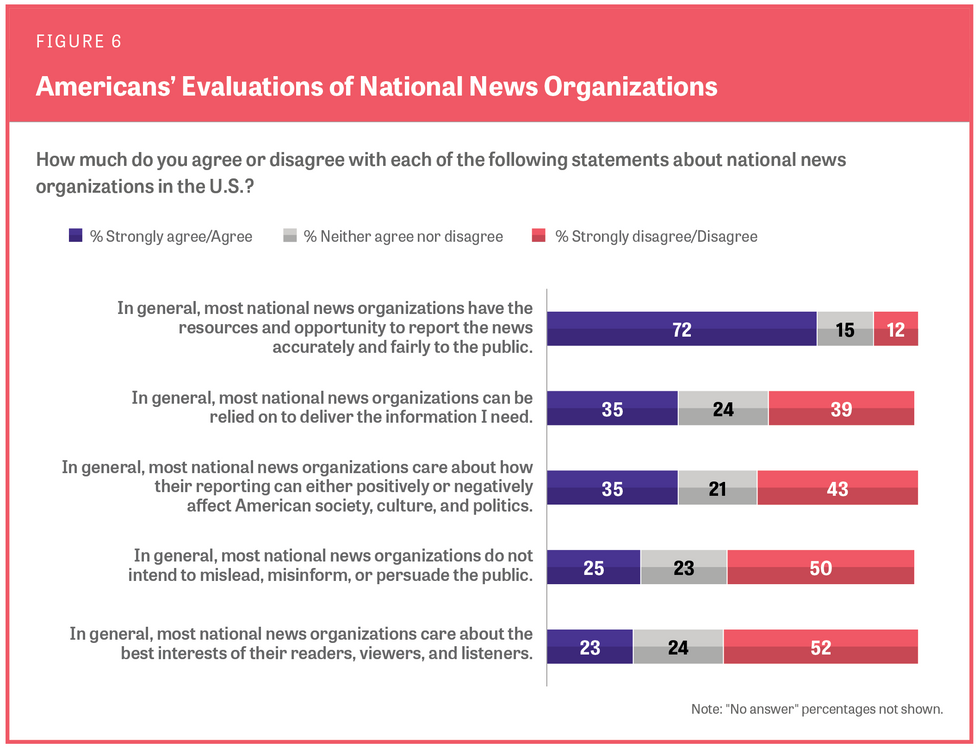
The survey shows a stark difference between how Americans view national versus local media. While nearly three-quarters believe national outlets "have the resources and opportunity to report the news accurately and fairly to the public," just 35% think such organizations can be relied on to provide needed information and generally care about the impact of their reporting.
"Americans don't seem to think that the national news organizations care about the overall impact of their reporting on the society," John Sands, senior director for media and democracy at the Knight Foundation, told The Associated Press.
According to the polling, 52% of Americans don't believe that most national news organizations "care about the best interests of their readers, viewers, and listeners." Just 23% say national media do care about those interests.
"That was pretty striking for us," Gallup consultant Sarah Fioroni told the AP. Summarizing her, the outlet added that "the findings showed a depth of distrust and bad feeling that go beyond the foundations and processes of journalism."
Meanwhile, when it comes to local news, 65% say such organizations have the resources they need. Over half of those surveyed also think that most local outlets care about the impact of their reporting and can be trusted to deliver needed information.
Additionally, nearly half of the respondents believe that local media care about readers, viewers, and listeners, and that such outlets do not intend to mislead, misinform, or persuade the public.

The researchers also examined emotional trust in media and found similar trends: 44% have high emotional trust in local media, while only 18% have low trust in these outlets; 41% report low trust in national news, and just 21% say they have high trust in such organizations.
"Nearly half (47%) of Americans who prefer to get most of their news online report low emotional trust in national news organizations, while only 15% report high emotional trust," the report notes. "In contrast, only 28% of Americans who prefer to get most of their news from television report low emotional trust in national news."
According to the publication:
The pollsters found that "low emotional trust in national news is associated with feeling unable to sort out facts or be well-informed." It is also linked to "a negative outlook on the state of our democracy" and being "more doubtful of the political process and the opinions of experts."
There is also a potential financial impact of low trust in media. The report says that "the more emotional trust Americans have in news organizations, the more willing they are to pay for news in the future."
"This study affirms the importance of a more nuanced understanding of Americans' deeply rooted and growing distrust of the national news media," the publication stresses. "The data provide compelling evidence that efforts by national news organizations to gain the trust of the public may need to focus on communicating more directly with audiences about how their reporting affects society at large."
"While emphasizing transparency and accuracy in news remains important, it is just as important for news organizations to demonstrate the care they have for their readers, listeners, or viewers," the report adds. "Having a financially stable fourth estate that fuels confidence in Americans' ability to be well-informed and greater optimism about the state of U.S. democracy today may depend on it."
Last year, when the survey was conducted, national corporate media outlets came under fire for the quality of reporting on issues including GOP efforts to cut Medicare and Social Security, inflation, student loan debt cancellation, and threats to reproductive rights.
The poll results come as former President Donald Trump—known for his frequent declarations of "fake news" and attacks on the media that were embraced and echoed by his supporters—seeks the GOP presidential nomination for 2024. Rolling Stone reported in November that Trump was soliciting advice for imprisoning journalists if he is reelected.
Polling released Wednesday by Gallup and the John S. and James L. Knight Foundation reveals half of American adults "feel most national news organizations intend to mislead, misinform, or persuade the public," which could impact the future of both the industry and U.S. democracy.
The report is the second in a series that began with a publication in October and builds on a body of research that Gallup and the Knight Foundation have conducted about Americans' trust in the news media since 2017.
"This data offers further evidence that sustainable journalism begins and ends with trust," said Knight Foundation president Alberto Ibargüen in a statement. "We believe a citizenry that trusts the news is more informed, more engaged, and better prepared to participate meaningfully in our democracy."
Key findings from the latest survey include that 53% of about 5,600 Americans across political affiliations have an unfavorable view of the U.S. news media overall, compared with just 26% who hold a favorable view. In line with previous polling, younger adults have less favorable views.
"Americans don't seem to think that the national news organizations care about the overall impact of their reporting on the society."
The survey shows a stark difference between how Americans view national versus local media. While nearly three-quarters believe national outlets "have the resources and opportunity to report the news accurately and fairly to the public," just 35% think such organizations can be relied on to provide needed information and generally care about the impact of their reporting.
"Americans don't seem to think that the national news organizations care about the overall impact of their reporting on the society," John Sands, senior director for media and democracy at the Knight Foundation, told The Associated Press.
According to the polling, 52% of Americans don't believe that most national news organizations "care about the best interests of their readers, viewers, and listeners." Just 23% say national media do care about those interests.
"That was pretty striking for us," Gallup consultant Sarah Fioroni told the AP. Summarizing her, the outlet added that "the findings showed a depth of distrust and bad feeling that go beyond the foundations and processes of journalism."
Meanwhile, when it comes to local news, 65% say such organizations have the resources they need. Over half of those surveyed also think that most local outlets care about the impact of their reporting and can be trusted to deliver needed information.
Additionally, nearly half of the respondents believe that local media care about readers, viewers, and listeners, and that such outlets do not intend to mislead, misinform, or persuade the public.
The researchers also examined emotional trust in media and found similar trends: 44% have high emotional trust in local media, while only 18% have low trust in these outlets; 41% report low trust in national news, and just 21% say they have high trust in such organizations.
"Nearly half (47%) of Americans who prefer to get most of their news online report low emotional trust in national news organizations, while only 15% report high emotional trust," the report notes. "In contrast, only 28% of Americans who prefer to get most of their news from television report low emotional trust in national news."
According to the publication:
The pollsters found that "low emotional trust in national news is associated with feeling unable to sort out facts or be well-informed." It is also linked to "a negative outlook on the state of our democracy" and being "more doubtful of the political process and the opinions of experts."
There is also a potential financial impact of low trust in media. The report says that "the more emotional trust Americans have in news organizations, the more willing they are to pay for news in the future."
"This study affirms the importance of a more nuanced understanding of Americans' deeply rooted and growing distrust of the national news media," the publication stresses. "The data provide compelling evidence that efforts by national news organizations to gain the trust of the public may need to focus on communicating more directly with audiences about how their reporting affects society at large."
"While emphasizing transparency and accuracy in news remains important, it is just as important for news organizations to demonstrate the care they have for their readers, listeners, or viewers," the report adds. "Having a financially stable fourth estate that fuels confidence in Americans' ability to be well-informed and greater optimism about the state of U.S. democracy today may depend on it."
Last year, when the survey was conducted, national corporate media outlets came under fire for the quality of reporting on issues including GOP efforts to cut Medicare and Social Security, inflation, student loan debt cancellation, and threats to reproductive rights.
The poll results come as former President Donald Trump—known for his frequent declarations of "fake news" and attacks on the media that were embraced and echoed by his supporters—seeks the GOP presidential nomination for 2024. Rolling Stone reported in November that Trump was soliciting advice for imprisoning journalists if he is reelected.
Polling released Wednesday by Gallup and the John S. and James L. Knight Foundation reveals half of American adults "feel most national news organizations intend to mislead, misinform, or persuade the public," which could impact the future of both the industry and U.S. democracy.
The report is the second in a series that began with a publication in October and builds on a body of research that Gallup and the Knight Foundation have conducted about Americans' trust in the news media since 2017.
"This data offers further evidence that sustainable journalism begins and ends with trust," said Knight Foundation president Alberto Ibargüen in a statement. "We believe a citizenry that trusts the news is more informed, more engaged, and better prepared to participate meaningfully in our democracy."
Key findings from the latest survey include that 53% of about 5,600 Americans across political affiliations have an unfavorable view of the U.S. news media overall, compared with just 26% who hold a favorable view. In line with previous polling, younger adults have less favorable views.
"Americans don't seem to think that the national news organizations care about the overall impact of their reporting on the society."
The survey shows a stark difference between how Americans view national versus local media. While nearly three-quarters believe national outlets "have the resources and opportunity to report the news accurately and fairly to the public," just 35% think such organizations can be relied on to provide needed information and generally care about the impact of their reporting.
"Americans don't seem to think that the national news organizations care about the overall impact of their reporting on the society," John Sands, senior director for media and democracy at the Knight Foundation, told The Associated Press.
According to the polling, 52% of Americans don't believe that most national news organizations "care about the best interests of their readers, viewers, and listeners." Just 23% say national media do care about those interests.
"That was pretty striking for us," Gallup consultant Sarah Fioroni told the AP. Summarizing her, the outlet added that "the findings showed a depth of distrust and bad feeling that go beyond the foundations and processes of journalism."
Meanwhile, when it comes to local news, 65% say such organizations have the resources they need. Over half of those surveyed also think that most local outlets care about the impact of their reporting and can be trusted to deliver needed information.
Additionally, nearly half of the respondents believe that local media care about readers, viewers, and listeners, and that such outlets do not intend to mislead, misinform, or persuade the public.
The researchers also examined emotional trust in media and found similar trends: 44% have high emotional trust in local media, while only 18% have low trust in these outlets; 41% report low trust in national news, and just 21% say they have high trust in such organizations.
"Nearly half (47%) of Americans who prefer to get most of their news online report low emotional trust in national news organizations, while only 15% report high emotional trust," the report notes. "In contrast, only 28% of Americans who prefer to get most of their news from television report low emotional trust in national news."
According to the publication:
The pollsters found that "low emotional trust in national news is associated with feeling unable to sort out facts or be well-informed." It is also linked to "a negative outlook on the state of our democracy" and being "more doubtful of the political process and the opinions of experts."
There is also a potential financial impact of low trust in media. The report says that "the more emotional trust Americans have in news organizations, the more willing they are to pay for news in the future."
"This study affirms the importance of a more nuanced understanding of Americans' deeply rooted and growing distrust of the national news media," the publication stresses. "The data provide compelling evidence that efforts by national news organizations to gain the trust of the public may need to focus on communicating more directly with audiences about how their reporting affects society at large."
"While emphasizing transparency and accuracy in news remains important, it is just as important for news organizations to demonstrate the care they have for their readers, listeners, or viewers," the report adds. "Having a financially stable fourth estate that fuels confidence in Americans' ability to be well-informed and greater optimism about the state of U.S. democracy today may depend on it."
Last year, when the survey was conducted, national corporate media outlets came under fire for the quality of reporting on issues including GOP efforts to cut Medicare and Social Security, inflation, student loan debt cancellation, and threats to reproductive rights.
The poll results come as former President Donald Trump—known for his frequent declarations of "fake news" and attacks on the media that were embraced and echoed by his supporters—seeks the GOP presidential nomination for 2024. Rolling Stone reported in November that Trump was soliciting advice for imprisoning journalists if he is reelected.