
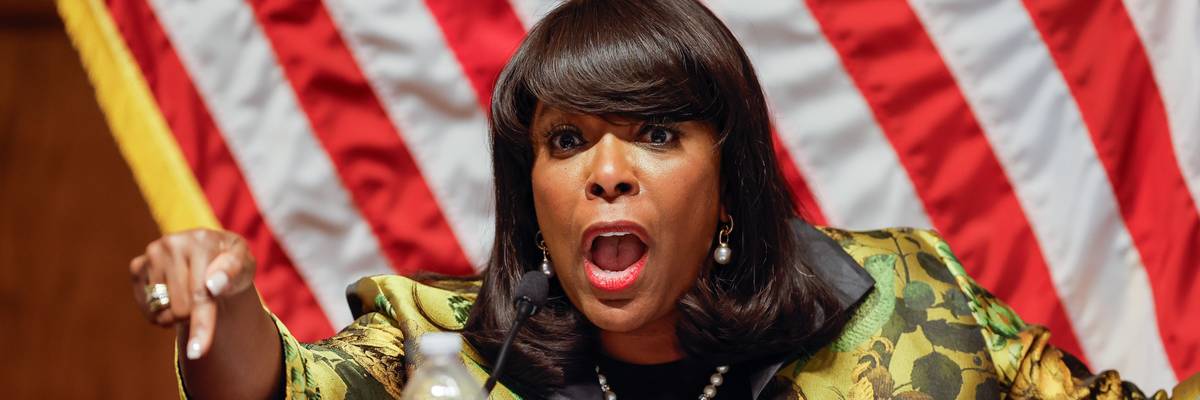
U.S. Rep. Terri Sewell (D-Ala.) convenes civil rights leaders at the 16th Street Baptist Church in Birmingham to strategize on a path forward for voting rights on June 28, 2023.
Alabama Voters Prep for Another Map Fight After Republicans Flout SCOTUS Ruling
A group of plaintiffs pledged not to rest until the state "complies with the Voting Rights Act and enacts a map with two districts where Black voters have a real opportunity to elect their candidates of choice."
Voters in Alabama are preparing for another legal battle after the state's GOP-dominated Legislature and Republican Gov. Kay Ivey on Friday approved new congressional districts that critics say defy a surprising recent decision from the U.S. Supreme Court.
The latest map "is really a slap in the face, not only to Black Alabamians but to the Supreme Court," state Rep. Barbara Drummond (D-103) asserted during a floor debate this week, according to ABC News.
Legal experts and voting rights advocates were shocked last month when two right-wing members of the high court joined the three liberal justices for a ruling in Allen v. Milligan that sided with Black voters who argued that Alabama's map was racially gerrymandered by the state's GOP legislators in violation of the federal Voting Rights Act (VRA).
"Following the U.S. Supreme Court order, I called the Alabama Legislature into a special session to readdress our congressional map," Ivey said Friday. "The Legislature knows our state, our people, and our districts better than the federal courts or activist groups, and I am pleased that they answered the call, remained focused, and produced new districts ahead of the court deadline."
Meanwhile, Scott Douglas, executive director at Greater Birmingham Ministries, one of the Allen plaintiffs, declared Friday that "Alabama lawmakers appear hell-bent on preventing Black voters from fully participating in the democratic process and they are blatantly ignoring their constituents, federal law, and the highest court of the land to disenfranchise us."
"Alabama lawmakers appear hell-bent on preventing Black voters from fully participating in the democratic process."
The plaintiffs from Allen—represented by the Alabama and national ACLU, the Legal Defense Fund, and two law firms—have already pledged to challenge the updated map, which was sponsored by state Sen. Steve Livingston (R-8) and does not include a second majority-Black district.
"Let's be clear: The Alabama Legislature believes it is above the law. What we are dealing with is a group of lawmakers who are blatantly disregarding not just the Voting Rights Act, but a decision from the U.S. Supreme Court and a court order from the three-judge district court," the plaintiffs said Friday in a joint statement.
"Even worse, they continue to ignore constituents' pleas to ensure the map is fair and instead remain determined to rob Black voters of the representation we deserve. We won't let that happen," they added. "Since the beginning of the redistricting process, we have testified before the state Legislature, sent letters, and proposed maps—then we sued to defend Black representation and won. We will not rest until the state of Alabama complies with the Voting Rights Act and enacts a map with two districts where Black voters have a real opportunity to elect their candidates of choice and the Legislature fulfills its duty to obey the law."
A federal court hearing about the new districts is set for August 14. As The Associated Press reported Saturday:
The state's Republican legislative supermajority boosted the percentage of Black voters in the majority-white 2nd Congressional District, now represented by Republican Rep. Barry Moore, from about 31% to almost 40%. The plan also dropped the Black voting-age population in the state's sole majority Black district, now represented by Democratic Rep. Terri Sewell, to 50.65%.
[...]
Republicans, who have been reluctant to create a Democratic-leaning district, are gambling that the court will accept their proposal or that the state will prevail in a second round of appeals.
The office of Republican Alabama Attorney General Steve Marshall claimed that "the Legislature's new plan fully and fairly applies traditional principles in a way that complies with the Voting Rights Act."
"Contrary to mainstream media talking points, the Supreme Court did not hold that Alabama must draw two majority-minority districts," the office added. "Instead, the court made clear that the VRA never requires adoption of districts that violate traditional redistricting principles."
However, Sewell said in a statement that "the Supreme Court was very clear... This map does not comply with the Supreme Court's order and is an insult to Black voters across our state. I fully expect that it will be rejected by the courts."
If a three-judge panel finds that the Alabama districts approved Friday violate the VRA, it can appoint a special master to draw another map. Political boundaries for the 2024 election could help determine who has a majority in the U.S. House of Representatives, which is now narrowly controlled by the fractured Republican Party.
Citing GOP attacks on voting rights, Democrats in the U.S. House and Senate on Tuesday reintroduced the Freedom to Vote Act—a move that was widely praised by democracy defenders, even though the bill is unlikely to pass this session given current divisions in Congress.
We are at a crossroads
This country and this world are at a monumental crossroads. In a few short weeks, US voters will have an opportunity to beat back the forces of fascism and confront the billionaires who are rigging the economy, our media system, and our democracy, making it increasingly impossible for ordinary people to get by. We’re not just talking about the election. We’re talking about what must be done once these fascist elements are vanquished from power. We need a bolder set of solutions than what either major party has so far been willing to offer and a working-class movement ready to fight like hell for it. Trump didn't emerge from nowhere. The conditions that fueled MAGA authoritarianism were created by decades of radical neoliberal economic policies and a corrupt political system dominated by corporate interests. They slashed taxes on the super-rich, promising that the benefits would trickle down. They said giveaways to the corporate titans would make life more affordable for the rest of us. It was all bullshit. And when a bitter, betrayed populace searches for someone to blame, right-wing demagogues have little trouble finding scapegoats. People know when they're being lied to, but you won't hear any of this from the corporate media. Only independent journalism—powered and funded by people who believe in building a better world—can deliver truly trustworthy daily news. Our Fall Campaign is underway, and we need your help. To power our newsroom through the rest of the year, we need to raise $125,000 by midnight on October 31. So if you share our vision, please contribute whatever you can to sustain our work. |
Voters in Alabama are preparing for another legal battle after the state's GOP-dominated Legislature and Republican Gov. Kay Ivey on Friday approved new congressional districts that critics say defy a surprising recent decision from the U.S. Supreme Court.
The latest map "is really a slap in the face, not only to Black Alabamians but to the Supreme Court," state Rep. Barbara Drummond (D-103) asserted during a floor debate this week, according to ABC News.
Legal experts and voting rights advocates were shocked last month when two right-wing members of the high court joined the three liberal justices for a ruling in Allen v. Milligan that sided with Black voters who argued that Alabama's map was racially gerrymandered by the state's GOP legislators in violation of the federal Voting Rights Act (VRA).
"Following the U.S. Supreme Court order, I called the Alabama Legislature into a special session to readdress our congressional map," Ivey said Friday. "The Legislature knows our state, our people, and our districts better than the federal courts or activist groups, and I am pleased that they answered the call, remained focused, and produced new districts ahead of the court deadline."
Meanwhile, Scott Douglas, executive director at Greater Birmingham Ministries, one of the Allen plaintiffs, declared Friday that "Alabama lawmakers appear hell-bent on preventing Black voters from fully participating in the democratic process and they are blatantly ignoring their constituents, federal law, and the highest court of the land to disenfranchise us."
"Alabama lawmakers appear hell-bent on preventing Black voters from fully participating in the democratic process."
The plaintiffs from Allen—represented by the Alabama and national ACLU, the Legal Defense Fund, and two law firms—have already pledged to challenge the updated map, which was sponsored by state Sen. Steve Livingston (R-8) and does not include a second majority-Black district.
"Let's be clear: The Alabama Legislature believes it is above the law. What we are dealing with is a group of lawmakers who are blatantly disregarding not just the Voting Rights Act, but a decision from the U.S. Supreme Court and a court order from the three-judge district court," the plaintiffs said Friday in a joint statement.
"Even worse, they continue to ignore constituents' pleas to ensure the map is fair and instead remain determined to rob Black voters of the representation we deserve. We won't let that happen," they added. "Since the beginning of the redistricting process, we have testified before the state Legislature, sent letters, and proposed maps—then we sued to defend Black representation and won. We will not rest until the state of Alabama complies with the Voting Rights Act and enacts a map with two districts where Black voters have a real opportunity to elect their candidates of choice and the Legislature fulfills its duty to obey the law."
A federal court hearing about the new districts is set for August 14. As The Associated Press reported Saturday:
The state's Republican legislative supermajority boosted the percentage of Black voters in the majority-white 2nd Congressional District, now represented by Republican Rep. Barry Moore, from about 31% to almost 40%. The plan also dropped the Black voting-age population in the state's sole majority Black district, now represented by Democratic Rep. Terri Sewell, to 50.65%.
[...]
Republicans, who have been reluctant to create a Democratic-leaning district, are gambling that the court will accept their proposal or that the state will prevail in a second round of appeals.
The office of Republican Alabama Attorney General Steve Marshall claimed that "the Legislature's new plan fully and fairly applies traditional principles in a way that complies with the Voting Rights Act."
"Contrary to mainstream media talking points, the Supreme Court did not hold that Alabama must draw two majority-minority districts," the office added. "Instead, the court made clear that the VRA never requires adoption of districts that violate traditional redistricting principles."
However, Sewell said in a statement that "the Supreme Court was very clear... This map does not comply with the Supreme Court's order and is an insult to Black voters across our state. I fully expect that it will be rejected by the courts."
If a three-judge panel finds that the Alabama districts approved Friday violate the VRA, it can appoint a special master to draw another map. Political boundaries for the 2024 election could help determine who has a majority in the U.S. House of Representatives, which is now narrowly controlled by the fractured Republican Party.
Citing GOP attacks on voting rights, Democrats in the U.S. House and Senate on Tuesday reintroduced the Freedom to Vote Act—a move that was widely praised by democracy defenders, even though the bill is unlikely to pass this session given current divisions in Congress.
Voters in Alabama are preparing for another legal battle after the state's GOP-dominated Legislature and Republican Gov. Kay Ivey on Friday approved new congressional districts that critics say defy a surprising recent decision from the U.S. Supreme Court.
The latest map "is really a slap in the face, not only to Black Alabamians but to the Supreme Court," state Rep. Barbara Drummond (D-103) asserted during a floor debate this week, according to ABC News.
Legal experts and voting rights advocates were shocked last month when two right-wing members of the high court joined the three liberal justices for a ruling in Allen v. Milligan that sided with Black voters who argued that Alabama's map was racially gerrymandered by the state's GOP legislators in violation of the federal Voting Rights Act (VRA).
"Following the U.S. Supreme Court order, I called the Alabama Legislature into a special session to readdress our congressional map," Ivey said Friday. "The Legislature knows our state, our people, and our districts better than the federal courts or activist groups, and I am pleased that they answered the call, remained focused, and produced new districts ahead of the court deadline."
Meanwhile, Scott Douglas, executive director at Greater Birmingham Ministries, one of the Allen plaintiffs, declared Friday that "Alabama lawmakers appear hell-bent on preventing Black voters from fully participating in the democratic process and they are blatantly ignoring their constituents, federal law, and the highest court of the land to disenfranchise us."
"Alabama lawmakers appear hell-bent on preventing Black voters from fully participating in the democratic process."
The plaintiffs from Allen—represented by the Alabama and national ACLU, the Legal Defense Fund, and two law firms—have already pledged to challenge the updated map, which was sponsored by state Sen. Steve Livingston (R-8) and does not include a second majority-Black district.
"Let's be clear: The Alabama Legislature believes it is above the law. What we are dealing with is a group of lawmakers who are blatantly disregarding not just the Voting Rights Act, but a decision from the U.S. Supreme Court and a court order from the three-judge district court," the plaintiffs said Friday in a joint statement.
"Even worse, they continue to ignore constituents' pleas to ensure the map is fair and instead remain determined to rob Black voters of the representation we deserve. We won't let that happen," they added. "Since the beginning of the redistricting process, we have testified before the state Legislature, sent letters, and proposed maps—then we sued to defend Black representation and won. We will not rest until the state of Alabama complies with the Voting Rights Act and enacts a map with two districts where Black voters have a real opportunity to elect their candidates of choice and the Legislature fulfills its duty to obey the law."
A federal court hearing about the new districts is set for August 14. As The Associated Press reported Saturday:
The state's Republican legislative supermajority boosted the percentage of Black voters in the majority-white 2nd Congressional District, now represented by Republican Rep. Barry Moore, from about 31% to almost 40%. The plan also dropped the Black voting-age population in the state's sole majority Black district, now represented by Democratic Rep. Terri Sewell, to 50.65%.
[...]
Republicans, who have been reluctant to create a Democratic-leaning district, are gambling that the court will accept their proposal or that the state will prevail in a second round of appeals.
The office of Republican Alabama Attorney General Steve Marshall claimed that "the Legislature's new plan fully and fairly applies traditional principles in a way that complies with the Voting Rights Act."
"Contrary to mainstream media talking points, the Supreme Court did not hold that Alabama must draw two majority-minority districts," the office added. "Instead, the court made clear that the VRA never requires adoption of districts that violate traditional redistricting principles."
However, Sewell said in a statement that "the Supreme Court was very clear... This map does not comply with the Supreme Court's order and is an insult to Black voters across our state. I fully expect that it will be rejected by the courts."
If a three-judge panel finds that the Alabama districts approved Friday violate the VRA, it can appoint a special master to draw another map. Political boundaries for the 2024 election could help determine who has a majority in the U.S. House of Representatives, which is now narrowly controlled by the fractured Republican Party.
Citing GOP attacks on voting rights, Democrats in the U.S. House and Senate on Tuesday reintroduced the Freedom to Vote Act—a move that was widely praised by democracy defenders, even though the bill is unlikely to pass this session given current divisions in Congress.