SUBSCRIBE TO OUR FREE NEWSLETTER
Daily news & progressive opinion—funded by the people, not the corporations—delivered straight to your inbox.
5
#000000
#FFFFFF
To donate by check, phone, or other method, see our More Ways to Give page.
Daily news & progressive opinion—funded by the people, not the corporations—delivered straight to your inbox.
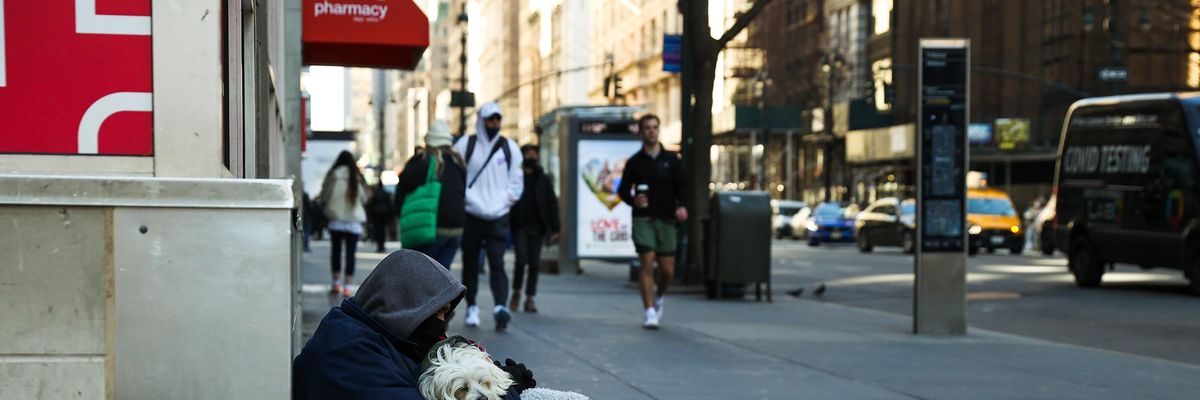
A homeless person is seen near a subway station in New York City on February 21, 2022. (Photo: Tayfun Coskun/Anadolu Agency via Getty Images)
Rights groups are sharply condemning New York City Mayor Eric Adams' Tuesday directive requiring local law enforcement and emergency medical workers to respond to the intertwined mental health and homelessness crises with involuntary hospitalizations.
"This 'compassionate' approach neglects the demands of the vulnerable communities he's claiming to help."
"If the circumstances support an objectively reasonable basis to conclude that the person appears to have a mental illness and cannot support their basic human needs to an extent that causes them harm, they may be removed for an evaluation," states a city document.
While the mayor framed the plan to forcibly remove people with severe mental illness from streets and subways as a compassionate policy for those "in urgent need of treatment," motivated by a "moral obligation" to act, critics called the former New York City Police Department captain's plan ineffective and harmful.
After Adams unveiled the directive at a Tuesday press conference, Harvey Rosenthal, chief executive of the New York Association of Psychiatric Rehabilitation Services and a longtime critic of involuntary confinement, told The New York Times that "the mayor talked about a 'trauma-informed approach,' but coercion is itself traumatic."
The mayor's approach, Rosenthal said, relies on "the same failed system that's overburdened and can't address the people they already have now."
"New Yorkers will see this plan for what it is: a draconian attempt to say the Adams' administration is tackling a problem, while only making it worse," said Jawanza Williams, director of organizing at VOCAL-NY. "Mayor Adams is using progressive language around care and compassion to distract from his continued budget cuts to services and agency staff, while fueling the NYPD budget."
"This 'compassionate' approach neglects the demands of the vulnerable communities he's claiming to help: permanent housing, equitable access to public health tools, and investments in community services that meet people where they are," Williams continued. "If the Adams administration actually cared about helping people experiencing mental health crises, Daniel's Law would be at the top of his legislative agenda, and he would halt his austerity budget measures immediately. Anything less, will only do more harm."
The proposed state law--named for Daniel Prude, a 41-year-old Black man who died in 2020 after being restrained by Rochester, New York police while experiencing a mental health crisis--would create trained response units to deescalate such emergencies instead of armed officers.
Jacquelyn Simone, policy director at the NYC-based Coalition for the Homeless, asserted Tuesday that "rather than further involving police in mental health responses and urging city workers to involuntarily transport more people to hospitals, the administration should focus on expanding access to voluntary inpatient and outpatient psychiatric care, offering individual hotel rooms to all unsheltered people, and cutting through red tape that has left far too many permanent supportive housing units sitting vacant."
Highlighting that many New Yorkers can't access psychiatric treatment even if they are seeking it out, Simone said that "Mayor Adams needs to focus on repairing our broken mental health system and prioritize bringing access to quality voluntary care and affordable, permanent housing with support services to New Yorkers who need it the most."
NYCLU executive director Donna Lieberman noted that Adams' new plan may also violate state and federal restrictions on detaining people with mental illness. She declared that "the mayor is playing fast and loose with the legal rights of New Yorkers and is not dedicating the resources necessary to address the mental health crises that affect our communities."
"Forcing people into treatment is a failed strategy for connecting people to long-term treatment and care," Lieberman stressed. "The decades-old practice of sweeping deep-seated problems out of public view may play well for the politicians, but the problems will persist--for vulnerable people in desperate need of government services and for New Yorkers."
Adams' effort to "police away homelessness and sweep individuals out of sight'' is a page from the failed playbook of former Mayor Rudy Giuliani, she added. "With no real plan for housing, services, or supports, the administration is choosing handcuffs and coercion."
Dear Common Dreams reader, It’s been nearly 30 years since I co-founded Common Dreams with my late wife, Lina Newhouser. We had the radical notion that journalism should serve the public good, not corporate profits. It was clear to us from the outset what it would take to build such a project. No paid advertisements. No corporate sponsors. No millionaire publisher telling us what to think or do. Many people said we wouldn't last a year, but we proved those doubters wrong. Together with a tremendous team of journalists and dedicated staff, we built an independent media outlet free from the constraints of profits and corporate control. Our mission has always been simple: To inform. To inspire. To ignite change for the common good. Building Common Dreams was not easy. Our survival was never guaranteed. When you take on the most powerful forces—Wall Street greed, fossil fuel industry destruction, Big Tech lobbyists, and uber-rich oligarchs who have spent billions upon billions rigging the economy and democracy in their favor—the only bulwark you have is supporters who believe in your work. But here’s the urgent message from me today. It's never been this bad out there. And it's never been this hard to keep us going. At the very moment Common Dreams is most needed, the threats we face are intensifying. We need your support now more than ever. We don't accept corporate advertising and never will. We don't have a paywall because we don't think people should be blocked from critical news based on their ability to pay. Everything we do is funded by the donations of readers like you. When everyone does the little they can afford, we are strong. But if that support retreats or dries up, so do we. Will you donate now to make sure Common Dreams not only survives but thrives? —Craig Brown, Co-founder |
Rights groups are sharply condemning New York City Mayor Eric Adams' Tuesday directive requiring local law enforcement and emergency medical workers to respond to the intertwined mental health and homelessness crises with involuntary hospitalizations.
"This 'compassionate' approach neglects the demands of the vulnerable communities he's claiming to help."
"If the circumstances support an objectively reasonable basis to conclude that the person appears to have a mental illness and cannot support their basic human needs to an extent that causes them harm, they may be removed for an evaluation," states a city document.
While the mayor framed the plan to forcibly remove people with severe mental illness from streets and subways as a compassionate policy for those "in urgent need of treatment," motivated by a "moral obligation" to act, critics called the former New York City Police Department captain's plan ineffective and harmful.
After Adams unveiled the directive at a Tuesday press conference, Harvey Rosenthal, chief executive of the New York Association of Psychiatric Rehabilitation Services and a longtime critic of involuntary confinement, told The New York Times that "the mayor talked about a 'trauma-informed approach,' but coercion is itself traumatic."
The mayor's approach, Rosenthal said, relies on "the same failed system that's overburdened and can't address the people they already have now."
"New Yorkers will see this plan for what it is: a draconian attempt to say the Adams' administration is tackling a problem, while only making it worse," said Jawanza Williams, director of organizing at VOCAL-NY. "Mayor Adams is using progressive language around care and compassion to distract from his continued budget cuts to services and agency staff, while fueling the NYPD budget."
"This 'compassionate' approach neglects the demands of the vulnerable communities he's claiming to help: permanent housing, equitable access to public health tools, and investments in community services that meet people where they are," Williams continued. "If the Adams administration actually cared about helping people experiencing mental health crises, Daniel's Law would be at the top of his legislative agenda, and he would halt his austerity budget measures immediately. Anything less, will only do more harm."
The proposed state law--named for Daniel Prude, a 41-year-old Black man who died in 2020 after being restrained by Rochester, New York police while experiencing a mental health crisis--would create trained response units to deescalate such emergencies instead of armed officers.
Jacquelyn Simone, policy director at the NYC-based Coalition for the Homeless, asserted Tuesday that "rather than further involving police in mental health responses and urging city workers to involuntarily transport more people to hospitals, the administration should focus on expanding access to voluntary inpatient and outpatient psychiatric care, offering individual hotel rooms to all unsheltered people, and cutting through red tape that has left far too many permanent supportive housing units sitting vacant."
Highlighting that many New Yorkers can't access psychiatric treatment even if they are seeking it out, Simone said that "Mayor Adams needs to focus on repairing our broken mental health system and prioritize bringing access to quality voluntary care and affordable, permanent housing with support services to New Yorkers who need it the most."
NYCLU executive director Donna Lieberman noted that Adams' new plan may also violate state and federal restrictions on detaining people with mental illness. She declared that "the mayor is playing fast and loose with the legal rights of New Yorkers and is not dedicating the resources necessary to address the mental health crises that affect our communities."
"Forcing people into treatment is a failed strategy for connecting people to long-term treatment and care," Lieberman stressed. "The decades-old practice of sweeping deep-seated problems out of public view may play well for the politicians, but the problems will persist--for vulnerable people in desperate need of government services and for New Yorkers."
Adams' effort to "police away homelessness and sweep individuals out of sight'' is a page from the failed playbook of former Mayor Rudy Giuliani, she added. "With no real plan for housing, services, or supports, the administration is choosing handcuffs and coercion."
Rights groups are sharply condemning New York City Mayor Eric Adams' Tuesday directive requiring local law enforcement and emergency medical workers to respond to the intertwined mental health and homelessness crises with involuntary hospitalizations.
"This 'compassionate' approach neglects the demands of the vulnerable communities he's claiming to help."
"If the circumstances support an objectively reasonable basis to conclude that the person appears to have a mental illness and cannot support their basic human needs to an extent that causes them harm, they may be removed for an evaluation," states a city document.
While the mayor framed the plan to forcibly remove people with severe mental illness from streets and subways as a compassionate policy for those "in urgent need of treatment," motivated by a "moral obligation" to act, critics called the former New York City Police Department captain's plan ineffective and harmful.
After Adams unveiled the directive at a Tuesday press conference, Harvey Rosenthal, chief executive of the New York Association of Psychiatric Rehabilitation Services and a longtime critic of involuntary confinement, told The New York Times that "the mayor talked about a 'trauma-informed approach,' but coercion is itself traumatic."
The mayor's approach, Rosenthal said, relies on "the same failed system that's overburdened and can't address the people they already have now."
"New Yorkers will see this plan for what it is: a draconian attempt to say the Adams' administration is tackling a problem, while only making it worse," said Jawanza Williams, director of organizing at VOCAL-NY. "Mayor Adams is using progressive language around care and compassion to distract from his continued budget cuts to services and agency staff, while fueling the NYPD budget."
"This 'compassionate' approach neglects the demands of the vulnerable communities he's claiming to help: permanent housing, equitable access to public health tools, and investments in community services that meet people where they are," Williams continued. "If the Adams administration actually cared about helping people experiencing mental health crises, Daniel's Law would be at the top of his legislative agenda, and he would halt his austerity budget measures immediately. Anything less, will only do more harm."
The proposed state law--named for Daniel Prude, a 41-year-old Black man who died in 2020 after being restrained by Rochester, New York police while experiencing a mental health crisis--would create trained response units to deescalate such emergencies instead of armed officers.
Jacquelyn Simone, policy director at the NYC-based Coalition for the Homeless, asserted Tuesday that "rather than further involving police in mental health responses and urging city workers to involuntarily transport more people to hospitals, the administration should focus on expanding access to voluntary inpatient and outpatient psychiatric care, offering individual hotel rooms to all unsheltered people, and cutting through red tape that has left far too many permanent supportive housing units sitting vacant."
Highlighting that many New Yorkers can't access psychiatric treatment even if they are seeking it out, Simone said that "Mayor Adams needs to focus on repairing our broken mental health system and prioritize bringing access to quality voluntary care and affordable, permanent housing with support services to New Yorkers who need it the most."
NYCLU executive director Donna Lieberman noted that Adams' new plan may also violate state and federal restrictions on detaining people with mental illness. She declared that "the mayor is playing fast and loose with the legal rights of New Yorkers and is not dedicating the resources necessary to address the mental health crises that affect our communities."
"Forcing people into treatment is a failed strategy for connecting people to long-term treatment and care," Lieberman stressed. "The decades-old practice of sweeping deep-seated problems out of public view may play well for the politicians, but the problems will persist--for vulnerable people in desperate need of government services and for New Yorkers."
Adams' effort to "police away homelessness and sweep individuals out of sight'' is a page from the failed playbook of former Mayor Rudy Giuliani, she added. "With no real plan for housing, services, or supports, the administration is choosing handcuffs and coercion."