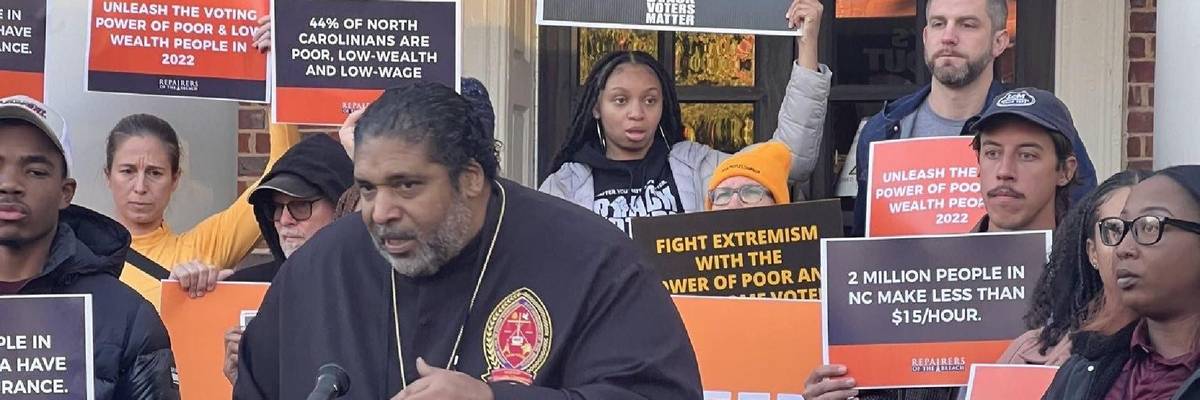
Rev. William Barber speaks during a rally in Durham, North Carolina on October 23, 2022. (Photo: Repairers of the Breach)
Poor People's Campaign Mobilizes Low-Income Voters in North Carolina
"North Carolina has an opportunity to determine the makeup of the U.S. House of Representatives and Senate, and can show the nation how to fight against extremist state legislatures, said Rev. William Barber.
A multiracial coalition of justice organizations and low-wage workers wrapped up its statewide voter mobilization tour in North Carolina on Saturday with rallies and marches aimed at elevating marginalized residents' calls for a living wage, universal healthcare, and other long-denied rights.
The alliance's final stops in Durham and Asheville came on the first weekend of early voting in North Carolina, quietly home to one of the most important U.S. Senate races of this midterm cycle. Democratic candidate Cheri Beasley is looking to defeat Rep. Ted Budd (R-N.C.), a Wall Street ally and Trump loyalist--and recent surveys indicate she is closing in on her GOP opponent with the election just over two weeks away.
"We must exercise the right to vote that's been so hard-fought for, not 50 years ago, but in recent history."
But Rev. William Barber, president and senior lecturer of Repairers of the Breach--which led the North Carolina mobilization alongside the state's chapter of the Poor People's Campaign, Fight for $15, and other groups--stressed Saturday that "voting is not just a matter of casting a vote on a candidate."
"It's about demands on public policy," said Barber. "In these midterm elections, North Carolinians get to express their demands for living wages and healthcare without their voices being suppressed and stymied because of various forms of voter suppression that were attempted in North Carolina and overcome."
"We must exercise the right to vote that's been so hard-fought for, not 50 years ago, but in recent history," he added.
North Carolina is a key battleground in the nationwide fight for voting rights--and the future of U.S. democracy. More than 56,000 people are newly eligible to vote in the upcoming midterms thanks to a July court ruling restoring the franchise for North Carolinians with prior felony convictions, and courts have rebuffed some aggressive voter suppression measures in the state.
But Moore v. Harper, a gerrymandering case currently before the U.S. Supreme Court, threatens to undermine such progress, potentially handing state legislatures control over federal elections. Given the massive stakes, the case has been described as "terrifying" and possibly "the most significant case of the U.S. Supreme Court term" that began earlier this month.
"With the U.S. Supreme Court now reviewing North Carolina lawmakers' ability to draw district maps, the future of voting rights remains unclear in North Carolina," Repairers of the Breach said in a statement Saturday. "The time is now for every North Carolinian to make their voice heard and for every poor and low-income individual to turn out to vote."
Throughout the North Carolina tour--which reached all 14 of the state's congressional districts--organizers and low-income people centered progressive economic messaging as well as the critical importance of abortion rights as Democrats face criticism for failing to focus sufficiently on the economy and the pain workers are enduring as corporate profits surge to record highs.
The Lever reported earlier this month that "Republican candidates and political groups have spent $44 million on TV ads focused on the economy and inflation since Labor Day."
"In the same period," the outlet found, "Democrats have spotlighted these issues in just $12 million worth of ads, less than 7% of the party's total ad spending during that time."
Repairers of the Breach noted Saturday that 44% of North Carolinians--around 4.6 million people--are "poor or low-income."
"This includes 53% of children (1.2 million), 46% of women (2.3 million), 58% of Black people (1.2 million), 67% of Latinx people (699,000), and 36% of white people (2.2 million)," the group said. "In addition, 2 million North Carolina workers make less than $15 an hour--that's almost 50% of the state's workforce. And 1 million people are uninsured."
A study released last year by the Poor People's Campaign showed that low-income voters were integral to the defeat of former President Donald Trump in 2020, a finding that has animated organizers' efforts to mobilize poor voters in North Carolina and across the country.
"The number one reason poor and low-wealth voters don't vote is they say nobody talks to us," Barber said during a Saturday rally. "What our campaign is saying is, 'When folks don't talk to you, you have to make them hear you.'"
We are at a crossroads
This country and this world are at a monumental crossroads. In a few short weeks, US voters will have an opportunity to beat back the forces of fascism and confront the billionaires who are rigging the economy, our media system, and our democracy, making it increasingly impossible for ordinary people to get by. We’re not just talking about the election. We’re talking about what must be done once these fascist elements are vanquished from power. We need a bolder set of solutions than what either major party has so far been willing to offer and a working-class movement ready to fight like hell for it. Trump didn't emerge from nowhere. The conditions that fueled MAGA authoritarianism were created by decades of radical neoliberal economic policies and a corrupt political system dominated by corporate interests. They slashed taxes on the super-rich, promising that the benefits would trickle down. They said giveaways to the corporate titans would make life more affordable for the rest of us. It was all bullshit. And when a bitter, betrayed populace searches for someone to blame, right-wing demagogues have little trouble finding scapegoats. People know when they're being lied to, but you won't hear any of this from the corporate media. Only independent journalism—powered and funded by people who believe in building a better world—can deliver truly trustworthy daily news. Our Fall Campaign is underway, and we need your help. To power our newsroom through the rest of the year, we need to raise $125,000 by midnight on October 31. So if you share our vision, please contribute whatever you can to sustain our work. |
A multiracial coalition of justice organizations and low-wage workers wrapped up its statewide voter mobilization tour in North Carolina on Saturday with rallies and marches aimed at elevating marginalized residents' calls for a living wage, universal healthcare, and other long-denied rights.
The alliance's final stops in Durham and Asheville came on the first weekend of early voting in North Carolina, quietly home to one of the most important U.S. Senate races of this midterm cycle. Democratic candidate Cheri Beasley is looking to defeat Rep. Ted Budd (R-N.C.), a Wall Street ally and Trump loyalist--and recent surveys indicate she is closing in on her GOP opponent with the election just over two weeks away.
"We must exercise the right to vote that's been so hard-fought for, not 50 years ago, but in recent history."
But Rev. William Barber, president and senior lecturer of Repairers of the Breach--which led the North Carolina mobilization alongside the state's chapter of the Poor People's Campaign, Fight for $15, and other groups--stressed Saturday that "voting is not just a matter of casting a vote on a candidate."
"It's about demands on public policy," said Barber. "In these midterm elections, North Carolinians get to express their demands for living wages and healthcare without their voices being suppressed and stymied because of various forms of voter suppression that were attempted in North Carolina and overcome."
"We must exercise the right to vote that's been so hard-fought for, not 50 years ago, but in recent history," he added.
North Carolina is a key battleground in the nationwide fight for voting rights--and the future of U.S. democracy. More than 56,000 people are newly eligible to vote in the upcoming midterms thanks to a July court ruling restoring the franchise for North Carolinians with prior felony convictions, and courts have rebuffed some aggressive voter suppression measures in the state.
But Moore v. Harper, a gerrymandering case currently before the U.S. Supreme Court, threatens to undermine such progress, potentially handing state legislatures control over federal elections. Given the massive stakes, the case has been described as "terrifying" and possibly "the most significant case of the U.S. Supreme Court term" that began earlier this month.
"With the U.S. Supreme Court now reviewing North Carolina lawmakers' ability to draw district maps, the future of voting rights remains unclear in North Carolina," Repairers of the Breach said in a statement Saturday. "The time is now for every North Carolinian to make their voice heard and for every poor and low-income individual to turn out to vote."
Throughout the North Carolina tour--which reached all 14 of the state's congressional districts--organizers and low-income people centered progressive economic messaging as well as the critical importance of abortion rights as Democrats face criticism for failing to focus sufficiently on the economy and the pain workers are enduring as corporate profits surge to record highs.
The Lever reported earlier this month that "Republican candidates and political groups have spent $44 million on TV ads focused on the economy and inflation since Labor Day."
"In the same period," the outlet found, "Democrats have spotlighted these issues in just $12 million worth of ads, less than 7% of the party's total ad spending during that time."
Repairers of the Breach noted Saturday that 44% of North Carolinians--around 4.6 million people--are "poor or low-income."
"This includes 53% of children (1.2 million), 46% of women (2.3 million), 58% of Black people (1.2 million), 67% of Latinx people (699,000), and 36% of white people (2.2 million)," the group said. "In addition, 2 million North Carolina workers make less than $15 an hour--that's almost 50% of the state's workforce. And 1 million people are uninsured."
A study released last year by the Poor People's Campaign showed that low-income voters were integral to the defeat of former President Donald Trump in 2020, a finding that has animated organizers' efforts to mobilize poor voters in North Carolina and across the country.
"The number one reason poor and low-wealth voters don't vote is they say nobody talks to us," Barber said during a Saturday rally. "What our campaign is saying is, 'When folks don't talk to you, you have to make them hear you.'"
A multiracial coalition of justice organizations and low-wage workers wrapped up its statewide voter mobilization tour in North Carolina on Saturday with rallies and marches aimed at elevating marginalized residents' calls for a living wage, universal healthcare, and other long-denied rights.
The alliance's final stops in Durham and Asheville came on the first weekend of early voting in North Carolina, quietly home to one of the most important U.S. Senate races of this midterm cycle. Democratic candidate Cheri Beasley is looking to defeat Rep. Ted Budd (R-N.C.), a Wall Street ally and Trump loyalist--and recent surveys indicate she is closing in on her GOP opponent with the election just over two weeks away.
"We must exercise the right to vote that's been so hard-fought for, not 50 years ago, but in recent history."
But Rev. William Barber, president and senior lecturer of Repairers of the Breach--which led the North Carolina mobilization alongside the state's chapter of the Poor People's Campaign, Fight for $15, and other groups--stressed Saturday that "voting is not just a matter of casting a vote on a candidate."
"It's about demands on public policy," said Barber. "In these midterm elections, North Carolinians get to express their demands for living wages and healthcare without their voices being suppressed and stymied because of various forms of voter suppression that were attempted in North Carolina and overcome."
"We must exercise the right to vote that's been so hard-fought for, not 50 years ago, but in recent history," he added.
North Carolina is a key battleground in the nationwide fight for voting rights--and the future of U.S. democracy. More than 56,000 people are newly eligible to vote in the upcoming midterms thanks to a July court ruling restoring the franchise for North Carolinians with prior felony convictions, and courts have rebuffed some aggressive voter suppression measures in the state.
But Moore v. Harper, a gerrymandering case currently before the U.S. Supreme Court, threatens to undermine such progress, potentially handing state legislatures control over federal elections. Given the massive stakes, the case has been described as "terrifying" and possibly "the most significant case of the U.S. Supreme Court term" that began earlier this month.
"With the U.S. Supreme Court now reviewing North Carolina lawmakers' ability to draw district maps, the future of voting rights remains unclear in North Carolina," Repairers of the Breach said in a statement Saturday. "The time is now for every North Carolinian to make their voice heard and for every poor and low-income individual to turn out to vote."
Throughout the North Carolina tour--which reached all 14 of the state's congressional districts--organizers and low-income people centered progressive economic messaging as well as the critical importance of abortion rights as Democrats face criticism for failing to focus sufficiently on the economy and the pain workers are enduring as corporate profits surge to record highs.
The Lever reported earlier this month that "Republican candidates and political groups have spent $44 million on TV ads focused on the economy and inflation since Labor Day."
"In the same period," the outlet found, "Democrats have spotlighted these issues in just $12 million worth of ads, less than 7% of the party's total ad spending during that time."
Repairers of the Breach noted Saturday that 44% of North Carolinians--around 4.6 million people--are "poor or low-income."
"This includes 53% of children (1.2 million), 46% of women (2.3 million), 58% of Black people (1.2 million), 67% of Latinx people (699,000), and 36% of white people (2.2 million)," the group said. "In addition, 2 million North Carolina workers make less than $15 an hour--that's almost 50% of the state's workforce. And 1 million people are uninsured."
A study released last year by the Poor People's Campaign showed that low-income voters were integral to the defeat of former President Donald Trump in 2020, a finding that has animated organizers' efforts to mobilize poor voters in North Carolina and across the country.
"The number one reason poor and low-wealth voters don't vote is they say nobody talks to us," Barber said during a Saturday rally. "What our campaign is saying is, 'When folks don't talk to you, you have to make them hear you.'"