SUBSCRIBE TO OUR FREE NEWSLETTER
Daily news & progressive opinion—funded by the people, not the corporations—delivered straight to your inbox.
5
#000000
#FFFFFF
To donate by check, phone, or other method, see our More Ways to Give page.
Daily news & progressive opinion—funded by the people, not the corporations—delivered straight to your inbox.
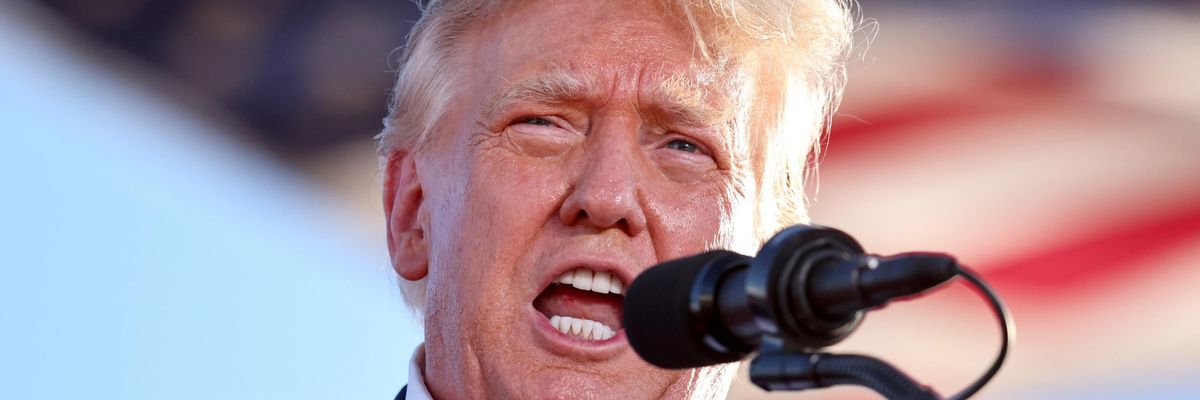
Former U.S. President Donald Trump speaks at a campaign rally at Legacy Sports USA on October 9, 2022 in Mesa, Arizona. (Photo: Mario Tama/Getty Images)
The U.S. Supreme Court on Thursday rejected former President Donald Trump's request to weigh in on the battle over documents that Federal Bureau of Investigation agents took while executing a search warrant at his Florida estate.
The ex-president's lawyers wanted the court to ensure that more than 100 classified documents seized from Mar-a-Lago are included in a special master review approved by Trump-appointed U.S. District Judge Aileen Cannon.
Though six of the high court's nine justices are right-wingers--and Trump appointed three of them--the rejection was widely anticipated by legal experts.
When Trump's team filed the request earlier this month, University of Texas at Austin law professor and CNN analyst Steve Vladeck explained that "this is what good lawyers who are stuck do to appease bad clients: The jurisdictional argument is narrow, technical, and nonfrivolous."
"It's a way of filing something in the Supreme Court without going all the way to crazytown and/or acting unethically," he said.
While Vladeck correctly predicted that the justices would reject the modest request, he also noted that even if they granted it, such an order would not impede the ongoing investigation by the U.S. Department of Justice, as Trump's attorneys notably did not ask the court to block the DOJ's use of the records.
Vladeck said Thursday that though decisions like this one do not require the justices to publicly disclose their position, the fact that none of them publicly dissented or wrote separately "is as big a loss" for the former president as he could've received.
The Supreme Court's refusal to intervene in the case came as the U.S. House select committee investigating the January 6, 2021 attack voted Thursday to subpoena Trump.
The twice-impeached former president, who's expected to run again in 2024, also faces potential legal trouble in Georgia for his attempts to overturn the last presidential election and in New York for alleged criminal fraud involving the Trump Organization.
Dear Common Dreams reader, It’s been nearly 30 years since I co-founded Common Dreams with my late wife, Lina Newhouser. We had the radical notion that journalism should serve the public good, not corporate profits. It was clear to us from the outset what it would take to build such a project. No paid advertisements. No corporate sponsors. No millionaire publisher telling us what to think or do. Many people said we wouldn't last a year, but we proved those doubters wrong. Together with a tremendous team of journalists and dedicated staff, we built an independent media outlet free from the constraints of profits and corporate control. Our mission has always been simple: To inform. To inspire. To ignite change for the common good. Building Common Dreams was not easy. Our survival was never guaranteed. When you take on the most powerful forces—Wall Street greed, fossil fuel industry destruction, Big Tech lobbyists, and uber-rich oligarchs who have spent billions upon billions rigging the economy and democracy in their favor—the only bulwark you have is supporters who believe in your work. But here’s the urgent message from me today. It's never been this bad out there. And it's never been this hard to keep us going. At the very moment Common Dreams is most needed, the threats we face are intensifying. We need your support now more than ever. We don't accept corporate advertising and never will. We don't have a paywall because we don't think people should be blocked from critical news based on their ability to pay. Everything we do is funded by the donations of readers like you. When everyone does the little they can afford, we are strong. But if that support retreats or dries up, so do we. Will you donate now to make sure Common Dreams not only survives but thrives? —Craig Brown, Co-founder |
The U.S. Supreme Court on Thursday rejected former President Donald Trump's request to weigh in on the battle over documents that Federal Bureau of Investigation agents took while executing a search warrant at his Florida estate.
The ex-president's lawyers wanted the court to ensure that more than 100 classified documents seized from Mar-a-Lago are included in a special master review approved by Trump-appointed U.S. District Judge Aileen Cannon.
Though six of the high court's nine justices are right-wingers--and Trump appointed three of them--the rejection was widely anticipated by legal experts.
When Trump's team filed the request earlier this month, University of Texas at Austin law professor and CNN analyst Steve Vladeck explained that "this is what good lawyers who are stuck do to appease bad clients: The jurisdictional argument is narrow, technical, and nonfrivolous."
"It's a way of filing something in the Supreme Court without going all the way to crazytown and/or acting unethically," he said.
While Vladeck correctly predicted that the justices would reject the modest request, he also noted that even if they granted it, such an order would not impede the ongoing investigation by the U.S. Department of Justice, as Trump's attorneys notably did not ask the court to block the DOJ's use of the records.
Vladeck said Thursday that though decisions like this one do not require the justices to publicly disclose their position, the fact that none of them publicly dissented or wrote separately "is as big a loss" for the former president as he could've received.
The Supreme Court's refusal to intervene in the case came as the U.S. House select committee investigating the January 6, 2021 attack voted Thursday to subpoena Trump.
The twice-impeached former president, who's expected to run again in 2024, also faces potential legal trouble in Georgia for his attempts to overturn the last presidential election and in New York for alleged criminal fraud involving the Trump Organization.
The U.S. Supreme Court on Thursday rejected former President Donald Trump's request to weigh in on the battle over documents that Federal Bureau of Investigation agents took while executing a search warrant at his Florida estate.
The ex-president's lawyers wanted the court to ensure that more than 100 classified documents seized from Mar-a-Lago are included in a special master review approved by Trump-appointed U.S. District Judge Aileen Cannon.
Though six of the high court's nine justices are right-wingers--and Trump appointed three of them--the rejection was widely anticipated by legal experts.
When Trump's team filed the request earlier this month, University of Texas at Austin law professor and CNN analyst Steve Vladeck explained that "this is what good lawyers who are stuck do to appease bad clients: The jurisdictional argument is narrow, technical, and nonfrivolous."
"It's a way of filing something in the Supreme Court without going all the way to crazytown and/or acting unethically," he said.
While Vladeck correctly predicted that the justices would reject the modest request, he also noted that even if they granted it, such an order would not impede the ongoing investigation by the U.S. Department of Justice, as Trump's attorneys notably did not ask the court to block the DOJ's use of the records.
Vladeck said Thursday that though decisions like this one do not require the justices to publicly disclose their position, the fact that none of them publicly dissented or wrote separately "is as big a loss" for the former president as he could've received.
The Supreme Court's refusal to intervene in the case came as the U.S. House select committee investigating the January 6, 2021 attack voted Thursday to subpoena Trump.
The twice-impeached former president, who's expected to run again in 2024, also faces potential legal trouble in Georgia for his attempts to overturn the last presidential election and in New York for alleged criminal fraud involving the Trump Organization.