SUBSCRIBE TO OUR FREE NEWSLETTER
Daily news & progressive opinion—funded by the people, not the corporations—delivered straight to your inbox.
5
#000000
#FFFFFF
To donate by check, phone, or other method, see our More Ways to Give page.
Scientists who conducted new research into the future of coral reefs on Wednesday called for swift action to save the "diverse and valuable ecosystems."
"The fact that we're going to see these changes by 2050 is a strong wake-up call."
Using computer models, researchers from Louisiana State University, Rice University, and the University of Colorado Boulder analyzed the "ominous threats" that ocean acidification and warming pose to coral reefs in the Caribbean and Gulf of Mexico under a "business as usual" emissions scenario and one in which planet-heating pollution is reduced.
Their study, published this summer in the Journal of Geophysical Research: Biogeosciences, shows that "ocean temperatures increase by 2degC-3degC over the 21st century, and surpass reported regional bleaching thresholds by midcentury."
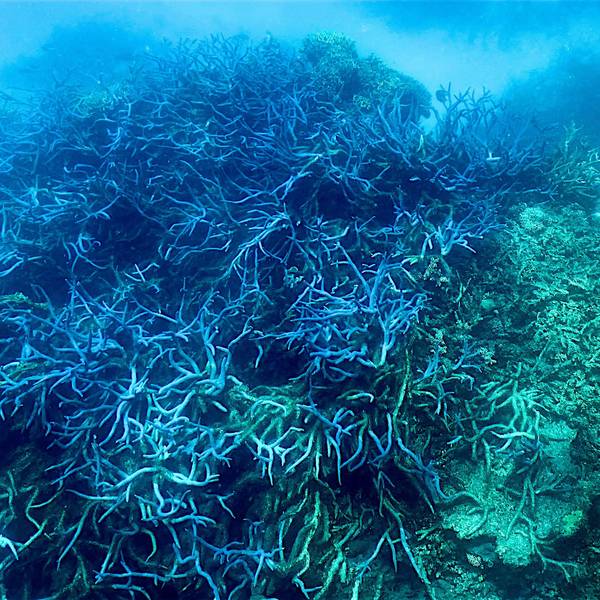
Bleaching is when corals expel algae--with which they have a symbiotic relationship--and turn white. Though the corals are not yet dead, they are at higher risk of mortality. Mass bleaching events around the world in recent years have heightened concerns about the fate of reefs--especially given governments' inadequate plans to rapidly transition away from fossil fuels driving the global climate emergency.
Study co-author Adrienne Correa, a marine biologist and assistant professor at Rice, said Wednesday, "The fact that we're going to see these changes by 2050 is a strong wake-up call."
"We get a lot of bad news about reefs, but we can still draw hope and motivation from this," she noted. "Some of the reefs that are included in this analysis are really special, like the Flower Garden Banks, and reefs off of Cuba and in some other parts of the Caribbean where there's still really high coral cover. We can help protect and keep the high coral cover reefs we have if we take immediate action to shift how much energy we use and where we get our energy."
"There are reefs in the Gulf that are really worth saving," Correa added. "Some of the healthiest reefs that we still have in the United States are in the areas covered by these projections."
Related Content

Allison Lawman, a postdoctoral associate in Colorado, explained that the study shows projected coral mortality through the next century is largely tied to the number of months each year that the reefs are exposed to high marine temperatures.
"There's always one month that is the hottest of the year," Lawman said. "Let's say it's August and the average baseline temperature for that month is 29degC in the region we're studying. A 'degree heating month' in that region is any month in the future that has a higher average temperature than 29degC."
The researchers found that under the business as usual scenario, degree heating months could become the new normal by the late 2100s, with parts of the Caribbean seeing such conditions for as many as 10 months per year.
"That's a huge number of months in which corals could experience thermal stress beyond the usual levels to which they are adapted," Lawman said. "These projections are very concerning... I think the takeaway message is that the time to act is now."
Rice climate scientist and assistant professor Sylvia Dee similarly stressed the urgency of reef-saving action.
"In one case, we have more time to mitigate, and in the other we don't," she said. "People need to be aware this is coming up fast, and the time to explore mitigation techniques is now."
The areas examined by the researchers "contain more than 10% of the world's reefs and host hundreds of fish species, and they provide more than $6 billion in economic benefits courtesy of fisheries, tourism, and other ecosystem services," according to Eos. "But over the past four decades, climate change and local stressors like overfishing, pollution, and invasive species have taken a heavy toll. On average, live coral covers less than 10% of the surface of most reefs in the region."
In a summary of the study, the researchers wrote that "we hope that this work will inform and streamline mitigation efforts to protect vulnerable coral reef ecosystems and the valuable benefits and resources they provide to local communities."
The scientists' calls for action come as world leaders prepare for COP27, a United Nations climate summit set to kick off in Egypt next month.
Scientists who conducted new research into the future of coral reefs on Wednesday called for swift action to save the "diverse and valuable ecosystems."
"The fact that we're going to see these changes by 2050 is a strong wake-up call."
Using computer models, researchers from Louisiana State University, Rice University, and the University of Colorado Boulder analyzed the "ominous threats" that ocean acidification and warming pose to coral reefs in the Caribbean and Gulf of Mexico under a "business as usual" emissions scenario and one in which planet-heating pollution is reduced.
Their study, published this summer in the Journal of Geophysical Research: Biogeosciences, shows that "ocean temperatures increase by 2degC-3degC over the 21st century, and surpass reported regional bleaching thresholds by midcentury."
Bleaching is when corals expel algae--with which they have a symbiotic relationship--and turn white. Though the corals are not yet dead, they are at higher risk of mortality. Mass bleaching events around the world in recent years have heightened concerns about the fate of reefs--especially given governments' inadequate plans to rapidly transition away from fossil fuels driving the global climate emergency.
Study co-author Adrienne Correa, a marine biologist and assistant professor at Rice, said Wednesday, "The fact that we're going to see these changes by 2050 is a strong wake-up call."
"We get a lot of bad news about reefs, but we can still draw hope and motivation from this," she noted. "Some of the reefs that are included in this analysis are really special, like the Flower Garden Banks, and reefs off of Cuba and in some other parts of the Caribbean where there's still really high coral cover. We can help protect and keep the high coral cover reefs we have if we take immediate action to shift how much energy we use and where we get our energy."
"There are reefs in the Gulf that are really worth saving," Correa added. "Some of the healthiest reefs that we still have in the United States are in the areas covered by these projections."
Related Content
Allison Lawman, a postdoctoral associate in Colorado, explained that the study shows projected coral mortality through the next century is largely tied to the number of months each year that the reefs are exposed to high marine temperatures.
"There's always one month that is the hottest of the year," Lawman said. "Let's say it's August and the average baseline temperature for that month is 29degC in the region we're studying. A 'degree heating month' in that region is any month in the future that has a higher average temperature than 29degC."
The researchers found that under the business as usual scenario, degree heating months could become the new normal by the late 2100s, with parts of the Caribbean seeing such conditions for as many as 10 months per year.
"That's a huge number of months in which corals could experience thermal stress beyond the usual levels to which they are adapted," Lawman said. "These projections are very concerning... I think the takeaway message is that the time to act is now."
Rice climate scientist and assistant professor Sylvia Dee similarly stressed the urgency of reef-saving action.
"In one case, we have more time to mitigate, and in the other we don't," she said. "People need to be aware this is coming up fast, and the time to explore mitigation techniques is now."
The areas examined by the researchers "contain more than 10% of the world's reefs and host hundreds of fish species, and they provide more than $6 billion in economic benefits courtesy of fisheries, tourism, and other ecosystem services," according to Eos. "But over the past four decades, climate change and local stressors like overfishing, pollution, and invasive species have taken a heavy toll. On average, live coral covers less than 10% of the surface of most reefs in the region."
In a summary of the study, the researchers wrote that "we hope that this work will inform and streamline mitigation efforts to protect vulnerable coral reef ecosystems and the valuable benefits and resources they provide to local communities."
The scientists' calls for action come as world leaders prepare for COP27, a United Nations climate summit set to kick off in Egypt next month.
Scientists who conducted new research into the future of coral reefs on Wednesday called for swift action to save the "diverse and valuable ecosystems."
"The fact that we're going to see these changes by 2050 is a strong wake-up call."
Using computer models, researchers from Louisiana State University, Rice University, and the University of Colorado Boulder analyzed the "ominous threats" that ocean acidification and warming pose to coral reefs in the Caribbean and Gulf of Mexico under a "business as usual" emissions scenario and one in which planet-heating pollution is reduced.
Their study, published this summer in the Journal of Geophysical Research: Biogeosciences, shows that "ocean temperatures increase by 2degC-3degC over the 21st century, and surpass reported regional bleaching thresholds by midcentury."
Bleaching is when corals expel algae--with which they have a symbiotic relationship--and turn white. Though the corals are not yet dead, they are at higher risk of mortality. Mass bleaching events around the world in recent years have heightened concerns about the fate of reefs--especially given governments' inadequate plans to rapidly transition away from fossil fuels driving the global climate emergency.
Study co-author Adrienne Correa, a marine biologist and assistant professor at Rice, said Wednesday, "The fact that we're going to see these changes by 2050 is a strong wake-up call."
"We get a lot of bad news about reefs, but we can still draw hope and motivation from this," she noted. "Some of the reefs that are included in this analysis are really special, like the Flower Garden Banks, and reefs off of Cuba and in some other parts of the Caribbean where there's still really high coral cover. We can help protect and keep the high coral cover reefs we have if we take immediate action to shift how much energy we use and where we get our energy."
"There are reefs in the Gulf that are really worth saving," Correa added. "Some of the healthiest reefs that we still have in the United States are in the areas covered by these projections."
Related Content
Allison Lawman, a postdoctoral associate in Colorado, explained that the study shows projected coral mortality through the next century is largely tied to the number of months each year that the reefs are exposed to high marine temperatures.
"There's always one month that is the hottest of the year," Lawman said. "Let's say it's August and the average baseline temperature for that month is 29degC in the region we're studying. A 'degree heating month' in that region is any month in the future that has a higher average temperature than 29degC."
The researchers found that under the business as usual scenario, degree heating months could become the new normal by the late 2100s, with parts of the Caribbean seeing such conditions for as many as 10 months per year.
"That's a huge number of months in which corals could experience thermal stress beyond the usual levels to which they are adapted," Lawman said. "These projections are very concerning... I think the takeaway message is that the time to act is now."
Rice climate scientist and assistant professor Sylvia Dee similarly stressed the urgency of reef-saving action.
"In one case, we have more time to mitigate, and in the other we don't," she said. "People need to be aware this is coming up fast, and the time to explore mitigation techniques is now."
The areas examined by the researchers "contain more than 10% of the world's reefs and host hundreds of fish species, and they provide more than $6 billion in economic benefits courtesy of fisheries, tourism, and other ecosystem services," according to Eos. "But over the past four decades, climate change and local stressors like overfishing, pollution, and invasive species have taken a heavy toll. On average, live coral covers less than 10% of the surface of most reefs in the region."
In a summary of the study, the researchers wrote that "we hope that this work will inform and streamline mitigation efforts to protect vulnerable coral reef ecosystems and the valuable benefits and resources they provide to local communities."
The scientists' calls for action come as world leaders prepare for COP27, a United Nations climate summit set to kick off in Egypt next month.