SUBSCRIBE TO OUR FREE NEWSLETTER
Daily news & progressive opinion—funded by the people, not the corporations—delivered straight to your inbox.
5
#000000
#FFFFFF
To donate by check, phone, or other method, see our More Ways to Give page.
Daily news & progressive opinion—funded by the people, not the corporations—delivered straight to your inbox.
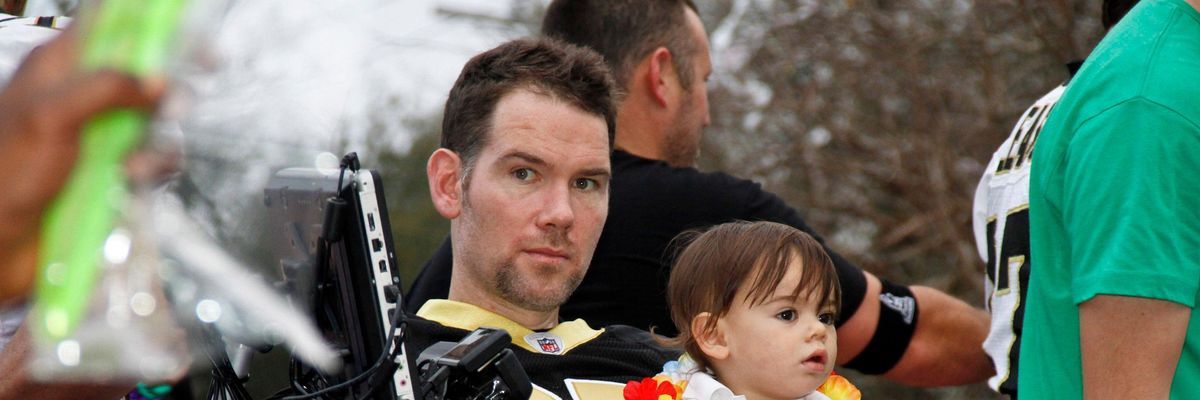
ALS patient Steve Gleason attends an event to raise public awareness about the fatal disease on February 10, 2013 in New Orleans, Louisiana. (Photo: Skip Bolen/Getty Images)
Patient advocates on Tuesday condemned Amylyx Pharmaceuticals for setting the price of its newly FDA-approved ALS treatment at a staggering $158,000 a year, more than five times the top-line cost recommended by independent analysts.
Last week, the FDA formally approved Relyvrio to treat patients with amyotrophic lateral sclerosis, a progressive and rapidly fatal disease of the nervous system that currently affects tens of thousands of people in the United States.
"There is no justification for pricing Relyvrio, a drug that has not been proven effective, at $158,000."
Relyvrio, the first ALS treatment the FDA has approved in five years, is not a new drug but a combination of sodium phenylbutyrate and taurursodiol--a pairing that some research suggests can slow the disease's progression.
Personal anecdotes from ALS patients, many of whom celebrated the FDA's approval decision, also indicate the treatment can be effective, though the agency conceded that evidence for Relyvrio's effectiveness is still lacking.
A day after receiving approval from the FDA--which is barred from weighing the potential cost of a drug in its decision-making process--Amylyx announced an annual list price of $158,000 for Relyvrio. Experts at the Institute for Clinical and Economic Review, a nonprofit that analyzes medicine costs, published an assessment in August suggesting that Relyvrio should be priced somewhere between $9,100 and $30,600 per year assuming the treatment is effective.
"The price of the newly approved drug combination Relyvrio to treat ALS--a terrible neurological disease--is yet another clear and powerful example of unjustified high prices set by drug companies that ultimately exploit patients desperate for new treatments," David Mitchell, a cancer patient and president of Patients For Affordable Drugs, said in a statement Tuesday.
"This is not a new drug that required years of expensive, high-risk research in a lab; Relyvrio is a combination of two old drugs," Mitchell noted. "It was approved based on a small trial of 137 patients over 24 weeks, not an expensive, large, long study."
"There is no justification for pricing Relyvrio, a drug that has not been proven effective, at $158,000," he added. "It is a poster child for what is wrong with drug pricing in America and why our system must be reformed to arrive at appropriate prices that maximize accessibility and affordability for drugs that are shown to be both safe and effective."
Amylyx officials said during a conference call with investors last week that they expect insurers to absorb most of the costs of Relyvrio for ALS patients who opt to try the treatment--a claim that experts greeted with skepticism.
"We all pay for the premiums of our health plans," Stacie Dusetzina, an associate professor of health policy at Vanderbilt University Medical Center, told Politico.
"We're not talking about them setting a price to recoup their investments or anything like that," said Dusetzina. "This is basically taking advantage of the fact that we allow the price to be what the market will bear." Research published earlier this year found that roughly half of all new brand-name prescription drugs launched in the U.S. in 2020 and 2021 had an original price tag of at least $150,000 a year.
In addition to concerns about costs for ALS patients with commercial insurance, analysts have warned that Medicare Part D recipients who attempt to access Relyvrio "may be in for a significant cost-sharing burden."
Dear Common Dreams reader, It’s been nearly 30 years since I co-founded Common Dreams with my late wife, Lina Newhouser. We had the radical notion that journalism should serve the public good, not corporate profits. It was clear to us from the outset what it would take to build such a project. No paid advertisements. No corporate sponsors. No millionaire publisher telling us what to think or do. Many people said we wouldn't last a year, but we proved those doubters wrong. Together with a tremendous team of journalists and dedicated staff, we built an independent media outlet free from the constraints of profits and corporate control. Our mission has always been simple: To inform. To inspire. To ignite change for the common good. Building Common Dreams was not easy. Our survival was never guaranteed. When you take on the most powerful forces—Wall Street greed, fossil fuel industry destruction, Big Tech lobbyists, and uber-rich oligarchs who have spent billions upon billions rigging the economy and democracy in their favor—the only bulwark you have is supporters who believe in your work. But here’s the urgent message from me today. It's never been this bad out there. And it's never been this hard to keep us going. At the very moment Common Dreams is most needed, the threats we face are intensifying. We need your support now more than ever. We don't accept corporate advertising and never will. We don't have a paywall because we don't think people should be blocked from critical news based on their ability to pay. Everything we do is funded by the donations of readers like you. When everyone does the little they can afford, we are strong. But if that support retreats or dries up, so do we. Will you donate now to make sure Common Dreams not only survives but thrives? —Craig Brown, Co-founder |
Patient advocates on Tuesday condemned Amylyx Pharmaceuticals for setting the price of its newly FDA-approved ALS treatment at a staggering $158,000 a year, more than five times the top-line cost recommended by independent analysts.
Last week, the FDA formally approved Relyvrio to treat patients with amyotrophic lateral sclerosis, a progressive and rapidly fatal disease of the nervous system that currently affects tens of thousands of people in the United States.
"There is no justification for pricing Relyvrio, a drug that has not been proven effective, at $158,000."
Relyvrio, the first ALS treatment the FDA has approved in five years, is not a new drug but a combination of sodium phenylbutyrate and taurursodiol--a pairing that some research suggests can slow the disease's progression.
Personal anecdotes from ALS patients, many of whom celebrated the FDA's approval decision, also indicate the treatment can be effective, though the agency conceded that evidence for Relyvrio's effectiveness is still lacking.
A day after receiving approval from the FDA--which is barred from weighing the potential cost of a drug in its decision-making process--Amylyx announced an annual list price of $158,000 for Relyvrio. Experts at the Institute for Clinical and Economic Review, a nonprofit that analyzes medicine costs, published an assessment in August suggesting that Relyvrio should be priced somewhere between $9,100 and $30,600 per year assuming the treatment is effective.
"The price of the newly approved drug combination Relyvrio to treat ALS--a terrible neurological disease--is yet another clear and powerful example of unjustified high prices set by drug companies that ultimately exploit patients desperate for new treatments," David Mitchell, a cancer patient and president of Patients For Affordable Drugs, said in a statement Tuesday.
"This is not a new drug that required years of expensive, high-risk research in a lab; Relyvrio is a combination of two old drugs," Mitchell noted. "It was approved based on a small trial of 137 patients over 24 weeks, not an expensive, large, long study."
"There is no justification for pricing Relyvrio, a drug that has not been proven effective, at $158,000," he added. "It is a poster child for what is wrong with drug pricing in America and why our system must be reformed to arrive at appropriate prices that maximize accessibility and affordability for drugs that are shown to be both safe and effective."
Amylyx officials said during a conference call with investors last week that they expect insurers to absorb most of the costs of Relyvrio for ALS patients who opt to try the treatment--a claim that experts greeted with skepticism.
"We all pay for the premiums of our health plans," Stacie Dusetzina, an associate professor of health policy at Vanderbilt University Medical Center, told Politico.
"We're not talking about them setting a price to recoup their investments or anything like that," said Dusetzina. "This is basically taking advantage of the fact that we allow the price to be what the market will bear." Research published earlier this year found that roughly half of all new brand-name prescription drugs launched in the U.S. in 2020 and 2021 had an original price tag of at least $150,000 a year.
In addition to concerns about costs for ALS patients with commercial insurance, analysts have warned that Medicare Part D recipients who attempt to access Relyvrio "may be in for a significant cost-sharing burden."
Patient advocates on Tuesday condemned Amylyx Pharmaceuticals for setting the price of its newly FDA-approved ALS treatment at a staggering $158,000 a year, more than five times the top-line cost recommended by independent analysts.
Last week, the FDA formally approved Relyvrio to treat patients with amyotrophic lateral sclerosis, a progressive and rapidly fatal disease of the nervous system that currently affects tens of thousands of people in the United States.
"There is no justification for pricing Relyvrio, a drug that has not been proven effective, at $158,000."
Relyvrio, the first ALS treatment the FDA has approved in five years, is not a new drug but a combination of sodium phenylbutyrate and taurursodiol--a pairing that some research suggests can slow the disease's progression.
Personal anecdotes from ALS patients, many of whom celebrated the FDA's approval decision, also indicate the treatment can be effective, though the agency conceded that evidence for Relyvrio's effectiveness is still lacking.
A day after receiving approval from the FDA--which is barred from weighing the potential cost of a drug in its decision-making process--Amylyx announced an annual list price of $158,000 for Relyvrio. Experts at the Institute for Clinical and Economic Review, a nonprofit that analyzes medicine costs, published an assessment in August suggesting that Relyvrio should be priced somewhere between $9,100 and $30,600 per year assuming the treatment is effective.
"The price of the newly approved drug combination Relyvrio to treat ALS--a terrible neurological disease--is yet another clear and powerful example of unjustified high prices set by drug companies that ultimately exploit patients desperate for new treatments," David Mitchell, a cancer patient and president of Patients For Affordable Drugs, said in a statement Tuesday.
"This is not a new drug that required years of expensive, high-risk research in a lab; Relyvrio is a combination of two old drugs," Mitchell noted. "It was approved based on a small trial of 137 patients over 24 weeks, not an expensive, large, long study."
"There is no justification for pricing Relyvrio, a drug that has not been proven effective, at $158,000," he added. "It is a poster child for what is wrong with drug pricing in America and why our system must be reformed to arrive at appropriate prices that maximize accessibility and affordability for drugs that are shown to be both safe and effective."
Amylyx officials said during a conference call with investors last week that they expect insurers to absorb most of the costs of Relyvrio for ALS patients who opt to try the treatment--a claim that experts greeted with skepticism.
"We all pay for the premiums of our health plans," Stacie Dusetzina, an associate professor of health policy at Vanderbilt University Medical Center, told Politico.
"We're not talking about them setting a price to recoup their investments or anything like that," said Dusetzina. "This is basically taking advantage of the fact that we allow the price to be what the market will bear." Research published earlier this year found that roughly half of all new brand-name prescription drugs launched in the U.S. in 2020 and 2021 had an original price tag of at least $150,000 a year.
In addition to concerns about costs for ALS patients with commercial insurance, analysts have warned that Medicare Part D recipients who attempt to access Relyvrio "may be in for a significant cost-sharing burden."