

SUBSCRIBE TO OUR FREE NEWSLETTER
Daily news & progressive opinion—funded by the people, not the corporations—delivered straight to your inbox.
5
#000000
#FFFFFF
To donate by check, phone, or other method, see our More Ways to Give page.
Daily news & progressive opinion—funded by the people, not the corporations—delivered straight to your inbox.
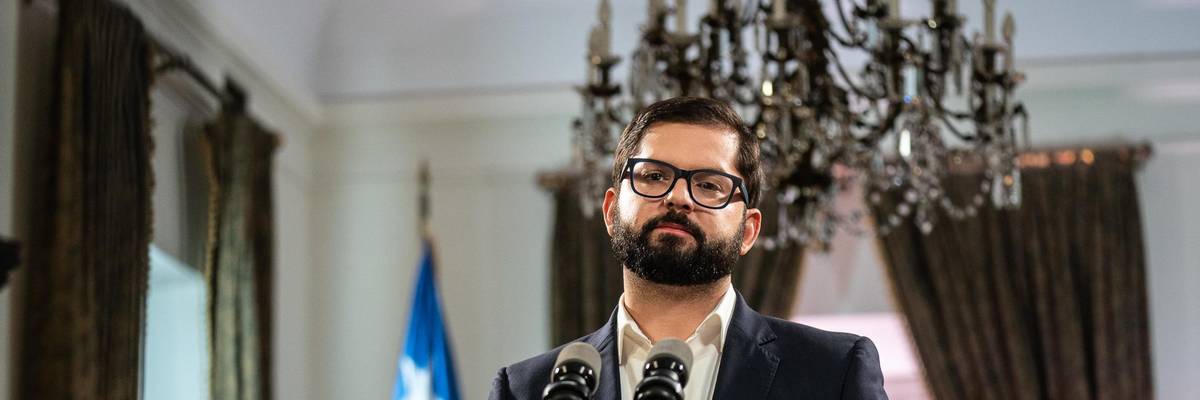
Chilean President Gabriel Boric delivers a speech in Santiago on September 4, 2022 after voters resoundingly rejected a proposed new constitution in a referendum. (Photo: Chilean Presidency Press Office / Handout/Anadolu Agency via Getty Images)
Proponents of Chile's new progressive constitution pledged to keep fighting Sunday following their crushing defeat in a plebiscite whose outcome was cheered by the oligarchs and corporations who spent heavily on the "no" campaign.
"We resisted for 500 years and will continue to do so."
With nearly all votes counted Sunday evening, the reject, or "rechazo," campaign was leading the approve, or "apruebo," effort, 60% to 40%.
The proposed document would have replaced a charter imposed during the U.S.-backed dictatorship of Gen. Augusto Pinochet with what proponents called the "world's most progressive constitution," replete with extensive rights for Indigenous peoples, women, and the environment. The proposal also guaranteed free healthcare, housing, and education.
Gabriel Boric, Chile's recently inaugurated democratic socialist president, acknowledged in a Sunday evening address to the nation that "the Chilean people were not satisfied with the constitutional proposal that the convention produced."
Boric added that "Chile trusts in its democracy."
"I will do all I can to build a new constitutional itinerary alongside the Congress and the civil society that will give us a text that, collecting the learnings of the process, aims to achieve a big majority," he added.
"Apruebo" advocates said the fight for a more just constitution is not over.
Rosa Catrileo, a constitutional delegate representing the Mapuche people, said that "it is never easy to move major transformations."
But, she added, "we resisted for 500 years and will continue to do so."
Barbara Sepulveda Hales, a constitutional attorney, tweeted: "Today we lost, but the fight to transform Chile continues. Thanks to the thousands who participated and debated to have an egalitarian constitution. Especially to the women who paved the way to advance for our rights."
"The horizon is one of change and it is inevitable," she added.
"The fears, the lies, were stronger," human rights activist Trinidad Lathrop tweeted. "How powerful is the power of money. But we're going to make it. Give yourselves some time to lick your wounds and then we'll come back stronger. For all and all... we are going to get ahead."
Amnesty International Chile tweeted that "today is a sad day. We have missed the historical opportunity to have a new constitution."
"But although the result of the plebiscite was not as expected," the group added, "we will continue fighting more than ever to live in fairer, more egalitarian, and more humane Chile."
While there is widespread agreement across the political spectrum that Chile's constitution must change, it is not known how the process--which is expected to be highly contentious--will move forward.
Boric said he is confident that Chileans can work toward a constitutional consensus.
"When we act in unity," the president in his speech, "we get the best of us."
Dear Common Dreams reader, It’s been nearly 30 years since I co-founded Common Dreams with my late wife, Lina Newhouser. We had the radical notion that journalism should serve the public good, not corporate profits. It was clear to us from the outset what it would take to build such a project. No paid advertisements. No corporate sponsors. No millionaire publisher telling us what to think or do. Many people said we wouldn't last a year, but we proved those doubters wrong. Together with a tremendous team of journalists and dedicated staff, we built an independent media outlet free from the constraints of profits and corporate control. Our mission has always been simple: To inform. To inspire. To ignite change for the common good. Building Common Dreams was not easy. Our survival was never guaranteed. When you take on the most powerful forces—Wall Street greed, fossil fuel industry destruction, Big Tech lobbyists, and uber-rich oligarchs who have spent billions upon billions rigging the economy and democracy in their favor—the only bulwark you have is supporters who believe in your work. But here’s the urgent message from me today. It's never been this bad out there. And it's never been this hard to keep us going. At the very moment Common Dreams is most needed, the threats we face are intensifying. We need your support now more than ever. We don't accept corporate advertising and never will. We don't have a paywall because we don't think people should be blocked from critical news based on their ability to pay. Everything we do is funded by the donations of readers like you. When everyone does the little they can afford, we are strong. But if that support retreats or dries up, so do we. Will you donate now to make sure Common Dreams not only survives but thrives? —Craig Brown, Co-founder |
Proponents of Chile's new progressive constitution pledged to keep fighting Sunday following their crushing defeat in a plebiscite whose outcome was cheered by the oligarchs and corporations who spent heavily on the "no" campaign.
"We resisted for 500 years and will continue to do so."
With nearly all votes counted Sunday evening, the reject, or "rechazo," campaign was leading the approve, or "apruebo," effort, 60% to 40%.
The proposed document would have replaced a charter imposed during the U.S.-backed dictatorship of Gen. Augusto Pinochet with what proponents called the "world's most progressive constitution," replete with extensive rights for Indigenous peoples, women, and the environment. The proposal also guaranteed free healthcare, housing, and education.
Gabriel Boric, Chile's recently inaugurated democratic socialist president, acknowledged in a Sunday evening address to the nation that "the Chilean people were not satisfied with the constitutional proposal that the convention produced."
Boric added that "Chile trusts in its democracy."
"I will do all I can to build a new constitutional itinerary alongside the Congress and the civil society that will give us a text that, collecting the learnings of the process, aims to achieve a big majority," he added.
"Apruebo" advocates said the fight for a more just constitution is not over.
Rosa Catrileo, a constitutional delegate representing the Mapuche people, said that "it is never easy to move major transformations."
But, she added, "we resisted for 500 years and will continue to do so."
Barbara Sepulveda Hales, a constitutional attorney, tweeted: "Today we lost, but the fight to transform Chile continues. Thanks to the thousands who participated and debated to have an egalitarian constitution. Especially to the women who paved the way to advance for our rights."
"The horizon is one of change and it is inevitable," she added.
"The fears, the lies, were stronger," human rights activist Trinidad Lathrop tweeted. "How powerful is the power of money. But we're going to make it. Give yourselves some time to lick your wounds and then we'll come back stronger. For all and all... we are going to get ahead."
Amnesty International Chile tweeted that "today is a sad day. We have missed the historical opportunity to have a new constitution."
"But although the result of the plebiscite was not as expected," the group added, "we will continue fighting more than ever to live in fairer, more egalitarian, and more humane Chile."
While there is widespread agreement across the political spectrum that Chile's constitution must change, it is not known how the process--which is expected to be highly contentious--will move forward.
Boric said he is confident that Chileans can work toward a constitutional consensus.
"When we act in unity," the president in his speech, "we get the best of us."
Proponents of Chile's new progressive constitution pledged to keep fighting Sunday following their crushing defeat in a plebiscite whose outcome was cheered by the oligarchs and corporations who spent heavily on the "no" campaign.
"We resisted for 500 years and will continue to do so."
With nearly all votes counted Sunday evening, the reject, or "rechazo," campaign was leading the approve, or "apruebo," effort, 60% to 40%.
The proposed document would have replaced a charter imposed during the U.S.-backed dictatorship of Gen. Augusto Pinochet with what proponents called the "world's most progressive constitution," replete with extensive rights for Indigenous peoples, women, and the environment. The proposal also guaranteed free healthcare, housing, and education.
Gabriel Boric, Chile's recently inaugurated democratic socialist president, acknowledged in a Sunday evening address to the nation that "the Chilean people were not satisfied with the constitutional proposal that the convention produced."
Boric added that "Chile trusts in its democracy."
"I will do all I can to build a new constitutional itinerary alongside the Congress and the civil society that will give us a text that, collecting the learnings of the process, aims to achieve a big majority," he added.
"Apruebo" advocates said the fight for a more just constitution is not over.
Rosa Catrileo, a constitutional delegate representing the Mapuche people, said that "it is never easy to move major transformations."
But, she added, "we resisted for 500 years and will continue to do so."
Barbara Sepulveda Hales, a constitutional attorney, tweeted: "Today we lost, but the fight to transform Chile continues. Thanks to the thousands who participated and debated to have an egalitarian constitution. Especially to the women who paved the way to advance for our rights."
"The horizon is one of change and it is inevitable," she added.
"The fears, the lies, were stronger," human rights activist Trinidad Lathrop tweeted. "How powerful is the power of money. But we're going to make it. Give yourselves some time to lick your wounds and then we'll come back stronger. For all and all... we are going to get ahead."
Amnesty International Chile tweeted that "today is a sad day. We have missed the historical opportunity to have a new constitution."
"But although the result of the plebiscite was not as expected," the group added, "we will continue fighting more than ever to live in fairer, more egalitarian, and more humane Chile."
While there is widespread agreement across the political spectrum that Chile's constitution must change, it is not known how the process--which is expected to be highly contentious--will move forward.
Boric said he is confident that Chileans can work toward a constitutional consensus.
"When we act in unity," the president in his speech, "we get the best of us."

