SUBSCRIBE TO OUR FREE NEWSLETTER
Daily news & progressive opinion—funded by the people, not the corporations—delivered straight to your inbox.
5
#000000
#FFFFFF
To donate by check, phone, or other method, see our More Ways to Give page.
Daily news & progressive opinion—funded by the people, not the corporations—delivered straight to your inbox.
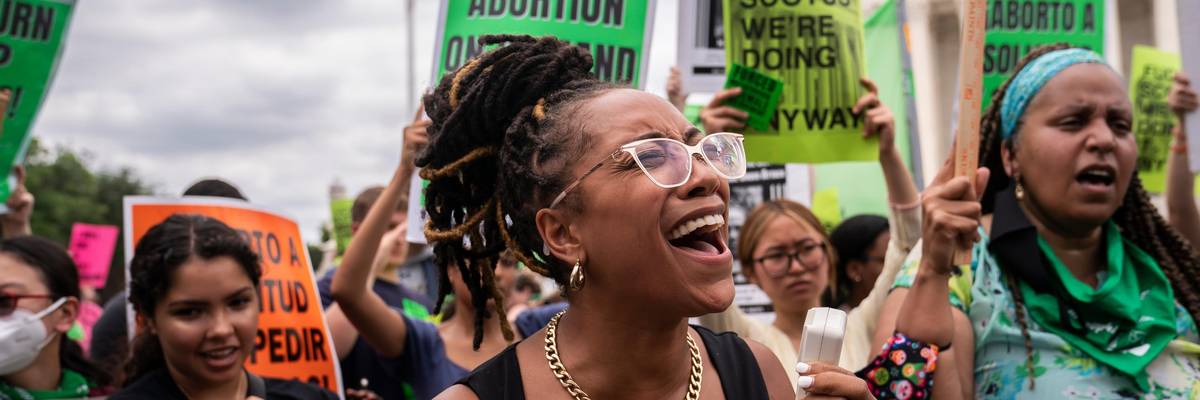
Reproductive rights advocates rally outside the U.S. Supreme Court in Washington, D.C. after the justices reversed Roe v. Wade on June 24, 2022. (Photo: Nathan Howard/Getty Images)
Large crowds of people took to the streets of cities and towns across the United States Friday evening to protest the Supreme Court's reversal of Roe v. Wade and to vow to fight for reproductive rights.
In San Francisco, hundreds of youth-led protesters shouting slogans including "We won't go back!" and "Keep your rosaries off my ovaries" rallied in Civic Center Plaza, while hundreds marched and staged a sit-in on Market Street.
" Abortion is a human right," Amnesty International youth leader and protest co-organizer Samprikta Basu told Common Dreams outside San Francisco City Hall. "A ban on abortions is a ban on safe abortions and this affects marginalized communities, the poor, and people of color the most."
"So it's important that we come out and make our voice heard," Basu added. "It's not okay to take away a constitutional right."
In Albuquerque, hundreds of people gathered in Old Town's Tiguex Park to protest Friday's ruling.
"I just can't believe the Supreme Court is rolling back constitutional rights," Alix King, who said she almost died after an illegal abortion in 1965 when she was 13 years old, told the Albuquerque Journal. "That's terrifying."
More than 1,000 people marched from Lincoln Park to City Hall in downtown Portland, Maine, where protester Abby Friedlander condemned the Supreme Court ruling as "a real setback for women's rights."
Meg Palitz was among the thousands of demonstrators who rallied in Philadelphia.
"A lot of people will be forced to have children they don't want," she told CBS Philadelphia. "You can have health complications, it can be really bad financially and can really just change their lives for the worse, not to mention flooding the foster care system."
In Denver, the Party for Socialism and Liberation, which held a rally at the Colorado state Capitol, defiantly declared that "We won't go back. We WILL fight back."
Thousands of people descended upon Austin's Republic Square before marching through downtown chanting slogans including, "My body, my choice!" and "Fuck the court and legislature, I am not an incubator!"
Texas is one of 13 states with so-called "trigger laws," which in its case will make most abortions illegal unless necessary to save the life of the pregnant person or if there's a risk of serious impairment because of the pregnancy.
At the University of Minnesota in Minneapolis, a speaker at a youth-led rally was cheered loudly after proclaiming that "we're not just gonna sit back and allow a group of people, of mostly old white men who were not even elected to their positions, take these rights away from us."
In Cedar Rapids, Iowa at least one reproductive rights protester was struck by a truck. Iowa is one of several states that have enacted laws shielding motorists who hit protesters under certain circumstances.
In New York City, protesters at a Washington Square Park rally held signs with messages like "Forced birth = Violence" and chanted slogans including "Abortion is a human right, not just for the rich and white."
Emma Handler, one of the thousands who gathered in Washington Square, told The New York Times that for a handful of unelected justices to have the power to "make these decisions about our lives and our health and our well-being is deeply dystopian."
"People will die from this choice, and I hope that people in power have this on their conscience," she added. "I'm just sad."
Dear Common Dreams reader, It’s been nearly 30 years since I co-founded Common Dreams with my late wife, Lina Newhouser. We had the radical notion that journalism should serve the public good, not corporate profits. It was clear to us from the outset what it would take to build such a project. No paid advertisements. No corporate sponsors. No millionaire publisher telling us what to think or do. Many people said we wouldn't last a year, but we proved those doubters wrong. Together with a tremendous team of journalists and dedicated staff, we built an independent media outlet free from the constraints of profits and corporate control. Our mission has always been simple: To inform. To inspire. To ignite change for the common good. Building Common Dreams was not easy. Our survival was never guaranteed. When you take on the most powerful forces—Wall Street greed, fossil fuel industry destruction, Big Tech lobbyists, and uber-rich oligarchs who have spent billions upon billions rigging the economy and democracy in their favor—the only bulwark you have is supporters who believe in your work. But here’s the urgent message from me today. It's never been this bad out there. And it's never been this hard to keep us going. At the very moment Common Dreams is most needed, the threats we face are intensifying. We need your support now more than ever. We don't accept corporate advertising and never will. We don't have a paywall because we don't think people should be blocked from critical news based on their ability to pay. Everything we do is funded by the donations of readers like you. When everyone does the little they can afford, we are strong. But if that support retreats or dries up, so do we. Will you donate now to make sure Common Dreams not only survives but thrives? —Craig Brown, Co-founder |
Large crowds of people took to the streets of cities and towns across the United States Friday evening to protest the Supreme Court's reversal of Roe v. Wade and to vow to fight for reproductive rights.
In San Francisco, hundreds of youth-led protesters shouting slogans including "We won't go back!" and "Keep your rosaries off my ovaries" rallied in Civic Center Plaza, while hundreds marched and staged a sit-in on Market Street.
" Abortion is a human right," Amnesty International youth leader and protest co-organizer Samprikta Basu told Common Dreams outside San Francisco City Hall. "A ban on abortions is a ban on safe abortions and this affects marginalized communities, the poor, and people of color the most."
"So it's important that we come out and make our voice heard," Basu added. "It's not okay to take away a constitutional right."
In Albuquerque, hundreds of people gathered in Old Town's Tiguex Park to protest Friday's ruling.
"I just can't believe the Supreme Court is rolling back constitutional rights," Alix King, who said she almost died after an illegal abortion in 1965 when she was 13 years old, told the Albuquerque Journal. "That's terrifying."
More than 1,000 people marched from Lincoln Park to City Hall in downtown Portland, Maine, where protester Abby Friedlander condemned the Supreme Court ruling as "a real setback for women's rights."
Meg Palitz was among the thousands of demonstrators who rallied in Philadelphia.
"A lot of people will be forced to have children they don't want," she told CBS Philadelphia. "You can have health complications, it can be really bad financially and can really just change their lives for the worse, not to mention flooding the foster care system."
In Denver, the Party for Socialism and Liberation, which held a rally at the Colorado state Capitol, defiantly declared that "We won't go back. We WILL fight back."
Thousands of people descended upon Austin's Republic Square before marching through downtown chanting slogans including, "My body, my choice!" and "Fuck the court and legislature, I am not an incubator!"
Texas is one of 13 states with so-called "trigger laws," which in its case will make most abortions illegal unless necessary to save the life of the pregnant person or if there's a risk of serious impairment because of the pregnancy.
At the University of Minnesota in Minneapolis, a speaker at a youth-led rally was cheered loudly after proclaiming that "we're not just gonna sit back and allow a group of people, of mostly old white men who were not even elected to their positions, take these rights away from us."
In Cedar Rapids, Iowa at least one reproductive rights protester was struck by a truck. Iowa is one of several states that have enacted laws shielding motorists who hit protesters under certain circumstances.
In New York City, protesters at a Washington Square Park rally held signs with messages like "Forced birth = Violence" and chanted slogans including "Abortion is a human right, not just for the rich and white."
Emma Handler, one of the thousands who gathered in Washington Square, told The New York Times that for a handful of unelected justices to have the power to "make these decisions about our lives and our health and our well-being is deeply dystopian."
"People will die from this choice, and I hope that people in power have this on their conscience," she added. "I'm just sad."
Large crowds of people took to the streets of cities and towns across the United States Friday evening to protest the Supreme Court's reversal of Roe v. Wade and to vow to fight for reproductive rights.
In San Francisco, hundreds of youth-led protesters shouting slogans including "We won't go back!" and "Keep your rosaries off my ovaries" rallied in Civic Center Plaza, while hundreds marched and staged a sit-in on Market Street.
" Abortion is a human right," Amnesty International youth leader and protest co-organizer Samprikta Basu told Common Dreams outside San Francisco City Hall. "A ban on abortions is a ban on safe abortions and this affects marginalized communities, the poor, and people of color the most."
"So it's important that we come out and make our voice heard," Basu added. "It's not okay to take away a constitutional right."
In Albuquerque, hundreds of people gathered in Old Town's Tiguex Park to protest Friday's ruling.
"I just can't believe the Supreme Court is rolling back constitutional rights," Alix King, who said she almost died after an illegal abortion in 1965 when she was 13 years old, told the Albuquerque Journal. "That's terrifying."
More than 1,000 people marched from Lincoln Park to City Hall in downtown Portland, Maine, where protester Abby Friedlander condemned the Supreme Court ruling as "a real setback for women's rights."
Meg Palitz was among the thousands of demonstrators who rallied in Philadelphia.
"A lot of people will be forced to have children they don't want," she told CBS Philadelphia. "You can have health complications, it can be really bad financially and can really just change their lives for the worse, not to mention flooding the foster care system."
In Denver, the Party for Socialism and Liberation, which held a rally at the Colorado state Capitol, defiantly declared that "We won't go back. We WILL fight back."
Thousands of people descended upon Austin's Republic Square before marching through downtown chanting slogans including, "My body, my choice!" and "Fuck the court and legislature, I am not an incubator!"
Texas is one of 13 states with so-called "trigger laws," which in its case will make most abortions illegal unless necessary to save the life of the pregnant person or if there's a risk of serious impairment because of the pregnancy.
At the University of Minnesota in Minneapolis, a speaker at a youth-led rally was cheered loudly after proclaiming that "we're not just gonna sit back and allow a group of people, of mostly old white men who were not even elected to their positions, take these rights away from us."
In Cedar Rapids, Iowa at least one reproductive rights protester was struck by a truck. Iowa is one of several states that have enacted laws shielding motorists who hit protesters under certain circumstances.
In New York City, protesters at a Washington Square Park rally held signs with messages like "Forced birth = Violence" and chanted slogans including "Abortion is a human right, not just for the rich and white."
Emma Handler, one of the thousands who gathered in Washington Square, told The New York Times that for a handful of unelected justices to have the power to "make these decisions about our lives and our health and our well-being is deeply dystopian."
"People will die from this choice, and I hope that people in power have this on their conscience," she added. "I'm just sad."