SUBSCRIBE TO OUR FREE NEWSLETTER
Daily news & progressive opinion—funded by the people, not the corporations—delivered straight to your inbox.
5
#000000
#FFFFFF
To donate by check, phone, or other method, see our More Ways to Give page.
Daily news & progressive opinion—funded by the people, not the corporations—delivered straight to your inbox.
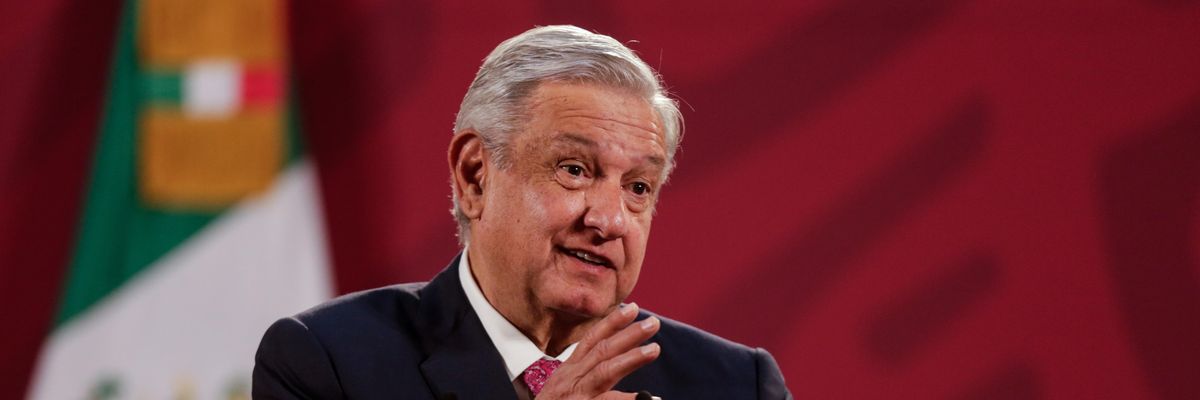
Mexican President Andres Manuel Lopez Obrador speaks at a press conference in Mexico City on December 8, 2020. (Photo: by Francisco Canedo/Xinhua via Getty Images)
Mexico's leftist President Andres Manuel Lopez Obrador announced Monday that he is skipping the Summit of the Americas, following through on his threat to boycott the upcoming meeting if the White House refused to invite officials from all nations in the Western Hemisphere.
The Biden administration's decision to bar the governments of Cuba, Nicaragua, and Venezuela from this week's gathering in Los Angeles was made final on Sunday.
Unnamed sources familiar with deliberations between Washington officials and their Latin American and Caribbean counterparts, including those in Mexico, said that U.S. President Joe Biden's long-anticipated move was "based on concerns about the lack of democracy and respect for human rights in the three countries," Bloomberg reported.
However, the White House is reportedly considering a role for Juan Guaido--an unelected and unpopular right-wing opposition figure who participated in a failed, Trump-backed bid to overthrow elected Venezuelan President Nicolas Maduro in 2019--at a virtual side event.
Washington does not officially recognize Maduro as the legitimate leader of the South American country even though he was re-elected last year in a contest that U.S. legal observers called fair. Instead, the U.S. recognizes Guaido as interim president, and Biden previously invited the Venezuelan coup leader to his administration's so-called Summit for Democracy in December.
In addition to Maduro, the U.S. is excluding Nicaraguan President Daniel Ortega, whose 2021 re-election Biden called fraudulent, from the Summit of the Americas.
According to U.S. officials, the Biden administration decided against inviting a lower-ranking government representative to attend in place of Cuban President Miguel Diaz-Canel, who said last month that he would not travel to Los Angeles even if invited due to the White House's "brutal" pressure campaign to make this week's event non-inclusive.
Cuba participated in the 2015 meeting in Panama and the 2018 meeting in Peru, which former U.S. President Donald Trump skipped.
Despite Democratic lawmakers' pleas and Biden's own campaign pledge to reverse Trump's "failed" approach to Cuba--which included implementing more than 200 punitive policies following Obama-era efforts at normalization--the White House has imposed additional sanctions in recent months, intensifying Washington's 60-year embargo on the Caribbean island.
Among other officials in the hemisphere, far-right presidents Jair Bolsonaro of Brazil and Ivan Duque of Colombia are expected to attend the Summit of the Americas, which begins Monday and ends June 10.
Like Lopez Obrador, however, Honduras' socialist President Xiomara Castro will not be making the trip to Los Angeles. Her decision to stay home was announced Sunday.
Mexican Foreign Minister Marcelo Ebrard and Honduran Foreign Minister Eduardo Enrique Reina are expected to fill in, but the absence of multiple Central American presidents is likely to complicate Biden's agenda, which reportedly includes crafting an agreement to reduce and manage undocumented migration as well as discussions of regional economic, health, and food security issues exacerbated by rising inequality and the fossil fuel-driven climate crisis.
Aileen Teague, a non-resident fellow at the Quincy Institute, argued last month that "the Biden administration will lose political capital if it allows its growing tendency to divide the world into 'democratic' friends and 'authoritarian' states to dictate the invitation list for a forum that is much larger than Washington's professed policy objectives."
The stated focus of the Summit of the Americas is to commit to "concrete actions that dramatically improve pandemic response and resilience, promote a green and equitable recovery, bold strong and inclusive democracies, and address the root causes of irregular migration."
John Kirk, professor emeritus of Latin American Studies at Dalhousie University in Canada, argued last week that "for a summit that aims to 'dramatically improve pandemic response,' it seems odd to exclude Cuba--the only country in Latin America to have developed its own Covid vaccines, to have sent thousands of medical professionals abroad to help people during the pandemic, and to have fully vaccinated 96% of the population. (Latest figures show fewer than 70 Covid cases per day)."
"In terms of their role abroad, some 5,000 Cuban specialists worked in 42 countries on anti-Covid missions," Kirk continued. "As the prime minister of Dominica, Roosevelt Skerrit explained: 'Here in the Caribbean if the support of Cuban doctors was to be removed from the health system of all the countries that are members of Caricom [the Caribbean Community], these would collapse.'"
"Cuba has one of the best public health systems in the Americas," wrote Kirk. "Given these successes, and its program of international medical support, why not at least listen to its successful approach to the pandemic?"
Dear Common Dreams reader, It’s been nearly 30 years since I co-founded Common Dreams with my late wife, Lina Newhouser. We had the radical notion that journalism should serve the public good, not corporate profits. It was clear to us from the outset what it would take to build such a project. No paid advertisements. No corporate sponsors. No millionaire publisher telling us what to think or do. Many people said we wouldn't last a year, but we proved those doubters wrong. Together with a tremendous team of journalists and dedicated staff, we built an independent media outlet free from the constraints of profits and corporate control. Our mission has always been simple: To inform. To inspire. To ignite change for the common good. Building Common Dreams was not easy. Our survival was never guaranteed. When you take on the most powerful forces—Wall Street greed, fossil fuel industry destruction, Big Tech lobbyists, and uber-rich oligarchs who have spent billions upon billions rigging the economy and democracy in their favor—the only bulwark you have is supporters who believe in your work. But here’s the urgent message from me today. It's never been this bad out there. And it's never been this hard to keep us going. At the very moment Common Dreams is most needed, the threats we face are intensifying. We need your support now more than ever. We don't accept corporate advertising and never will. We don't have a paywall because we don't think people should be blocked from critical news based on their ability to pay. Everything we do is funded by the donations of readers like you. When everyone does the little they can afford, we are strong. But if that support retreats or dries up, so do we. Will you donate now to make sure Common Dreams not only survives but thrives? —Craig Brown, Co-founder |
Mexico's leftist President Andres Manuel Lopez Obrador announced Monday that he is skipping the Summit of the Americas, following through on his threat to boycott the upcoming meeting if the White House refused to invite officials from all nations in the Western Hemisphere.
The Biden administration's decision to bar the governments of Cuba, Nicaragua, and Venezuela from this week's gathering in Los Angeles was made final on Sunday.
Unnamed sources familiar with deliberations between Washington officials and their Latin American and Caribbean counterparts, including those in Mexico, said that U.S. President Joe Biden's long-anticipated move was "based on concerns about the lack of democracy and respect for human rights in the three countries," Bloomberg reported.
However, the White House is reportedly considering a role for Juan Guaido--an unelected and unpopular right-wing opposition figure who participated in a failed, Trump-backed bid to overthrow elected Venezuelan President Nicolas Maduro in 2019--at a virtual side event.
Washington does not officially recognize Maduro as the legitimate leader of the South American country even though he was re-elected last year in a contest that U.S. legal observers called fair. Instead, the U.S. recognizes Guaido as interim president, and Biden previously invited the Venezuelan coup leader to his administration's so-called Summit for Democracy in December.
In addition to Maduro, the U.S. is excluding Nicaraguan President Daniel Ortega, whose 2021 re-election Biden called fraudulent, from the Summit of the Americas.
According to U.S. officials, the Biden administration decided against inviting a lower-ranking government representative to attend in place of Cuban President Miguel Diaz-Canel, who said last month that he would not travel to Los Angeles even if invited due to the White House's "brutal" pressure campaign to make this week's event non-inclusive.
Cuba participated in the 2015 meeting in Panama and the 2018 meeting in Peru, which former U.S. President Donald Trump skipped.
Despite Democratic lawmakers' pleas and Biden's own campaign pledge to reverse Trump's "failed" approach to Cuba--which included implementing more than 200 punitive policies following Obama-era efforts at normalization--the White House has imposed additional sanctions in recent months, intensifying Washington's 60-year embargo on the Caribbean island.
Among other officials in the hemisphere, far-right presidents Jair Bolsonaro of Brazil and Ivan Duque of Colombia are expected to attend the Summit of the Americas, which begins Monday and ends June 10.
Like Lopez Obrador, however, Honduras' socialist President Xiomara Castro will not be making the trip to Los Angeles. Her decision to stay home was announced Sunday.
Mexican Foreign Minister Marcelo Ebrard and Honduran Foreign Minister Eduardo Enrique Reina are expected to fill in, but the absence of multiple Central American presidents is likely to complicate Biden's agenda, which reportedly includes crafting an agreement to reduce and manage undocumented migration as well as discussions of regional economic, health, and food security issues exacerbated by rising inequality and the fossil fuel-driven climate crisis.
Aileen Teague, a non-resident fellow at the Quincy Institute, argued last month that "the Biden administration will lose political capital if it allows its growing tendency to divide the world into 'democratic' friends and 'authoritarian' states to dictate the invitation list for a forum that is much larger than Washington's professed policy objectives."
The stated focus of the Summit of the Americas is to commit to "concrete actions that dramatically improve pandemic response and resilience, promote a green and equitable recovery, bold strong and inclusive democracies, and address the root causes of irregular migration."
John Kirk, professor emeritus of Latin American Studies at Dalhousie University in Canada, argued last week that "for a summit that aims to 'dramatically improve pandemic response,' it seems odd to exclude Cuba--the only country in Latin America to have developed its own Covid vaccines, to have sent thousands of medical professionals abroad to help people during the pandemic, and to have fully vaccinated 96% of the population. (Latest figures show fewer than 70 Covid cases per day)."
"In terms of their role abroad, some 5,000 Cuban specialists worked in 42 countries on anti-Covid missions," Kirk continued. "As the prime minister of Dominica, Roosevelt Skerrit explained: 'Here in the Caribbean if the support of Cuban doctors was to be removed from the health system of all the countries that are members of Caricom [the Caribbean Community], these would collapse.'"
"Cuba has one of the best public health systems in the Americas," wrote Kirk. "Given these successes, and its program of international medical support, why not at least listen to its successful approach to the pandemic?"
Mexico's leftist President Andres Manuel Lopez Obrador announced Monday that he is skipping the Summit of the Americas, following through on his threat to boycott the upcoming meeting if the White House refused to invite officials from all nations in the Western Hemisphere.
The Biden administration's decision to bar the governments of Cuba, Nicaragua, and Venezuela from this week's gathering in Los Angeles was made final on Sunday.
Unnamed sources familiar with deliberations between Washington officials and their Latin American and Caribbean counterparts, including those in Mexico, said that U.S. President Joe Biden's long-anticipated move was "based on concerns about the lack of democracy and respect for human rights in the three countries," Bloomberg reported.
However, the White House is reportedly considering a role for Juan Guaido--an unelected and unpopular right-wing opposition figure who participated in a failed, Trump-backed bid to overthrow elected Venezuelan President Nicolas Maduro in 2019--at a virtual side event.
Washington does not officially recognize Maduro as the legitimate leader of the South American country even though he was re-elected last year in a contest that U.S. legal observers called fair. Instead, the U.S. recognizes Guaido as interim president, and Biden previously invited the Venezuelan coup leader to his administration's so-called Summit for Democracy in December.
In addition to Maduro, the U.S. is excluding Nicaraguan President Daniel Ortega, whose 2021 re-election Biden called fraudulent, from the Summit of the Americas.
According to U.S. officials, the Biden administration decided against inviting a lower-ranking government representative to attend in place of Cuban President Miguel Diaz-Canel, who said last month that he would not travel to Los Angeles even if invited due to the White House's "brutal" pressure campaign to make this week's event non-inclusive.
Cuba participated in the 2015 meeting in Panama and the 2018 meeting in Peru, which former U.S. President Donald Trump skipped.
Despite Democratic lawmakers' pleas and Biden's own campaign pledge to reverse Trump's "failed" approach to Cuba--which included implementing more than 200 punitive policies following Obama-era efforts at normalization--the White House has imposed additional sanctions in recent months, intensifying Washington's 60-year embargo on the Caribbean island.
Among other officials in the hemisphere, far-right presidents Jair Bolsonaro of Brazil and Ivan Duque of Colombia are expected to attend the Summit of the Americas, which begins Monday and ends June 10.
Like Lopez Obrador, however, Honduras' socialist President Xiomara Castro will not be making the trip to Los Angeles. Her decision to stay home was announced Sunday.
Mexican Foreign Minister Marcelo Ebrard and Honduran Foreign Minister Eduardo Enrique Reina are expected to fill in, but the absence of multiple Central American presidents is likely to complicate Biden's agenda, which reportedly includes crafting an agreement to reduce and manage undocumented migration as well as discussions of regional economic, health, and food security issues exacerbated by rising inequality and the fossil fuel-driven climate crisis.
Aileen Teague, a non-resident fellow at the Quincy Institute, argued last month that "the Biden administration will lose political capital if it allows its growing tendency to divide the world into 'democratic' friends and 'authoritarian' states to dictate the invitation list for a forum that is much larger than Washington's professed policy objectives."
The stated focus of the Summit of the Americas is to commit to "concrete actions that dramatically improve pandemic response and resilience, promote a green and equitable recovery, bold strong and inclusive democracies, and address the root causes of irregular migration."
John Kirk, professor emeritus of Latin American Studies at Dalhousie University in Canada, argued last week that "for a summit that aims to 'dramatically improve pandemic response,' it seems odd to exclude Cuba--the only country in Latin America to have developed its own Covid vaccines, to have sent thousands of medical professionals abroad to help people during the pandemic, and to have fully vaccinated 96% of the population. (Latest figures show fewer than 70 Covid cases per day)."
"In terms of their role abroad, some 5,000 Cuban specialists worked in 42 countries on anti-Covid missions," Kirk continued. "As the prime minister of Dominica, Roosevelt Skerrit explained: 'Here in the Caribbean if the support of Cuban doctors was to be removed from the health system of all the countries that are members of Caricom [the Caribbean Community], these would collapse.'"
"Cuba has one of the best public health systems in the Americas," wrote Kirk. "Given these successes, and its program of international medical support, why not at least listen to its successful approach to the pandemic?"