SUBSCRIBE TO OUR FREE NEWSLETTER
Daily news & progressive opinion—funded by the people, not the corporations—delivered straight to your inbox.
5
#000000
#FFFFFF
To donate by check, phone, or other method, see our More Ways to Give page.
"The developing world is at the brink of a perfect storm of debt, food, and energy crises."
"Instances of civil unrest are brewing in all corners of the world."
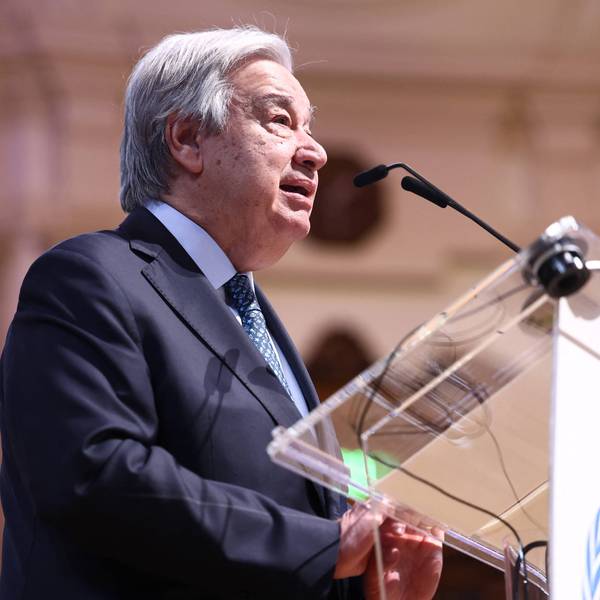
So said Rebecca Grynspan, head of the United Nations Conference on Trade and Development (UNCTAD), during her remarks at Monday's 55th meeting of the U.N. Commission on Population and Development (CPD).
Given "elevated levels of socioeconomic stress" amid the Covid-19 pandemic and "the unremitting cost" of the climate emergency, "global exposure to this crisis is counted in the billions of people living in over a hundred countries," said Grynspan.
Citing the recently published inaugural brief from the Global Crisis Response Group, a team that U.N. Secretary-General Antonio Guterres created following Russia's invasion of Ukraine, Grynspan said that "107 economies are severely exposed to at least one of the three global channels of transmission that characterize this crisis--rising food prices, rising energy prices, and tightening financial conditions." Nearly one-fifth of humanity--1.7 billion people--"live in these countries, of which more than 500 million are already poor, and 215 million are undernourished."
With global inflation soaring--driven by a supply chain crunch and price gouging, both occurring in a context of highly concentrated corporate power following decades of neoliberal globalization--and a systemic debt crisis underway, "instances of civil unrest are brewing in all corners of the world," said Grynspan.
Related Content

The price of food, in particular, is surging--hitting record highs in recent weeks. Hunger was already rampant in several impoverished nations, but Russia's war on Ukraine has significantly diminished agricultural output from one of the world's most productive growing regions. As a result, tens of millions of people throughout the Global South--including in the occupied Palestinian territories, several countries in the Middle East and North Africa, and in parts of East Africa--are at risk of extreme hunger.
The situation is especially dire in war-torn and drought-stricken countries such as Yemen--where the U.S.-backed, Saudi-led military assault has entered its eighth year--and Afghanistan, whose central bank reserves have been seized by the Biden administration.
In Latin America, fertilizer shortages are already hurting poor Peruvians, contributing to unrest and throwing the political future of leftist President Pedro Castillo into doubt.
In addition, as the West cracks down on Russian fossil fuel exports and Big Oil capitalizes on the war, energy prices are also increasing worldwide.
Making matters worse, conditions on nearly 90% of the International Monetary Fund's pandemic-related loans are forcing low-income nations to impose austerity measures that undermine vital public services and exacerbate immiseration.
Related Content

"Our progress towards the Sustainable Development Goals has been severely hampered in the past few years," said Grynspan, "and we have witnessed with alarm growing poverty levels and greater inequalities."
"When the 2030 Agenda was approved, we at UNCTAD calculated the investment gap for developing countries to meet their SDGs at $2.5 trillion dollars," Grynspan continued. "The pandemic widened this gap to $4.3 trillion dollars. The war in Ukraine is expected to widen this gap further. Now, an ever-widening gap is not a gap. It is an abyss."
"We urgently need to renew the social contract to rebuild trust and social cohesion."
U.N. Deputy Secretary-General Amina Mohammed concurred that "the triple emergency of food, energy, and finance faced by many developing countries" has been intensified by the ongoing coronavirus pandemic, war in Ukraine, and climate crisis.
"Covid-19 has caused more than six million deaths worldwide," Mohammed pointed out. "Excess mortality figures suggest that millions more have been killed by the disease or indirectly by its impacts."
And yet, thanks to the refusal of profit-maximizing pharmaceutical corporations and their wealthy government allies to share knowledge and technology, access to lifesaving vaccines, tests, and treatments remains profoundly unequal--prolonging global economic hardship and increasing the risk that a vaccine-resistant variant emerges.
"The pandemic has kept boys and girls out of school, increased the burden of care work, especially for women, and exacerbated gender-based violence," said Mohammed.
"As the war in Ukraine is causing food and energy prices to skyrocket... the numbers of people affected by hunger are projected to increase by tens of millions," she continued. "Meanwhile, recent reports by the Intergovernmental Panel on Climate Change show that the world is on a fast track to climate disaster."
"In the face of this gathering storm of adversity, we must come together as an international community," Mohammed stressed. "We urgently need to renew the social contract to rebuild trust and social cohesion."
The CPD--with its focus on achieving what U.N. Population Fund executive director Natalia Kanem called "sexual and reproductive justice for all" to advance equitable and sustainable development--"has an important role to play," said Mohammed.
Elaborating on the need to invest in universal healthcare, public education, and other forms of social protection in ways that promote gender equity and are sensitive to changing demographic patterns, Mohammed said:
A renewed social contract should enable young people to live in dignity, ensure women have the same prospects and opportunities as men, and protect the sick, the vulnerable, and minorities of all kinds.
Most countries are experiencing progressive population aging and facing corresponding fiscal pressures. In response, governments need to prioritize investment in the care economy, lifelong learning and decent work, and healthy lifestyles across the age range.
At the same time, we are presented with a unique, global opportunity: the largest youth population in human history. It is paramount that we make use of the population dividend, and that we invest in young people to unlock their full potential.
"We have no choice but to do so while also addressing the climate crisis and rebuilding economies ravaged by the pandemic and armed conflict," she added.
"The developing world is at the brink of a perfect storm of debt, food, and energy crises."
"Instances of civil unrest are brewing in all corners of the world."
So said Rebecca Grynspan, head of the United Nations Conference on Trade and Development (UNCTAD), during her remarks at Monday's 55th meeting of the U.N. Commission on Population and Development (CPD).
Given "elevated levels of socioeconomic stress" amid the Covid-19 pandemic and "the unremitting cost" of the climate emergency, "global exposure to this crisis is counted in the billions of people living in over a hundred countries," said Grynspan.
Citing the recently published inaugural brief from the Global Crisis Response Group, a team that U.N. Secretary-General Antonio Guterres created following Russia's invasion of Ukraine, Grynspan said that "107 economies are severely exposed to at least one of the three global channels of transmission that characterize this crisis--rising food prices, rising energy prices, and tightening financial conditions." Nearly one-fifth of humanity--1.7 billion people--"live in these countries, of which more than 500 million are already poor, and 215 million are undernourished."
With global inflation soaring--driven by a supply chain crunch and price gouging, both occurring in a context of highly concentrated corporate power following decades of neoliberal globalization--and a systemic debt crisis underway, "instances of civil unrest are brewing in all corners of the world," said Grynspan.
Related Content
The price of food, in particular, is surging--hitting record highs in recent weeks. Hunger was already rampant in several impoverished nations, but Russia's war on Ukraine has significantly diminished agricultural output from one of the world's most productive growing regions. As a result, tens of millions of people throughout the Global South--including in the occupied Palestinian territories, several countries in the Middle East and North Africa, and in parts of East Africa--are at risk of extreme hunger.
The situation is especially dire in war-torn and drought-stricken countries such as Yemen--where the U.S.-backed, Saudi-led military assault has entered its eighth year--and Afghanistan, whose central bank reserves have been seized by the Biden administration.
In Latin America, fertilizer shortages are already hurting poor Peruvians, contributing to unrest and throwing the political future of leftist President Pedro Castillo into doubt.
In addition, as the West cracks down on Russian fossil fuel exports and Big Oil capitalizes on the war, energy prices are also increasing worldwide.
Making matters worse, conditions on nearly 90% of the International Monetary Fund's pandemic-related loans are forcing low-income nations to impose austerity measures that undermine vital public services and exacerbate immiseration.
Related Content
"Our progress towards the Sustainable Development Goals has been severely hampered in the past few years," said Grynspan, "and we have witnessed with alarm growing poverty levels and greater inequalities."
"When the 2030 Agenda was approved, we at UNCTAD calculated the investment gap for developing countries to meet their SDGs at $2.5 trillion dollars," Grynspan continued. "The pandemic widened this gap to $4.3 trillion dollars. The war in Ukraine is expected to widen this gap further. Now, an ever-widening gap is not a gap. It is an abyss."
"We urgently need to renew the social contract to rebuild trust and social cohesion."
U.N. Deputy Secretary-General Amina Mohammed concurred that "the triple emergency of food, energy, and finance faced by many developing countries" has been intensified by the ongoing coronavirus pandemic, war in Ukraine, and climate crisis.
"Covid-19 has caused more than six million deaths worldwide," Mohammed pointed out. "Excess mortality figures suggest that millions more have been killed by the disease or indirectly by its impacts."
And yet, thanks to the refusal of profit-maximizing pharmaceutical corporations and their wealthy government allies to share knowledge and technology, access to lifesaving vaccines, tests, and treatments remains profoundly unequal--prolonging global economic hardship and increasing the risk that a vaccine-resistant variant emerges.
"The pandemic has kept boys and girls out of school, increased the burden of care work, especially for women, and exacerbated gender-based violence," said Mohammed.
"As the war in Ukraine is causing food and energy prices to skyrocket... the numbers of people affected by hunger are projected to increase by tens of millions," she continued. "Meanwhile, recent reports by the Intergovernmental Panel on Climate Change show that the world is on a fast track to climate disaster."
"In the face of this gathering storm of adversity, we must come together as an international community," Mohammed stressed. "We urgently need to renew the social contract to rebuild trust and social cohesion."
The CPD--with its focus on achieving what U.N. Population Fund executive director Natalia Kanem called "sexual and reproductive justice for all" to advance equitable and sustainable development--"has an important role to play," said Mohammed.
Elaborating on the need to invest in universal healthcare, public education, and other forms of social protection in ways that promote gender equity and are sensitive to changing demographic patterns, Mohammed said:
A renewed social contract should enable young people to live in dignity, ensure women have the same prospects and opportunities as men, and protect the sick, the vulnerable, and minorities of all kinds.
Most countries are experiencing progressive population aging and facing corresponding fiscal pressures. In response, governments need to prioritize investment in the care economy, lifelong learning and decent work, and healthy lifestyles across the age range.
At the same time, we are presented with a unique, global opportunity: the largest youth population in human history. It is paramount that we make use of the population dividend, and that we invest in young people to unlock their full potential.
"We have no choice but to do so while also addressing the climate crisis and rebuilding economies ravaged by the pandemic and armed conflict," she added.
"The developing world is at the brink of a perfect storm of debt, food, and energy crises."
"Instances of civil unrest are brewing in all corners of the world."
So said Rebecca Grynspan, head of the United Nations Conference on Trade and Development (UNCTAD), during her remarks at Monday's 55th meeting of the U.N. Commission on Population and Development (CPD).
Given "elevated levels of socioeconomic stress" amid the Covid-19 pandemic and "the unremitting cost" of the climate emergency, "global exposure to this crisis is counted in the billions of people living in over a hundred countries," said Grynspan.
Citing the recently published inaugural brief from the Global Crisis Response Group, a team that U.N. Secretary-General Antonio Guterres created following Russia's invasion of Ukraine, Grynspan said that "107 economies are severely exposed to at least one of the three global channels of transmission that characterize this crisis--rising food prices, rising energy prices, and tightening financial conditions." Nearly one-fifth of humanity--1.7 billion people--"live in these countries, of which more than 500 million are already poor, and 215 million are undernourished."
With global inflation soaring--driven by a supply chain crunch and price gouging, both occurring in a context of highly concentrated corporate power following decades of neoliberal globalization--and a systemic debt crisis underway, "instances of civil unrest are brewing in all corners of the world," said Grynspan.
Related Content
The price of food, in particular, is surging--hitting record highs in recent weeks. Hunger was already rampant in several impoverished nations, but Russia's war on Ukraine has significantly diminished agricultural output from one of the world's most productive growing regions. As a result, tens of millions of people throughout the Global South--including in the occupied Palestinian territories, several countries in the Middle East and North Africa, and in parts of East Africa--are at risk of extreme hunger.
The situation is especially dire in war-torn and drought-stricken countries such as Yemen--where the U.S.-backed, Saudi-led military assault has entered its eighth year--and Afghanistan, whose central bank reserves have been seized by the Biden administration.
In Latin America, fertilizer shortages are already hurting poor Peruvians, contributing to unrest and throwing the political future of leftist President Pedro Castillo into doubt.
In addition, as the West cracks down on Russian fossil fuel exports and Big Oil capitalizes on the war, energy prices are also increasing worldwide.
Making matters worse, conditions on nearly 90% of the International Monetary Fund's pandemic-related loans are forcing low-income nations to impose austerity measures that undermine vital public services and exacerbate immiseration.
Related Content
"Our progress towards the Sustainable Development Goals has been severely hampered in the past few years," said Grynspan, "and we have witnessed with alarm growing poverty levels and greater inequalities."
"When the 2030 Agenda was approved, we at UNCTAD calculated the investment gap for developing countries to meet their SDGs at $2.5 trillion dollars," Grynspan continued. "The pandemic widened this gap to $4.3 trillion dollars. The war in Ukraine is expected to widen this gap further. Now, an ever-widening gap is not a gap. It is an abyss."
"We urgently need to renew the social contract to rebuild trust and social cohesion."
U.N. Deputy Secretary-General Amina Mohammed concurred that "the triple emergency of food, energy, and finance faced by many developing countries" has been intensified by the ongoing coronavirus pandemic, war in Ukraine, and climate crisis.
"Covid-19 has caused more than six million deaths worldwide," Mohammed pointed out. "Excess mortality figures suggest that millions more have been killed by the disease or indirectly by its impacts."
And yet, thanks to the refusal of profit-maximizing pharmaceutical corporations and their wealthy government allies to share knowledge and technology, access to lifesaving vaccines, tests, and treatments remains profoundly unequal--prolonging global economic hardship and increasing the risk that a vaccine-resistant variant emerges.
"The pandemic has kept boys and girls out of school, increased the burden of care work, especially for women, and exacerbated gender-based violence," said Mohammed.
"As the war in Ukraine is causing food and energy prices to skyrocket... the numbers of people affected by hunger are projected to increase by tens of millions," she continued. "Meanwhile, recent reports by the Intergovernmental Panel on Climate Change show that the world is on a fast track to climate disaster."
"In the face of this gathering storm of adversity, we must come together as an international community," Mohammed stressed. "We urgently need to renew the social contract to rebuild trust and social cohesion."
The CPD--with its focus on achieving what U.N. Population Fund executive director Natalia Kanem called "sexual and reproductive justice for all" to advance equitable and sustainable development--"has an important role to play," said Mohammed.
Elaborating on the need to invest in universal healthcare, public education, and other forms of social protection in ways that promote gender equity and are sensitive to changing demographic patterns, Mohammed said:
A renewed social contract should enable young people to live in dignity, ensure women have the same prospects and opportunities as men, and protect the sick, the vulnerable, and minorities of all kinds.
Most countries are experiencing progressive population aging and facing corresponding fiscal pressures. In response, governments need to prioritize investment in the care economy, lifelong learning and decent work, and healthy lifestyles across the age range.
At the same time, we are presented with a unique, global opportunity: the largest youth population in human history. It is paramount that we make use of the population dividend, and that we invest in young people to unlock their full potential.
"We have no choice but to do so while also addressing the climate crisis and rebuilding economies ravaged by the pandemic and armed conflict," she added.