SUBSCRIBE TO OUR FREE NEWSLETTER
Daily news & progressive opinion—funded by the people, not the corporations—delivered straight to your inbox.
5
#000000
#FFFFFF
To donate by check, phone, or other method, see our More Ways to Give page.
Daily news & progressive opinion—funded by the people, not the corporations—delivered straight to your inbox.
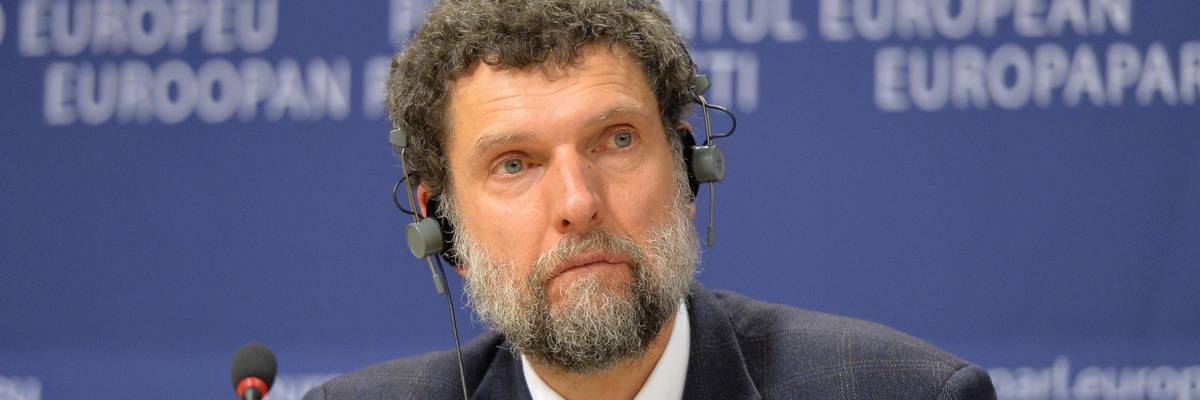
Member of the International Peace and Reconciliation Initiative (IPRI) delegation to Turkey Osman Kavala is seen during a joint press conference after the 11th International Conference on the European Union, Turkey, the Middle East and the Kurds at European Parliament headquarters in Brussels on December 11, 2014. (Photo: Dursun Aydemir/Anadolu Agency/Getty Images)
An Istanbul court on Monday sentenced Turkish civil rights activist and philanthropist Osman Kavala to aggravated life in prison, setting off a wave of strong global condemnation.
"This egregious sentence is a death knell for Turkey's democracy."
"We have witnessed a travesty of justice of spectacular proportions," said Nils Muiznieks, Amnesty International's Europe director.
"This verdict deals a devastating blow not only to Osman Kavala, his co-defendants, and their families," he added, "but to everyone who believes in justice and human rights activism in Turkey and beyond."
Sixty-four-year-old Kavala, who had already spent four years in prison without a conviction, was sentenced along with seven other defendants for allegedly trying to overthrow the government during an uprising that broke out in 2013.
According to CNN:
He was first arrested in 2017 on charges related to the 2013 Gezi Park protests in Istanbul. The trial was closely watched by rights groups, who have accused the Turkish government of using the judicial system to crack down on dissenting voices.
Though Kavala was acquitted in 2020, that verdict was overturned and new charges were brought against him for his alleged involvement in the July 2016 attempted coup, which resulted in the death of at least 250 people and a subsequent crackdown that has seen over 110,000 people, including civil servants, teachers, activists, and journalists detained.
The court's decision, said Muiznieks, "defies all logic."
"The prosecuting authorities have repeatedly failed to provide any evidence that substantiates the baseless charges of attempting to overthrow the government. This unjust verdict shows that the Gezi trial was only an attempt to silence independent voices," he added.
Liesl Gerntholtz, director of the PEN/Barbey Freedom to Write Center, said Monday marked "a dark moment for Turkey" and called Kavala's life sentence "a devastating and unjust blow, not only to him and his family, but to freedom of expression and human rights in Turkey."
"Kavala's case," she added, "is a blatant attempt to criminalize free expression and use the courts to retaliate against those who dare to criticize the government. This egregious sentence is a death knell for Turkey's democracy."
Human Rights Watch executive director Kenneth Roth similarly denounced the sentencing as "an abomination" and said that Kavala "did nothing other than have an independent voice, but [Turkish] President Erdogan seems to need to blame someone for the widespread opposition to his autocratic rule."
Adding to the outrage is Ankara's disregard for the European Court of Human Rights' call for Kavala's release--a flouting that in February prompted the Council of Europe to take nearly unprecedented disciplinary action against Turkey.
The E.U.'s top diplomat, Josep Borrell Fontelles, put the harsh sentences in the context of the European court's demands and said, "Respecting fundamental rights and freedoms is today more important than ever."
European nations including France also bemoaned the outcome. The French foreign ministry called for Kavala's "immediate release" and for all charges against him to be dropped. The ministry added that Kavala's four years in detention already ran afoul of "Turkey's international obligations."
The U.S. State Department also weighed in, with spokesperson Ned Price calling Kavala's "unjust conviction" one that is "inconsistent with respect for human rights, fundamental freedoms, and the rule of law."
"We again call on Turkey to release Osman Kavala, in keeping with European Court of Human Rights rulings, as well as to free all others arbitrarily incarcerated," said Price.
Dear Common Dreams reader, It’s been nearly 30 years since I co-founded Common Dreams with my late wife, Lina Newhouser. We had the radical notion that journalism should serve the public good, not corporate profits. It was clear to us from the outset what it would take to build such a project. No paid advertisements. No corporate sponsors. No millionaire publisher telling us what to think or do. Many people said we wouldn't last a year, but we proved those doubters wrong. Together with a tremendous team of journalists and dedicated staff, we built an independent media outlet free from the constraints of profits and corporate control. Our mission has always been simple: To inform. To inspire. To ignite change for the common good. Building Common Dreams was not easy. Our survival was never guaranteed. When you take on the most powerful forces—Wall Street greed, fossil fuel industry destruction, Big Tech lobbyists, and uber-rich oligarchs who have spent billions upon billions rigging the economy and democracy in their favor—the only bulwark you have is supporters who believe in your work. But here’s the urgent message from me today. It's never been this bad out there. And it's never been this hard to keep us going. At the very moment Common Dreams is most needed, the threats we face are intensifying. We need your support now more than ever. We don't accept corporate advertising and never will. We don't have a paywall because we don't think people should be blocked from critical news based on their ability to pay. Everything we do is funded by the donations of readers like you. When everyone does the little they can afford, we are strong. But if that support retreats or dries up, so do we. Will you donate now to make sure Common Dreams not only survives but thrives? —Craig Brown, Co-founder |
An Istanbul court on Monday sentenced Turkish civil rights activist and philanthropist Osman Kavala to aggravated life in prison, setting off a wave of strong global condemnation.
"This egregious sentence is a death knell for Turkey's democracy."
"We have witnessed a travesty of justice of spectacular proportions," said Nils Muiznieks, Amnesty International's Europe director.
"This verdict deals a devastating blow not only to Osman Kavala, his co-defendants, and their families," he added, "but to everyone who believes in justice and human rights activism in Turkey and beyond."
Sixty-four-year-old Kavala, who had already spent four years in prison without a conviction, was sentenced along with seven other defendants for allegedly trying to overthrow the government during an uprising that broke out in 2013.
According to CNN:
He was first arrested in 2017 on charges related to the 2013 Gezi Park protests in Istanbul. The trial was closely watched by rights groups, who have accused the Turkish government of using the judicial system to crack down on dissenting voices.
Though Kavala was acquitted in 2020, that verdict was overturned and new charges were brought against him for his alleged involvement in the July 2016 attempted coup, which resulted in the death of at least 250 people and a subsequent crackdown that has seen over 110,000 people, including civil servants, teachers, activists, and journalists detained.
The court's decision, said Muiznieks, "defies all logic."
"The prosecuting authorities have repeatedly failed to provide any evidence that substantiates the baseless charges of attempting to overthrow the government. This unjust verdict shows that the Gezi trial was only an attempt to silence independent voices," he added.
Liesl Gerntholtz, director of the PEN/Barbey Freedom to Write Center, said Monday marked "a dark moment for Turkey" and called Kavala's life sentence "a devastating and unjust blow, not only to him and his family, but to freedom of expression and human rights in Turkey."
"Kavala's case," she added, "is a blatant attempt to criminalize free expression and use the courts to retaliate against those who dare to criticize the government. This egregious sentence is a death knell for Turkey's democracy."
Human Rights Watch executive director Kenneth Roth similarly denounced the sentencing as "an abomination" and said that Kavala "did nothing other than have an independent voice, but [Turkish] President Erdogan seems to need to blame someone for the widespread opposition to his autocratic rule."
Adding to the outrage is Ankara's disregard for the European Court of Human Rights' call for Kavala's release--a flouting that in February prompted the Council of Europe to take nearly unprecedented disciplinary action against Turkey.
The E.U.'s top diplomat, Josep Borrell Fontelles, put the harsh sentences in the context of the European court's demands and said, "Respecting fundamental rights and freedoms is today more important than ever."
European nations including France also bemoaned the outcome. The French foreign ministry called for Kavala's "immediate release" and for all charges against him to be dropped. The ministry added that Kavala's four years in detention already ran afoul of "Turkey's international obligations."
The U.S. State Department also weighed in, with spokesperson Ned Price calling Kavala's "unjust conviction" one that is "inconsistent with respect for human rights, fundamental freedoms, and the rule of law."
"We again call on Turkey to release Osman Kavala, in keeping with European Court of Human Rights rulings, as well as to free all others arbitrarily incarcerated," said Price.
An Istanbul court on Monday sentenced Turkish civil rights activist and philanthropist Osman Kavala to aggravated life in prison, setting off a wave of strong global condemnation.
"This egregious sentence is a death knell for Turkey's democracy."
"We have witnessed a travesty of justice of spectacular proportions," said Nils Muiznieks, Amnesty International's Europe director.
"This verdict deals a devastating blow not only to Osman Kavala, his co-defendants, and their families," he added, "but to everyone who believes in justice and human rights activism in Turkey and beyond."
Sixty-four-year-old Kavala, who had already spent four years in prison without a conviction, was sentenced along with seven other defendants for allegedly trying to overthrow the government during an uprising that broke out in 2013.
According to CNN:
He was first arrested in 2017 on charges related to the 2013 Gezi Park protests in Istanbul. The trial was closely watched by rights groups, who have accused the Turkish government of using the judicial system to crack down on dissenting voices.
Though Kavala was acquitted in 2020, that verdict was overturned and new charges were brought against him for his alleged involvement in the July 2016 attempted coup, which resulted in the death of at least 250 people and a subsequent crackdown that has seen over 110,000 people, including civil servants, teachers, activists, and journalists detained.
The court's decision, said Muiznieks, "defies all logic."
"The prosecuting authorities have repeatedly failed to provide any evidence that substantiates the baseless charges of attempting to overthrow the government. This unjust verdict shows that the Gezi trial was only an attempt to silence independent voices," he added.
Liesl Gerntholtz, director of the PEN/Barbey Freedom to Write Center, said Monday marked "a dark moment for Turkey" and called Kavala's life sentence "a devastating and unjust blow, not only to him and his family, but to freedom of expression and human rights in Turkey."
"Kavala's case," she added, "is a blatant attempt to criminalize free expression and use the courts to retaliate against those who dare to criticize the government. This egregious sentence is a death knell for Turkey's democracy."
Human Rights Watch executive director Kenneth Roth similarly denounced the sentencing as "an abomination" and said that Kavala "did nothing other than have an independent voice, but [Turkish] President Erdogan seems to need to blame someone for the widespread opposition to his autocratic rule."
Adding to the outrage is Ankara's disregard for the European Court of Human Rights' call for Kavala's release--a flouting that in February prompted the Council of Europe to take nearly unprecedented disciplinary action against Turkey.
The E.U.'s top diplomat, Josep Borrell Fontelles, put the harsh sentences in the context of the European court's demands and said, "Respecting fundamental rights and freedoms is today more important than ever."
European nations including France also bemoaned the outcome. The French foreign ministry called for Kavala's "immediate release" and for all charges against him to be dropped. The ministry added that Kavala's four years in detention already ran afoul of "Turkey's international obligations."
The U.S. State Department also weighed in, with spokesperson Ned Price calling Kavala's "unjust conviction" one that is "inconsistent with respect for human rights, fundamental freedoms, and the rule of law."
"We again call on Turkey to release Osman Kavala, in keeping with European Court of Human Rights rulings, as well as to free all others arbitrarily incarcerated," said Price.