SUBSCRIBE TO OUR FREE NEWSLETTER
Daily news & progressive opinion—funded by the people, not the corporations—delivered straight to your inbox.
5
#000000
#FFFFFF
To donate by check, phone, or other method, see our More Ways to Give page.
Daily news & progressive opinion—funded by the people, not the corporations—delivered straight to your inbox.
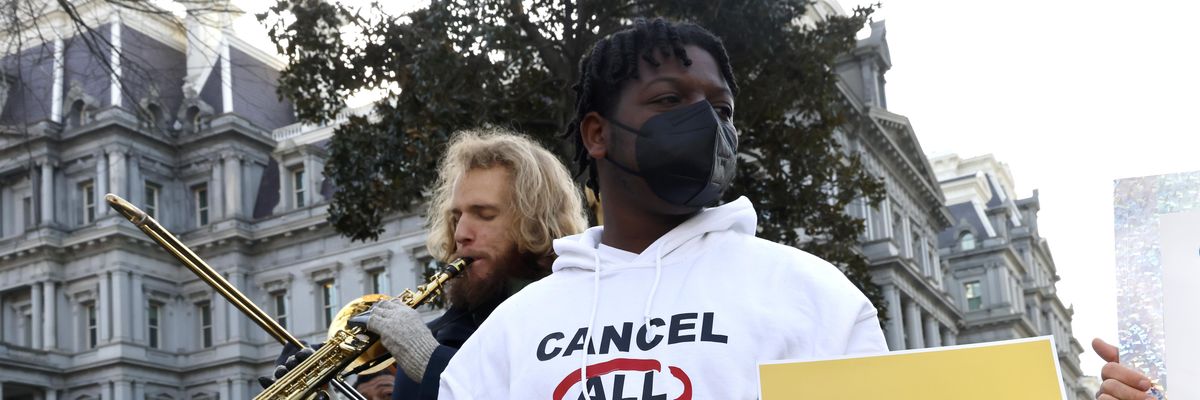
Student loan borrowers and the Too Much Talent Band thank President Joe Biden and Vice President Kamala Harris for extending the student loan pause while demanding that they cancel student debt at a gathering outside the White House on January 13, 2022, in Washington, D.C. (Photo: Paul Morigi/Getty Images for We The 45 Million)
Nearly nine in 10 young Americans want the government to address the student loan debt crisis, with a plurality--but overall minority--supporting full cancellation, according to the results of a national survey published Monday.
The survey, conducted by Harvard Kennedy School's Institute of Politics (IOP), found that 85% of respondents under age 30 "favor some form of government action on student loan debt."
However, "young Americans had no clear consensus on a path forward related to student loan debt," with 38% of overall respondents wanting all debt canceled, 27% agreeing that the government should assist with--but not cancel--repayment, 21% favoring cancellation for the neediest borrowers, and 13% supporting the status quo.
Among Democratic voters, the survey found 43% support for canceling all debt, 19% wanting some government help, 29% backing cancellation for those in need, and 4% favoring current policy.
"Opinions on this issue do not differ significantly among likely voters in the 2022 midterms compared to the broader population of 18-to-29-year-olds," said IOP, "as 83% of young likely voters express a preference for government action, including 79% of those not in college now, and without a degree."
The IOP survey also found:
The survey also revealed that young people are increasingly cynical about the ability of electoral politics to deliver solutions to the world's problems.
In what IOP called a "warning sign that interest in voting in the 2022 midterms could wane," the survey found a sharp increase in the percentage of youth who agree that "political involvement rarely has any tangible results," from 22% in 2018 to 36% in 2022. More than four in 10 survey respondents also agreed with the assertion that their vote won't "make a real difference," while over half of those surveyed believe that "politics today are no longer able to meet the challenges our country is facing."
Dear Common Dreams reader, It’s been nearly 30 years since I co-founded Common Dreams with my late wife, Lina Newhouser. We had the radical notion that journalism should serve the public good, not corporate profits. It was clear to us from the outset what it would take to build such a project. No paid advertisements. No corporate sponsors. No millionaire publisher telling us what to think or do. Many people said we wouldn't last a year, but we proved those doubters wrong. Together with a tremendous team of journalists and dedicated staff, we built an independent media outlet free from the constraints of profits and corporate control. Our mission has always been simple: To inform. To inspire. To ignite change for the common good. Building Common Dreams was not easy. Our survival was never guaranteed. When you take on the most powerful forces—Wall Street greed, fossil fuel industry destruction, Big Tech lobbyists, and uber-rich oligarchs who have spent billions upon billions rigging the economy and democracy in their favor—the only bulwark you have is supporters who believe in your work. But here’s the urgent message from me today. It's never been this bad out there. And it's never been this hard to keep us going. At the very moment Common Dreams is most needed, the threats we face are intensifying. We need your support now more than ever. We don't accept corporate advertising and never will. We don't have a paywall because we don't think people should be blocked from critical news based on their ability to pay. Everything we do is funded by the donations of readers like you. When everyone does the little they can afford, we are strong. But if that support retreats or dries up, so do we. Will you donate now to make sure Common Dreams not only survives but thrives? —Craig Brown, Co-founder |
Nearly nine in 10 young Americans want the government to address the student loan debt crisis, with a plurality--but overall minority--supporting full cancellation, according to the results of a national survey published Monday.
The survey, conducted by Harvard Kennedy School's Institute of Politics (IOP), found that 85% of respondents under age 30 "favor some form of government action on student loan debt."
However, "young Americans had no clear consensus on a path forward related to student loan debt," with 38% of overall respondents wanting all debt canceled, 27% agreeing that the government should assist with--but not cancel--repayment, 21% favoring cancellation for the neediest borrowers, and 13% supporting the status quo.
Among Democratic voters, the survey found 43% support for canceling all debt, 19% wanting some government help, 29% backing cancellation for those in need, and 4% favoring current policy.
"Opinions on this issue do not differ significantly among likely voters in the 2022 midterms compared to the broader population of 18-to-29-year-olds," said IOP, "as 83% of young likely voters express a preference for government action, including 79% of those not in college now, and without a degree."
The IOP survey also found:
The survey also revealed that young people are increasingly cynical about the ability of electoral politics to deliver solutions to the world's problems.
In what IOP called a "warning sign that interest in voting in the 2022 midterms could wane," the survey found a sharp increase in the percentage of youth who agree that "political involvement rarely has any tangible results," from 22% in 2018 to 36% in 2022. More than four in 10 survey respondents also agreed with the assertion that their vote won't "make a real difference," while over half of those surveyed believe that "politics today are no longer able to meet the challenges our country is facing."
Nearly nine in 10 young Americans want the government to address the student loan debt crisis, with a plurality--but overall minority--supporting full cancellation, according to the results of a national survey published Monday.
The survey, conducted by Harvard Kennedy School's Institute of Politics (IOP), found that 85% of respondents under age 30 "favor some form of government action on student loan debt."
However, "young Americans had no clear consensus on a path forward related to student loan debt," with 38% of overall respondents wanting all debt canceled, 27% agreeing that the government should assist with--but not cancel--repayment, 21% favoring cancellation for the neediest borrowers, and 13% supporting the status quo.
Among Democratic voters, the survey found 43% support for canceling all debt, 19% wanting some government help, 29% backing cancellation for those in need, and 4% favoring current policy.
"Opinions on this issue do not differ significantly among likely voters in the 2022 midterms compared to the broader population of 18-to-29-year-olds," said IOP, "as 83% of young likely voters express a preference for government action, including 79% of those not in college now, and without a degree."
The IOP survey also found:
The survey also revealed that young people are increasingly cynical about the ability of electoral politics to deliver solutions to the world's problems.
In what IOP called a "warning sign that interest in voting in the 2022 midterms could wane," the survey found a sharp increase in the percentage of youth who agree that "political involvement rarely has any tangible results," from 22% in 2018 to 36% in 2022. More than four in 10 survey respondents also agreed with the assertion that their vote won't "make a real difference," while over half of those surveyed believe that "politics today are no longer able to meet the challenges our country is facing."