SUBSCRIBE TO OUR FREE NEWSLETTER
Daily news & progressive opinion—funded by the people, not the corporations—delivered straight to your inbox.
5
#000000
#FFFFFF
To donate by check, phone, or other method, see our More Ways to Give page.
Daily news & progressive opinion—funded by the people, not the corporations—delivered straight to your inbox.
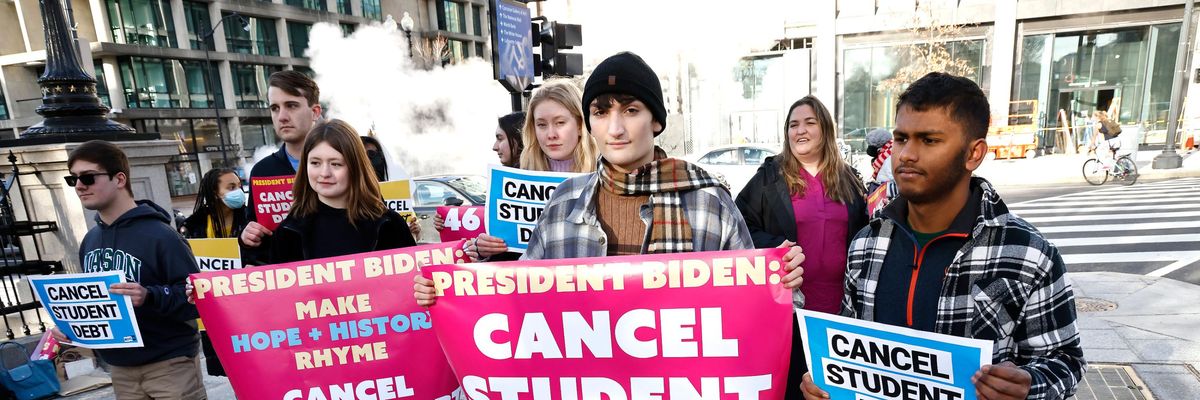
The Too Much Talent Band and local activists hold a protest outside the White House urging President Joe Biden to cancel student debt on March 15, 2022 in Washington, D.C. (Photo: Paul Morigi/Getty Images for We The 45 Million)
More than 1,000 professors from colleges and universities across the country--including prominent institutions such as Columbia, Yale, and Berkeley--released a letter Tuesday endorsing calls for President Joe Biden to use his executive power to cancel all outstanding federal student loan debt.
"President Biden has the complete legal authority to eliminate student loan debt on his own."
"Through executive action, President Biden has the complete legal authority to eliminate student loan debt on his own--without Congress--and it is a step supported by a majority of Americans," the faculty members write. "In fact, the Debt Collective has already written an executive order President Biden could sign today to end this financial burden."
"We see universal debt cancellation as a powerful first step in the process of reinvestment in quality public education," they continue. "We know that subsequent steps will require the fight for state reinvestment, high quality and diverse curricula, robust research support, and the de-adjunctification of our workforce."
"Universal debt cancellation," the letter adds, "would be the first serious step toward the goal of College for All that we have seen in our lifetime."
The professors' demand comes as the federal government's student debt repayment and interest moratorium--which has saved borrowers nearly $200 billion since early 2020--is set to expire in just over a month, potentially hitting millions of people with significant monthly payments that they may not be able to afford.
According to a recent survey by Fighting Chance for Families, fewer than one in seven people with student loan debt are "very confident" in their ability to make payments once the moratorium ends. With the coronavirus pandemic still wreaking havoc, the Biden administration is reportedly considering extending the repayment pause beyond May 1, but it has yet to publicly announce a decision.
The president's newly released budget blueprint for Fiscal Year 2023 makes no mention of student debt forgiveness. While Biden has unilaterally wiped away billions of dollars worth of student loan debt for certain groups of borrowers, he has yet to enact the kind of broad-based cancellation that progressive lawmakers and U.S. voters are demanding.
"He's not delivering on his promise," Jennifer Lewis, a 57-year-old nurse practitioner saddled with about $80,000 in student loan debt, told CNN over the weekend, referring to Biden's campaign trail vow to cancel $10,000 in student loan debt per borrower.
"If he were to run again," she added, "I would think twice about voting for president at all."
In their new letter, which was organized by the Debt Collective, the professors note that "more than 45 million student debtors are burdened by nearly $1.8 trillion in student debt." Total cancellation of that debt, the letter argues, would bring about both "a substantial boost" for the U.S. economy and "a significant narrowing of the racial wealth gap."
"Far from a boon to the already-wealthy, the vast majority of the benefits of universal debt discharge would go to the bottom 20% of households," the faculty members write. "The largest impact, in proportion to household wealth, would be on Black and Latinx families and communities."
"A demand for universal student debt relief, along with continued pressure for tuition-free public college, unites tens of millions of people around a commonly shared idea," they continue. "In other industrialized countries, higher education, like healthcare, is regarded as a public good and as a right, but in the U.S., it has been turned into an expensive commodity. Now is the time to reclaim the vocation of learning to which we have devoted our careers."
Dear Common Dreams reader, It’s been nearly 30 years since I co-founded Common Dreams with my late wife, Lina Newhouser. We had the radical notion that journalism should serve the public good, not corporate profits. It was clear to us from the outset what it would take to build such a project. No paid advertisements. No corporate sponsors. No millionaire publisher telling us what to think or do. Many people said we wouldn't last a year, but we proved those doubters wrong. Together with a tremendous team of journalists and dedicated staff, we built an independent media outlet free from the constraints of profits and corporate control. Our mission has always been simple: To inform. To inspire. To ignite change for the common good. Building Common Dreams was not easy. Our survival was never guaranteed. When you take on the most powerful forces—Wall Street greed, fossil fuel industry destruction, Big Tech lobbyists, and uber-rich oligarchs who have spent billions upon billions rigging the economy and democracy in their favor—the only bulwark you have is supporters who believe in your work. But here’s the urgent message from me today. It's never been this bad out there. And it's never been this hard to keep us going. At the very moment Common Dreams is most needed, the threats we face are intensifying. We need your support now more than ever. We don't accept corporate advertising and never will. We don't have a paywall because we don't think people should be blocked from critical news based on their ability to pay. Everything we do is funded by the donations of readers like you. When everyone does the little they can afford, we are strong. But if that support retreats or dries up, so do we. Will you donate now to make sure Common Dreams not only survives but thrives? —Craig Brown, Co-founder |
More than 1,000 professors from colleges and universities across the country--including prominent institutions such as Columbia, Yale, and Berkeley--released a letter Tuesday endorsing calls for President Joe Biden to use his executive power to cancel all outstanding federal student loan debt.
"President Biden has the complete legal authority to eliminate student loan debt on his own."
"Through executive action, President Biden has the complete legal authority to eliminate student loan debt on his own--without Congress--and it is a step supported by a majority of Americans," the faculty members write. "In fact, the Debt Collective has already written an executive order President Biden could sign today to end this financial burden."
"We see universal debt cancellation as a powerful first step in the process of reinvestment in quality public education," they continue. "We know that subsequent steps will require the fight for state reinvestment, high quality and diverse curricula, robust research support, and the de-adjunctification of our workforce."
"Universal debt cancellation," the letter adds, "would be the first serious step toward the goal of College for All that we have seen in our lifetime."
The professors' demand comes as the federal government's student debt repayment and interest moratorium--which has saved borrowers nearly $200 billion since early 2020--is set to expire in just over a month, potentially hitting millions of people with significant monthly payments that they may not be able to afford.
According to a recent survey by Fighting Chance for Families, fewer than one in seven people with student loan debt are "very confident" in their ability to make payments once the moratorium ends. With the coronavirus pandemic still wreaking havoc, the Biden administration is reportedly considering extending the repayment pause beyond May 1, but it has yet to publicly announce a decision.
The president's newly released budget blueprint for Fiscal Year 2023 makes no mention of student debt forgiveness. While Biden has unilaterally wiped away billions of dollars worth of student loan debt for certain groups of borrowers, he has yet to enact the kind of broad-based cancellation that progressive lawmakers and U.S. voters are demanding.
"He's not delivering on his promise," Jennifer Lewis, a 57-year-old nurse practitioner saddled with about $80,000 in student loan debt, told CNN over the weekend, referring to Biden's campaign trail vow to cancel $10,000 in student loan debt per borrower.
"If he were to run again," she added, "I would think twice about voting for president at all."
In their new letter, which was organized by the Debt Collective, the professors note that "more than 45 million student debtors are burdened by nearly $1.8 trillion in student debt." Total cancellation of that debt, the letter argues, would bring about both "a substantial boost" for the U.S. economy and "a significant narrowing of the racial wealth gap."
"Far from a boon to the already-wealthy, the vast majority of the benefits of universal debt discharge would go to the bottom 20% of households," the faculty members write. "The largest impact, in proportion to household wealth, would be on Black and Latinx families and communities."
"A demand for universal student debt relief, along with continued pressure for tuition-free public college, unites tens of millions of people around a commonly shared idea," they continue. "In other industrialized countries, higher education, like healthcare, is regarded as a public good and as a right, but in the U.S., it has been turned into an expensive commodity. Now is the time to reclaim the vocation of learning to which we have devoted our careers."
More than 1,000 professors from colleges and universities across the country--including prominent institutions such as Columbia, Yale, and Berkeley--released a letter Tuesday endorsing calls for President Joe Biden to use his executive power to cancel all outstanding federal student loan debt.
"President Biden has the complete legal authority to eliminate student loan debt on his own."
"Through executive action, President Biden has the complete legal authority to eliminate student loan debt on his own--without Congress--and it is a step supported by a majority of Americans," the faculty members write. "In fact, the Debt Collective has already written an executive order President Biden could sign today to end this financial burden."
"We see universal debt cancellation as a powerful first step in the process of reinvestment in quality public education," they continue. "We know that subsequent steps will require the fight for state reinvestment, high quality and diverse curricula, robust research support, and the de-adjunctification of our workforce."
"Universal debt cancellation," the letter adds, "would be the first serious step toward the goal of College for All that we have seen in our lifetime."
The professors' demand comes as the federal government's student debt repayment and interest moratorium--which has saved borrowers nearly $200 billion since early 2020--is set to expire in just over a month, potentially hitting millions of people with significant monthly payments that they may not be able to afford.
According to a recent survey by Fighting Chance for Families, fewer than one in seven people with student loan debt are "very confident" in their ability to make payments once the moratorium ends. With the coronavirus pandemic still wreaking havoc, the Biden administration is reportedly considering extending the repayment pause beyond May 1, but it has yet to publicly announce a decision.
The president's newly released budget blueprint for Fiscal Year 2023 makes no mention of student debt forgiveness. While Biden has unilaterally wiped away billions of dollars worth of student loan debt for certain groups of borrowers, he has yet to enact the kind of broad-based cancellation that progressive lawmakers and U.S. voters are demanding.
"He's not delivering on his promise," Jennifer Lewis, a 57-year-old nurse practitioner saddled with about $80,000 in student loan debt, told CNN over the weekend, referring to Biden's campaign trail vow to cancel $10,000 in student loan debt per borrower.
"If he were to run again," she added, "I would think twice about voting for president at all."
In their new letter, which was organized by the Debt Collective, the professors note that "more than 45 million student debtors are burdened by nearly $1.8 trillion in student debt." Total cancellation of that debt, the letter argues, would bring about both "a substantial boost" for the U.S. economy and "a significant narrowing of the racial wealth gap."
"Far from a boon to the already-wealthy, the vast majority of the benefits of universal debt discharge would go to the bottom 20% of households," the faculty members write. "The largest impact, in proportion to household wealth, would be on Black and Latinx families and communities."
"A demand for universal student debt relief, along with continued pressure for tuition-free public college, unites tens of millions of people around a commonly shared idea," they continue. "In other industrialized countries, higher education, like healthcare, is regarded as a public good and as a right, but in the U.S., it has been turned into an expensive commodity. Now is the time to reclaim the vocation of learning to which we have devoted our careers."