SUBSCRIBE TO OUR FREE NEWSLETTER
Daily news & progressive opinion—funded by the people, not the corporations—delivered straight to your inbox.
5
#000000
#FFFFFF
To donate by check, phone, or other method, see our More Ways to Give page.
Daily news & progressive opinion—funded by the people, not the corporations—delivered straight to your inbox.
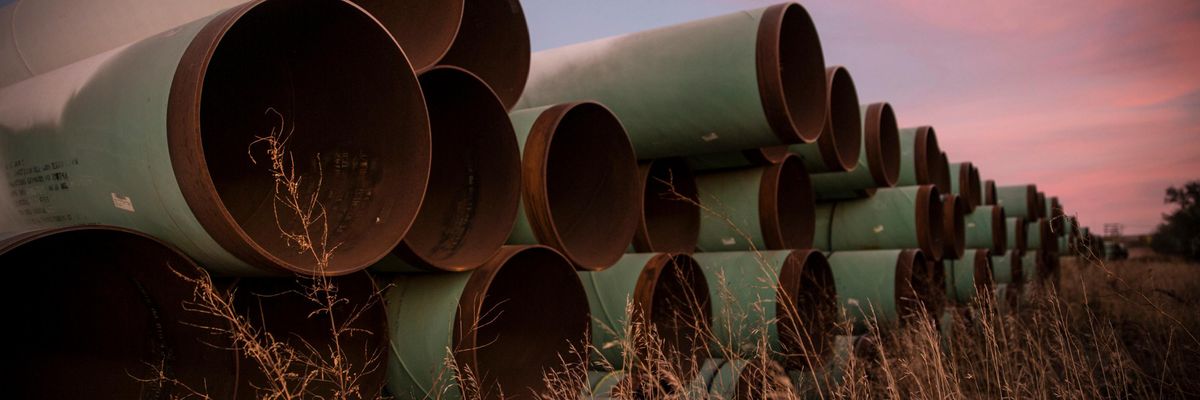
Miles of unused pipe, prepared for the proposed Keystone XL pipeline, sit in a lot on October 14, 2014 outside Gascoyne, North Dakota. (Photo: Andrew Burton via Getty Images)
U.S. climate activists were outraged after a federal regulatory agency on Thursday walked back plans to consider the planet-heating emissions and environmental justice impacts when weighing whether to approve new fossil fuel infrastructure.
"Even the suggestion that the agency be more than just a rubber-stamp for gas pipelines was a bridge too far for industry and their politicians."
Federal Energy Regulatory Commission (FERC) Chair Richard Glick, a Democrat, announced that the policy statements issued last month will now be considered "drafts" and won't apply to any pending projects until the agency issues final guidance.
"This is ridiculous," climate campaigner Justin McCarthy tweeted about FERC "already backtracking on its plans to assess the climate impact of gas pipelines."
Kelly Sheehan, Sierra Club's senior director of energy campaigns, was similarly critical, saying in a statement Thursday that "the fossil fuel industry and the politicians they finance are pitching a fit because they're worried FERC's modest proposed policy changes might mean they no longer have free rein to build as many polluting pipelines as they want with no regard for the impacts on communities or the climate."
Critics of the FERC policies have included Senate Minority Leader Mitch McConnell (R-Ky.) and Sen. Joe Manchin (D-W.Va.)--a major barrier to passing Democrats' Build Back Better package, which included key climate provisions.
The Associated Press reports that Glick denied climate activists' claims that he was bowing to political pressure:
"I'm not going to do anything for political purposes," he told reporters, adding that he and other commissioners have had discussions with numerous pipeline and natural gas companies since the panel approved the climate policy last month. Industry leaders told them the policy changes "raise additional questions that could benefit from further clarification," Glick said.
The AP noted that in addition to voting unanimously to pause the new guidelines, FERC on Thursday "approved three natural gas projects that have been pending before the panel for months. Two of the projects will expand gas production in the U.S. Gulf Coast, while the third is located in New York state. One of the projects will connect with an export terminal in Louisiana for liquefied natural gas, or LNG."
Sheehan said that "the commission's draft policy statements are just a small step towards doing what's legally required of them and building a fairer system, but FERC's approval today of fracked gas pipelines makes it painfully clear that FERC has not changed course."
"However, the courts are increasingly affirming that FERC cannot ignore climate and environmental justice impacts of the projects they approve, and as long as they fail to take these impacts seriously, they'll continue to lose in court," she added.
Climate groups had cautiously welcomed the policy shifts last month. Food & Water Watch staff attorney Adam Carlesco said at the time that the "announcements suggest that FERC is finally moving towards creating policies that it should have enacted years ago" while emphasizing that "guidance is not the same thing as action."
"Climate science tells us that we cannot build new fossil fuel projects if we are to have a chance at averting real climate chaos," Carlesco added, noting that "this policy can only move the needle so far without bold and necessary action from Congress, which should pass legislation that puts an end to the approval of new fossil gas pipelines."
Dear Common Dreams reader, It’s been nearly 30 years since I co-founded Common Dreams with my late wife, Lina Newhouser. We had the radical notion that journalism should serve the public good, not corporate profits. It was clear to us from the outset what it would take to build such a project. No paid advertisements. No corporate sponsors. No millionaire publisher telling us what to think or do. Many people said we wouldn't last a year, but we proved those doubters wrong. Together with a tremendous team of journalists and dedicated staff, we built an independent media outlet free from the constraints of profits and corporate control. Our mission has always been simple: To inform. To inspire. To ignite change for the common good. Building Common Dreams was not easy. Our survival was never guaranteed. When you take on the most powerful forces—Wall Street greed, fossil fuel industry destruction, Big Tech lobbyists, and uber-rich oligarchs who have spent billions upon billions rigging the economy and democracy in their favor—the only bulwark you have is supporters who believe in your work. But here’s the urgent message from me today. It's never been this bad out there. And it's never been this hard to keep us going. At the very moment Common Dreams is most needed, the threats we face are intensifying. We need your support now more than ever. We don't accept corporate advertising and never will. We don't have a paywall because we don't think people should be blocked from critical news based on their ability to pay. Everything we do is funded by the donations of readers like you. When everyone does the little they can afford, we are strong. But if that support retreats or dries up, so do we. Will you donate now to make sure Common Dreams not only survives but thrives? —Craig Brown, Co-founder |
U.S. climate activists were outraged after a federal regulatory agency on Thursday walked back plans to consider the planet-heating emissions and environmental justice impacts when weighing whether to approve new fossil fuel infrastructure.
"Even the suggestion that the agency be more than just a rubber-stamp for gas pipelines was a bridge too far for industry and their politicians."
Federal Energy Regulatory Commission (FERC) Chair Richard Glick, a Democrat, announced that the policy statements issued last month will now be considered "drafts" and won't apply to any pending projects until the agency issues final guidance.
"This is ridiculous," climate campaigner Justin McCarthy tweeted about FERC "already backtracking on its plans to assess the climate impact of gas pipelines."
Kelly Sheehan, Sierra Club's senior director of energy campaigns, was similarly critical, saying in a statement Thursday that "the fossil fuel industry and the politicians they finance are pitching a fit because they're worried FERC's modest proposed policy changes might mean they no longer have free rein to build as many polluting pipelines as they want with no regard for the impacts on communities or the climate."
Critics of the FERC policies have included Senate Minority Leader Mitch McConnell (R-Ky.) and Sen. Joe Manchin (D-W.Va.)--a major barrier to passing Democrats' Build Back Better package, which included key climate provisions.
The Associated Press reports that Glick denied climate activists' claims that he was bowing to political pressure:
"I'm not going to do anything for political purposes," he told reporters, adding that he and other commissioners have had discussions with numerous pipeline and natural gas companies since the panel approved the climate policy last month. Industry leaders told them the policy changes "raise additional questions that could benefit from further clarification," Glick said.
The AP noted that in addition to voting unanimously to pause the new guidelines, FERC on Thursday "approved three natural gas projects that have been pending before the panel for months. Two of the projects will expand gas production in the U.S. Gulf Coast, while the third is located in New York state. One of the projects will connect with an export terminal in Louisiana for liquefied natural gas, or LNG."
Sheehan said that "the commission's draft policy statements are just a small step towards doing what's legally required of them and building a fairer system, but FERC's approval today of fracked gas pipelines makes it painfully clear that FERC has not changed course."
"However, the courts are increasingly affirming that FERC cannot ignore climate and environmental justice impacts of the projects they approve, and as long as they fail to take these impacts seriously, they'll continue to lose in court," she added.
Climate groups had cautiously welcomed the policy shifts last month. Food & Water Watch staff attorney Adam Carlesco said at the time that the "announcements suggest that FERC is finally moving towards creating policies that it should have enacted years ago" while emphasizing that "guidance is not the same thing as action."
"Climate science tells us that we cannot build new fossil fuel projects if we are to have a chance at averting real climate chaos," Carlesco added, noting that "this policy can only move the needle so far without bold and necessary action from Congress, which should pass legislation that puts an end to the approval of new fossil gas pipelines."
U.S. climate activists were outraged after a federal regulatory agency on Thursday walked back plans to consider the planet-heating emissions and environmental justice impacts when weighing whether to approve new fossil fuel infrastructure.
"Even the suggestion that the agency be more than just a rubber-stamp for gas pipelines was a bridge too far for industry and their politicians."
Federal Energy Regulatory Commission (FERC) Chair Richard Glick, a Democrat, announced that the policy statements issued last month will now be considered "drafts" and won't apply to any pending projects until the agency issues final guidance.
"This is ridiculous," climate campaigner Justin McCarthy tweeted about FERC "already backtracking on its plans to assess the climate impact of gas pipelines."
Kelly Sheehan, Sierra Club's senior director of energy campaigns, was similarly critical, saying in a statement Thursday that "the fossil fuel industry and the politicians they finance are pitching a fit because they're worried FERC's modest proposed policy changes might mean they no longer have free rein to build as many polluting pipelines as they want with no regard for the impacts on communities or the climate."
Critics of the FERC policies have included Senate Minority Leader Mitch McConnell (R-Ky.) and Sen. Joe Manchin (D-W.Va.)--a major barrier to passing Democrats' Build Back Better package, which included key climate provisions.
The Associated Press reports that Glick denied climate activists' claims that he was bowing to political pressure:
"I'm not going to do anything for political purposes," he told reporters, adding that he and other commissioners have had discussions with numerous pipeline and natural gas companies since the panel approved the climate policy last month. Industry leaders told them the policy changes "raise additional questions that could benefit from further clarification," Glick said.
The AP noted that in addition to voting unanimously to pause the new guidelines, FERC on Thursday "approved three natural gas projects that have been pending before the panel for months. Two of the projects will expand gas production in the U.S. Gulf Coast, while the third is located in New York state. One of the projects will connect with an export terminal in Louisiana for liquefied natural gas, or LNG."
Sheehan said that "the commission's draft policy statements are just a small step towards doing what's legally required of them and building a fairer system, but FERC's approval today of fracked gas pipelines makes it painfully clear that FERC has not changed course."
"However, the courts are increasingly affirming that FERC cannot ignore climate and environmental justice impacts of the projects they approve, and as long as they fail to take these impacts seriously, they'll continue to lose in court," she added.
Climate groups had cautiously welcomed the policy shifts last month. Food & Water Watch staff attorney Adam Carlesco said at the time that the "announcements suggest that FERC is finally moving towards creating policies that it should have enacted years ago" while emphasizing that "guidance is not the same thing as action."
"Climate science tells us that we cannot build new fossil fuel projects if we are to have a chance at averting real climate chaos," Carlesco added, noting that "this policy can only move the needle so far without bold and necessary action from Congress, which should pass legislation that puts an end to the approval of new fossil gas pipelines."