SUBSCRIBE TO OUR FREE NEWSLETTER
Daily news & progressive opinion—funded by the people, not the corporations—delivered straight to your inbox.
5
#000000
#FFFFFF
To donate by check, phone, or other method, see our More Ways to Give page.
Daily news & progressive opinion—funded by the people, not the corporations—delivered straight to your inbox.
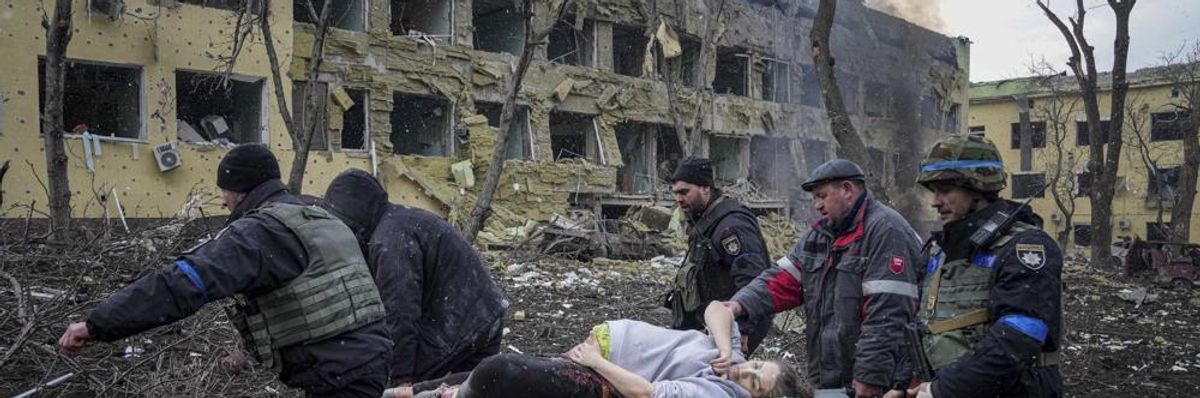
Ukrainian emergency workers and volunteers carry an injured pregnant woman from a maternity hospital that was damaged by shelling in Mariupol on 9 March. (Photograph: Evgeniy Maloletka/AP)
Captured in one of the most visceral and painful photographs yet taken of the carnage and human suffering underway in Ukraine, a pregnant woman and her unborn child died from the injuries suffered during a Russian bombing of a maternity hospital in the city of Mariupal last week.
According to the Associated Press, whose photographer Evgeniy Maloletka took the picture "epitomizing the horror of an attack on humanity's most innocent" outside the bombed hospital on March 9, the mother and her baby died shortly after the attack despite efforts by paramedics on the scene and doctors at a nearby hospital to save them.
At the hospital to which she was rushed, AP reports,
Surgeon Timur Marin found the woman's pelvis crushed and hip detached. Medics delivered the baby via cesarean section, but it showed "no signs of life," the surgeon said.
Then, they focused on the mother.
"More than 30 minutes of resuscitation of the mother didn't produce results," Marin said Saturday.
"Both died."
In the chaos after Wednesday's airstrike, medics didn't have time to get the woman's name before her husband and father came to take away her body. At least someone came to retrieve her, they said--so she didn't end up in the mass graves being dug for many of Mariupol's growing number of dead.
Last Wednesday's bombing of the hospital was condemned worldwide as a possible war crime, an attack that coincided with increasingly aggressive targeting by Russian forces on civilian infrastructure that prevented thousands of individuals and families from fleeing areas under assault.
The United Nations says nearly 600 civilians have died since the Russian invasion began, though the international body concedes the actual number is certainly much higher.
In a joint statement on Sunday, UNICEF executive director Catherine Russell, UNFPA executive director Dr. Natalia Kanem, and WHO director general Dr. Tedros Adhanom Ghebreyesus said there can be no tolerance for military attacks on hospitals or other places of care in Ukraine.
"To attack the most vulnerable--babies, children, pregnant women, and those already suffering from illness and disease, and health workers risking their own lives to save lives--is an act of unconscionable cruelty," the statement read.
According to the U.N. agencies, 31 attacks on health care facilities--including hospitals and ambulances--have been documented since Russia attacked Ukraine last month.
"These horrific attacks are killing and causing serious injuries to patients and health workers, destroying vital health infrastructure, and forcing thousands to forgo accessing health services despite catastrophic needs," the trio wrote in their statement.
Russell, Kanem, and Dr. Tedros concluded by saying, "For the sake of health workers, and for all people in Ukraine who need access to the lifesaving services they provide, attacks on all health care and other civilian infrastructure must stop."
"We call for an immediate ceasefire," they said, "which includes unhindered access so that people in need can access humanitarian assistance. A peaceful resolution to end the war in Ukraine is possible."
Dear Common Dreams reader, It’s been nearly 30 years since I co-founded Common Dreams with my late wife, Lina Newhouser. We had the radical notion that journalism should serve the public good, not corporate profits. It was clear to us from the outset what it would take to build such a project. No paid advertisements. No corporate sponsors. No millionaire publisher telling us what to think or do. Many people said we wouldn't last a year, but we proved those doubters wrong. Together with a tremendous team of journalists and dedicated staff, we built an independent media outlet free from the constraints of profits and corporate control. Our mission has always been simple: To inform. To inspire. To ignite change for the common good. Building Common Dreams was not easy. Our survival was never guaranteed. When you take on the most powerful forces—Wall Street greed, fossil fuel industry destruction, Big Tech lobbyists, and uber-rich oligarchs who have spent billions upon billions rigging the economy and democracy in their favor—the only bulwark you have is supporters who believe in your work. But here’s the urgent message from me today. It's never been this bad out there. And it's never been this hard to keep us going. At the very moment Common Dreams is most needed, the threats we face are intensifying. We need your support now more than ever. We don't accept corporate advertising and never will. We don't have a paywall because we don't think people should be blocked from critical news based on their ability to pay. Everything we do is funded by the donations of readers like you. When everyone does the little they can afford, we are strong. But if that support retreats or dries up, so do we. Will you donate now to make sure Common Dreams not only survives but thrives? —Craig Brown, Co-founder |
Captured in one of the most visceral and painful photographs yet taken of the carnage and human suffering underway in Ukraine, a pregnant woman and her unborn child died from the injuries suffered during a Russian bombing of a maternity hospital in the city of Mariupal last week.
According to the Associated Press, whose photographer Evgeniy Maloletka took the picture "epitomizing the horror of an attack on humanity's most innocent" outside the bombed hospital on March 9, the mother and her baby died shortly after the attack despite efforts by paramedics on the scene and doctors at a nearby hospital to save them.
At the hospital to which she was rushed, AP reports,
Surgeon Timur Marin found the woman's pelvis crushed and hip detached. Medics delivered the baby via cesarean section, but it showed "no signs of life," the surgeon said.
Then, they focused on the mother.
"More than 30 minutes of resuscitation of the mother didn't produce results," Marin said Saturday.
"Both died."
In the chaos after Wednesday's airstrike, medics didn't have time to get the woman's name before her husband and father came to take away her body. At least someone came to retrieve her, they said--so she didn't end up in the mass graves being dug for many of Mariupol's growing number of dead.
Last Wednesday's bombing of the hospital was condemned worldwide as a possible war crime, an attack that coincided with increasingly aggressive targeting by Russian forces on civilian infrastructure that prevented thousands of individuals and families from fleeing areas under assault.
The United Nations says nearly 600 civilians have died since the Russian invasion began, though the international body concedes the actual number is certainly much higher.
In a joint statement on Sunday, UNICEF executive director Catherine Russell, UNFPA executive director Dr. Natalia Kanem, and WHO director general Dr. Tedros Adhanom Ghebreyesus said there can be no tolerance for military attacks on hospitals or other places of care in Ukraine.
"To attack the most vulnerable--babies, children, pregnant women, and those already suffering from illness and disease, and health workers risking their own lives to save lives--is an act of unconscionable cruelty," the statement read.
According to the U.N. agencies, 31 attacks on health care facilities--including hospitals and ambulances--have been documented since Russia attacked Ukraine last month.
"These horrific attacks are killing and causing serious injuries to patients and health workers, destroying vital health infrastructure, and forcing thousands to forgo accessing health services despite catastrophic needs," the trio wrote in their statement.
Russell, Kanem, and Dr. Tedros concluded by saying, "For the sake of health workers, and for all people in Ukraine who need access to the lifesaving services they provide, attacks on all health care and other civilian infrastructure must stop."
"We call for an immediate ceasefire," they said, "which includes unhindered access so that people in need can access humanitarian assistance. A peaceful resolution to end the war in Ukraine is possible."
Captured in one of the most visceral and painful photographs yet taken of the carnage and human suffering underway in Ukraine, a pregnant woman and her unborn child died from the injuries suffered during a Russian bombing of a maternity hospital in the city of Mariupal last week.
According to the Associated Press, whose photographer Evgeniy Maloletka took the picture "epitomizing the horror of an attack on humanity's most innocent" outside the bombed hospital on March 9, the mother and her baby died shortly after the attack despite efforts by paramedics on the scene and doctors at a nearby hospital to save them.
At the hospital to which she was rushed, AP reports,
Surgeon Timur Marin found the woman's pelvis crushed and hip detached. Medics delivered the baby via cesarean section, but it showed "no signs of life," the surgeon said.
Then, they focused on the mother.
"More than 30 minutes of resuscitation of the mother didn't produce results," Marin said Saturday.
"Both died."
In the chaos after Wednesday's airstrike, medics didn't have time to get the woman's name before her husband and father came to take away her body. At least someone came to retrieve her, they said--so she didn't end up in the mass graves being dug for many of Mariupol's growing number of dead.
Last Wednesday's bombing of the hospital was condemned worldwide as a possible war crime, an attack that coincided with increasingly aggressive targeting by Russian forces on civilian infrastructure that prevented thousands of individuals and families from fleeing areas under assault.
The United Nations says nearly 600 civilians have died since the Russian invasion began, though the international body concedes the actual number is certainly much higher.
In a joint statement on Sunday, UNICEF executive director Catherine Russell, UNFPA executive director Dr. Natalia Kanem, and WHO director general Dr. Tedros Adhanom Ghebreyesus said there can be no tolerance for military attacks on hospitals or other places of care in Ukraine.
"To attack the most vulnerable--babies, children, pregnant women, and those already suffering from illness and disease, and health workers risking their own lives to save lives--is an act of unconscionable cruelty," the statement read.
According to the U.N. agencies, 31 attacks on health care facilities--including hospitals and ambulances--have been documented since Russia attacked Ukraine last month.
"These horrific attacks are killing and causing serious injuries to patients and health workers, destroying vital health infrastructure, and forcing thousands to forgo accessing health services despite catastrophic needs," the trio wrote in their statement.
Russell, Kanem, and Dr. Tedros concluded by saying, "For the sake of health workers, and for all people in Ukraine who need access to the lifesaving services they provide, attacks on all health care and other civilian infrastructure must stop."
"We call for an immediate ceasefire," they said, "which includes unhindered access so that people in need can access humanitarian assistance. A peaceful resolution to end the war in Ukraine is possible."