SUBSCRIBE TO OUR FREE NEWSLETTER
Daily news & progressive opinion—funded by the people, not the corporations—delivered straight to your inbox.
5
#000000
#FFFFFF
To donate by check, phone, or other method, see our More Ways to Give page.
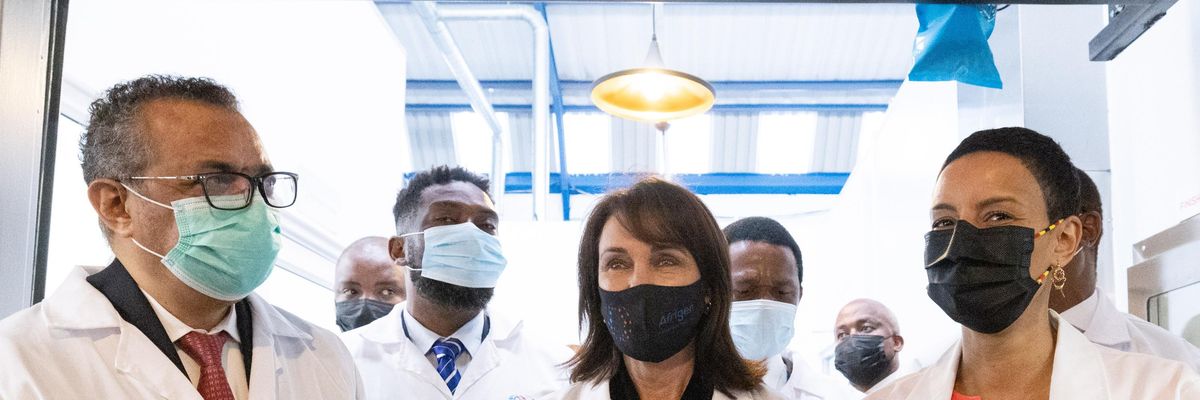
The World Health Organization on Wednesday announced it is expanding its mRNA technology transfer efforts to five additional countries as it works to bolster coronavirus vaccine manufacturing in the Global South, an initiative that seeks to overcome persistent obstruction from the pharmaceutical industry and rich nations.
Bangladesh, Indonesia, Pakistan, Serbia, and Vietnam will be the newest recipients of mRNA vaccine technology from the WHO's hub in Cape Town, South Africa, which has succeeded in creating an mRNA-based coronavirus vaccine modeled after Moderna's shot--the sequence of which was reverse-engineered by Stanford University scientists and published online last year.
"These countries have seen the damage that reliance on the profit-hungry big pharmaceutical corporations has done."
The nations will be added to the original list of recipients, which included Egypt, Kenya, Nigeria, Senegal, South Africa, and Tunisia.
"These countries were vetted by a group of experts and proved that they had the capacity to absorb the technology and, with targeted training, move to production stage relatively quickly," the WHO said in a statement Wednesday. "WHO will enter into discussions with other interested countries and other mRNA technology recipients will be announced in the coming months."
The WHO also announced Wednesday that it is teaming up with South Korea to establish a new "global biomanufacturing training hub that will serve all low- and middle-income countries wishing to produce biologicals, such as vaccines, insulin, monoclonal antibodies, and cancer treatments."
Nick Dearden, director of the U.K.-based advocacy group Global Justice Now, was among those who applauded the WHO for continuing to build on its ambitious technology transfer project.
"This is a game-changer," Dearden said in a statement. "The pharmaceutical system is being remade from the ground up by lower- and middle-income countries. These countries have seen the damage that reliance on the profit-hungry big pharmaceutical corporations has done."
"While some countries have barely received any Covid-19 vaccines, rich nations are throwing millions of doses in the bin, and the three big corporations producing mRNA vaccines are raking in $1,000 a second in profit," he added. "It's time to end this obscenity."
The WHO's technology transfer push is quickly gaining steam even as the makers of the two currently available mRNA-based coronavirus vaccines--Pfizer-BioNTech and Moderna--refuse to share their vaccine recipes or give up patent protections that could end up undercutting the WHO-led effort.
Zain Rizvi, research director at Public Citizen, told the Associated Press that the WHO is providing "a stark contrast to the failures of Moderna and Pfizers of the world who have largely hoarded the technology."
"The E.U., U.K., and Switzerland should heed the call of low- and middle-income countries to endorse this groundbreaking waiver."
"WHO is charting an alternative course that is more open and transparent," said Rizvi. "But it still needs help."
According to Medecins Sans Frontieres (MSF), Moderna holds at least three mRNA vaccine patents in South Africa, meaning the company could attempt to sue scientists in the country who are working urgently to manufacture vaccines as the pandemic continues to take nearly 10,000 lives across the globe each day.
During a press briefing on Wednesday, WHO Director-General Tedros Adhanom Ghebreyesus lamented that the organization's technology transfer process--which began in earnest last June--"would be accelerated if manufacturers were willing to share their intellectual property and know-how with the hub."
In the absence of such voluntary support from the pharmaceutical industry, Tedros said the WHO "strongly" backs "the proposal from South Africa and India for a temporary waiver of intellectual property rights under the TRIPS agreement," a World Trade Organization (WTO) accord that establishes patent protection standards.
Supporters of the waiver argue that a temporary suspension of international patent protections would allow tech transfer efforts like the WHO's to move forward without the threat of legal retribution.
But despite garnering support from more than 100 WTO member nations, the proposed patent waiver has remained stuck in largely fruitless negotiations for more than a year as the European Union, the United Kingdom, Switzerland, and other wealthy countries have remained firm in their opposition, leaving developing nations to rely mostly on vaccine charity for their limited supply.
During the latest round of WTO negotiations this week, the E.U. signaled that it has no intention of changing its position on the waiver.
The pharmaceutical industry has also lobbied aggressively against the patent waiver, arguing--falsely--that developing countries don't have the ability to produce mRNA shots.
Related Content

To date, just 12% of people in low-income countries have received at least one coronavirus vaccine dose, according to Our World in Data. On the African continent, 83% of people have yet to receive a single dose.
"With almost six million lives lost nearly two years into the Covid-19 pandemic, it is heartbreaking for us to continue to witness outrageous inequity in access to Covid-19 medical tools in many of the low- and middle-income countries where we work while wealthy countries which have hoarded vaccines are now buying up much of the supply of new treatments," Yuanqiong Hu, senior legal and policy adviser for MSF's Access Campaign, said in a statement Tuesday.
"The E.U., U.K., and Switzerland should heed the call of low- and middle-income countries to endorse this groundbreaking waiver that could promote access, local production, and self-reliance," said Hu.
The World Health Organization on Wednesday announced it is expanding its mRNA technology transfer efforts to five additional countries as it works to bolster coronavirus vaccine manufacturing in the Global South, an initiative that seeks to overcome persistent obstruction from the pharmaceutical industry and rich nations.
Bangladesh, Indonesia, Pakistan, Serbia, and Vietnam will be the newest recipients of mRNA vaccine technology from the WHO's hub in Cape Town, South Africa, which has succeeded in creating an mRNA-based coronavirus vaccine modeled after Moderna's shot--the sequence of which was reverse-engineered by Stanford University scientists and published online last year.
"These countries have seen the damage that reliance on the profit-hungry big pharmaceutical corporations has done."
The nations will be added to the original list of recipients, which included Egypt, Kenya, Nigeria, Senegal, South Africa, and Tunisia.
"These countries were vetted by a group of experts and proved that they had the capacity to absorb the technology and, with targeted training, move to production stage relatively quickly," the WHO said in a statement Wednesday. "WHO will enter into discussions with other interested countries and other mRNA technology recipients will be announced in the coming months."
The WHO also announced Wednesday that it is teaming up with South Korea to establish a new "global biomanufacturing training hub that will serve all low- and middle-income countries wishing to produce biologicals, such as vaccines, insulin, monoclonal antibodies, and cancer treatments."
Nick Dearden, director of the U.K.-based advocacy group Global Justice Now, was among those who applauded the WHO for continuing to build on its ambitious technology transfer project.
"This is a game-changer," Dearden said in a statement. "The pharmaceutical system is being remade from the ground up by lower- and middle-income countries. These countries have seen the damage that reliance on the profit-hungry big pharmaceutical corporations has done."
"While some countries have barely received any Covid-19 vaccines, rich nations are throwing millions of doses in the bin, and the three big corporations producing mRNA vaccines are raking in $1,000 a second in profit," he added. "It's time to end this obscenity."
The WHO's technology transfer push is quickly gaining steam even as the makers of the two currently available mRNA-based coronavirus vaccines--Pfizer-BioNTech and Moderna--refuse to share their vaccine recipes or give up patent protections that could end up undercutting the WHO-led effort.
Zain Rizvi, research director at Public Citizen, told the Associated Press that the WHO is providing "a stark contrast to the failures of Moderna and Pfizers of the world who have largely hoarded the technology."
"The E.U., U.K., and Switzerland should heed the call of low- and middle-income countries to endorse this groundbreaking waiver."
"WHO is charting an alternative course that is more open and transparent," said Rizvi. "But it still needs help."
According to Medecins Sans Frontieres (MSF), Moderna holds at least three mRNA vaccine patents in South Africa, meaning the company could attempt to sue scientists in the country who are working urgently to manufacture vaccines as the pandemic continues to take nearly 10,000 lives across the globe each day.
During a press briefing on Wednesday, WHO Director-General Tedros Adhanom Ghebreyesus lamented that the organization's technology transfer process--which began in earnest last June--"would be accelerated if manufacturers were willing to share their intellectual property and know-how with the hub."
In the absence of such voluntary support from the pharmaceutical industry, Tedros said the WHO "strongly" backs "the proposal from South Africa and India for a temporary waiver of intellectual property rights under the TRIPS agreement," a World Trade Organization (WTO) accord that establishes patent protection standards.
Supporters of the waiver argue that a temporary suspension of international patent protections would allow tech transfer efforts like the WHO's to move forward without the threat of legal retribution.
But despite garnering support from more than 100 WTO member nations, the proposed patent waiver has remained stuck in largely fruitless negotiations for more than a year as the European Union, the United Kingdom, Switzerland, and other wealthy countries have remained firm in their opposition, leaving developing nations to rely mostly on vaccine charity for their limited supply.
During the latest round of WTO negotiations this week, the E.U. signaled that it has no intention of changing its position on the waiver.
The pharmaceutical industry has also lobbied aggressively against the patent waiver, arguing--falsely--that developing countries don't have the ability to produce mRNA shots.
Related Content
To date, just 12% of people in low-income countries have received at least one coronavirus vaccine dose, according to Our World in Data. On the African continent, 83% of people have yet to receive a single dose.
"With almost six million lives lost nearly two years into the Covid-19 pandemic, it is heartbreaking for us to continue to witness outrageous inequity in access to Covid-19 medical tools in many of the low- and middle-income countries where we work while wealthy countries which have hoarded vaccines are now buying up much of the supply of new treatments," Yuanqiong Hu, senior legal and policy adviser for MSF's Access Campaign, said in a statement Tuesday.
"The E.U., U.K., and Switzerland should heed the call of low- and middle-income countries to endorse this groundbreaking waiver that could promote access, local production, and self-reliance," said Hu.
The World Health Organization on Wednesday announced it is expanding its mRNA technology transfer efforts to five additional countries as it works to bolster coronavirus vaccine manufacturing in the Global South, an initiative that seeks to overcome persistent obstruction from the pharmaceutical industry and rich nations.
Bangladesh, Indonesia, Pakistan, Serbia, and Vietnam will be the newest recipients of mRNA vaccine technology from the WHO's hub in Cape Town, South Africa, which has succeeded in creating an mRNA-based coronavirus vaccine modeled after Moderna's shot--the sequence of which was reverse-engineered by Stanford University scientists and published online last year.
"These countries have seen the damage that reliance on the profit-hungry big pharmaceutical corporations has done."
The nations will be added to the original list of recipients, which included Egypt, Kenya, Nigeria, Senegal, South Africa, and Tunisia.
"These countries were vetted by a group of experts and proved that they had the capacity to absorb the technology and, with targeted training, move to production stage relatively quickly," the WHO said in a statement Wednesday. "WHO will enter into discussions with other interested countries and other mRNA technology recipients will be announced in the coming months."
The WHO also announced Wednesday that it is teaming up with South Korea to establish a new "global biomanufacturing training hub that will serve all low- and middle-income countries wishing to produce biologicals, such as vaccines, insulin, monoclonal antibodies, and cancer treatments."
Nick Dearden, director of the U.K.-based advocacy group Global Justice Now, was among those who applauded the WHO for continuing to build on its ambitious technology transfer project.
"This is a game-changer," Dearden said in a statement. "The pharmaceutical system is being remade from the ground up by lower- and middle-income countries. These countries have seen the damage that reliance on the profit-hungry big pharmaceutical corporations has done."
"While some countries have barely received any Covid-19 vaccines, rich nations are throwing millions of doses in the bin, and the three big corporations producing mRNA vaccines are raking in $1,000 a second in profit," he added. "It's time to end this obscenity."
The WHO's technology transfer push is quickly gaining steam even as the makers of the two currently available mRNA-based coronavirus vaccines--Pfizer-BioNTech and Moderna--refuse to share their vaccine recipes or give up patent protections that could end up undercutting the WHO-led effort.
Zain Rizvi, research director at Public Citizen, told the Associated Press that the WHO is providing "a stark contrast to the failures of Moderna and Pfizers of the world who have largely hoarded the technology."
"The E.U., U.K., and Switzerland should heed the call of low- and middle-income countries to endorse this groundbreaking waiver."
"WHO is charting an alternative course that is more open and transparent," said Rizvi. "But it still needs help."
According to Medecins Sans Frontieres (MSF), Moderna holds at least three mRNA vaccine patents in South Africa, meaning the company could attempt to sue scientists in the country who are working urgently to manufacture vaccines as the pandemic continues to take nearly 10,000 lives across the globe each day.
During a press briefing on Wednesday, WHO Director-General Tedros Adhanom Ghebreyesus lamented that the organization's technology transfer process--which began in earnest last June--"would be accelerated if manufacturers were willing to share their intellectual property and know-how with the hub."
In the absence of such voluntary support from the pharmaceutical industry, Tedros said the WHO "strongly" backs "the proposal from South Africa and India for a temporary waiver of intellectual property rights under the TRIPS agreement," a World Trade Organization (WTO) accord that establishes patent protection standards.
Supporters of the waiver argue that a temporary suspension of international patent protections would allow tech transfer efforts like the WHO's to move forward without the threat of legal retribution.
But despite garnering support from more than 100 WTO member nations, the proposed patent waiver has remained stuck in largely fruitless negotiations for more than a year as the European Union, the United Kingdom, Switzerland, and other wealthy countries have remained firm in their opposition, leaving developing nations to rely mostly on vaccine charity for their limited supply.
During the latest round of WTO negotiations this week, the E.U. signaled that it has no intention of changing its position on the waiver.
The pharmaceutical industry has also lobbied aggressively against the patent waiver, arguing--falsely--that developing countries don't have the ability to produce mRNA shots.
Related Content
To date, just 12% of people in low-income countries have received at least one coronavirus vaccine dose, according to Our World in Data. On the African continent, 83% of people have yet to receive a single dose.
"With almost six million lives lost nearly two years into the Covid-19 pandemic, it is heartbreaking for us to continue to witness outrageous inequity in access to Covid-19 medical tools in many of the low- and middle-income countries where we work while wealthy countries which have hoarded vaccines are now buying up much of the supply of new treatments," Yuanqiong Hu, senior legal and policy adviser for MSF's Access Campaign, said in a statement Tuesday.
"The E.U., U.K., and Switzerland should heed the call of low- and middle-income countries to endorse this groundbreaking waiver that could promote access, local production, and self-reliance," said Hu.