SUBSCRIBE TO OUR FREE NEWSLETTER
Daily news & progressive opinion—funded by the people, not the corporations—delivered straight to your inbox.
5
#000000
#FFFFFF
To donate by check, phone, or other method, see our More Ways to Give page.
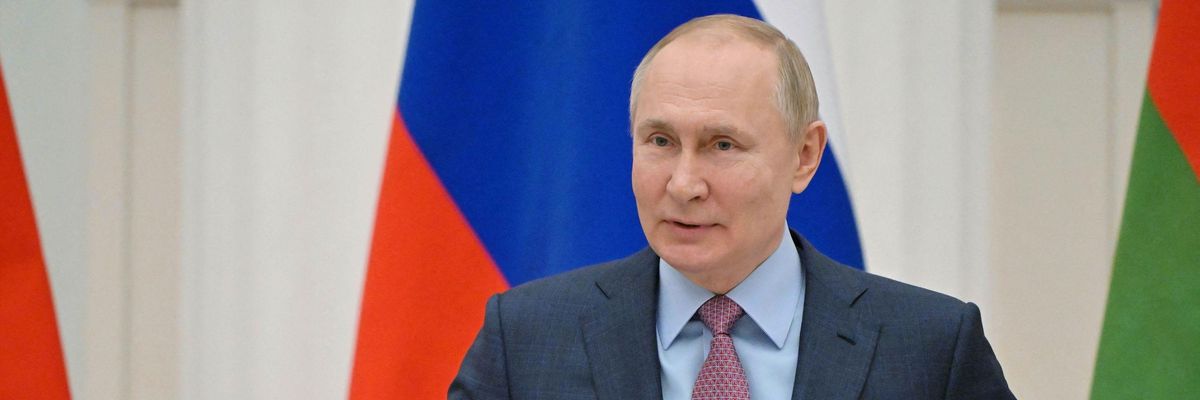
Amid ongoing calls for a diplomatic resolution to tensions over Ukraine, Russia's military announced Friday that it would hold nuclear drills this weekend.
Scheduled for Saturday, the drills will be overseen by Russian President Vladimir Putin and will involve the launching of ballistic and cruise missiles, Russia's Defense Ministry said, according to state news agency TASS.
The military exercises are designed in part to test the "reliability of the strategic nuclear and conventional forces' weapons," the ministry said.
Rejecting Russia's assertions of transparency surrounding the weekend action--which comes as Russia conducts ongoing drills with Belarus--France 24 international affairs commentator Douglas Herbert argued that the timing of exercises that normally occur in summer was "not coincidental" and said that "Russia is in a not very subtle way... reminding everyone" that it's a nuclear-armed superpower.
Joe Cirincione, an author and fellow at the Quincy Institute for Responsible Statecraft, had a similar takeaway.
"Upping the ante," Cirincione tweeted Friday. "Russia reminds us that it has the world's largest nuclear arsenal (~6,200), followed closely by U.S. (5,600)."
While Russian forces are coordinating their "massive" drills, the Associated Press reports Friday that NATO countries "are also flexing their might, beefing up military forces around eastern Europe, but insist the actions are purely defensive and to show unity in the face of Russian threats."
In addition, AP added, "the U.S. announced the $6 billion sale of 250 tanks to Poland, a NATO member that has been occupied or attacked by Russia over past centuries."
Russia, meanwhile, continues to reject Western allegations that it's planning an invasion of Ukraine and says the U.S. has failed to provide security assurances including Ukraine's exclusion from NATO.
Related Content

The developments follow U.S. Secretary of State Antony Blinken's remarks Thursday to the U.N. Security Council in which he accused Russia of having been "steadily amassing more than 150,000 troops on Ukraine's borders." In a Friday statement, the U.S. Mission to the Organization for Security and Co-operation in Europe said that the number of Russian "personnel in and near Ukraine" stood at 169,000-190,000, which it called "the most significant military mobilization in Europe since the Second World War."
Blinken and Russian Foreign Minister Sergei Lavrov have also agreed to sit down for a meeting next week in Europe, the State Department said Friday.
Also on Friday, Pentagon chief Lloyd Austin had a call with his Russian counterpart, Defense Minister Sergei Shoigu, in which he urged de-escalation.
U.S. Vice President Kamala Harris also met Friday with NATO Secretary General Jens Stoltenberg and declared the U.S. "supportive of diplomacy as it relates to the dialogue and discussions we've had with Russia" but warned that "we are also committed to taking corrective actions to ensure there will be severe consequences in terms of the sanctions we have discussed. And we know the alliance is strong in that regard."
Word of Russia's planned nuclear drills will cap a week United Nations Secretary-General Antonio Guterres began by warning that "the price in human suffering, destruction, and damage to European and global security is too high to contemplate" should military conflict break out over Ukraine.
"There is no alternative to diplomacy," said Guterres.
Amid ongoing calls for a diplomatic resolution to tensions over Ukraine, Russia's military announced Friday that it would hold nuclear drills this weekend.
Scheduled for Saturday, the drills will be overseen by Russian President Vladimir Putin and will involve the launching of ballistic and cruise missiles, Russia's Defense Ministry said, according to state news agency TASS.
The military exercises are designed in part to test the "reliability of the strategic nuclear and conventional forces' weapons," the ministry said.
Rejecting Russia's assertions of transparency surrounding the weekend action--which comes as Russia conducts ongoing drills with Belarus--France 24 international affairs commentator Douglas Herbert argued that the timing of exercises that normally occur in summer was "not coincidental" and said that "Russia is in a not very subtle way... reminding everyone" that it's a nuclear-armed superpower.
Joe Cirincione, an author and fellow at the Quincy Institute for Responsible Statecraft, had a similar takeaway.
"Upping the ante," Cirincione tweeted Friday. "Russia reminds us that it has the world's largest nuclear arsenal (~6,200), followed closely by U.S. (5,600)."
While Russian forces are coordinating their "massive" drills, the Associated Press reports Friday that NATO countries "are also flexing their might, beefing up military forces around eastern Europe, but insist the actions are purely defensive and to show unity in the face of Russian threats."
In addition, AP added, "the U.S. announced the $6 billion sale of 250 tanks to Poland, a NATO member that has been occupied or attacked by Russia over past centuries."
Russia, meanwhile, continues to reject Western allegations that it's planning an invasion of Ukraine and says the U.S. has failed to provide security assurances including Ukraine's exclusion from NATO.
Related Content
The developments follow U.S. Secretary of State Antony Blinken's remarks Thursday to the U.N. Security Council in which he accused Russia of having been "steadily amassing more than 150,000 troops on Ukraine's borders." In a Friday statement, the U.S. Mission to the Organization for Security and Co-operation in Europe said that the number of Russian "personnel in and near Ukraine" stood at 169,000-190,000, which it called "the most significant military mobilization in Europe since the Second World War."
Blinken and Russian Foreign Minister Sergei Lavrov have also agreed to sit down for a meeting next week in Europe, the State Department said Friday.
Also on Friday, Pentagon chief Lloyd Austin had a call with his Russian counterpart, Defense Minister Sergei Shoigu, in which he urged de-escalation.
U.S. Vice President Kamala Harris also met Friday with NATO Secretary General Jens Stoltenberg and declared the U.S. "supportive of diplomacy as it relates to the dialogue and discussions we've had with Russia" but warned that "we are also committed to taking corrective actions to ensure there will be severe consequences in terms of the sanctions we have discussed. And we know the alliance is strong in that regard."
Word of Russia's planned nuclear drills will cap a week United Nations Secretary-General Antonio Guterres began by warning that "the price in human suffering, destruction, and damage to European and global security is too high to contemplate" should military conflict break out over Ukraine.
"There is no alternative to diplomacy," said Guterres.
Amid ongoing calls for a diplomatic resolution to tensions over Ukraine, Russia's military announced Friday that it would hold nuclear drills this weekend.
Scheduled for Saturday, the drills will be overseen by Russian President Vladimir Putin and will involve the launching of ballistic and cruise missiles, Russia's Defense Ministry said, according to state news agency TASS.
The military exercises are designed in part to test the "reliability of the strategic nuclear and conventional forces' weapons," the ministry said.
Rejecting Russia's assertions of transparency surrounding the weekend action--which comes as Russia conducts ongoing drills with Belarus--France 24 international affairs commentator Douglas Herbert argued that the timing of exercises that normally occur in summer was "not coincidental" and said that "Russia is in a not very subtle way... reminding everyone" that it's a nuclear-armed superpower.
Joe Cirincione, an author and fellow at the Quincy Institute for Responsible Statecraft, had a similar takeaway.
"Upping the ante," Cirincione tweeted Friday. "Russia reminds us that it has the world's largest nuclear arsenal (~6,200), followed closely by U.S. (5,600)."
While Russian forces are coordinating their "massive" drills, the Associated Press reports Friday that NATO countries "are also flexing their might, beefing up military forces around eastern Europe, but insist the actions are purely defensive and to show unity in the face of Russian threats."
In addition, AP added, "the U.S. announced the $6 billion sale of 250 tanks to Poland, a NATO member that has been occupied or attacked by Russia over past centuries."
Russia, meanwhile, continues to reject Western allegations that it's planning an invasion of Ukraine and says the U.S. has failed to provide security assurances including Ukraine's exclusion from NATO.
Related Content
The developments follow U.S. Secretary of State Antony Blinken's remarks Thursday to the U.N. Security Council in which he accused Russia of having been "steadily amassing more than 150,000 troops on Ukraine's borders." In a Friday statement, the U.S. Mission to the Organization for Security and Co-operation in Europe said that the number of Russian "personnel in and near Ukraine" stood at 169,000-190,000, which it called "the most significant military mobilization in Europe since the Second World War."
Blinken and Russian Foreign Minister Sergei Lavrov have also agreed to sit down for a meeting next week in Europe, the State Department said Friday.
Also on Friday, Pentagon chief Lloyd Austin had a call with his Russian counterpart, Defense Minister Sergei Shoigu, in which he urged de-escalation.
U.S. Vice President Kamala Harris also met Friday with NATO Secretary General Jens Stoltenberg and declared the U.S. "supportive of diplomacy as it relates to the dialogue and discussions we've had with Russia" but warned that "we are also committed to taking corrective actions to ensure there will be severe consequences in terms of the sanctions we have discussed. And we know the alliance is strong in that regard."
Word of Russia's planned nuclear drills will cap a week United Nations Secretary-General Antonio Guterres began by warning that "the price in human suffering, destruction, and damage to European and global security is too high to contemplate" should military conflict break out over Ukraine.
"There is no alternative to diplomacy," said Guterres.