

SUBSCRIBE TO OUR FREE NEWSLETTER
Daily news & progressive opinion—funded by the people, not the corporations—delivered straight to your inbox.
5
#000000
#FFFFFF
To donate by check, phone, or other method, see our More Ways to Give page.
Daily news & progressive opinion—funded by the people, not the corporations—delivered straight to your inbox.
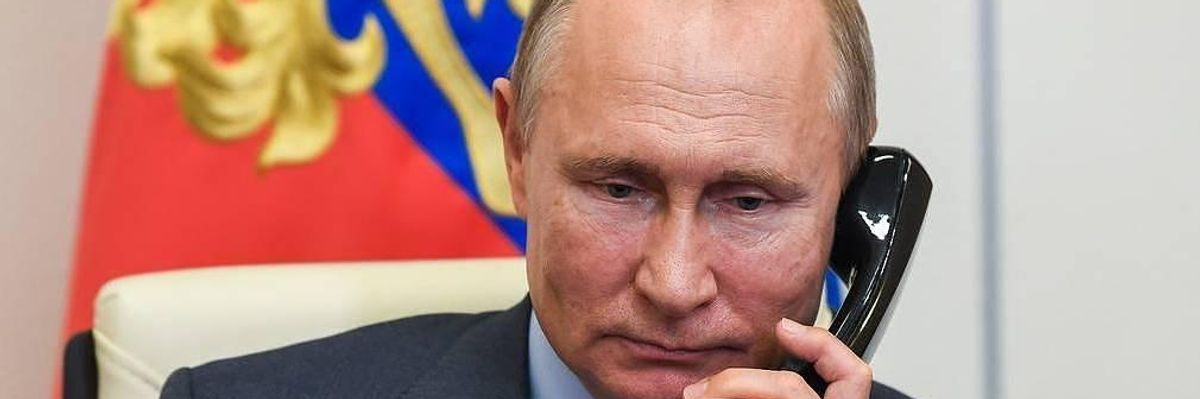
Russia President Vladimir Putin speaking on the phone. Putin spoke with U.S. President Joe Biden on Saturday, February 12, 2022 in an effort to ease tensions over Ukraine. (Photo: Alexei Nikolsky/Russian Presidential Press and Information Office/TASS)
Following the one-on-one call between Joe Biden and Vladimir Putin on Saturday, a top Russian official accused the U.S. government of stoking dangerous "hysteria" and blasted anyone leaking unfounded claims about Moscow's intention to launch an imminent invasion of Ukraine.
"Hysteria has reached its peak," Yury Ushakov, Putin's top foreign policy advisor, told reporters on a conference call following the phone conversation between the two heads of state.
In his comments, according to Agence France-Presse, Ushakov bemoaned reports in the American press--those citing unnamed or anonymous U.S. officials--that claimed Russia had specific plans, or even a date, that an invasion would occur. On Friday, the U.S. State Department said an invasion could happen "any day," but offered no evidence to back up such claims.
"We don't understand why false information about our intentions is being passed to the media," said Ushakov, who further accused authorities in the U.S., Europe, and Kiev of "sabotaging" efforts to achieve a peaceful resolution.
In an official readout of the Biden-Putin call issued Saturday afternoon, the White House said it was made clear that "if Russia undertakes a further invasion of Ukraine, the United States together with our Allies and partners will respond decisively and impose swift and severe costs on Russia."
While the statement said Biden also made clear Washington is willing to continue with diplomatic efforts, it added that the U.S.--along with its allies--"are equally prepared for other scenarios," a not-so-veiled reference to possible military action.
Russia has said repeatedly that its demand for an end to the eastward expansion of NATO, including future inclusion of Ukraine into the alliance, is central to its national security interests. Moscow has also called for autonomy for the Donbass region in eastern Ukraine and a return to peace accords contained in the Minsk agreements.
Russian Foreign Minister Sergei Lavrov earlier on Saturday, in a call with U.S. Secretary of State Antony Blinken, said his country has no plans to invade Ukraine and condemned "the propaganda campaign unleashed by the United States and its allies concerning 'Russian aggression' against Ukraine pursues provocative goals."
While the U.S. and NATO countries in Europe have refused to accept this demand, Ukraine President Volodymyr Zelensky has urged against false information and unnecessary ratcheting up of tensions.
"I think there is too much information in the media about a deep, full-scale war," Zelenksy said on Saturday. "People are even naming dates."
"The best friend for our enemies is panic in our country," he added, "and all this information only creates panic, it doesn't help us."
Despite the flurry of diplomatic calls and statements on Saturday, an event in Russian territorial waters in the north Pacific triggered the Russian Defense Ministry to summon the U.S. military attache in Moscow after the country's Navy said it had detected a Virginia-class U.S. nuclear submarine in the vicinity of a battle group conducting drills in the region.
"The attache for defense issues at the US Embassy in Moscow has been summoned to the Russian Defense Ministry in connection with the violation of the Russian state border by the US Navy's submarine," the ministry said in a statement.
According to the state-run TASS News Agency, the Defense Ministry informed the U.S. military attache that it considered the submarine's presence "a blatant violation of international law."
Dear Common Dreams reader, It’s been nearly 30 years since I co-founded Common Dreams with my late wife, Lina Newhouser. We had the radical notion that journalism should serve the public good, not corporate profits. It was clear to us from the outset what it would take to build such a project. No paid advertisements. No corporate sponsors. No millionaire publisher telling us what to think or do. Many people said we wouldn't last a year, but we proved those doubters wrong. Together with a tremendous team of journalists and dedicated staff, we built an independent media outlet free from the constraints of profits and corporate control. Our mission has always been simple: To inform. To inspire. To ignite change for the common good. Building Common Dreams was not easy. Our survival was never guaranteed. When you take on the most powerful forces—Wall Street greed, fossil fuel industry destruction, Big Tech lobbyists, and uber-rich oligarchs who have spent billions upon billions rigging the economy and democracy in their favor—the only bulwark you have is supporters who believe in your work. But here’s the urgent message from me today. It's never been this bad out there. And it's never been this hard to keep us going. At the very moment Common Dreams is most needed, the threats we face are intensifying. We need your support now more than ever. We don't accept corporate advertising and never will. We don't have a paywall because we don't think people should be blocked from critical news based on their ability to pay. Everything we do is funded by the donations of readers like you. When everyone does the little they can afford, we are strong. But if that support retreats or dries up, so do we. Will you donate now to make sure Common Dreams not only survives but thrives? —Craig Brown, Co-founder |
Following the one-on-one call between Joe Biden and Vladimir Putin on Saturday, a top Russian official accused the U.S. government of stoking dangerous "hysteria" and blasted anyone leaking unfounded claims about Moscow's intention to launch an imminent invasion of Ukraine.
"Hysteria has reached its peak," Yury Ushakov, Putin's top foreign policy advisor, told reporters on a conference call following the phone conversation between the two heads of state.
In his comments, according to Agence France-Presse, Ushakov bemoaned reports in the American press--those citing unnamed or anonymous U.S. officials--that claimed Russia had specific plans, or even a date, that an invasion would occur. On Friday, the U.S. State Department said an invasion could happen "any day," but offered no evidence to back up such claims.
"We don't understand why false information about our intentions is being passed to the media," said Ushakov, who further accused authorities in the U.S., Europe, and Kiev of "sabotaging" efforts to achieve a peaceful resolution.
In an official readout of the Biden-Putin call issued Saturday afternoon, the White House said it was made clear that "if Russia undertakes a further invasion of Ukraine, the United States together with our Allies and partners will respond decisively and impose swift and severe costs on Russia."
While the statement said Biden also made clear Washington is willing to continue with diplomatic efforts, it added that the U.S.--along with its allies--"are equally prepared for other scenarios," a not-so-veiled reference to possible military action.
Russia has said repeatedly that its demand for an end to the eastward expansion of NATO, including future inclusion of Ukraine into the alliance, is central to its national security interests. Moscow has also called for autonomy for the Donbass region in eastern Ukraine and a return to peace accords contained in the Minsk agreements.
Russian Foreign Minister Sergei Lavrov earlier on Saturday, in a call with U.S. Secretary of State Antony Blinken, said his country has no plans to invade Ukraine and condemned "the propaganda campaign unleashed by the United States and its allies concerning 'Russian aggression' against Ukraine pursues provocative goals."
While the U.S. and NATO countries in Europe have refused to accept this demand, Ukraine President Volodymyr Zelensky has urged against false information and unnecessary ratcheting up of tensions.
"I think there is too much information in the media about a deep, full-scale war," Zelenksy said on Saturday. "People are even naming dates."
"The best friend for our enemies is panic in our country," he added, "and all this information only creates panic, it doesn't help us."
Despite the flurry of diplomatic calls and statements on Saturday, an event in Russian territorial waters in the north Pacific triggered the Russian Defense Ministry to summon the U.S. military attache in Moscow after the country's Navy said it had detected a Virginia-class U.S. nuclear submarine in the vicinity of a battle group conducting drills in the region.
"The attache for defense issues at the US Embassy in Moscow has been summoned to the Russian Defense Ministry in connection with the violation of the Russian state border by the US Navy's submarine," the ministry said in a statement.
According to the state-run TASS News Agency, the Defense Ministry informed the U.S. military attache that it considered the submarine's presence "a blatant violation of international law."
Following the one-on-one call between Joe Biden and Vladimir Putin on Saturday, a top Russian official accused the U.S. government of stoking dangerous "hysteria" and blasted anyone leaking unfounded claims about Moscow's intention to launch an imminent invasion of Ukraine.
"Hysteria has reached its peak," Yury Ushakov, Putin's top foreign policy advisor, told reporters on a conference call following the phone conversation between the two heads of state.
In his comments, according to Agence France-Presse, Ushakov bemoaned reports in the American press--those citing unnamed or anonymous U.S. officials--that claimed Russia had specific plans, or even a date, that an invasion would occur. On Friday, the U.S. State Department said an invasion could happen "any day," but offered no evidence to back up such claims.
"We don't understand why false information about our intentions is being passed to the media," said Ushakov, who further accused authorities in the U.S., Europe, and Kiev of "sabotaging" efforts to achieve a peaceful resolution.
In an official readout of the Biden-Putin call issued Saturday afternoon, the White House said it was made clear that "if Russia undertakes a further invasion of Ukraine, the United States together with our Allies and partners will respond decisively and impose swift and severe costs on Russia."
While the statement said Biden also made clear Washington is willing to continue with diplomatic efforts, it added that the U.S.--along with its allies--"are equally prepared for other scenarios," a not-so-veiled reference to possible military action.
Russia has said repeatedly that its demand for an end to the eastward expansion of NATO, including future inclusion of Ukraine into the alliance, is central to its national security interests. Moscow has also called for autonomy for the Donbass region in eastern Ukraine and a return to peace accords contained in the Minsk agreements.
Russian Foreign Minister Sergei Lavrov earlier on Saturday, in a call with U.S. Secretary of State Antony Blinken, said his country has no plans to invade Ukraine and condemned "the propaganda campaign unleashed by the United States and its allies concerning 'Russian aggression' against Ukraine pursues provocative goals."
While the U.S. and NATO countries in Europe have refused to accept this demand, Ukraine President Volodymyr Zelensky has urged against false information and unnecessary ratcheting up of tensions.
"I think there is too much information in the media about a deep, full-scale war," Zelenksy said on Saturday. "People are even naming dates."
"The best friend for our enemies is panic in our country," he added, "and all this information only creates panic, it doesn't help us."
Despite the flurry of diplomatic calls and statements on Saturday, an event in Russian territorial waters in the north Pacific triggered the Russian Defense Ministry to summon the U.S. military attache in Moscow after the country's Navy said it had detected a Virginia-class U.S. nuclear submarine in the vicinity of a battle group conducting drills in the region.
"The attache for defense issues at the US Embassy in Moscow has been summoned to the Russian Defense Ministry in connection with the violation of the Russian state border by the US Navy's submarine," the ministry said in a statement.
According to the state-run TASS News Agency, the Defense Ministry informed the U.S. military attache that it considered the submarine's presence "a blatant violation of international law."

