SUBSCRIBE TO OUR FREE NEWSLETTER
Daily news & progressive opinion—funded by the people, not the corporations—delivered straight to your inbox.
5
#000000
#FFFFFF
To donate by check, phone, or other method, see our More Ways to Give page.
Daily news & progressive opinion—funded by the people, not the corporations—delivered straight to your inbox.
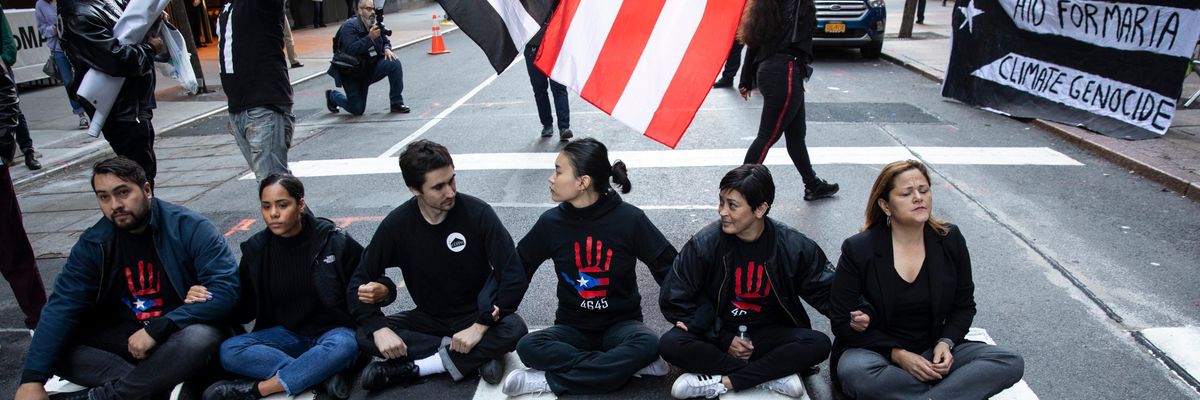
Puerto Ricans sit in the street in New York City as they protest against a hedge fund that owns over $2 billion of Puerto Rico's debt on October 21, 2019. (Photo: Drew Angerer/Getty Images)
Progressives and anti-austerity campaigners on Wednesday were wary of a federal judge's ruling which wiped out 80% of Puerto Rico's debt--the product of four years of negotiations between the U.S. territory's government, creditors, and a fiscal control board that Puerto Ricans derisively call "la junta."
"Some believe the debt should've been cut down further... Others say the debt shouldn't be paid by the Puerto Rican people without auditing it and holding those responsible accountable."
While Gov. Pedro Pierluisi said the debt restructuring plan, which reduces $33 billion of the island's debt to $7.4 billion, will be "very good for Puerto Rico" and will "serve our people," critics said the plan will do little to help future generations of workers on the island while allowing some Wall Street hedge funds which previously bought up the debt to profit off of the deal.
Under the debt restructuring plan announced by Judge Laura Taylor Swain of the Federal District Court for the Southern District of New York, bondholders "will receive $7 billion in cash and other benefits," according to economic justice coalition Jubilee USA.
In a victory for Puerto Rican activists, existing pensions for retired teachers and other public sector workers will not be cut, as the fiscal control board previously planned following restructuring talks last year.
But while the deal was hailed by the board as the beginning of "a new chapter to lead to renewed economic prosperity," independent Puerto Rican journalist Bianca Graulau pointed out that the government will not be able to make cost-of-living adjustments to pay for public employees.
As Graulau reported, while the deal saves Puerto Rico $50 billion in debt payments and allows for repaying loans at a discount, it still commits the island "to debt payments that some say are unsustainable."
After a federal law giving foreign companies tax incentives to operate in Puerto Rico expires at the end of 2022, economist Jose Caraballo-Cueto of the University of Puerto Rico told the New York Times, the government's general fund will be reduced--translating to "more austerity measures to essential services or higher taxes to make the payments."
"Some believe the debt should've been cut down further," said Graulau. "Others say the debt shouldn't be paid by the [Puerto Rican people] without auditing it and holding those responsible accountable."
Puerto Rico's debt exceeded $70 billion and it owed $55 billion in unfunded pensions when it entered bankruptcy in 2017. Its debts were partially brought on by decades of lost tax revenue after the U.S. Congress repealed a tax break for businesses on the island in 1976. "Vulture" hedge funds then bought up the debt, only to sue the Puerto Rican government when it defaulted on paying the funds back--forcing the bankruptcy filing.
Jubilee USA said while "there is room for optimism, only time can tell if the debt cuts were deep enough to prevent Puerto Rico from needing another debt restructuring in a few years."
"We remain concerned by some of the assumptions of the debt deal. The island's ability to resume growth and avoid cuts in anti-poverty programs are both chief concerns," said executive director Eric LeCompte.
Julio Lopez Varona of the Center for Popular Democracy was far less optimistic, saying Swain "turned her back on Puerto Ricans and approved a debt adjustment plan that leads us down the path of austerity and bankruptcy."
"The plan that was approved today is a plan predicated on continuing the suffering that we have suffered for decades and that has led thousands of people to leave the island while those who remain suffer from a lack of resources, basic services, and increases," said Lopez Varona. "This is not over, last year we worked with pensioners to achieve the elimination of pension cuts from this agreement. We will now take our claim to Congress and the White House to make sure the board can no longer abuse and pass legislation that helps us achieve the fair recovery we deserve."
Congress put the fiscal control board in place in 2016, and it is set to remain on the island until Puerto Rico can show four consecutive years of balanced budgets.
Former San Juan Mayor Carmen Yulin Cruz denounced the board's claim that the ruling brings a "new chapter" for Puerto Rico.
"A new chapter of austerity which has not worked anywhere else in the world," tweeted Yulin Cruz. "Reducing the debt at what cost?"
The economic justice campaign Hedge Clippers, which targets "unscrupulous hedge fund managers, private equity firms, and Wall Street speculators," said that as long as the vulture funds profit off the debt restructuring plan, "people suffer."
"This is why we have always said that the only way to ensure a just recovery for Puerto Rico is to cancel the debt," Hedge Clippers said.
Dear Common Dreams reader, It’s been nearly 30 years since I co-founded Common Dreams with my late wife, Lina Newhouser. We had the radical notion that journalism should serve the public good, not corporate profits. It was clear to us from the outset what it would take to build such a project. No paid advertisements. No corporate sponsors. No millionaire publisher telling us what to think or do. Many people said we wouldn't last a year, but we proved those doubters wrong. Together with a tremendous team of journalists and dedicated staff, we built an independent media outlet free from the constraints of profits and corporate control. Our mission has always been simple: To inform. To inspire. To ignite change for the common good. Building Common Dreams was not easy. Our survival was never guaranteed. When you take on the most powerful forces—Wall Street greed, fossil fuel industry destruction, Big Tech lobbyists, and uber-rich oligarchs who have spent billions upon billions rigging the economy and democracy in their favor—the only bulwark you have is supporters who believe in your work. But here’s the urgent message from me today. It's never been this bad out there. And it's never been this hard to keep us going. At the very moment Common Dreams is most needed, the threats we face are intensifying. We need your support now more than ever. We don't accept corporate advertising and never will. We don't have a paywall because we don't think people should be blocked from critical news based on their ability to pay. Everything we do is funded by the donations of readers like you. When everyone does the little they can afford, we are strong. But if that support retreats or dries up, so do we. Will you donate now to make sure Common Dreams not only survives but thrives? —Craig Brown, Co-founder |
Progressives and anti-austerity campaigners on Wednesday were wary of a federal judge's ruling which wiped out 80% of Puerto Rico's debt--the product of four years of negotiations between the U.S. territory's government, creditors, and a fiscal control board that Puerto Ricans derisively call "la junta."
"Some believe the debt should've been cut down further... Others say the debt shouldn't be paid by the Puerto Rican people without auditing it and holding those responsible accountable."
While Gov. Pedro Pierluisi said the debt restructuring plan, which reduces $33 billion of the island's debt to $7.4 billion, will be "very good for Puerto Rico" and will "serve our people," critics said the plan will do little to help future generations of workers on the island while allowing some Wall Street hedge funds which previously bought up the debt to profit off of the deal.
Under the debt restructuring plan announced by Judge Laura Taylor Swain of the Federal District Court for the Southern District of New York, bondholders "will receive $7 billion in cash and other benefits," according to economic justice coalition Jubilee USA.
In a victory for Puerto Rican activists, existing pensions for retired teachers and other public sector workers will not be cut, as the fiscal control board previously planned following restructuring talks last year.
But while the deal was hailed by the board as the beginning of "a new chapter to lead to renewed economic prosperity," independent Puerto Rican journalist Bianca Graulau pointed out that the government will not be able to make cost-of-living adjustments to pay for public employees.
As Graulau reported, while the deal saves Puerto Rico $50 billion in debt payments and allows for repaying loans at a discount, it still commits the island "to debt payments that some say are unsustainable."
After a federal law giving foreign companies tax incentives to operate in Puerto Rico expires at the end of 2022, economist Jose Caraballo-Cueto of the University of Puerto Rico told the New York Times, the government's general fund will be reduced--translating to "more austerity measures to essential services or higher taxes to make the payments."
"Some believe the debt should've been cut down further," said Graulau. "Others say the debt shouldn't be paid by the [Puerto Rican people] without auditing it and holding those responsible accountable."
Puerto Rico's debt exceeded $70 billion and it owed $55 billion in unfunded pensions when it entered bankruptcy in 2017. Its debts were partially brought on by decades of lost tax revenue after the U.S. Congress repealed a tax break for businesses on the island in 1976. "Vulture" hedge funds then bought up the debt, only to sue the Puerto Rican government when it defaulted on paying the funds back--forcing the bankruptcy filing.
Jubilee USA said while "there is room for optimism, only time can tell if the debt cuts were deep enough to prevent Puerto Rico from needing another debt restructuring in a few years."
"We remain concerned by some of the assumptions of the debt deal. The island's ability to resume growth and avoid cuts in anti-poverty programs are both chief concerns," said executive director Eric LeCompte.
Julio Lopez Varona of the Center for Popular Democracy was far less optimistic, saying Swain "turned her back on Puerto Ricans and approved a debt adjustment plan that leads us down the path of austerity and bankruptcy."
"The plan that was approved today is a plan predicated on continuing the suffering that we have suffered for decades and that has led thousands of people to leave the island while those who remain suffer from a lack of resources, basic services, and increases," said Lopez Varona. "This is not over, last year we worked with pensioners to achieve the elimination of pension cuts from this agreement. We will now take our claim to Congress and the White House to make sure the board can no longer abuse and pass legislation that helps us achieve the fair recovery we deserve."
Congress put the fiscal control board in place in 2016, and it is set to remain on the island until Puerto Rico can show four consecutive years of balanced budgets.
Former San Juan Mayor Carmen Yulin Cruz denounced the board's claim that the ruling brings a "new chapter" for Puerto Rico.
"A new chapter of austerity which has not worked anywhere else in the world," tweeted Yulin Cruz. "Reducing the debt at what cost?"
The economic justice campaign Hedge Clippers, which targets "unscrupulous hedge fund managers, private equity firms, and Wall Street speculators," said that as long as the vulture funds profit off the debt restructuring plan, "people suffer."
"This is why we have always said that the only way to ensure a just recovery for Puerto Rico is to cancel the debt," Hedge Clippers said.
Progressives and anti-austerity campaigners on Wednesday were wary of a federal judge's ruling which wiped out 80% of Puerto Rico's debt--the product of four years of negotiations between the U.S. territory's government, creditors, and a fiscal control board that Puerto Ricans derisively call "la junta."
"Some believe the debt should've been cut down further... Others say the debt shouldn't be paid by the Puerto Rican people without auditing it and holding those responsible accountable."
While Gov. Pedro Pierluisi said the debt restructuring plan, which reduces $33 billion of the island's debt to $7.4 billion, will be "very good for Puerto Rico" and will "serve our people," critics said the plan will do little to help future generations of workers on the island while allowing some Wall Street hedge funds which previously bought up the debt to profit off of the deal.
Under the debt restructuring plan announced by Judge Laura Taylor Swain of the Federal District Court for the Southern District of New York, bondholders "will receive $7 billion in cash and other benefits," according to economic justice coalition Jubilee USA.
In a victory for Puerto Rican activists, existing pensions for retired teachers and other public sector workers will not be cut, as the fiscal control board previously planned following restructuring talks last year.
But while the deal was hailed by the board as the beginning of "a new chapter to lead to renewed economic prosperity," independent Puerto Rican journalist Bianca Graulau pointed out that the government will not be able to make cost-of-living adjustments to pay for public employees.
As Graulau reported, while the deal saves Puerto Rico $50 billion in debt payments and allows for repaying loans at a discount, it still commits the island "to debt payments that some say are unsustainable."
After a federal law giving foreign companies tax incentives to operate in Puerto Rico expires at the end of 2022, economist Jose Caraballo-Cueto of the University of Puerto Rico told the New York Times, the government's general fund will be reduced--translating to "more austerity measures to essential services or higher taxes to make the payments."
"Some believe the debt should've been cut down further," said Graulau. "Others say the debt shouldn't be paid by the [Puerto Rican people] without auditing it and holding those responsible accountable."
Puerto Rico's debt exceeded $70 billion and it owed $55 billion in unfunded pensions when it entered bankruptcy in 2017. Its debts were partially brought on by decades of lost tax revenue after the U.S. Congress repealed a tax break for businesses on the island in 1976. "Vulture" hedge funds then bought up the debt, only to sue the Puerto Rican government when it defaulted on paying the funds back--forcing the bankruptcy filing.
Jubilee USA said while "there is room for optimism, only time can tell if the debt cuts were deep enough to prevent Puerto Rico from needing another debt restructuring in a few years."
"We remain concerned by some of the assumptions of the debt deal. The island's ability to resume growth and avoid cuts in anti-poverty programs are both chief concerns," said executive director Eric LeCompte.
Julio Lopez Varona of the Center for Popular Democracy was far less optimistic, saying Swain "turned her back on Puerto Ricans and approved a debt adjustment plan that leads us down the path of austerity and bankruptcy."
"The plan that was approved today is a plan predicated on continuing the suffering that we have suffered for decades and that has led thousands of people to leave the island while those who remain suffer from a lack of resources, basic services, and increases," said Lopez Varona. "This is not over, last year we worked with pensioners to achieve the elimination of pension cuts from this agreement. We will now take our claim to Congress and the White House to make sure the board can no longer abuse and pass legislation that helps us achieve the fair recovery we deserve."
Congress put the fiscal control board in place in 2016, and it is set to remain on the island until Puerto Rico can show four consecutive years of balanced budgets.
Former San Juan Mayor Carmen Yulin Cruz denounced the board's claim that the ruling brings a "new chapter" for Puerto Rico.
"A new chapter of austerity which has not worked anywhere else in the world," tweeted Yulin Cruz. "Reducing the debt at what cost?"
The economic justice campaign Hedge Clippers, which targets "unscrupulous hedge fund managers, private equity firms, and Wall Street speculators," said that as long as the vulture funds profit off the debt restructuring plan, "people suffer."
"This is why we have always said that the only way to ensure a just recovery for Puerto Rico is to cancel the debt," Hedge Clippers said.