

SUBSCRIBE TO OUR FREE NEWSLETTER
Daily news & progressive opinion—funded by the people, not the corporations—delivered straight to your inbox.
5
#000000
#FFFFFF
To donate by check, phone, or other method, see our More Ways to Give page.
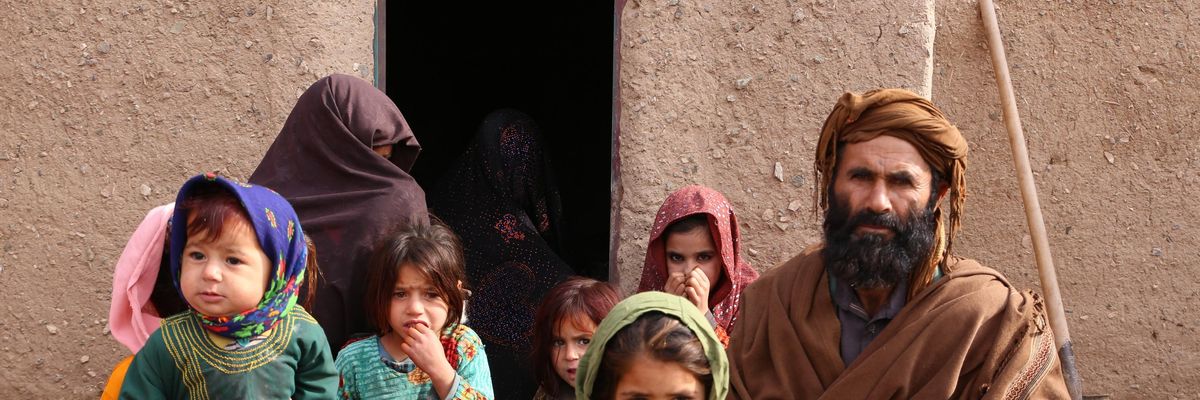
The Biden administration said Tuesday that it will contribute roughly $308 million to humanitarian assistance efforts in Afghanistan, where millions are on the brink of starvation and at risk of freezing to death in the aftermath of the U.S.-led war.
But the newly announced aid falls far short of estimates of the war-torn country's immediate needs and pales in comparison to the $9.4 billion in Afghan government assets that the Biden administration is refusing to unfreeze, despite growing pressure from progressive members of Congress and human rights advocates.
"U.S. actions do not harm the Taliban. In the bitter winter, it pushes millions of ordinary Afghans to misery and death."
On Tuesday morning, the United Nations launched what was described as its "largest single country aid appeal ever," requesting just over $5 billion in assistance that officials said would go toward providing food and other relief to Afghans struggling to survive as winter sets in.
"This is a stop-gap, an absolutely essential stop-gap measure that we are putting in front of the international community today," said U.N. Emergency Relief Coordinator Martin Griffiths. "Without this being funded, there won't be a future."
David Miliband, president and CEO of the International Rescue Committee (IRC), said in a statement Tuesday that the new U.N. appeal "confirms what IRC staff see every day: the people of Afghanistan are being pushed towards the brink of disaster, and for some already beyond the brink, by a misguided policy mix that is punishing the Afghan people for political differences between the international community and the Afghan government."
The group estimated Tuesday that IRC health clinics in Afghanistan saw a thirty-fold rise in acutely malnourished children in the one-month period between November and December 2021.
"The proximate cause of today's humanitarian disaster," Miliband argued, "is clear: the economic tourniquet applied to Afghanistan, with the withdrawal of budgetary support to pay civil servants (including teachers and doctors), a freeze on Afghan assets, and broad-ranging sanctions despite exemptions for humanitarian work, is having a brutal and obvious effect."
"The economic withdrawal following the military withdrawal is indefensible and needs urgent repair," he added, "not just with more humanitarian aid but with a change of approach by governing bodies of World Bank and International Monetary Fund as well as donor governments."
Related Content

In August, the Biden administration froze over $9 billion in Afghan government assets held largely in U.S. bank accounts after the Taliban retook control of the nation's capital.
The administration has also kept in place a sanctions regime that critics and rights groups say is suffocating the nation's economy and hindering the flow of aid, despite exemptions that U.S. officials claimed would allow humanitarian assistance efforts to continue unabated.
"Cutting off all development aid and the freezing of Afghan financial assets are hurting civilians," Vicki Aken, the IRC's Afghanistan director, said Tuesday. "The grim reality is that disease and child malnutrition are rising as health workers go without pay and hospitals go without medicine, while nine million Afghans are on the brink of famine conditions against the backdrop of massive economic collapse."
Last month, as Common Dreams reported, nearly 50 House Democrats led by Reps. Pramila Jayapal (D-Wash.), Sara Jacobs (D-Calif.), and Jesus "Chuy" Garcia (D-Ill.) implored the Biden Treasury Department to unfreeze Afghan government funds and consider lifting sanctions that are "creating a chilling effect for financial institutions and aid organizations."
"Afghanistan's economic pain and humanitarian collapse both threaten to trigger a new refugee crisis throughout the region," the lawmakers warned.
Ashok Swain, a professor of peace and conflict research at Uppsala University in Sweden, argued Monday that "President Joe Biden is committing a crime against humanity" by refusing to release Afghan government funds.
"During its 20 years of presence, the U.S. had spent 2.3 trillion dollars on Afghanistan," Swain noted in a column for Gulf News. "Though it lost 6,000 of its troops and private security contractors, the loss of life in Afghanistan, on the other hand, was at least 300,000, with more than 2.5 million Afghans displaced. When the U.S. left, more than one-third of the population had no food, half had no access to drinking water, and two-thirds had no electricity."
"The blocking of funds by the U.S. and its allies have devastated Afghanistan's struggling economy," he added. "U.S. actions do not harm the Taliban. In the bitter winter, it pushes millions of ordinary Afghans to misery and death."
The Biden administration said Tuesday that it will contribute roughly $308 million to humanitarian assistance efforts in Afghanistan, where millions are on the brink of starvation and at risk of freezing to death in the aftermath of the U.S.-led war.
But the newly announced aid falls far short of estimates of the war-torn country's immediate needs and pales in comparison to the $9.4 billion in Afghan government assets that the Biden administration is refusing to unfreeze, despite growing pressure from progressive members of Congress and human rights advocates.
"U.S. actions do not harm the Taliban. In the bitter winter, it pushes millions of ordinary Afghans to misery and death."
On Tuesday morning, the United Nations launched what was described as its "largest single country aid appeal ever," requesting just over $5 billion in assistance that officials said would go toward providing food and other relief to Afghans struggling to survive as winter sets in.
"This is a stop-gap, an absolutely essential stop-gap measure that we are putting in front of the international community today," said U.N. Emergency Relief Coordinator Martin Griffiths. "Without this being funded, there won't be a future."
David Miliband, president and CEO of the International Rescue Committee (IRC), said in a statement Tuesday that the new U.N. appeal "confirms what IRC staff see every day: the people of Afghanistan are being pushed towards the brink of disaster, and for some already beyond the brink, by a misguided policy mix that is punishing the Afghan people for political differences between the international community and the Afghan government."
The group estimated Tuesday that IRC health clinics in Afghanistan saw a thirty-fold rise in acutely malnourished children in the one-month period between November and December 2021.
"The proximate cause of today's humanitarian disaster," Miliband argued, "is clear: the economic tourniquet applied to Afghanistan, with the withdrawal of budgetary support to pay civil servants (including teachers and doctors), a freeze on Afghan assets, and broad-ranging sanctions despite exemptions for humanitarian work, is having a brutal and obvious effect."
"The economic withdrawal following the military withdrawal is indefensible and needs urgent repair," he added, "not just with more humanitarian aid but with a change of approach by governing bodies of World Bank and International Monetary Fund as well as donor governments."
Related Content
In August, the Biden administration froze over $9 billion in Afghan government assets held largely in U.S. bank accounts after the Taliban retook control of the nation's capital.
The administration has also kept in place a sanctions regime that critics and rights groups say is suffocating the nation's economy and hindering the flow of aid, despite exemptions that U.S. officials claimed would allow humanitarian assistance efforts to continue unabated.
"Cutting off all development aid and the freezing of Afghan financial assets are hurting civilians," Vicki Aken, the IRC's Afghanistan director, said Tuesday. "The grim reality is that disease and child malnutrition are rising as health workers go without pay and hospitals go without medicine, while nine million Afghans are on the brink of famine conditions against the backdrop of massive economic collapse."
Last month, as Common Dreams reported, nearly 50 House Democrats led by Reps. Pramila Jayapal (D-Wash.), Sara Jacobs (D-Calif.), and Jesus "Chuy" Garcia (D-Ill.) implored the Biden Treasury Department to unfreeze Afghan government funds and consider lifting sanctions that are "creating a chilling effect for financial institutions and aid organizations."
"Afghanistan's economic pain and humanitarian collapse both threaten to trigger a new refugee crisis throughout the region," the lawmakers warned.
Ashok Swain, a professor of peace and conflict research at Uppsala University in Sweden, argued Monday that "President Joe Biden is committing a crime against humanity" by refusing to release Afghan government funds.
"During its 20 years of presence, the U.S. had spent 2.3 trillion dollars on Afghanistan," Swain noted in a column for Gulf News. "Though it lost 6,000 of its troops and private security contractors, the loss of life in Afghanistan, on the other hand, was at least 300,000, with more than 2.5 million Afghans displaced. When the U.S. left, more than one-third of the population had no food, half had no access to drinking water, and two-thirds had no electricity."
"The blocking of funds by the U.S. and its allies have devastated Afghanistan's struggling economy," he added. "U.S. actions do not harm the Taliban. In the bitter winter, it pushes millions of ordinary Afghans to misery and death."
The Biden administration said Tuesday that it will contribute roughly $308 million to humanitarian assistance efforts in Afghanistan, where millions are on the brink of starvation and at risk of freezing to death in the aftermath of the U.S.-led war.
But the newly announced aid falls far short of estimates of the war-torn country's immediate needs and pales in comparison to the $9.4 billion in Afghan government assets that the Biden administration is refusing to unfreeze, despite growing pressure from progressive members of Congress and human rights advocates.
"U.S. actions do not harm the Taliban. In the bitter winter, it pushes millions of ordinary Afghans to misery and death."
On Tuesday morning, the United Nations launched what was described as its "largest single country aid appeal ever," requesting just over $5 billion in assistance that officials said would go toward providing food and other relief to Afghans struggling to survive as winter sets in.
"This is a stop-gap, an absolutely essential stop-gap measure that we are putting in front of the international community today," said U.N. Emergency Relief Coordinator Martin Griffiths. "Without this being funded, there won't be a future."
David Miliband, president and CEO of the International Rescue Committee (IRC), said in a statement Tuesday that the new U.N. appeal "confirms what IRC staff see every day: the people of Afghanistan are being pushed towards the brink of disaster, and for some already beyond the brink, by a misguided policy mix that is punishing the Afghan people for political differences between the international community and the Afghan government."
The group estimated Tuesday that IRC health clinics in Afghanistan saw a thirty-fold rise in acutely malnourished children in the one-month period between November and December 2021.
"The proximate cause of today's humanitarian disaster," Miliband argued, "is clear: the economic tourniquet applied to Afghanistan, with the withdrawal of budgetary support to pay civil servants (including teachers and doctors), a freeze on Afghan assets, and broad-ranging sanctions despite exemptions for humanitarian work, is having a brutal and obvious effect."
"The economic withdrawal following the military withdrawal is indefensible and needs urgent repair," he added, "not just with more humanitarian aid but with a change of approach by governing bodies of World Bank and International Monetary Fund as well as donor governments."
Related Content
In August, the Biden administration froze over $9 billion in Afghan government assets held largely in U.S. bank accounts after the Taliban retook control of the nation's capital.
The administration has also kept in place a sanctions regime that critics and rights groups say is suffocating the nation's economy and hindering the flow of aid, despite exemptions that U.S. officials claimed would allow humanitarian assistance efforts to continue unabated.
"Cutting off all development aid and the freezing of Afghan financial assets are hurting civilians," Vicki Aken, the IRC's Afghanistan director, said Tuesday. "The grim reality is that disease and child malnutrition are rising as health workers go without pay and hospitals go without medicine, while nine million Afghans are on the brink of famine conditions against the backdrop of massive economic collapse."
Last month, as Common Dreams reported, nearly 50 House Democrats led by Reps. Pramila Jayapal (D-Wash.), Sara Jacobs (D-Calif.), and Jesus "Chuy" Garcia (D-Ill.) implored the Biden Treasury Department to unfreeze Afghan government funds and consider lifting sanctions that are "creating a chilling effect for financial institutions and aid organizations."
"Afghanistan's economic pain and humanitarian collapse both threaten to trigger a new refugee crisis throughout the region," the lawmakers warned.
Ashok Swain, a professor of peace and conflict research at Uppsala University in Sweden, argued Monday that "President Joe Biden is committing a crime against humanity" by refusing to release Afghan government funds.
"During its 20 years of presence, the U.S. had spent 2.3 trillion dollars on Afghanistan," Swain noted in a column for Gulf News. "Though it lost 6,000 of its troops and private security contractors, the loss of life in Afghanistan, on the other hand, was at least 300,000, with more than 2.5 million Afghans displaced. When the U.S. left, more than one-third of the population had no food, half had no access to drinking water, and two-thirds had no electricity."
"The blocking of funds by the U.S. and its allies have devastated Afghanistan's struggling economy," he added. "U.S. actions do not harm the Taliban. In the bitter winter, it pushes millions of ordinary Afghans to misery and death."

