SUBSCRIBE TO OUR FREE NEWSLETTER
Daily news & progressive opinion—funded by the people, not the corporations—delivered straight to your inbox.
5
#000000
#FFFFFF
To donate by check, phone, or other method, see our More Ways to Give page.
Daily news & progressive opinion—funded by the people, not the corporations—delivered straight to your inbox.
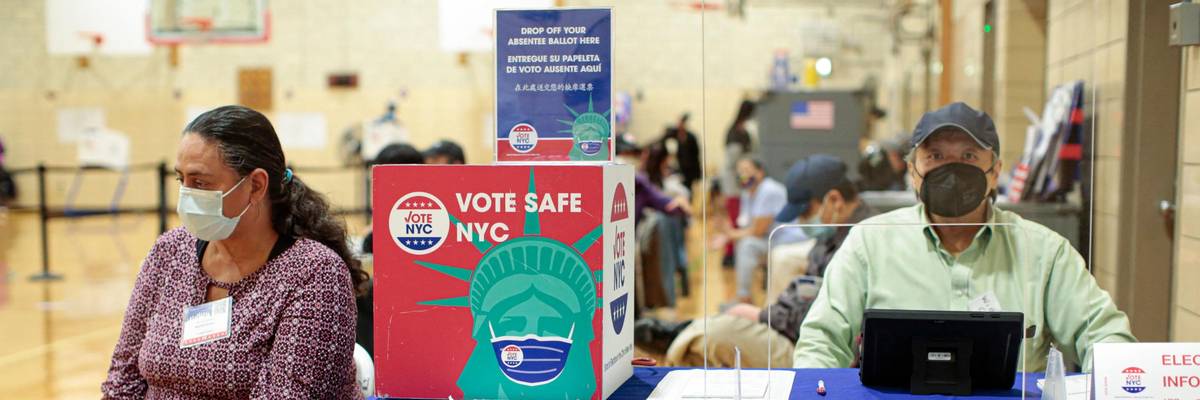
Electoral workers wait inside a school in Manhattan during early voting in the New York City mayoral election on October 23, 2021. (Photo: Kena Betancur/AFP via Getty Images)
A New York City law granting more than 800,000 lawful permanent residents the right to vote in local elections took effect Sunday after the recently elected mayor, Democrat Eric Adams, declined to veto it.
"We build a stronger democracy when we include the voices of immigrants."
The New York City Council had voted 33-14--with two abstentions--for the measure to allow noncitizens who have resided in the city for at least 30 days to vote for mayor, council members, and other municipal offices beginning next year.
"The New York City Council is making history," declared Ydanis Rodriguez, the former council member who sponsored the bill, last month. "New York City must be seen as a shining example for other progressive cities to follow."
Rodriguez--an immigrant and naturalized citizen from the Dominican Republic who is now the city's Department of Transportation commissioner--added Sunday that "we build a stronger democracy when we include the voices of immigrants."
While some Republicans are threatening lawsuits, citing the state constitution, the city's Board of Elections (BOE) must now craft an implementation plan by July, which the Associated Press reported will include "voter registration rules and provisions that would create separate ballots for municipal races to prevent noncitizens from casting ballots in federal and state contests."
"It's a watershed moment for the nation's most populous city, where legally documented, voting-age noncitizens comprise nearly one in nine of the city's seven million voting-age inhabitants," the AP noted while acknowledging that at least 11 towns in Maryland and two in Vermont had previously taken similar action.
Adams announced his decision in a statement Saturday, saying that "I believe that New Yorkers should have a say in their government, which is why I have and will continue to support this important legislation."
"While I initially had some concerns about one aspect of the bill, I had a productive dialogue with my colleagues in government that put those concerns at ease," he added. "I believe allowing the legislation to be enacted is by far the best choice, and look forward to bringing millions more into the democratic process."
The mayor expanded on his position during a Sunday interview with CNN's Jake Tapper, explaining that while he had concerns about the 30-day part, he ultimately "thought it was more important to not veto the bill or get in the way at all and allow the bill to move forward."
Nora Moran, director of policy and advocacy for United Neighborhood Houses, which has supported versions of this law for over a decade, praised Adams' move.
"It sends both a message to immigrant communities who do a lot of work to keep New York City moving forward, that this is a mayor who supports them and champions them," Moran told Gothamist. "His statement also signals to us a willingness to engage in dialogue around policy that just feels very refreshing."
According to Gothamist:
Other supporters offered cautious optimism about moving in the next phase of their campaign, from lobbying for the bill's passage to encouraging its effective implementation.
"This is going to be a very long process of ensuring that this huge expansion of the franchise is done in the right way," said Murad Awawdeh, executive director of the New York Immigration Coalition.
He said advocates will be watching closely to ensure the New York City Board of Elections sets up the new voter registration process in a timely manner so that those eligible to participate can begin voting in elections starting next year. That will require the city BOE to set up a new protocol to register and identify these noncitizen voters in their registration files, which feed into the state's voter registration database.
Abou Sy Diakhate, co-chair of the Staten Island Immigrants Council, told the Staten Island Advance last month that the new law could lay the groundwork for future changes.
"Immigrants are the backbone of this country and all persons should receive fair treatment under the law and it is critical for the U.S. to encourage such initiatives," he said. "From our side as advocates and community organizers, we will keep pushing the envelope and extend this law to the governor, and for congressional elections."
The development in NYC comes as progressives nationwide push for federal voting rights legislation and the state of U.S. democracy has generated concern at a global level.
Dear Common Dreams reader, It’s been nearly 30 years since I co-founded Common Dreams with my late wife, Lina Newhouser. We had the radical notion that journalism should serve the public good, not corporate profits. It was clear to us from the outset what it would take to build such a project. No paid advertisements. No corporate sponsors. No millionaire publisher telling us what to think or do. Many people said we wouldn't last a year, but we proved those doubters wrong. Together with a tremendous team of journalists and dedicated staff, we built an independent media outlet free from the constraints of profits and corporate control. Our mission has always been simple: To inform. To inspire. To ignite change for the common good. Building Common Dreams was not easy. Our survival was never guaranteed. When you take on the most powerful forces—Wall Street greed, fossil fuel industry destruction, Big Tech lobbyists, and uber-rich oligarchs who have spent billions upon billions rigging the economy and democracy in their favor—the only bulwark you have is supporters who believe in your work. But here’s the urgent message from me today. It's never been this bad out there. And it's never been this hard to keep us going. At the very moment Common Dreams is most needed, the threats we face are intensifying. We need your support now more than ever. We don't accept corporate advertising and never will. We don't have a paywall because we don't think people should be blocked from critical news based on their ability to pay. Everything we do is funded by the donations of readers like you. When everyone does the little they can afford, we are strong. But if that support retreats or dries up, so do we. Will you donate now to make sure Common Dreams not only survives but thrives? —Craig Brown, Co-founder |
A New York City law granting more than 800,000 lawful permanent residents the right to vote in local elections took effect Sunday after the recently elected mayor, Democrat Eric Adams, declined to veto it.
"We build a stronger democracy when we include the voices of immigrants."
The New York City Council had voted 33-14--with two abstentions--for the measure to allow noncitizens who have resided in the city for at least 30 days to vote for mayor, council members, and other municipal offices beginning next year.
"The New York City Council is making history," declared Ydanis Rodriguez, the former council member who sponsored the bill, last month. "New York City must be seen as a shining example for other progressive cities to follow."
Rodriguez--an immigrant and naturalized citizen from the Dominican Republic who is now the city's Department of Transportation commissioner--added Sunday that "we build a stronger democracy when we include the voices of immigrants."
While some Republicans are threatening lawsuits, citing the state constitution, the city's Board of Elections (BOE) must now craft an implementation plan by July, which the Associated Press reported will include "voter registration rules and provisions that would create separate ballots for municipal races to prevent noncitizens from casting ballots in federal and state contests."
"It's a watershed moment for the nation's most populous city, where legally documented, voting-age noncitizens comprise nearly one in nine of the city's seven million voting-age inhabitants," the AP noted while acknowledging that at least 11 towns in Maryland and two in Vermont had previously taken similar action.
Adams announced his decision in a statement Saturday, saying that "I believe that New Yorkers should have a say in their government, which is why I have and will continue to support this important legislation."
"While I initially had some concerns about one aspect of the bill, I had a productive dialogue with my colleagues in government that put those concerns at ease," he added. "I believe allowing the legislation to be enacted is by far the best choice, and look forward to bringing millions more into the democratic process."
The mayor expanded on his position during a Sunday interview with CNN's Jake Tapper, explaining that while he had concerns about the 30-day part, he ultimately "thought it was more important to not veto the bill or get in the way at all and allow the bill to move forward."
Nora Moran, director of policy and advocacy for United Neighborhood Houses, which has supported versions of this law for over a decade, praised Adams' move.
"It sends both a message to immigrant communities who do a lot of work to keep New York City moving forward, that this is a mayor who supports them and champions them," Moran told Gothamist. "His statement also signals to us a willingness to engage in dialogue around policy that just feels very refreshing."
According to Gothamist:
Other supporters offered cautious optimism about moving in the next phase of their campaign, from lobbying for the bill's passage to encouraging its effective implementation.
"This is going to be a very long process of ensuring that this huge expansion of the franchise is done in the right way," said Murad Awawdeh, executive director of the New York Immigration Coalition.
He said advocates will be watching closely to ensure the New York City Board of Elections sets up the new voter registration process in a timely manner so that those eligible to participate can begin voting in elections starting next year. That will require the city BOE to set up a new protocol to register and identify these noncitizen voters in their registration files, which feed into the state's voter registration database.
Abou Sy Diakhate, co-chair of the Staten Island Immigrants Council, told the Staten Island Advance last month that the new law could lay the groundwork for future changes.
"Immigrants are the backbone of this country and all persons should receive fair treatment under the law and it is critical for the U.S. to encourage such initiatives," he said. "From our side as advocates and community organizers, we will keep pushing the envelope and extend this law to the governor, and for congressional elections."
The development in NYC comes as progressives nationwide push for federal voting rights legislation and the state of U.S. democracy has generated concern at a global level.
A New York City law granting more than 800,000 lawful permanent residents the right to vote in local elections took effect Sunday after the recently elected mayor, Democrat Eric Adams, declined to veto it.
"We build a stronger democracy when we include the voices of immigrants."
The New York City Council had voted 33-14--with two abstentions--for the measure to allow noncitizens who have resided in the city for at least 30 days to vote for mayor, council members, and other municipal offices beginning next year.
"The New York City Council is making history," declared Ydanis Rodriguez, the former council member who sponsored the bill, last month. "New York City must be seen as a shining example for other progressive cities to follow."
Rodriguez--an immigrant and naturalized citizen from the Dominican Republic who is now the city's Department of Transportation commissioner--added Sunday that "we build a stronger democracy when we include the voices of immigrants."
While some Republicans are threatening lawsuits, citing the state constitution, the city's Board of Elections (BOE) must now craft an implementation plan by July, which the Associated Press reported will include "voter registration rules and provisions that would create separate ballots for municipal races to prevent noncitizens from casting ballots in federal and state contests."
"It's a watershed moment for the nation's most populous city, where legally documented, voting-age noncitizens comprise nearly one in nine of the city's seven million voting-age inhabitants," the AP noted while acknowledging that at least 11 towns in Maryland and two in Vermont had previously taken similar action.
Adams announced his decision in a statement Saturday, saying that "I believe that New Yorkers should have a say in their government, which is why I have and will continue to support this important legislation."
"While I initially had some concerns about one aspect of the bill, I had a productive dialogue with my colleagues in government that put those concerns at ease," he added. "I believe allowing the legislation to be enacted is by far the best choice, and look forward to bringing millions more into the democratic process."
The mayor expanded on his position during a Sunday interview with CNN's Jake Tapper, explaining that while he had concerns about the 30-day part, he ultimately "thought it was more important to not veto the bill or get in the way at all and allow the bill to move forward."
Nora Moran, director of policy and advocacy for United Neighborhood Houses, which has supported versions of this law for over a decade, praised Adams' move.
"It sends both a message to immigrant communities who do a lot of work to keep New York City moving forward, that this is a mayor who supports them and champions them," Moran told Gothamist. "His statement also signals to us a willingness to engage in dialogue around policy that just feels very refreshing."
According to Gothamist:
Other supporters offered cautious optimism about moving in the next phase of their campaign, from lobbying for the bill's passage to encouraging its effective implementation.
"This is going to be a very long process of ensuring that this huge expansion of the franchise is done in the right way," said Murad Awawdeh, executive director of the New York Immigration Coalition.
He said advocates will be watching closely to ensure the New York City Board of Elections sets up the new voter registration process in a timely manner so that those eligible to participate can begin voting in elections starting next year. That will require the city BOE to set up a new protocol to register and identify these noncitizen voters in their registration files, which feed into the state's voter registration database.
Abou Sy Diakhate, co-chair of the Staten Island Immigrants Council, told the Staten Island Advance last month that the new law could lay the groundwork for future changes.
"Immigrants are the backbone of this country and all persons should receive fair treatment under the law and it is critical for the U.S. to encourage such initiatives," he said. "From our side as advocates and community organizers, we will keep pushing the envelope and extend this law to the governor, and for congressional elections."
The development in NYC comes as progressives nationwide push for federal voting rights legislation and the state of U.S. democracy has generated concern at a global level.