SUBSCRIBE TO OUR FREE NEWSLETTER
Daily news & progressive opinion—funded by the people, not the corporations—delivered straight to your inbox.
5
#000000
#FFFFFF
To donate by check, phone, or other method, see our More Ways to Give page.
Daily news & progressive opinion—funded by the people, not the corporations—delivered straight to your inbox.
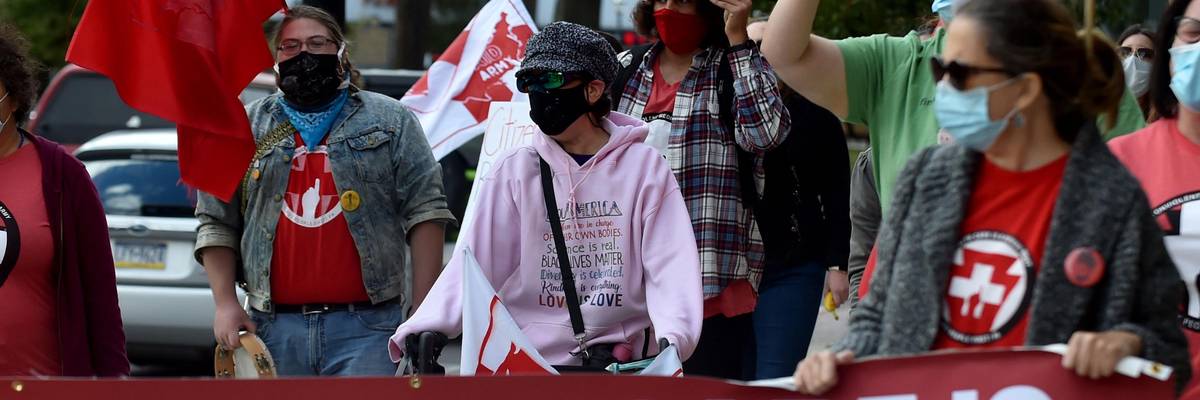
Activists demand universal healthcare during a march in Wilkes-Barre, Pennsylvania on October 2, 2020. (Photo: Aimee Dilger/SOPA Images/LightRocket via Getty Images)
While welcoming a federal ban on most surprise medical bills that went into effect on Saturday, Medicare for All advocates made clear that the new law, which crucially excludes ground ambulances, is only necessary because the United States lacks the superior alternative taken for granted in every other wealthy nation: a single-payer healthcare system.
"While this is good news for consumers, this is necessary because of our complex multi-payer for-profit healthcare system."
Thanks to the No Surprises Act, a bipartisan piece of legislation passed during the Trump administration and "fine-tuned" by the Biden administration, millions of people in the U.S. will be protected from unexpected and costly bills that private-equity-owned providers foist upon patients who inadvertently receive out-of-network care during medical emergencies, the New York Times reported.
"Even with insurance, emergency medical care can still be expensive, and patients with high deductible plans could still face large medical bills," the Times noted. "But the law will eliminate the risk that an out-of-network doctor or hospital will send an extra bill. Currently, those bills add up to billions in costs for consumers each year."
Journalist James Conner, founder and editor of the Flathead Memo, tweeted earlier this week that "this law would not be needed if we ha[d] an everyone covered for everything, zero copay, federal single-payer healthcare system paid for by fair taxes."
The Times reported that "behind the scenes, medical providers are still fighting with regulators over how they will be paid when they provide out-of-network care. But those disputes will not interfere with the law's key consumer protections."
The newspaper explained:
If you are having a medical emergency and go to an urgent care center or emergency room, you can't be charged more than the cost-sharing you are accustomed to for in-network services. This is where the law's protections are the simplest and the most clear for people with health insurance.
You will still be responsible for things like a deductible or a co-payment. But once patients make that normal payment, they should expect no more bills.
[...]
For scheduled services, like knee operations, C-sections, or colonoscopies, it's important you choose a facility and a main doctor that is in your insurance plan's network. If you do that, the law bars anyone else who treats you from sending you a surprise bill. This also addresses a large problem. Surprise bills from anesthesiologists, radiologists, pathologists, assistant surgeons, and laboratories were common before.
If, for some reason, you are having such a service and you really want an out-of-network doctor to be part of your care, that doctor typically needs to notify you at least three days before your procedure, and offer a "good faith estimate" of how much you will be charged. If you sign a form agreeing to pay extra, you could get additional bills. But the hospital or clinic can't force you to sign such a form as a condition of your care, and the form should include other choices of doctors who will accept your insurance.
Joe Sparks, host of "Medicare for All Explained", a podcast made in collaboration with Physicians for a National Health Program, said on Twitter that "while this is good news for consumers, this is necessary because of our complex multi-payer for-profit healthcare system."
" Medicare for All would eliminate the need for surprise medical bills and... other out-of-pocket medical expenses," he added.
Notably, the No Surprises Act only addresses narrowly defined "surprise bills," by which health policy experts mean "extra charges from a medical provider whom patients didn't choose," the Times reported. "But there are still many parts of the U.S. healthcare system that remain perplexing."
"Medicare for All would eliminate the need for surprise medical bills and... other out-of-pocket medical expenses."
Setting aside the fact that 28 million people in the U.S. were uninsured in 2020, the newspaper noted that "it is still not always obvious what medical care will cost in advance, and what insurance plans will cover."
That's why those with high deductible insurance plans or so-called "coinsurance" cost-sharing plans are still likely to be surprised by large medical bills that fall outside of the law's purview.
Moreover, even though the No Surprises Act is designed to protect patients who are unable to avoid out-of-network care during medical emergencies, it contains a key exception when it comes to transportation services.
Although it eliminates surprise bills from air ambulances, the Times reported, the legislation "does not prevent ambulance companies from billing you directly for their services if they travel on roads."
Such rides constitute a significant expense, with out-of-network ground ambulance bills totaling nearly $130 million per year.
According to the newspaper, "Ground ambulances were left out of the recent legislation because legislators determined they would need a different regulatory approach. Congress established a commission to study the issue and may consider reforms."
Pointing to the omission of ground ambulances from the ban on surprise medical bills, Sparks said, "Don't rejoice too much" about the new law.
"Again," he added, "this wouldn't be an issue with Medicare for All."
This country and this world are at a monumental crossroads. US voters have an opportunity to beat back the forces of fascism and confront the billionaires who are rigging the economy, our media system, and our democracy, making it increasingly impossible for ordinary people to get by. We’re not just talking about the election. We’re talking about what must be done once these fascist elements are vanquished from power. We need a bolder set of solutions than what either major party has so far been willing to offer and a working-class movement ready to fight like hell for it. Trump didn't emerge from nowhere. The conditions that fueled MAGA authoritarianism were created by decades of radical neoliberal economic policies and a corrupt political system dominated by corporate interests. They slashed taxes on the super-rich, promising that the benefits would trickle down. They said giveaways to the corporate titans would make life more affordable for the rest of us. It was all bullshit. And when a bitter, betrayed populace searches for someone to blame, right-wing demagogues have little trouble finding scapegoats. People know when they're being lied to, but you won't hear any of this from the corporate media. Only independent journalism—powered and funded by people who believe in building a better world—can deliver truly trustworthy daily news. If you share our vision, please contribute whatever you can to sustain our work. |
While welcoming a federal ban on most surprise medical bills that went into effect on Saturday, Medicare for All advocates made clear that the new law, which crucially excludes ground ambulances, is only necessary because the United States lacks the superior alternative taken for granted in every other wealthy nation: a single-payer healthcare system.
"While this is good news for consumers, this is necessary because of our complex multi-payer for-profit healthcare system."
Thanks to the No Surprises Act, a bipartisan piece of legislation passed during the Trump administration and "fine-tuned" by the Biden administration, millions of people in the U.S. will be protected from unexpected and costly bills that private-equity-owned providers foist upon patients who inadvertently receive out-of-network care during medical emergencies, the New York Times reported.
"Even with insurance, emergency medical care can still be expensive, and patients with high deductible plans could still face large medical bills," the Times noted. "But the law will eliminate the risk that an out-of-network doctor or hospital will send an extra bill. Currently, those bills add up to billions in costs for consumers each year."
Journalist James Conner, founder and editor of the Flathead Memo, tweeted earlier this week that "this law would not be needed if we ha[d] an everyone covered for everything, zero copay, federal single-payer healthcare system paid for by fair taxes."
The Times reported that "behind the scenes, medical providers are still fighting with regulators over how they will be paid when they provide out-of-network care. But those disputes will not interfere with the law's key consumer protections."
The newspaper explained:
If you are having a medical emergency and go to an urgent care center or emergency room, you can't be charged more than the cost-sharing you are accustomed to for in-network services. This is where the law's protections are the simplest and the most clear for people with health insurance.
You will still be responsible for things like a deductible or a co-payment. But once patients make that normal payment, they should expect no more bills.
[...]
For scheduled services, like knee operations, C-sections, or colonoscopies, it's important you choose a facility and a main doctor that is in your insurance plan's network. If you do that, the law bars anyone else who treats you from sending you a surprise bill. This also addresses a large problem. Surprise bills from anesthesiologists, radiologists, pathologists, assistant surgeons, and laboratories were common before.
If, for some reason, you are having such a service and you really want an out-of-network doctor to be part of your care, that doctor typically needs to notify you at least three days before your procedure, and offer a "good faith estimate" of how much you will be charged. If you sign a form agreeing to pay extra, you could get additional bills. But the hospital or clinic can't force you to sign such a form as a condition of your care, and the form should include other choices of doctors who will accept your insurance.
Joe Sparks, host of "Medicare for All Explained", a podcast made in collaboration with Physicians for a National Health Program, said on Twitter that "while this is good news for consumers, this is necessary because of our complex multi-payer for-profit healthcare system."
" Medicare for All would eliminate the need for surprise medical bills and... other out-of-pocket medical expenses," he added.
Notably, the No Surprises Act only addresses narrowly defined "surprise bills," by which health policy experts mean "extra charges from a medical provider whom patients didn't choose," the Times reported. "But there are still many parts of the U.S. healthcare system that remain perplexing."
"Medicare for All would eliminate the need for surprise medical bills and... other out-of-pocket medical expenses."
Setting aside the fact that 28 million people in the U.S. were uninsured in 2020, the newspaper noted that "it is still not always obvious what medical care will cost in advance, and what insurance plans will cover."
That's why those with high deductible insurance plans or so-called "coinsurance" cost-sharing plans are still likely to be surprised by large medical bills that fall outside of the law's purview.
Moreover, even though the No Surprises Act is designed to protect patients who are unable to avoid out-of-network care during medical emergencies, it contains a key exception when it comes to transportation services.
Although it eliminates surprise bills from air ambulances, the Times reported, the legislation "does not prevent ambulance companies from billing you directly for their services if they travel on roads."
Such rides constitute a significant expense, with out-of-network ground ambulance bills totaling nearly $130 million per year.
According to the newspaper, "Ground ambulances were left out of the recent legislation because legislators determined they would need a different regulatory approach. Congress established a commission to study the issue and may consider reforms."
Pointing to the omission of ground ambulances from the ban on surprise medical bills, Sparks said, "Don't rejoice too much" about the new law.
"Again," he added, "this wouldn't be an issue with Medicare for All."