

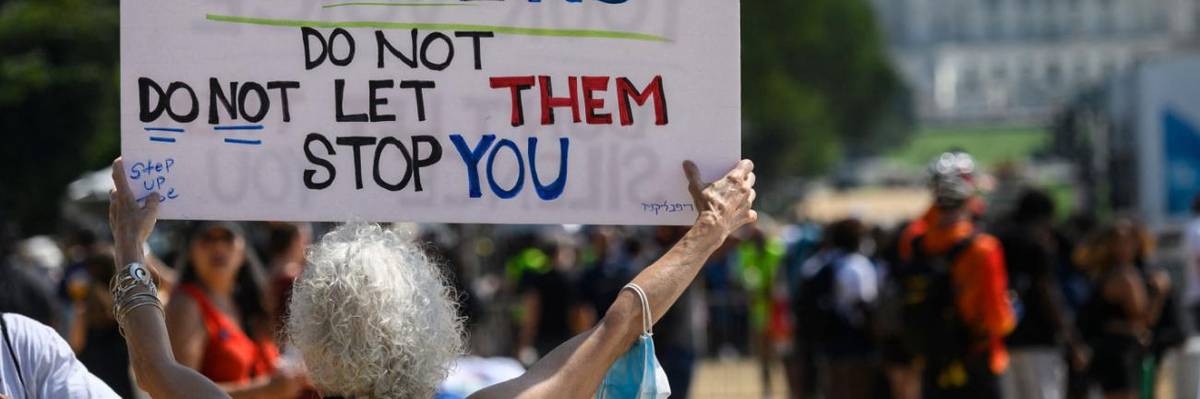
Protesters rally to demand protection for voting rights on the 58th anniversary of the 1963 March on Washington for Jobs and Freedom, in Washington, D.C, on August 28, 2021. (Photo: Andrew Caballero-Reynolds//AFP via Getty Images)
Report Spotlights Massive GOP Push to 'Hijack Elections in This Country'
"These coordinated efforts are based on the same lies about the 2020 election that led to a violent insurrection."
A detailed analysis published Thursday shines further light on the Republican Party's sprawling assault on voting rights and the democratic process nationwide, an effort that includes legislation that would "politicize, criminalize, and interfere" with elections.
Compiled by the States United Democracy Center, Protect Democracy, and Law Forward, the new report identifies at least 262 bills in 41 states that--if enacted--would "interfere with election administration." More than 30 such measures have become law in 17 Republican-led states.
"This is an all-hands-on-deck moment."
But the report makes clear that the intensifying Republican attack on democracy reaches far beyond the legislative process. "The nature of the threat," the authors warn, "has metastasized beyond proposing or passing bills."
"As we look toward 2022, we anticipate the anti-democratic strategy will consist of four key pillars: (i) changing the rules to make it easier to undermine the will of the voters; (ii) changing the people who defend our democratic system by sidelining, replacing, or attacking professional election officials; (iii) promoting controversial constitutional theories about our elections to justify partisan takeovers; and (iv) eroding public confidence and trust in elections," the analysis notes. "These four pillars are the foundation for election sabotage, contrary to the will of the voters."
Joanna Lydgate, CEO of the States United Democracy Center--a nonpartisan organization--said Thursday that "we're seeing an effort to hijack elections in this country, and ultimately, to take power away from the American people."
"The anti-democracy playbook is simple: change the rules, change the players, so they can change the outcome," said Lydgate. "These coordinated efforts are based on the same lies about the 2020 election that led to a violent insurrection. This is an all-hands-on-deck moment for those who care about protecting our republic and free and fair elections."
The report cites a number of specific examples of the GOP's attempted election subversion, which could have major impacts on the 2022 midterms and beyond. Republicans need to flip just five Democratic-held U.S. House seats to take control of the chamber.
"In Michigan, in eight of the eleven largest counties in the state, county Republican parties have systematically replaced their appointees to county canvassing boards with election deniers who embrace conspiracy theories and lies about the 2020 election," the report observes. "In Pennsylvania, the state legislature threatened to impeach the members of two county election commissions who voted to count timely received mail-in or absentee ballots that lacked a date handwritten by the voter."
"At the Secretary of State level," the report continues, "a number of candidates running in 2022 are campaigning on radical positions that would undercut independent election administration. Indeed, former President Donald Trump has endorsed three candidates for Secretary of State who contend that he won the 2020 presidential election: Mark Finchem in Arizona, Jody Hice in Georgia, and Kristina Karamo in Michigan."
Mel Barnes, staff counsel at the Wisconsin-based litigation firm Law Forward, said in a statement that the new analysis "demonstrates how urgent the need is to focus on what's happening to our country's democracy and address it head on."
"State legislatures are rolling back voting rights and sabotaging elections at the same time--we cannot remain idle," Barnes added.
In the face of Republicans' coordinated push to suppress the vote in states across the U.S., Senate Democrats have failed to approve legislation that would negate draconian GOP laws and bolster the franchise at the federal level.
This past weekend, the Senate Democratic leadership ignored calls to work through the holidays and adjourned for the year without approving voting rights legislation.
Republicans in the upper chamber have repeatedly wielded the 60-vote filibuster rule to block Democratic voting rights bills, including a compromise measure backed by Sen. Joe Manchin (D-W.Va.). Despite the GOP's unceasing obstruction, Manchin and Sen. Kyrsten Sinema (D-Ariz.) have refused to support changes to the filibuster rule.
On Thursday, President Joe Biden voiced support for a filibuster carve-out that would allow voting rights legislation to pass with a simple majority vote, a proposal that Manchin has thus far declined to endorse.
"The only thing standing between getting voting rights legislation passed and not getting passed is the filibuster," Biden told ABC News. "I support making an exception on voting rights for the filibuster."
As soon as the first week of January, Senate Majority Leader Chuck Schumer (D-N.Y.) is expected to try once more to advance a voting rights bill in the upper chamber. If Republicans filibuster, Schumer wrote in a recent letter to colleagues, the Senate will "consider changes to any rules which prevent us from debating and reaching final conclusion on important legislation."
We are at a crossroads
This country and this world are at a monumental crossroads. In a few short weeks, US voters will have an opportunity to beat back the forces of fascism and confront the billionaires who are rigging the economy, our media system, and our democracy, making it increasingly impossible for ordinary people to get by. We’re not just talking about the election. We’re talking about what must be done once these fascist elements are vanquished from power. We need a bolder set of solutions than what either major party has so far been willing to offer and a working-class movement ready to fight like hell for it. Trump didn't emerge from nowhere. The conditions that fueled MAGA authoritarianism were created by decades of radical neoliberal economic policies and a corrupt political system dominated by corporate interests. They slashed taxes on the super-rich, promising that the benefits would trickle down. They said giveaways to the corporate titans would make life more affordable for the rest of us. It was all bullshit. And when a bitter, betrayed populace searches for someone to blame, right-wing demagogues have little trouble finding scapegoats. People know when they're being lied to, but you won't hear any of this from the corporate media. Only independent journalism—powered and funded by people who believe in building a better world—can deliver truly trustworthy daily news. Our Fall Campaign is underway, and we need your help. To power our newsroom through the rest of the year, we need to raise $125,000 by midnight on October 31. So if you share our vision, please contribute whatever you can to sustain our work. |
A detailed analysis published Thursday shines further light on the Republican Party's sprawling assault on voting rights and the democratic process nationwide, an effort that includes legislation that would "politicize, criminalize, and interfere" with elections.
Compiled by the States United Democracy Center, Protect Democracy, and Law Forward, the new report identifies at least 262 bills in 41 states that--if enacted--would "interfere with election administration." More than 30 such measures have become law in 17 Republican-led states.
"This is an all-hands-on-deck moment."
But the report makes clear that the intensifying Republican attack on democracy reaches far beyond the legislative process. "The nature of the threat," the authors warn, "has metastasized beyond proposing or passing bills."
"As we look toward 2022, we anticipate the anti-democratic strategy will consist of four key pillars: (i) changing the rules to make it easier to undermine the will of the voters; (ii) changing the people who defend our democratic system by sidelining, replacing, or attacking professional election officials; (iii) promoting controversial constitutional theories about our elections to justify partisan takeovers; and (iv) eroding public confidence and trust in elections," the analysis notes. "These four pillars are the foundation for election sabotage, contrary to the will of the voters."
Joanna Lydgate, CEO of the States United Democracy Center--a nonpartisan organization--said Thursday that "we're seeing an effort to hijack elections in this country, and ultimately, to take power away from the American people."
"The anti-democracy playbook is simple: change the rules, change the players, so they can change the outcome," said Lydgate. "These coordinated efforts are based on the same lies about the 2020 election that led to a violent insurrection. This is an all-hands-on-deck moment for those who care about protecting our republic and free and fair elections."
The report cites a number of specific examples of the GOP's attempted election subversion, which could have major impacts on the 2022 midterms and beyond. Republicans need to flip just five Democratic-held U.S. House seats to take control of the chamber.
"In Michigan, in eight of the eleven largest counties in the state, county Republican parties have systematically replaced their appointees to county canvassing boards with election deniers who embrace conspiracy theories and lies about the 2020 election," the report observes. "In Pennsylvania, the state legislature threatened to impeach the members of two county election commissions who voted to count timely received mail-in or absentee ballots that lacked a date handwritten by the voter."
"At the Secretary of State level," the report continues, "a number of candidates running in 2022 are campaigning on radical positions that would undercut independent election administration. Indeed, former President Donald Trump has endorsed three candidates for Secretary of State who contend that he won the 2020 presidential election: Mark Finchem in Arizona, Jody Hice in Georgia, and Kristina Karamo in Michigan."
Mel Barnes, staff counsel at the Wisconsin-based litigation firm Law Forward, said in a statement that the new analysis "demonstrates how urgent the need is to focus on what's happening to our country's democracy and address it head on."
"State legislatures are rolling back voting rights and sabotaging elections at the same time--we cannot remain idle," Barnes added.
In the face of Republicans' coordinated push to suppress the vote in states across the U.S., Senate Democrats have failed to approve legislation that would negate draconian GOP laws and bolster the franchise at the federal level.
This past weekend, the Senate Democratic leadership ignored calls to work through the holidays and adjourned for the year without approving voting rights legislation.
Republicans in the upper chamber have repeatedly wielded the 60-vote filibuster rule to block Democratic voting rights bills, including a compromise measure backed by Sen. Joe Manchin (D-W.Va.). Despite the GOP's unceasing obstruction, Manchin and Sen. Kyrsten Sinema (D-Ariz.) have refused to support changes to the filibuster rule.
On Thursday, President Joe Biden voiced support for a filibuster carve-out that would allow voting rights legislation to pass with a simple majority vote, a proposal that Manchin has thus far declined to endorse.
"The only thing standing between getting voting rights legislation passed and not getting passed is the filibuster," Biden told ABC News. "I support making an exception on voting rights for the filibuster."
As soon as the first week of January, Senate Majority Leader Chuck Schumer (D-N.Y.) is expected to try once more to advance a voting rights bill in the upper chamber. If Republicans filibuster, Schumer wrote in a recent letter to colleagues, the Senate will "consider changes to any rules which prevent us from debating and reaching final conclusion on important legislation."
A detailed analysis published Thursday shines further light on the Republican Party's sprawling assault on voting rights and the democratic process nationwide, an effort that includes legislation that would "politicize, criminalize, and interfere" with elections.
Compiled by the States United Democracy Center, Protect Democracy, and Law Forward, the new report identifies at least 262 bills in 41 states that--if enacted--would "interfere with election administration." More than 30 such measures have become law in 17 Republican-led states.
"This is an all-hands-on-deck moment."
But the report makes clear that the intensifying Republican attack on democracy reaches far beyond the legislative process. "The nature of the threat," the authors warn, "has metastasized beyond proposing or passing bills."
"As we look toward 2022, we anticipate the anti-democratic strategy will consist of four key pillars: (i) changing the rules to make it easier to undermine the will of the voters; (ii) changing the people who defend our democratic system by sidelining, replacing, or attacking professional election officials; (iii) promoting controversial constitutional theories about our elections to justify partisan takeovers; and (iv) eroding public confidence and trust in elections," the analysis notes. "These four pillars are the foundation for election sabotage, contrary to the will of the voters."
Joanna Lydgate, CEO of the States United Democracy Center--a nonpartisan organization--said Thursday that "we're seeing an effort to hijack elections in this country, and ultimately, to take power away from the American people."
"The anti-democracy playbook is simple: change the rules, change the players, so they can change the outcome," said Lydgate. "These coordinated efforts are based on the same lies about the 2020 election that led to a violent insurrection. This is an all-hands-on-deck moment for those who care about protecting our republic and free and fair elections."
The report cites a number of specific examples of the GOP's attempted election subversion, which could have major impacts on the 2022 midterms and beyond. Republicans need to flip just five Democratic-held U.S. House seats to take control of the chamber.
"In Michigan, in eight of the eleven largest counties in the state, county Republican parties have systematically replaced their appointees to county canvassing boards with election deniers who embrace conspiracy theories and lies about the 2020 election," the report observes. "In Pennsylvania, the state legislature threatened to impeach the members of two county election commissions who voted to count timely received mail-in or absentee ballots that lacked a date handwritten by the voter."
"At the Secretary of State level," the report continues, "a number of candidates running in 2022 are campaigning on radical positions that would undercut independent election administration. Indeed, former President Donald Trump has endorsed three candidates for Secretary of State who contend that he won the 2020 presidential election: Mark Finchem in Arizona, Jody Hice in Georgia, and Kristina Karamo in Michigan."
Mel Barnes, staff counsel at the Wisconsin-based litigation firm Law Forward, said in a statement that the new analysis "demonstrates how urgent the need is to focus on what's happening to our country's democracy and address it head on."
"State legislatures are rolling back voting rights and sabotaging elections at the same time--we cannot remain idle," Barnes added.
In the face of Republicans' coordinated push to suppress the vote in states across the U.S., Senate Democrats have failed to approve legislation that would negate draconian GOP laws and bolster the franchise at the federal level.
This past weekend, the Senate Democratic leadership ignored calls to work through the holidays and adjourned for the year without approving voting rights legislation.
Republicans in the upper chamber have repeatedly wielded the 60-vote filibuster rule to block Democratic voting rights bills, including a compromise measure backed by Sen. Joe Manchin (D-W.Va.). Despite the GOP's unceasing obstruction, Manchin and Sen. Kyrsten Sinema (D-Ariz.) have refused to support changes to the filibuster rule.
On Thursday, President Joe Biden voiced support for a filibuster carve-out that would allow voting rights legislation to pass with a simple majority vote, a proposal that Manchin has thus far declined to endorse.
"The only thing standing between getting voting rights legislation passed and not getting passed is the filibuster," Biden told ABC News. "I support making an exception on voting rights for the filibuster."
As soon as the first week of January, Senate Majority Leader Chuck Schumer (D-N.Y.) is expected to try once more to advance a voting rights bill in the upper chamber. If Republicans filibuster, Schumer wrote in a recent letter to colleagues, the Senate will "consider changes to any rules which prevent us from debating and reaching final conclusion on important legislation."