SUBSCRIBE TO OUR FREE NEWSLETTER
Daily news & progressive opinion—funded by the people, not the corporations—delivered straight to your inbox.
5
#000000
#FFFFFF
To donate by check, phone, or other method, see our More Ways to Give page.
Daily news & progressive opinion—funded by the people, not the corporations—delivered straight to your inbox.
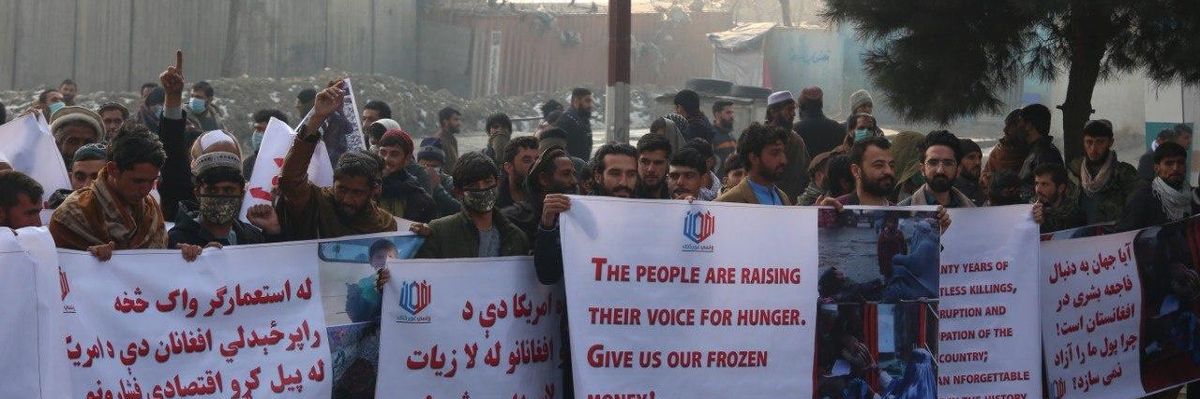
Afghans holding banners take part in a December 21, 2021 protest and march towards former U.S. Embassy in Kabul demanding the release of Afghanistan's frozen assets amid worsening economic conditions and rising poverty in the country. (Photo: Bilal Guler/Andalou Agency via Getty Images)
As the people of Afghanistan face increasing impoverishment and hardship exacerbated by a U.S.-led block on billions of dollars in Afghan assets, hundreds of demonstrators took to the streets of the capital Kabul Tuesday to demand that foreign governments and financial institutions release the frozen funds.
"Such economic pressures on Afghanistan are against international principles. Our people are struggling with economic problems here."
Carrying banners reading, "Let us eat" and "Give us our money," protesters decried financial restrictions imposed upon Afghanistan by nations--including the freezing of over $9 billion in Afghan assets by mostly American banks--following the Taliban's reconquest of the country after two decades of U.S.-led war and occupation.
"Such economic pressures on Afghanistan are against international principles. Our people are struggling with economic problems here," one protester told TOLO News.
Another demonstrator told the Afghan outlet that "Afghanistan's frozen money should be freed soon... This is not how to promote others' welfare."
Yet another participant asserted that "this money belongs to the people and should be freed."
According to the Associated Press:
The lack of funding has battered Afghanistan's already troubled economy, leading to increasing poverty while aid groups warn of a looming humanitarian catastrophe. State employees, from doctors to teachers and administrative civil servants, haven't been paid in months. Banks, meanwhile, have restricted how much money account holders can withdraw.
No country has yet officially recognized the country's new Taliban rulers due to the armed group's previous track record. The Taliban's previous regime 20 years ago banned women and girls from education and public life, mandated beards for men and attendance at prayers, banned sports and entertainment, and carried out public executions.
Unlike other recent protests in Afghanistan--including a women's rights demonstration last week at which foreign journalists were reportedly attacked--the Taliban promoted, praised, and provided security for the event, according to Hesamuddin Hesam, an Afghan journalist who is a correspondent for Germany's Deutsche Presse-Agentur.
Tuesday's protest occurred a day after 46 Democratic members of the U.S. House of Representatives warned President Joe Biden and Treasury Secretary Janet Yellen that the asset freeze and economic sanctions placed Afghanistan at risk of "humanitarian collapse."
"We fear, as aid groups do, that maintaining this policy could cause more civilian deaths in the coming year than were lost in 20 years of war," the lawmakers wrote in a letter.
On Wednesday, the U.S. Treasury Department took a series of steps to enable the flow of humanitarian aid to Afghanistan, issuing three general licenses allowing financial transactions involving the Taliban and the Afghan militant group Haqqani Network if the money is used to meet certain basic societal needs.
Kay Guinane, founder and senior adviser at the U.S.-based Charity & Security Network, said in a statement that the licenses "represent important progress in protecting the lifesaving work of civil society groups in Afghanistan."
"Ultimately, no amount of licensing can resolve this crisis," Guinane added. "Wherever sanctions exist, banks have been hesitant to provide financial services to nonprofits, even when those transactions are perfectly legal. Taking more proactive steps to reassure banks is one step Treasury can take to address this issue."
At a special meeting of the 54-member Organization of Islamic Cooperation (OIC) in Islamabad, Pakistan last week, Pakistani Prime Minister Imran Khan said the U.S. "must de-link the Taliban government from 40 million Afghan citizens, even if they [have] been in conflict with Taliban for 20 years."
Pakistani Foreign Minister Shah Mahmood Qureshi told conference attendees--who also included representatives of the Taliban, United States, China, Russia, the European Union, and the United Nations--that the world "cannot ignore the danger of complete economic meltdown" in Afghanistan.
Dear Common Dreams reader, It’s been nearly 30 years since I co-founded Common Dreams with my late wife, Lina Newhouser. We had the radical notion that journalism should serve the public good, not corporate profits. It was clear to us from the outset what it would take to build such a project. No paid advertisements. No corporate sponsors. No millionaire publisher telling us what to think or do. Many people said we wouldn't last a year, but we proved those doubters wrong. Together with a tremendous team of journalists and dedicated staff, we built an independent media outlet free from the constraints of profits and corporate control. Our mission has always been simple: To inform. To inspire. To ignite change for the common good. Building Common Dreams was not easy. Our survival was never guaranteed. When you take on the most powerful forces—Wall Street greed, fossil fuel industry destruction, Big Tech lobbyists, and uber-rich oligarchs who have spent billions upon billions rigging the economy and democracy in their favor—the only bulwark you have is supporters who believe in your work. But here’s the urgent message from me today. It's never been this bad out there. And it's never been this hard to keep us going. At the very moment Common Dreams is most needed, the threats we face are intensifying. We need your support now more than ever. We don't accept corporate advertising and never will. We don't have a paywall because we don't think people should be blocked from critical news based on their ability to pay. Everything we do is funded by the donations of readers like you. When everyone does the little they can afford, we are strong. But if that support retreats or dries up, so do we. Will you donate now to make sure Common Dreams not only survives but thrives? —Craig Brown, Co-founder |
As the people of Afghanistan face increasing impoverishment and hardship exacerbated by a U.S.-led block on billions of dollars in Afghan assets, hundreds of demonstrators took to the streets of the capital Kabul Tuesday to demand that foreign governments and financial institutions release the frozen funds.
"Such economic pressures on Afghanistan are against international principles. Our people are struggling with economic problems here."
Carrying banners reading, "Let us eat" and "Give us our money," protesters decried financial restrictions imposed upon Afghanistan by nations--including the freezing of over $9 billion in Afghan assets by mostly American banks--following the Taliban's reconquest of the country after two decades of U.S.-led war and occupation.
"Such economic pressures on Afghanistan are against international principles. Our people are struggling with economic problems here," one protester told TOLO News.
Another demonstrator told the Afghan outlet that "Afghanistan's frozen money should be freed soon... This is not how to promote others' welfare."
Yet another participant asserted that "this money belongs to the people and should be freed."
According to the Associated Press:
The lack of funding has battered Afghanistan's already troubled economy, leading to increasing poverty while aid groups warn of a looming humanitarian catastrophe. State employees, from doctors to teachers and administrative civil servants, haven't been paid in months. Banks, meanwhile, have restricted how much money account holders can withdraw.
No country has yet officially recognized the country's new Taliban rulers due to the armed group's previous track record. The Taliban's previous regime 20 years ago banned women and girls from education and public life, mandated beards for men and attendance at prayers, banned sports and entertainment, and carried out public executions.
Unlike other recent protests in Afghanistan--including a women's rights demonstration last week at which foreign journalists were reportedly attacked--the Taliban promoted, praised, and provided security for the event, according to Hesamuddin Hesam, an Afghan journalist who is a correspondent for Germany's Deutsche Presse-Agentur.
Tuesday's protest occurred a day after 46 Democratic members of the U.S. House of Representatives warned President Joe Biden and Treasury Secretary Janet Yellen that the asset freeze and economic sanctions placed Afghanistan at risk of "humanitarian collapse."
"We fear, as aid groups do, that maintaining this policy could cause more civilian deaths in the coming year than were lost in 20 years of war," the lawmakers wrote in a letter.
On Wednesday, the U.S. Treasury Department took a series of steps to enable the flow of humanitarian aid to Afghanistan, issuing three general licenses allowing financial transactions involving the Taliban and the Afghan militant group Haqqani Network if the money is used to meet certain basic societal needs.
Kay Guinane, founder and senior adviser at the U.S.-based Charity & Security Network, said in a statement that the licenses "represent important progress in protecting the lifesaving work of civil society groups in Afghanistan."
"Ultimately, no amount of licensing can resolve this crisis," Guinane added. "Wherever sanctions exist, banks have been hesitant to provide financial services to nonprofits, even when those transactions are perfectly legal. Taking more proactive steps to reassure banks is one step Treasury can take to address this issue."
At a special meeting of the 54-member Organization of Islamic Cooperation (OIC) in Islamabad, Pakistan last week, Pakistani Prime Minister Imran Khan said the U.S. "must de-link the Taliban government from 40 million Afghan citizens, even if they [have] been in conflict with Taliban for 20 years."
Pakistani Foreign Minister Shah Mahmood Qureshi told conference attendees--who also included representatives of the Taliban, United States, China, Russia, the European Union, and the United Nations--that the world "cannot ignore the danger of complete economic meltdown" in Afghanistan.
As the people of Afghanistan face increasing impoverishment and hardship exacerbated by a U.S.-led block on billions of dollars in Afghan assets, hundreds of demonstrators took to the streets of the capital Kabul Tuesday to demand that foreign governments and financial institutions release the frozen funds.
"Such economic pressures on Afghanistan are against international principles. Our people are struggling with economic problems here."
Carrying banners reading, "Let us eat" and "Give us our money," protesters decried financial restrictions imposed upon Afghanistan by nations--including the freezing of over $9 billion in Afghan assets by mostly American banks--following the Taliban's reconquest of the country after two decades of U.S.-led war and occupation.
"Such economic pressures on Afghanistan are against international principles. Our people are struggling with economic problems here," one protester told TOLO News.
Another demonstrator told the Afghan outlet that "Afghanistan's frozen money should be freed soon... This is not how to promote others' welfare."
Yet another participant asserted that "this money belongs to the people and should be freed."
According to the Associated Press:
The lack of funding has battered Afghanistan's already troubled economy, leading to increasing poverty while aid groups warn of a looming humanitarian catastrophe. State employees, from doctors to teachers and administrative civil servants, haven't been paid in months. Banks, meanwhile, have restricted how much money account holders can withdraw.
No country has yet officially recognized the country's new Taliban rulers due to the armed group's previous track record. The Taliban's previous regime 20 years ago banned women and girls from education and public life, mandated beards for men and attendance at prayers, banned sports and entertainment, and carried out public executions.
Unlike other recent protests in Afghanistan--including a women's rights demonstration last week at which foreign journalists were reportedly attacked--the Taliban promoted, praised, and provided security for the event, according to Hesamuddin Hesam, an Afghan journalist who is a correspondent for Germany's Deutsche Presse-Agentur.
Tuesday's protest occurred a day after 46 Democratic members of the U.S. House of Representatives warned President Joe Biden and Treasury Secretary Janet Yellen that the asset freeze and economic sanctions placed Afghanistan at risk of "humanitarian collapse."
"We fear, as aid groups do, that maintaining this policy could cause more civilian deaths in the coming year than were lost in 20 years of war," the lawmakers wrote in a letter.
On Wednesday, the U.S. Treasury Department took a series of steps to enable the flow of humanitarian aid to Afghanistan, issuing three general licenses allowing financial transactions involving the Taliban and the Afghan militant group Haqqani Network if the money is used to meet certain basic societal needs.
Kay Guinane, founder and senior adviser at the U.S.-based Charity & Security Network, said in a statement that the licenses "represent important progress in protecting the lifesaving work of civil society groups in Afghanistan."
"Ultimately, no amount of licensing can resolve this crisis," Guinane added. "Wherever sanctions exist, banks have been hesitant to provide financial services to nonprofits, even when those transactions are perfectly legal. Taking more proactive steps to reassure banks is one step Treasury can take to address this issue."
At a special meeting of the 54-member Organization of Islamic Cooperation (OIC) in Islamabad, Pakistan last week, Pakistani Prime Minister Imran Khan said the U.S. "must de-link the Taliban government from 40 million Afghan citizens, even if they [have] been in conflict with Taliban for 20 years."
Pakistani Foreign Minister Shah Mahmood Qureshi told conference attendees--who also included representatives of the Taliban, United States, China, Russia, the European Union, and the United Nations--that the world "cannot ignore the danger of complete economic meltdown" in Afghanistan.