SUBSCRIBE TO OUR FREE NEWSLETTER
Daily news & progressive opinion—funded by the people, not the corporations—delivered straight to your inbox.
5
#000000
#FFFFFF
To donate by check, phone, or other method, see our More Ways to Give page.
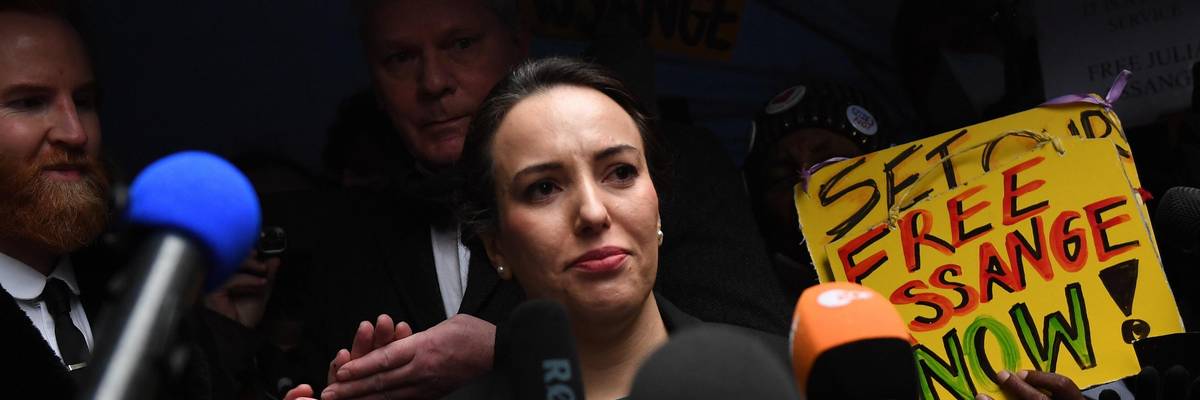
Stella Moris, the fiancee of Julian Assange, reiterated demands for his freedom as she revealed Saturday that the WikiLeaks founder suffered a mini-stroke in October.
"Julian Assange suffered a stroke on the first day of the High Court appeal hearing on October 27th," Moris said in a tweet.
She shared a new Daily Mail report in which she put blame for the event on "the constant chess game, battle after battle, the extreme stress" that Assange, who's been imprisoned at a maximum security prison in London since 2019, continues to endure as the U.S. government seeks to extradite and prosecute him under the Espionage Act for publishing classified information that exposed American war crimes.
"It must have been horrendous hearing a High Court appeal in which you can't participate, which is discussing your mental health and your risk of suicide and in which the U.S. is arguing you are making it all up," said Moris, who has two young children with Assange.
"The U.S. plays dirty every step of the way--it's a war of attrition," she told the outlet. "We can see from the fact that he has suffered a mini-stroke this is having a dangerous impact on him.'
According to United Nations Special Rapporteur on Torture Nils Melzer--who's previously sounded alarm about Assange's treatment--news of the stroke should come as "no surprise."
"As we warned after examining him, unless relieved of the constant pressure of isolation, arbitrariness, persecution, his health would enter a downward spiral endangering his life," Melzer wrote in a Twitter thread Saturday. The "U.K. is literally torturing him to death."
"As Assange clearly was not medically fit to attend his own trial through video link," Melzer added, "how can they even discuss whether he is fit to be exposed to a show trial in the U.S., a country that refuses to prosecute its torturers and war criminals but persecutes whistleblowers and journalists?"
Assange, who is being held at London's high-security Belmarsh Prison, had been expected to attend by video link, but he was not present as the hearing began. His lawyer, Edward Fitzgerald, said Assange "doesn't feel able to attend the proceedings."
Assange's partner, Stella Moris, said outside court that she was "very concerned for Julian's health. I saw him on Saturday. He's very thin."
Related Content

The weekend revelation from Moris followed a Friday British court's ruling that Assange can be extradited to the United States, a decision that drew fierce condemnation from human rights and press freedom organizations.
In a Sunday tweet, Agnes Callamard, the secretary-general of Amnesty International, said that "the relentless prosecution/persecution of Julian Assange is a stain on U.S. press freedom commitments and records."
Stella Moris, the fiancee of Julian Assange, reiterated demands for his freedom as she revealed Saturday that the WikiLeaks founder suffered a mini-stroke in October.
"Julian Assange suffered a stroke on the first day of the High Court appeal hearing on October 27th," Moris said in a tweet.
She shared a new Daily Mail report in which she put blame for the event on "the constant chess game, battle after battle, the extreme stress" that Assange, who's been imprisoned at a maximum security prison in London since 2019, continues to endure as the U.S. government seeks to extradite and prosecute him under the Espionage Act for publishing classified information that exposed American war crimes.
"It must have been horrendous hearing a High Court appeal in which you can't participate, which is discussing your mental health and your risk of suicide and in which the U.S. is arguing you are making it all up," said Moris, who has two young children with Assange.
"The U.S. plays dirty every step of the way--it's a war of attrition," she told the outlet. "We can see from the fact that he has suffered a mini-stroke this is having a dangerous impact on him.'
According to United Nations Special Rapporteur on Torture Nils Melzer--who's previously sounded alarm about Assange's treatment--news of the stroke should come as "no surprise."
"As we warned after examining him, unless relieved of the constant pressure of isolation, arbitrariness, persecution, his health would enter a downward spiral endangering his life," Melzer wrote in a Twitter thread Saturday. The "U.K. is literally torturing him to death."
"As Assange clearly was not medically fit to attend his own trial through video link," Melzer added, "how can they even discuss whether he is fit to be exposed to a show trial in the U.S., a country that refuses to prosecute its torturers and war criminals but persecutes whistleblowers and journalists?"
Assange, who is being held at London's high-security Belmarsh Prison, had been expected to attend by video link, but he was not present as the hearing began. His lawyer, Edward Fitzgerald, said Assange "doesn't feel able to attend the proceedings."
Assange's partner, Stella Moris, said outside court that she was "very concerned for Julian's health. I saw him on Saturday. He's very thin."
Related Content
The weekend revelation from Moris followed a Friday British court's ruling that Assange can be extradited to the United States, a decision that drew fierce condemnation from human rights and press freedom organizations.
In a Sunday tweet, Agnes Callamard, the secretary-general of Amnesty International, said that "the relentless prosecution/persecution of Julian Assange is a stain on U.S. press freedom commitments and records."
Stella Moris, the fiancee of Julian Assange, reiterated demands for his freedom as she revealed Saturday that the WikiLeaks founder suffered a mini-stroke in October.
"Julian Assange suffered a stroke on the first day of the High Court appeal hearing on October 27th," Moris said in a tweet.
She shared a new Daily Mail report in which she put blame for the event on "the constant chess game, battle after battle, the extreme stress" that Assange, who's been imprisoned at a maximum security prison in London since 2019, continues to endure as the U.S. government seeks to extradite and prosecute him under the Espionage Act for publishing classified information that exposed American war crimes.
"It must have been horrendous hearing a High Court appeal in which you can't participate, which is discussing your mental health and your risk of suicide and in which the U.S. is arguing you are making it all up," said Moris, who has two young children with Assange.
"The U.S. plays dirty every step of the way--it's a war of attrition," she told the outlet. "We can see from the fact that he has suffered a mini-stroke this is having a dangerous impact on him.'
According to United Nations Special Rapporteur on Torture Nils Melzer--who's previously sounded alarm about Assange's treatment--news of the stroke should come as "no surprise."
"As we warned after examining him, unless relieved of the constant pressure of isolation, arbitrariness, persecution, his health would enter a downward spiral endangering his life," Melzer wrote in a Twitter thread Saturday. The "U.K. is literally torturing him to death."
"As Assange clearly was not medically fit to attend his own trial through video link," Melzer added, "how can they even discuss whether he is fit to be exposed to a show trial in the U.S., a country that refuses to prosecute its torturers and war criminals but persecutes whistleblowers and journalists?"
Assange, who is being held at London's high-security Belmarsh Prison, had been expected to attend by video link, but he was not present as the hearing began. His lawyer, Edward Fitzgerald, said Assange "doesn't feel able to attend the proceedings."
Assange's partner, Stella Moris, said outside court that she was "very concerned for Julian's health. I saw him on Saturday. He's very thin."
Related Content
The weekend revelation from Moris followed a Friday British court's ruling that Assange can be extradited to the United States, a decision that drew fierce condemnation from human rights and press freedom organizations.
In a Sunday tweet, Agnes Callamard, the secretary-general of Amnesty International, said that "the relentless prosecution/persecution of Julian Assange is a stain on U.S. press freedom commitments and records."