SUBSCRIBE TO OUR FREE NEWSLETTER
Daily news & progressive opinion—funded by the people, not the corporations—delivered straight to your inbox.
5
#000000
#FFFFFF
To donate by check, phone, or other method, see our More Ways to Give page.
Daily news & progressive opinion—funded by the people, not the corporations—delivered straight to your inbox.
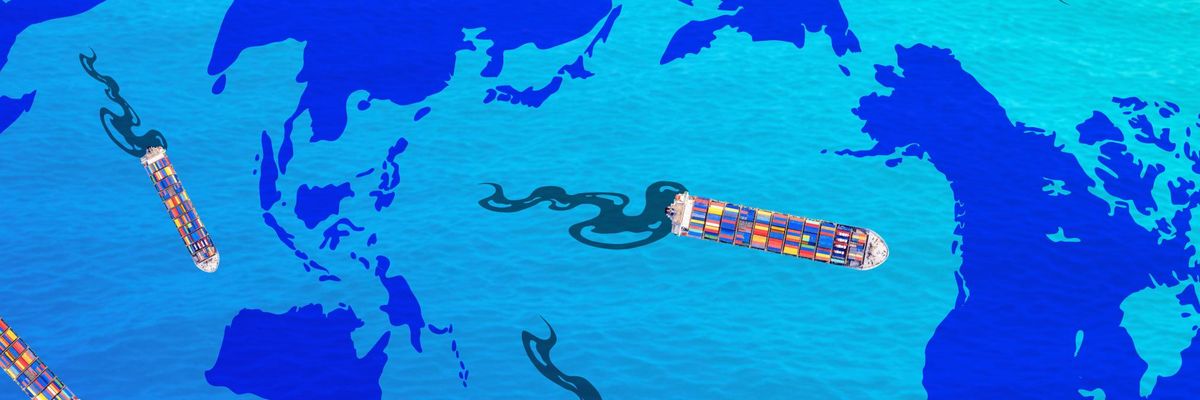
As shoppers scoured the internet for holiday deals on Cyber Monday, a pair of environmental groups published a report that exposes the planet-heating maritime shipping practices of four major global retailers: Amazon, IKEA, Target, and Walmart.
"Pandemic-fueled demand increases, record-breaking profits, and the supply chain crisis reveal the current maritime shipping system is ripe for transformation."
Entitled Shady Routes: How big retail and their carriers pollute along key ocean shipping corridors, the new report is from Pacific Environment and Stand.earth, environmental groups that belong to the Ship It Zero coalition, which pressures retail giants to "lead the way to climate-friendly, clean-air shipping practices."
"Until recently, the massive climate-disrupting and human health-harming emissions from international container shipping--and the companies that are buying their services--have sailed under the radar of public scrutiny," the report states.
This despite international shipping "accounting for 3% of global emissions," the report continues. "If it were a country, it would be the world's sixth largest climate polluter."
According to the environmental groups, "Goods imported via maritime shipping to the U.S. by Walmart, Target, Amazon, and IKEA between 2018-2020 accounted for an estimated 20 million tonnes of carbon dioxide equivalent emissions (CO2e)."
"These goods were predominantly shipped by a small group of major maritime cargo carriers who have long-term relationships with each company," Shady Routes notes. "The most common shipping routes for these goods are between Chinese and West Coast U.S. ports, where vessels left idling due to the current shipping crisis are pushing pollution levels for port communities to all-time highs."
In what the groups called "groundbreaking" research, their analysis found that Walmart, the top importer of goods in the United States, has the highest volumes traded and the most emissions. The retailer relies heavily on CMA CGM, the biggest polluter among the carriers in the report.
Other top carriers featured in Shady Routes include Cosco, Evergreen, Hapag-Lloyd, Maersk, MSC, and Yang Ming, as well as Amazon's AMZD, an "ocean forwarder, which means that other carriers are shipping cargo on the company's behalf."
"Major cargo carriers are lagging in moving towards zero emissions, citing that costs have been prohibitive," said Madeline Rose, climate campaign director at Pacific Environment, in a statement. "Container industry profits are unprecedentedly strong, consumers support clean shipping, and the technology is available. There are no longer any excuses left to set goals to meet zero emissions for 2030."
Rose called on retailers to "engage with cargo carriers that will give them zero-emission freight options to get their goods to market." That call to action was echoed by Kendra Ulrich, shipping campaigns director at Stand.earth.
"Pandemic-fueled demand increases, record-breaking profits, and the supply chain crisis reveal the current maritime shipping system is ripe for transformation," Ulrich said. "There is ample room for retail brands and cargo carriers to absorb the cost of transitioning to fossil-free, zero-emissions shipping and deliver healthier air to our port communities and a livable climate future."
"Retail companies can choose to be industry leaders and early adopters of zero-emissions technology," she added, "or they can put short-term profit over public health and the climate by making empty commitments that put off action on climate change until it's too late."
Shady Routes details steps the four retailers must take to be "leaders" in shipping:
Dawny'all Heydari, Ship It Zero campaign lead at Pacific Environment, highlighted that "Target and Amazon have played an outsized role in the current congestion and pollution crisis at the ports of Los Angeles and Long Beach."
"The retail brands that fill our homes and lives with their products bear a direct responsibility for the pollution their supply chains create."
"As Target faces a swell of demand in places like California and a doubling of its digital sales, and as Amazon increases its control over its own gas-guzzling shipment and parcel delivery, it is past time to hold these retailers accountable for their responsibilities at the ports," Heydari said. "Both companies will continue to favor West Coast routes, which means they'll also keep clogging West Coast ports, spewing cancer-causing emissions and threatening our climate future."
The report notes that IKEA sends a share of its products from China to Europe via rail, then uses maritime transport to get the goods to the United States--which "could be part of" a strategy to cut emissions. It also points out that last month, IKEA joined with Amazon and other retailers for an initiative called coZEV, committing to fossil-free maritime shipping by 2040.
While demanding bolder action, the campaigners on Monday also welcomed recent progress, including coZEV and rising awareness. Ulrich said that "consumers, corporations, and governments are waking up to the massive climate impact stemming from goods being shipped across our oceans."
"Reducing, and ultimately eliminating, maritime emissions will not happen without bold commitments and concrete actions from the companies paying for cargo carriers to transport their goods," she said. "The retail brands that fill our homes and lives with their products bear a direct responsibility for the pollution their supply chains create, and for taking the necessary actions to demand a transition to zero-emissions shipping this decade."
Dear Common Dreams reader, It’s been nearly 30 years since I co-founded Common Dreams with my late wife, Lina Newhouser. We had the radical notion that journalism should serve the public good, not corporate profits. It was clear to us from the outset what it would take to build such a project. No paid advertisements. No corporate sponsors. No millionaire publisher telling us what to think or do. Many people said we wouldn't last a year, but we proved those doubters wrong. Together with a tremendous team of journalists and dedicated staff, we built an independent media outlet free from the constraints of profits and corporate control. Our mission has always been simple: To inform. To inspire. To ignite change for the common good. Building Common Dreams was not easy. Our survival was never guaranteed. When you take on the most powerful forces—Wall Street greed, fossil fuel industry destruction, Big Tech lobbyists, and uber-rich oligarchs who have spent billions upon billions rigging the economy and democracy in their favor—the only bulwark you have is supporters who believe in your work. But here’s the urgent message from me today. It's never been this bad out there. And it's never been this hard to keep us going. At the very moment Common Dreams is most needed, the threats we face are intensifying. We need your support now more than ever. We don't accept corporate advertising and never will. We don't have a paywall because we don't think people should be blocked from critical news based on their ability to pay. Everything we do is funded by the donations of readers like you. When everyone does the little they can afford, we are strong. But if that support retreats or dries up, so do we. Will you donate now to make sure Common Dreams not only survives but thrives? —Craig Brown, Co-founder |
As shoppers scoured the internet for holiday deals on Cyber Monday, a pair of environmental groups published a report that exposes the planet-heating maritime shipping practices of four major global retailers: Amazon, IKEA, Target, and Walmart.
"Pandemic-fueled demand increases, record-breaking profits, and the supply chain crisis reveal the current maritime shipping system is ripe for transformation."
Entitled Shady Routes: How big retail and their carriers pollute along key ocean shipping corridors, the new report is from Pacific Environment and Stand.earth, environmental groups that belong to the Ship It Zero coalition, which pressures retail giants to "lead the way to climate-friendly, clean-air shipping practices."
"Until recently, the massive climate-disrupting and human health-harming emissions from international container shipping--and the companies that are buying their services--have sailed under the radar of public scrutiny," the report states.
This despite international shipping "accounting for 3% of global emissions," the report continues. "If it were a country, it would be the world's sixth largest climate polluter."
According to the environmental groups, "Goods imported via maritime shipping to the U.S. by Walmart, Target, Amazon, and IKEA between 2018-2020 accounted for an estimated 20 million tonnes of carbon dioxide equivalent emissions (CO2e)."
"These goods were predominantly shipped by a small group of major maritime cargo carriers who have long-term relationships with each company," Shady Routes notes. "The most common shipping routes for these goods are between Chinese and West Coast U.S. ports, where vessels left idling due to the current shipping crisis are pushing pollution levels for port communities to all-time highs."
In what the groups called "groundbreaking" research, their analysis found that Walmart, the top importer of goods in the United States, has the highest volumes traded and the most emissions. The retailer relies heavily on CMA CGM, the biggest polluter among the carriers in the report.
Other top carriers featured in Shady Routes include Cosco, Evergreen, Hapag-Lloyd, Maersk, MSC, and Yang Ming, as well as Amazon's AMZD, an "ocean forwarder, which means that other carriers are shipping cargo on the company's behalf."
"Major cargo carriers are lagging in moving towards zero emissions, citing that costs have been prohibitive," said Madeline Rose, climate campaign director at Pacific Environment, in a statement. "Container industry profits are unprecedentedly strong, consumers support clean shipping, and the technology is available. There are no longer any excuses left to set goals to meet zero emissions for 2030."
Rose called on retailers to "engage with cargo carriers that will give them zero-emission freight options to get their goods to market." That call to action was echoed by Kendra Ulrich, shipping campaigns director at Stand.earth.
"Pandemic-fueled demand increases, record-breaking profits, and the supply chain crisis reveal the current maritime shipping system is ripe for transformation," Ulrich said. "There is ample room for retail brands and cargo carriers to absorb the cost of transitioning to fossil-free, zero-emissions shipping and deliver healthier air to our port communities and a livable climate future."
"Retail companies can choose to be industry leaders and early adopters of zero-emissions technology," she added, "or they can put short-term profit over public health and the climate by making empty commitments that put off action on climate change until it's too late."
Shady Routes details steps the four retailers must take to be "leaders" in shipping:
Dawny'all Heydari, Ship It Zero campaign lead at Pacific Environment, highlighted that "Target and Amazon have played an outsized role in the current congestion and pollution crisis at the ports of Los Angeles and Long Beach."
"The retail brands that fill our homes and lives with their products bear a direct responsibility for the pollution their supply chains create."
"As Target faces a swell of demand in places like California and a doubling of its digital sales, and as Amazon increases its control over its own gas-guzzling shipment and parcel delivery, it is past time to hold these retailers accountable for their responsibilities at the ports," Heydari said. "Both companies will continue to favor West Coast routes, which means they'll also keep clogging West Coast ports, spewing cancer-causing emissions and threatening our climate future."
The report notes that IKEA sends a share of its products from China to Europe via rail, then uses maritime transport to get the goods to the United States--which "could be part of" a strategy to cut emissions. It also points out that last month, IKEA joined with Amazon and other retailers for an initiative called coZEV, committing to fossil-free maritime shipping by 2040.
While demanding bolder action, the campaigners on Monday also welcomed recent progress, including coZEV and rising awareness. Ulrich said that "consumers, corporations, and governments are waking up to the massive climate impact stemming from goods being shipped across our oceans."
"Reducing, and ultimately eliminating, maritime emissions will not happen without bold commitments and concrete actions from the companies paying for cargo carriers to transport their goods," she said. "The retail brands that fill our homes and lives with their products bear a direct responsibility for the pollution their supply chains create, and for taking the necessary actions to demand a transition to zero-emissions shipping this decade."
As shoppers scoured the internet for holiday deals on Cyber Monday, a pair of environmental groups published a report that exposes the planet-heating maritime shipping practices of four major global retailers: Amazon, IKEA, Target, and Walmart.
"Pandemic-fueled demand increases, record-breaking profits, and the supply chain crisis reveal the current maritime shipping system is ripe for transformation."
Entitled Shady Routes: How big retail and their carriers pollute along key ocean shipping corridors, the new report is from Pacific Environment and Stand.earth, environmental groups that belong to the Ship It Zero coalition, which pressures retail giants to "lead the way to climate-friendly, clean-air shipping practices."
"Until recently, the massive climate-disrupting and human health-harming emissions from international container shipping--and the companies that are buying their services--have sailed under the radar of public scrutiny," the report states.
This despite international shipping "accounting for 3% of global emissions," the report continues. "If it were a country, it would be the world's sixth largest climate polluter."
According to the environmental groups, "Goods imported via maritime shipping to the U.S. by Walmart, Target, Amazon, and IKEA between 2018-2020 accounted for an estimated 20 million tonnes of carbon dioxide equivalent emissions (CO2e)."
"These goods were predominantly shipped by a small group of major maritime cargo carriers who have long-term relationships with each company," Shady Routes notes. "The most common shipping routes for these goods are between Chinese and West Coast U.S. ports, where vessels left idling due to the current shipping crisis are pushing pollution levels for port communities to all-time highs."
In what the groups called "groundbreaking" research, their analysis found that Walmart, the top importer of goods in the United States, has the highest volumes traded and the most emissions. The retailer relies heavily on CMA CGM, the biggest polluter among the carriers in the report.
Other top carriers featured in Shady Routes include Cosco, Evergreen, Hapag-Lloyd, Maersk, MSC, and Yang Ming, as well as Amazon's AMZD, an "ocean forwarder, which means that other carriers are shipping cargo on the company's behalf."
"Major cargo carriers are lagging in moving towards zero emissions, citing that costs have been prohibitive," said Madeline Rose, climate campaign director at Pacific Environment, in a statement. "Container industry profits are unprecedentedly strong, consumers support clean shipping, and the technology is available. There are no longer any excuses left to set goals to meet zero emissions for 2030."
Rose called on retailers to "engage with cargo carriers that will give them zero-emission freight options to get their goods to market." That call to action was echoed by Kendra Ulrich, shipping campaigns director at Stand.earth.
"Pandemic-fueled demand increases, record-breaking profits, and the supply chain crisis reveal the current maritime shipping system is ripe for transformation," Ulrich said. "There is ample room for retail brands and cargo carriers to absorb the cost of transitioning to fossil-free, zero-emissions shipping and deliver healthier air to our port communities and a livable climate future."
"Retail companies can choose to be industry leaders and early adopters of zero-emissions technology," she added, "or they can put short-term profit over public health and the climate by making empty commitments that put off action on climate change until it's too late."
Shady Routes details steps the four retailers must take to be "leaders" in shipping:
Dawny'all Heydari, Ship It Zero campaign lead at Pacific Environment, highlighted that "Target and Amazon have played an outsized role in the current congestion and pollution crisis at the ports of Los Angeles and Long Beach."
"The retail brands that fill our homes and lives with their products bear a direct responsibility for the pollution their supply chains create."
"As Target faces a swell of demand in places like California and a doubling of its digital sales, and as Amazon increases its control over its own gas-guzzling shipment and parcel delivery, it is past time to hold these retailers accountable for their responsibilities at the ports," Heydari said. "Both companies will continue to favor West Coast routes, which means they'll also keep clogging West Coast ports, spewing cancer-causing emissions and threatening our climate future."
The report notes that IKEA sends a share of its products from China to Europe via rail, then uses maritime transport to get the goods to the United States--which "could be part of" a strategy to cut emissions. It also points out that last month, IKEA joined with Amazon and other retailers for an initiative called coZEV, committing to fossil-free maritime shipping by 2040.
While demanding bolder action, the campaigners on Monday also welcomed recent progress, including coZEV and rising awareness. Ulrich said that "consumers, corporations, and governments are waking up to the massive climate impact stemming from goods being shipped across our oceans."
"Reducing, and ultimately eliminating, maritime emissions will not happen without bold commitments and concrete actions from the companies paying for cargo carriers to transport their goods," she said. "The retail brands that fill our homes and lives with their products bear a direct responsibility for the pollution their supply chains create, and for taking the necessary actions to demand a transition to zero-emissions shipping this decade."