SUBSCRIBE TO OUR FREE NEWSLETTER
Daily news & progressive opinion—funded by the people, not the corporations—delivered straight to your inbox.
5
#000000
#FFFFFF
To donate by check, phone, or other method, see our More Ways to Give page.
Daily news & progressive opinion—funded by the people, not the corporations—delivered straight to your inbox.
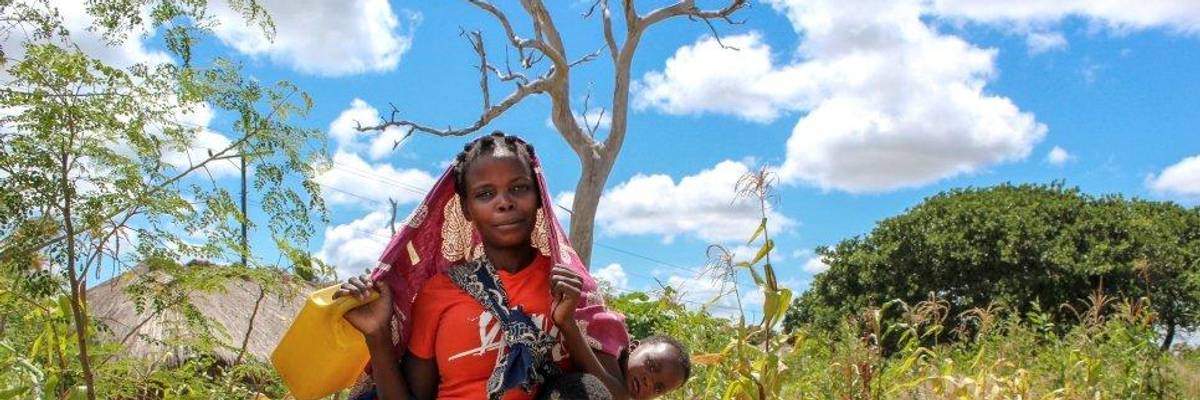
A mother and her children fetch water at a site for internally displaced people in Montepuez District, Cabo Delgado, Mozambique. (Photo: Martim Gray Pereira/UNHCR)
A United Nations agency revealed Thursday that a rising number of people worldwide are fleeing violence, insecurity, and the effects of the climate emergency, with over 84 million relocating within and beyond their home countries during the first half of this year.
"It is the communities and countries with the fewest resources that continue to shoulder the greatest burden in protecting and caring for the forcibly displaced."
The new U.N. Refugee Agency, or UNHCR, report--released at the tail end of a global climate summit--says that "durable solutions for forcibly displaced populations remained in short supply due to unresolved and escalating conflicts in many countries of origin, as well as the continuing restrictions on movement in response to Covid-19."
Internally displaced people (IDP) make up more than half of the agency's total tally at 48 million. According to UNHCR, from January to June, there were also 26.6 million refugees--nearly a fifth of whom are Palestinians--as well as 4.4 million asylum-seekers and 3.9 million Venezuelans displaced abroad, which is its own category.
"The international community is failing to prevent violence, persecution, and human rights violations, which continue to drive people from their homes," said Filippo Grandi, the U.N. high commissioner for refugees, in a statement. "In addition, the effects of climate change are exacerbating existing vulnerabilities in many areas hosting the forcibly displaced."
Grandi added that "the international community must redouble its efforts to make peace, and at the same time must ensure resources are available to displaced communities and their hosts."
"It is the communities and countries with the fewest resources that continue to shoulder the greatest burden in protecting and caring for the forcibly displaced," he noted, "and they must be better supported by the rest of the international community."
Along with the overall rise in forcibly displaced people from 82.4 million at the end of 2020, the agency found that:
The countries from which the most people fled were Syria, Venezuela, Afghanistan, South Sudan, and Myanmar. Some of those nations also have large amounts of internal displacement.
More than a million people were newly displaced within both Congo and Ethiopia. Globally, the nations with the next highest new internal displacements were Afghanistan, Myanmar, Central African Republic, South Sudan, Nigeria, Syria, Mozambique, and Burkina Faso.
"Consistent with 2020, Africa witnessed the most new internal displacements as conflict and violence flared in several countries across the continent," says the report, specifically noting the impact of civil war on Ethiopia's Tigray region, problems in Mozambique's northern province of Cabo Delgado, and "a crisis of governance and instability in rural areas of Burkina Faso linked to the presence of armed insurgents."
The report adds that "internal displacement also surged in the Asia-Pacific region, particularly in Afghanistan and Myanmar," pointing to a drawdown of U.S. troops after a nearly 20-year occupation in the former and a violent military coup in the latter.
"Pursuing voluntary, safe, and dignified solutions for millions of IDPs remains a critical priority for UNHCR," the report continues. "This includes supporting law and policymaking processes that reduce needs due to displacement and help IDPs enjoy their rights without discrimination."
As for people seeking asylum abroad, UNHCR expressed alarm about pending applications. According to the report:
At the end of June 2021, the number of pending individual asylum applications of all types stood at 4.4 million, nearly 7% more than the 4.1 million ending at the end of 2020. This trend is concerning, as lengthy backlogs heighten the risk that individuals with international protection needs will not be able to access protection and solutions in a timely and effective manner. If backlogs become protracted and asylum-seekers wait multiple years for a final determination of their claims without meaningful access to rights or certainty about their future, there will be negative consequences for everyone, including erosion of public confidence in the system, increased costs, and difficulties in returning rejected applicants.
While "returning home in safety and dignity based on a free and informed choice remains the preferred solution for most of the world's refugees," UNHCR also highlighted the important role of resettlement and local integration, due to protracted conflicts.
The report concludes with a section acknowledging that "the actual number of stateless people in the world remains unknown," due to a lack of accurate data. While 94 nations currently provide some data on the populations, the agency urges improvements on a global scale.
Dear Common Dreams reader, It’s been nearly 30 years since I co-founded Common Dreams with my late wife, Lina Newhouser. We had the radical notion that journalism should serve the public good, not corporate profits. It was clear to us from the outset what it would take to build such a project. No paid advertisements. No corporate sponsors. No millionaire publisher telling us what to think or do. Many people said we wouldn't last a year, but we proved those doubters wrong. Together with a tremendous team of journalists and dedicated staff, we built an independent media outlet free from the constraints of profits and corporate control. Our mission has always been simple: To inform. To inspire. To ignite change for the common good. Building Common Dreams was not easy. Our survival was never guaranteed. When you take on the most powerful forces—Wall Street greed, fossil fuel industry destruction, Big Tech lobbyists, and uber-rich oligarchs who have spent billions upon billions rigging the economy and democracy in their favor—the only bulwark you have is supporters who believe in your work. But here’s the urgent message from me today. It's never been this bad out there. And it's never been this hard to keep us going. At the very moment Common Dreams is most needed, the threats we face are intensifying. We need your support now more than ever. We don't accept corporate advertising and never will. We don't have a paywall because we don't think people should be blocked from critical news based on their ability to pay. Everything we do is funded by the donations of readers like you. When everyone does the little they can afford, we are strong. But if that support retreats or dries up, so do we. Will you donate now to make sure Common Dreams not only survives but thrives? —Craig Brown, Co-founder |
A United Nations agency revealed Thursday that a rising number of people worldwide are fleeing violence, insecurity, and the effects of the climate emergency, with over 84 million relocating within and beyond their home countries during the first half of this year.
"It is the communities and countries with the fewest resources that continue to shoulder the greatest burden in protecting and caring for the forcibly displaced."
The new U.N. Refugee Agency, or UNHCR, report--released at the tail end of a global climate summit--says that "durable solutions for forcibly displaced populations remained in short supply due to unresolved and escalating conflicts in many countries of origin, as well as the continuing restrictions on movement in response to Covid-19."
Internally displaced people (IDP) make up more than half of the agency's total tally at 48 million. According to UNHCR, from January to June, there were also 26.6 million refugees--nearly a fifth of whom are Palestinians--as well as 4.4 million asylum-seekers and 3.9 million Venezuelans displaced abroad, which is its own category.
"The international community is failing to prevent violence, persecution, and human rights violations, which continue to drive people from their homes," said Filippo Grandi, the U.N. high commissioner for refugees, in a statement. "In addition, the effects of climate change are exacerbating existing vulnerabilities in many areas hosting the forcibly displaced."
Grandi added that "the international community must redouble its efforts to make peace, and at the same time must ensure resources are available to displaced communities and their hosts."
"It is the communities and countries with the fewest resources that continue to shoulder the greatest burden in protecting and caring for the forcibly displaced," he noted, "and they must be better supported by the rest of the international community."
Along with the overall rise in forcibly displaced people from 82.4 million at the end of 2020, the agency found that:
The countries from which the most people fled were Syria, Venezuela, Afghanistan, South Sudan, and Myanmar. Some of those nations also have large amounts of internal displacement.
More than a million people were newly displaced within both Congo and Ethiopia. Globally, the nations with the next highest new internal displacements were Afghanistan, Myanmar, Central African Republic, South Sudan, Nigeria, Syria, Mozambique, and Burkina Faso.
"Consistent with 2020, Africa witnessed the most new internal displacements as conflict and violence flared in several countries across the continent," says the report, specifically noting the impact of civil war on Ethiopia's Tigray region, problems in Mozambique's northern province of Cabo Delgado, and "a crisis of governance and instability in rural areas of Burkina Faso linked to the presence of armed insurgents."
The report adds that "internal displacement also surged in the Asia-Pacific region, particularly in Afghanistan and Myanmar," pointing to a drawdown of U.S. troops after a nearly 20-year occupation in the former and a violent military coup in the latter.
"Pursuing voluntary, safe, and dignified solutions for millions of IDPs remains a critical priority for UNHCR," the report continues. "This includes supporting law and policymaking processes that reduce needs due to displacement and help IDPs enjoy their rights without discrimination."
As for people seeking asylum abroad, UNHCR expressed alarm about pending applications. According to the report:
At the end of June 2021, the number of pending individual asylum applications of all types stood at 4.4 million, nearly 7% more than the 4.1 million ending at the end of 2020. This trend is concerning, as lengthy backlogs heighten the risk that individuals with international protection needs will not be able to access protection and solutions in a timely and effective manner. If backlogs become protracted and asylum-seekers wait multiple years for a final determination of their claims without meaningful access to rights or certainty about their future, there will be negative consequences for everyone, including erosion of public confidence in the system, increased costs, and difficulties in returning rejected applicants.
While "returning home in safety and dignity based on a free and informed choice remains the preferred solution for most of the world's refugees," UNHCR also highlighted the important role of resettlement and local integration, due to protracted conflicts.
The report concludes with a section acknowledging that "the actual number of stateless people in the world remains unknown," due to a lack of accurate data. While 94 nations currently provide some data on the populations, the agency urges improvements on a global scale.
A United Nations agency revealed Thursday that a rising number of people worldwide are fleeing violence, insecurity, and the effects of the climate emergency, with over 84 million relocating within and beyond their home countries during the first half of this year.
"It is the communities and countries with the fewest resources that continue to shoulder the greatest burden in protecting and caring for the forcibly displaced."
The new U.N. Refugee Agency, or UNHCR, report--released at the tail end of a global climate summit--says that "durable solutions for forcibly displaced populations remained in short supply due to unresolved and escalating conflicts in many countries of origin, as well as the continuing restrictions on movement in response to Covid-19."
Internally displaced people (IDP) make up more than half of the agency's total tally at 48 million. According to UNHCR, from January to June, there were also 26.6 million refugees--nearly a fifth of whom are Palestinians--as well as 4.4 million asylum-seekers and 3.9 million Venezuelans displaced abroad, which is its own category.
"The international community is failing to prevent violence, persecution, and human rights violations, which continue to drive people from their homes," said Filippo Grandi, the U.N. high commissioner for refugees, in a statement. "In addition, the effects of climate change are exacerbating existing vulnerabilities in many areas hosting the forcibly displaced."
Grandi added that "the international community must redouble its efforts to make peace, and at the same time must ensure resources are available to displaced communities and their hosts."
"It is the communities and countries with the fewest resources that continue to shoulder the greatest burden in protecting and caring for the forcibly displaced," he noted, "and they must be better supported by the rest of the international community."
Along with the overall rise in forcibly displaced people from 82.4 million at the end of 2020, the agency found that:
The countries from which the most people fled were Syria, Venezuela, Afghanistan, South Sudan, and Myanmar. Some of those nations also have large amounts of internal displacement.
More than a million people were newly displaced within both Congo and Ethiopia. Globally, the nations with the next highest new internal displacements were Afghanistan, Myanmar, Central African Republic, South Sudan, Nigeria, Syria, Mozambique, and Burkina Faso.
"Consistent with 2020, Africa witnessed the most new internal displacements as conflict and violence flared in several countries across the continent," says the report, specifically noting the impact of civil war on Ethiopia's Tigray region, problems in Mozambique's northern province of Cabo Delgado, and "a crisis of governance and instability in rural areas of Burkina Faso linked to the presence of armed insurgents."
The report adds that "internal displacement also surged in the Asia-Pacific region, particularly in Afghanistan and Myanmar," pointing to a drawdown of U.S. troops after a nearly 20-year occupation in the former and a violent military coup in the latter.
"Pursuing voluntary, safe, and dignified solutions for millions of IDPs remains a critical priority for UNHCR," the report continues. "This includes supporting law and policymaking processes that reduce needs due to displacement and help IDPs enjoy their rights without discrimination."
As for people seeking asylum abroad, UNHCR expressed alarm about pending applications. According to the report:
At the end of June 2021, the number of pending individual asylum applications of all types stood at 4.4 million, nearly 7% more than the 4.1 million ending at the end of 2020. This trend is concerning, as lengthy backlogs heighten the risk that individuals with international protection needs will not be able to access protection and solutions in a timely and effective manner. If backlogs become protracted and asylum-seekers wait multiple years for a final determination of their claims without meaningful access to rights or certainty about their future, there will be negative consequences for everyone, including erosion of public confidence in the system, increased costs, and difficulties in returning rejected applicants.
While "returning home in safety and dignity based on a free and informed choice remains the preferred solution for most of the world's refugees," UNHCR also highlighted the important role of resettlement and local integration, due to protracted conflicts.
The report concludes with a section acknowledging that "the actual number of stateless people in the world remains unknown," due to a lack of accurate data. While 94 nations currently provide some data on the populations, the agency urges improvements on a global scale.