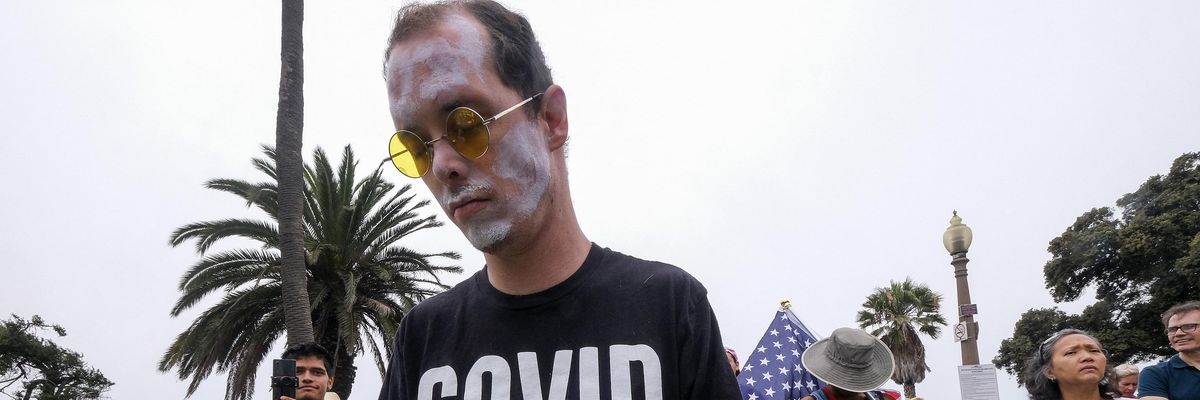
Anti-vaccination protesters take part in a rally against Covid-19 vaccine mandates in Santa Monica, California on August 29, 2021. (Photo: Ringo Chiu/AFP via Getty Images)
New Survey Shows Covid-19 Misinformation Has Spread as Quickly as the Virus
Nearly 40% of respondents believed that the U.S. government is lying about the number of Covid-19 deaths, and 22% said they were unsure about the statement's veracity.
Nov 08, 2021
Helped along by right-wing news outlets and social media, misinformation about the Covid-19 pandemic has spread far and wide according to new polling, with a large majority of Americans reporting they believed at least one false statement about the public health crisis and one-third saying they were unsure about the veracity of several statements--including ones accusing the government of lying about Covid-19 deaths and the safety of vaccines.
According to the Kaiser Family Foundation (KFF) Covid-19 Vaccine Monitor's latest poll, released on Monday, 78% of respondents said they had heard at least one of the false statements presented by researchers and that they either believed it or weren't sure whether it was true or untrue.
The statements presented included: "The government is exaggerating the number of Covid-19 deaths," "Deaths due to Covid-19 vaccines are being intentionally hidden by the government," "Ivermectin is a safe and effective treatment for Covid-19," "The Covid-19 vaccines have been shown to cause infertility," and "The Covid-19 vaccines contain a microchip."
Science policy professor Timothy Caulfield called the findings "grim."
The belief that the U.S. government is lying about the number of Covid-19 deaths was the most widely believed statement, with 38% of respondents saying it was true and 22% saying they were unsure.
Only 22% of respondents did not believe any of the statements were true while nearly a third of respondents believed at least four of the statements were factual.
KFF noted that people were more likely to believe misinformation if they relied on right-wing news sources including One America News (OAN), Fox News, and Newsmax.
Among respondents who trusted Newsmax to report accurately on the pandemic, 46% of people believed at least one of the statements, and more than one-third of OAN and Fox News viewers each believed at least some of the misinformation.
"One thing this study cannot disentangle is whether this is because people are exposed to misinformation from those news sources, or whether the types of people who choose those news sources are the same ones who are pre-disposed to believe certain types of misinformation for other reasons," noted the authors of the study.
Respondents who reported that they trusted news sources including CNN, NPR, and network news programs were much less likely to believe misinformation, with only 11% to 16% reporting they believed at least four of the false statements.
The survey found that respondents were more likely to trust various news outlets than social media platforms for information regarding the pandemic, but social media likely plays a major role in the proliferation of misinformation.
"The group that is influenced by information they see on these platforms may be larger than the share that says they trust information they see there, as we previously found in January that 31% of adults got information about Covid-19 vaccines from social media over a two-week period, nearly as large as the share who got information from cable, network, and local TV news," said KFF.
Adults who have not been vaccinated against Covid-19 were also more likely than vaccinated people to believe misinformation, as were Republicans compared to Democrats.
Nearly two-thirds of unvaccinated people surveyed said they believed four or more false statements about the virus. A majority of vaccinated people thought at least one of the statements to be true, but only 19% thought at least four were true.
The difference between Republican and Democratic voters was stark, with 84% of Republicans saying they believed the government is exaggerating the number of Covid-19 deaths by counting deaths in which other conditions were a contributing factor. One-third of Democrats believed that to be true.
The poll results, for which researchers surveyed 1,519 adults between October 14 and 24, were released a day after hundreds of health professionals signed a letter to Facebook, asking the social media company to disclose data on misinformation that's spreading on its platform. NPR found earlier this year that on nearly half of the days in 2021 up until March, stories about people dying after receiving a Covid-19 vaccine were among the most popular vaccine-related articles on social media.
An Urgent Message From Our Co-Founder
Dear Common Dreams reader, It’s been nearly 30 years since I co-founded Common Dreams with my late wife, Lina Newhouser. We had the radical notion that journalism should serve the public good, not corporate profits. It was clear to us from the outset what it would take to build such a project. No paid advertisements. No corporate sponsors. No millionaire publisher telling us what to think or do. Many people said we wouldn't last a year, but we proved those doubters wrong. Together with a tremendous team of journalists and dedicated staff, we built an independent media outlet free from the constraints of profits and corporate control. Our mission has always been simple: To inform. To inspire. To ignite change for the common good. Building Common Dreams was not easy. Our survival was never guaranteed. When you take on the most powerful forces—Wall Street greed, fossil fuel industry destruction, Big Tech lobbyists, and uber-rich oligarchs who have spent billions upon billions rigging the economy and democracy in their favor—the only bulwark you have is supporters who believe in your work. But here’s the urgent message from me today. It's never been this bad out there. And it's never been this hard to keep us going. At the very moment Common Dreams is most needed, the threats we face are intensifying. We need your support now more than ever. We don't accept corporate advertising and never will. We don't have a paywall because we don't think people should be blocked from critical news based on their ability to pay. Everything we do is funded by the donations of readers like you. When everyone does the little they can afford, we are strong. But if that support retreats or dries up, so do we. Will you donate now to make sure Common Dreams not only survives but thrives? —Craig Brown, Co-founder |

Our work is licensed under Creative Commons (CC BY-NC-ND 3.0). Feel free to republish and share widely.
Helped along by right-wing news outlets and social media, misinformation about the Covid-19 pandemic has spread far and wide according to new polling, with a large majority of Americans reporting they believed at least one false statement about the public health crisis and one-third saying they were unsure about the veracity of several statements--including ones accusing the government of lying about Covid-19 deaths and the safety of vaccines.
According to the Kaiser Family Foundation (KFF) Covid-19 Vaccine Monitor's latest poll, released on Monday, 78% of respondents said they had heard at least one of the false statements presented by researchers and that they either believed it or weren't sure whether it was true or untrue.
The statements presented included: "The government is exaggerating the number of Covid-19 deaths," "Deaths due to Covid-19 vaccines are being intentionally hidden by the government," "Ivermectin is a safe and effective treatment for Covid-19," "The Covid-19 vaccines have been shown to cause infertility," and "The Covid-19 vaccines contain a microchip."
Science policy professor Timothy Caulfield called the findings "grim."
The belief that the U.S. government is lying about the number of Covid-19 deaths was the most widely believed statement, with 38% of respondents saying it was true and 22% saying they were unsure.
Only 22% of respondents did not believe any of the statements were true while nearly a third of respondents believed at least four of the statements were factual.
KFF noted that people were more likely to believe misinformation if they relied on right-wing news sources including One America News (OAN), Fox News, and Newsmax.
Among respondents who trusted Newsmax to report accurately on the pandemic, 46% of people believed at least one of the statements, and more than one-third of OAN and Fox News viewers each believed at least some of the misinformation.
"One thing this study cannot disentangle is whether this is because people are exposed to misinformation from those news sources, or whether the types of people who choose those news sources are the same ones who are pre-disposed to believe certain types of misinformation for other reasons," noted the authors of the study.
Respondents who reported that they trusted news sources including CNN, NPR, and network news programs were much less likely to believe misinformation, with only 11% to 16% reporting they believed at least four of the false statements.
The survey found that respondents were more likely to trust various news outlets than social media platforms for information regarding the pandemic, but social media likely plays a major role in the proliferation of misinformation.
"The group that is influenced by information they see on these platforms may be larger than the share that says they trust information they see there, as we previously found in January that 31% of adults got information about Covid-19 vaccines from social media over a two-week period, nearly as large as the share who got information from cable, network, and local TV news," said KFF.
Adults who have not been vaccinated against Covid-19 were also more likely than vaccinated people to believe misinformation, as were Republicans compared to Democrats.
Nearly two-thirds of unvaccinated people surveyed said they believed four or more false statements about the virus. A majority of vaccinated people thought at least one of the statements to be true, but only 19% thought at least four were true.
The difference between Republican and Democratic voters was stark, with 84% of Republicans saying they believed the government is exaggerating the number of Covid-19 deaths by counting deaths in which other conditions were a contributing factor. One-third of Democrats believed that to be true.
The poll results, for which researchers surveyed 1,519 adults between October 14 and 24, were released a day after hundreds of health professionals signed a letter to Facebook, asking the social media company to disclose data on misinformation that's spreading on its platform. NPR found earlier this year that on nearly half of the days in 2021 up until March, stories about people dying after receiving a Covid-19 vaccine were among the most popular vaccine-related articles on social media.
Helped along by right-wing news outlets and social media, misinformation about the Covid-19 pandemic has spread far and wide according to new polling, with a large majority of Americans reporting they believed at least one false statement about the public health crisis and one-third saying they were unsure about the veracity of several statements--including ones accusing the government of lying about Covid-19 deaths and the safety of vaccines.
According to the Kaiser Family Foundation (KFF) Covid-19 Vaccine Monitor's latest poll, released on Monday, 78% of respondents said they had heard at least one of the false statements presented by researchers and that they either believed it or weren't sure whether it was true or untrue.
The statements presented included: "The government is exaggerating the number of Covid-19 deaths," "Deaths due to Covid-19 vaccines are being intentionally hidden by the government," "Ivermectin is a safe and effective treatment for Covid-19," "The Covid-19 vaccines have been shown to cause infertility," and "The Covid-19 vaccines contain a microchip."
Science policy professor Timothy Caulfield called the findings "grim."
The belief that the U.S. government is lying about the number of Covid-19 deaths was the most widely believed statement, with 38% of respondents saying it was true and 22% saying they were unsure.
Only 22% of respondents did not believe any of the statements were true while nearly a third of respondents believed at least four of the statements were factual.
KFF noted that people were more likely to believe misinformation if they relied on right-wing news sources including One America News (OAN), Fox News, and Newsmax.
Among respondents who trusted Newsmax to report accurately on the pandemic, 46% of people believed at least one of the statements, and more than one-third of OAN and Fox News viewers each believed at least some of the misinformation.
"One thing this study cannot disentangle is whether this is because people are exposed to misinformation from those news sources, or whether the types of people who choose those news sources are the same ones who are pre-disposed to believe certain types of misinformation for other reasons," noted the authors of the study.
Respondents who reported that they trusted news sources including CNN, NPR, and network news programs were much less likely to believe misinformation, with only 11% to 16% reporting they believed at least four of the false statements.
The survey found that respondents were more likely to trust various news outlets than social media platforms for information regarding the pandemic, but social media likely plays a major role in the proliferation of misinformation.
"The group that is influenced by information they see on these platforms may be larger than the share that says they trust information they see there, as we previously found in January that 31% of adults got information about Covid-19 vaccines from social media over a two-week period, nearly as large as the share who got information from cable, network, and local TV news," said KFF.
Adults who have not been vaccinated against Covid-19 were also more likely than vaccinated people to believe misinformation, as were Republicans compared to Democrats.
Nearly two-thirds of unvaccinated people surveyed said they believed four or more false statements about the virus. A majority of vaccinated people thought at least one of the statements to be true, but only 19% thought at least four were true.
The difference between Republican and Democratic voters was stark, with 84% of Republicans saying they believed the government is exaggerating the number of Covid-19 deaths by counting deaths in which other conditions were a contributing factor. One-third of Democrats believed that to be true.
The poll results, for which researchers surveyed 1,519 adults between October 14 and 24, were released a day after hundreds of health professionals signed a letter to Facebook, asking the social media company to disclose data on misinformation that's spreading on its platform. NPR found earlier this year that on nearly half of the days in 2021 up until March, stories about people dying after receiving a Covid-19 vaccine were among the most popular vaccine-related articles on social media.
We've had enough. The 1% own and operate the corporate media. They are doing everything they can to defend the status quo, squash dissent and protect the wealthy and the powerful. The Common Dreams media model is different. We cover the news that matters to the 99%. Our mission? To inform. To inspire. To ignite change for the common good. How? Nonprofit. Independent. Reader-supported. Free to read. Free to republish. Free to share. With no advertising. No paywalls. No selling of your data. Thousands of small donations fund our newsroom and allow us to continue publishing. Can you chip in? We can't do it without you. Thank you.