SUBSCRIBE TO OUR FREE NEWSLETTER
Daily news & progressive opinion—funded by the people, not the corporations—delivered straight to your inbox.
5
#000000
#FFFFFF
To donate by check, phone, or other method, see our More Ways to Give page.
Daily news & progressive opinion—funded by the people, not the corporations—delivered straight to your inbox.
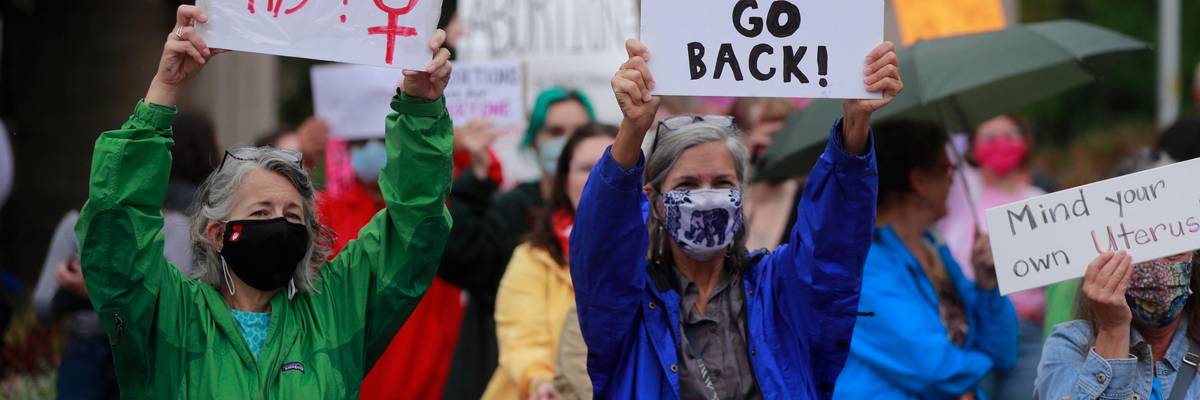
Demonstrators opposed to a new Texas abortion ban rally in Bloomington, Indiana as part of a wave of national protests. (Photo: Jeremy Hogan/SOPA Images/LightRocket via Getty Images)
Although the U.S. Supreme Court once again refused to block a restrictive Texas abortion ban on Friday, the justices agreed to hear arguments against the recently enacted law on an accelerated timeline--a development welcomed by defenders of reproductive rights.
"Lack of access to safe abortion care is harming our families and communities and will have lasting effects on Texas for decades to come."
The high court is now set to hear a pair of challenges to the Lone Star State's Senate Bill 8--United States v. Texas, filed by the U.S. Department of Justice, and Whole Woman's Health v. Jackson, filed by healthcare providers and abortion funds--on November 1.
"The Supreme Court's action today brings us one step closer to the restoration of Texans' constitutional rights and an end to the havoc and heartache of this ban," said Nancy Northup, president and CEO of the Center for Reproductive Rights, one of the groups representing the plaintiffs in Whole Woman's Health v. Jackson.
"We are enormously disappointed that the court has left the law in effect for now," Northup added. "However, we are confident that when the court ultimately rules in these cases, it will reject the state of Texas' cynical ploy to enact a brazenly unconstitutional abortion ban."
The plaintiffs in that case are also represented by Planned Parenthood Federation of America (PPFA), the Lawyering Project, Morrison & Foerster LLP, and both the national and Texas ACLU.
Brigitte Amiri, deputy director of the ACLU's Reproductive Freedom Project, similarly called out the high court for "refusing once again to block Texas' horrific abortion ban," highlighting that "this cruel law has had devastating consequences, with the impact hitting marginalized communities the hardest."
PPFA president and CEO Alexis McGill Johnson also drew attention to the effects of S.B. 8, which bans the termination of pregnancies after six weeks--before many people know they are pregnant--without exceptions for rape or incest, and empowers anti-choice vigilantes to sue anyone other than the patient who "aids or abets" an abortion after that brief window.
"For nearly two months, we've seen the catastrophic impact of S.B. 8 in Texas and beyond," McGill Johnson said. "Patients who have the means have fled the state, traveling hundreds of miles to access basic care, and those without means have been forced to carry pregnancies against their will."
Amy Hagstrom Miller, president and CEO of Whole Woman's Health and Whole Woman's Health Alliance, declared that "Texans deserved better than this. The legal limbo is excruciating for both patients and our clinic staff. Lack of access to safe abortion care is harming our families and communities and will have lasting effects on Texas for decades to come."
"We've had to turn hundreds of patients away since this ban took effect, and this ruling means we'll have to keep denying patients the abortion care that they need and deserve," she noted. "The Supreme Court has said that abortion is protected by our Constitution, yet they are allowing Texans to be deprived of their rights."
The New York Times reported that the justices will weigh in on a question in the U.S. government's appeal: "May the United States bring suit in federal court and obtain injunctive or declaratory relief against the state, state court judges, state court clerks, other state officials, or all private parties to prohibit S.B. 8 from being enforced?"
As the newspaper explained:
The court turned down a request from officials in Texas to use the cases to decide whether to overturn the right to abortion established in 1973 in Roe v. Wade.
That question is already before the court in a case challenging a Mississippi law that bans most abortions after 15 weeks. Roe and other Supreme Court precedents, notably Planned Parenthood v. Casey in 1992, prohibit states from banning abortion before fetal viability, the point at which fetuses can sustain life outside the womb, or about 22 to 24 weeks into a pregnancy. The Mississippi case will be argued on December 1, a month after the Texas case.
Liberal Justice Sonia Sotomayor, who notably slammed the court's early September decision that let S.B. 8 take effect, on Friday condemned its repeated refusal to block the law.
"I cannot capture the totality of this harm in these pages," Sotomayor wrote in her dissent. "But... the state (empowered by this court's inaction) has so thoroughly chilled the exercise of the right recognized in Roe as to nearly suspend it within its borders and strain access to it in other states. The state's gambit has worked. The impact is catastrophic."
"These ruinous effects were foreseeable and intentional," Sotomayor continued. "Every day that S.B. 8 remains in effect is a day in which such tactics are rewarded. And every day the scheme succeeds increases the likelihood that it will be adapted to attack other federal constitutional rights.
The "unprecedented" wave of attacks on reproductive freedom this year by anti-choice state legislators who are hoping that the high court's right-wing supermajority will eventually overturn the 1973 ruling--including Republicans' ongoing efforts to replicate S.B. 8 elsewhere--has bolstered the case for codifying Roe into federal law.
Though last month almost all House Democrats voted in favor of federal legislation to safeguard the right to abortion, getting the Women's Health Protection Act (WHPA) through the evenly divided Senate and to President Joe Biden's desk would likely require changing or abolishing the filibuster, which a few members of the Democratic caucus still oppose.
Dear Common Dreams reader, It’s been nearly 30 years since I co-founded Common Dreams with my late wife, Lina Newhouser. We had the radical notion that journalism should serve the public good, not corporate profits. It was clear to us from the outset what it would take to build such a project. No paid advertisements. No corporate sponsors. No millionaire publisher telling us what to think or do. Many people said we wouldn't last a year, but we proved those doubters wrong. Together with a tremendous team of journalists and dedicated staff, we built an independent media outlet free from the constraints of profits and corporate control. Our mission has always been simple: To inform. To inspire. To ignite change for the common good. Building Common Dreams was not easy. Our survival was never guaranteed. When you take on the most powerful forces—Wall Street greed, fossil fuel industry destruction, Big Tech lobbyists, and uber-rich oligarchs who have spent billions upon billions rigging the economy and democracy in their favor—the only bulwark you have is supporters who believe in your work. But here’s the urgent message from me today. It's never been this bad out there. And it's never been this hard to keep us going. At the very moment Common Dreams is most needed, the threats we face are intensifying. We need your support now more than ever. We don't accept corporate advertising and never will. We don't have a paywall because we don't think people should be blocked from critical news based on their ability to pay. Everything we do is funded by the donations of readers like you. When everyone does the little they can afford, we are strong. But if that support retreats or dries up, so do we. Will you donate now to make sure Common Dreams not only survives but thrives? —Craig Brown, Co-founder |
Although the U.S. Supreme Court once again refused to block a restrictive Texas abortion ban on Friday, the justices agreed to hear arguments against the recently enacted law on an accelerated timeline--a development welcomed by defenders of reproductive rights.
"Lack of access to safe abortion care is harming our families and communities and will have lasting effects on Texas for decades to come."
The high court is now set to hear a pair of challenges to the Lone Star State's Senate Bill 8--United States v. Texas, filed by the U.S. Department of Justice, and Whole Woman's Health v. Jackson, filed by healthcare providers and abortion funds--on November 1.
"The Supreme Court's action today brings us one step closer to the restoration of Texans' constitutional rights and an end to the havoc and heartache of this ban," said Nancy Northup, president and CEO of the Center for Reproductive Rights, one of the groups representing the plaintiffs in Whole Woman's Health v. Jackson.
"We are enormously disappointed that the court has left the law in effect for now," Northup added. "However, we are confident that when the court ultimately rules in these cases, it will reject the state of Texas' cynical ploy to enact a brazenly unconstitutional abortion ban."
The plaintiffs in that case are also represented by Planned Parenthood Federation of America (PPFA), the Lawyering Project, Morrison & Foerster LLP, and both the national and Texas ACLU.
Brigitte Amiri, deputy director of the ACLU's Reproductive Freedom Project, similarly called out the high court for "refusing once again to block Texas' horrific abortion ban," highlighting that "this cruel law has had devastating consequences, with the impact hitting marginalized communities the hardest."
PPFA president and CEO Alexis McGill Johnson also drew attention to the effects of S.B. 8, which bans the termination of pregnancies after six weeks--before many people know they are pregnant--without exceptions for rape or incest, and empowers anti-choice vigilantes to sue anyone other than the patient who "aids or abets" an abortion after that brief window.
"For nearly two months, we've seen the catastrophic impact of S.B. 8 in Texas and beyond," McGill Johnson said. "Patients who have the means have fled the state, traveling hundreds of miles to access basic care, and those without means have been forced to carry pregnancies against their will."
Amy Hagstrom Miller, president and CEO of Whole Woman's Health and Whole Woman's Health Alliance, declared that "Texans deserved better than this. The legal limbo is excruciating for both patients and our clinic staff. Lack of access to safe abortion care is harming our families and communities and will have lasting effects on Texas for decades to come."
"We've had to turn hundreds of patients away since this ban took effect, and this ruling means we'll have to keep denying patients the abortion care that they need and deserve," she noted. "The Supreme Court has said that abortion is protected by our Constitution, yet they are allowing Texans to be deprived of their rights."
The New York Times reported that the justices will weigh in on a question in the U.S. government's appeal: "May the United States bring suit in federal court and obtain injunctive or declaratory relief against the state, state court judges, state court clerks, other state officials, or all private parties to prohibit S.B. 8 from being enforced?"
As the newspaper explained:
The court turned down a request from officials in Texas to use the cases to decide whether to overturn the right to abortion established in 1973 in Roe v. Wade.
That question is already before the court in a case challenging a Mississippi law that bans most abortions after 15 weeks. Roe and other Supreme Court precedents, notably Planned Parenthood v. Casey in 1992, prohibit states from banning abortion before fetal viability, the point at which fetuses can sustain life outside the womb, or about 22 to 24 weeks into a pregnancy. The Mississippi case will be argued on December 1, a month after the Texas case.
Liberal Justice Sonia Sotomayor, who notably slammed the court's early September decision that let S.B. 8 take effect, on Friday condemned its repeated refusal to block the law.
"I cannot capture the totality of this harm in these pages," Sotomayor wrote in her dissent. "But... the state (empowered by this court's inaction) has so thoroughly chilled the exercise of the right recognized in Roe as to nearly suspend it within its borders and strain access to it in other states. The state's gambit has worked. The impact is catastrophic."
"These ruinous effects were foreseeable and intentional," Sotomayor continued. "Every day that S.B. 8 remains in effect is a day in which such tactics are rewarded. And every day the scheme succeeds increases the likelihood that it will be adapted to attack other federal constitutional rights.
The "unprecedented" wave of attacks on reproductive freedom this year by anti-choice state legislators who are hoping that the high court's right-wing supermajority will eventually overturn the 1973 ruling--including Republicans' ongoing efforts to replicate S.B. 8 elsewhere--has bolstered the case for codifying Roe into federal law.
Though last month almost all House Democrats voted in favor of federal legislation to safeguard the right to abortion, getting the Women's Health Protection Act (WHPA) through the evenly divided Senate and to President Joe Biden's desk would likely require changing or abolishing the filibuster, which a few members of the Democratic caucus still oppose.
Although the U.S. Supreme Court once again refused to block a restrictive Texas abortion ban on Friday, the justices agreed to hear arguments against the recently enacted law on an accelerated timeline--a development welcomed by defenders of reproductive rights.
"Lack of access to safe abortion care is harming our families and communities and will have lasting effects on Texas for decades to come."
The high court is now set to hear a pair of challenges to the Lone Star State's Senate Bill 8--United States v. Texas, filed by the U.S. Department of Justice, and Whole Woman's Health v. Jackson, filed by healthcare providers and abortion funds--on November 1.
"The Supreme Court's action today brings us one step closer to the restoration of Texans' constitutional rights and an end to the havoc and heartache of this ban," said Nancy Northup, president and CEO of the Center for Reproductive Rights, one of the groups representing the plaintiffs in Whole Woman's Health v. Jackson.
"We are enormously disappointed that the court has left the law in effect for now," Northup added. "However, we are confident that when the court ultimately rules in these cases, it will reject the state of Texas' cynical ploy to enact a brazenly unconstitutional abortion ban."
The plaintiffs in that case are also represented by Planned Parenthood Federation of America (PPFA), the Lawyering Project, Morrison & Foerster LLP, and both the national and Texas ACLU.
Brigitte Amiri, deputy director of the ACLU's Reproductive Freedom Project, similarly called out the high court for "refusing once again to block Texas' horrific abortion ban," highlighting that "this cruel law has had devastating consequences, with the impact hitting marginalized communities the hardest."
PPFA president and CEO Alexis McGill Johnson also drew attention to the effects of S.B. 8, which bans the termination of pregnancies after six weeks--before many people know they are pregnant--without exceptions for rape or incest, and empowers anti-choice vigilantes to sue anyone other than the patient who "aids or abets" an abortion after that brief window.
"For nearly two months, we've seen the catastrophic impact of S.B. 8 in Texas and beyond," McGill Johnson said. "Patients who have the means have fled the state, traveling hundreds of miles to access basic care, and those without means have been forced to carry pregnancies against their will."
Amy Hagstrom Miller, president and CEO of Whole Woman's Health and Whole Woman's Health Alliance, declared that "Texans deserved better than this. The legal limbo is excruciating for both patients and our clinic staff. Lack of access to safe abortion care is harming our families and communities and will have lasting effects on Texas for decades to come."
"We've had to turn hundreds of patients away since this ban took effect, and this ruling means we'll have to keep denying patients the abortion care that they need and deserve," she noted. "The Supreme Court has said that abortion is protected by our Constitution, yet they are allowing Texans to be deprived of their rights."
The New York Times reported that the justices will weigh in on a question in the U.S. government's appeal: "May the United States bring suit in federal court and obtain injunctive or declaratory relief against the state, state court judges, state court clerks, other state officials, or all private parties to prohibit S.B. 8 from being enforced?"
As the newspaper explained:
The court turned down a request from officials in Texas to use the cases to decide whether to overturn the right to abortion established in 1973 in Roe v. Wade.
That question is already before the court in a case challenging a Mississippi law that bans most abortions after 15 weeks. Roe and other Supreme Court precedents, notably Planned Parenthood v. Casey in 1992, prohibit states from banning abortion before fetal viability, the point at which fetuses can sustain life outside the womb, or about 22 to 24 weeks into a pregnancy. The Mississippi case will be argued on December 1, a month after the Texas case.
Liberal Justice Sonia Sotomayor, who notably slammed the court's early September decision that let S.B. 8 take effect, on Friday condemned its repeated refusal to block the law.
"I cannot capture the totality of this harm in these pages," Sotomayor wrote in her dissent. "But... the state (empowered by this court's inaction) has so thoroughly chilled the exercise of the right recognized in Roe as to nearly suspend it within its borders and strain access to it in other states. The state's gambit has worked. The impact is catastrophic."
"These ruinous effects were foreseeable and intentional," Sotomayor continued. "Every day that S.B. 8 remains in effect is a day in which such tactics are rewarded. And every day the scheme succeeds increases the likelihood that it will be adapted to attack other federal constitutional rights.
The "unprecedented" wave of attacks on reproductive freedom this year by anti-choice state legislators who are hoping that the high court's right-wing supermajority will eventually overturn the 1973 ruling--including Republicans' ongoing efforts to replicate S.B. 8 elsewhere--has bolstered the case for codifying Roe into federal law.
Though last month almost all House Democrats voted in favor of federal legislation to safeguard the right to abortion, getting the Women's Health Protection Act (WHPA) through the evenly divided Senate and to President Joe Biden's desk would likely require changing or abolishing the filibuster, which a few members of the Democratic caucus still oppose.